


LOS ANGELES COUNTY · OFFICE OF EMERGENCY MANAGEMENT
Disaster Response & Preparedness Portal
The Office of Emergency Management has the responsibility of comprehensively planning for, responding to and recovering from large-scale emergencies and disasters that impact Los Angeles County.
BE INFORMED · MAKE A PLAN · STAY SAFE
Welcome to Your Disaster Preparedness Hub
Use this guide to understand local hazards, organize your family response, build emergency supplies, connect to official alerts, and find City services before, during, and after disasters.
Know the risks. Make a plan. Build a kit. Stay informed.


THE 8 EMERGENCIES
Know the immediate hazards
Be Prepared. Secure your Family. Stay Alert. Stay Safe. Volunteer.


EMERGENCY GUIDE LIBRARY
Four Essential Emergency Guides
Tap a card to open the related PDF guide.


Quick Info & Resources
Fast-entry paths for specialized guidance, community tools, and audience-based preparedness topics.
Emergency Broadcast
Listen to radio, television, and official updates when emergencies disrupt routine communications.
Disability Resources
Preparedness guidance for people with disabilities and access or functional needs.
Pet Preparedness
Plan for pets and service animals, including carriers, food, medications, and records.
Business Readiness
Continuity planning ideas for employers, small businesses, and community organizations.
Schools & Youth
Preparedness support for families, students, schools, and children’s fire-safety learning.
Travel & Visitors
Helpful reference points for visitors, commuters, and residents who may need rapid orientation.
Stay Informed
10 Emergency Radio Stations & Frequencies
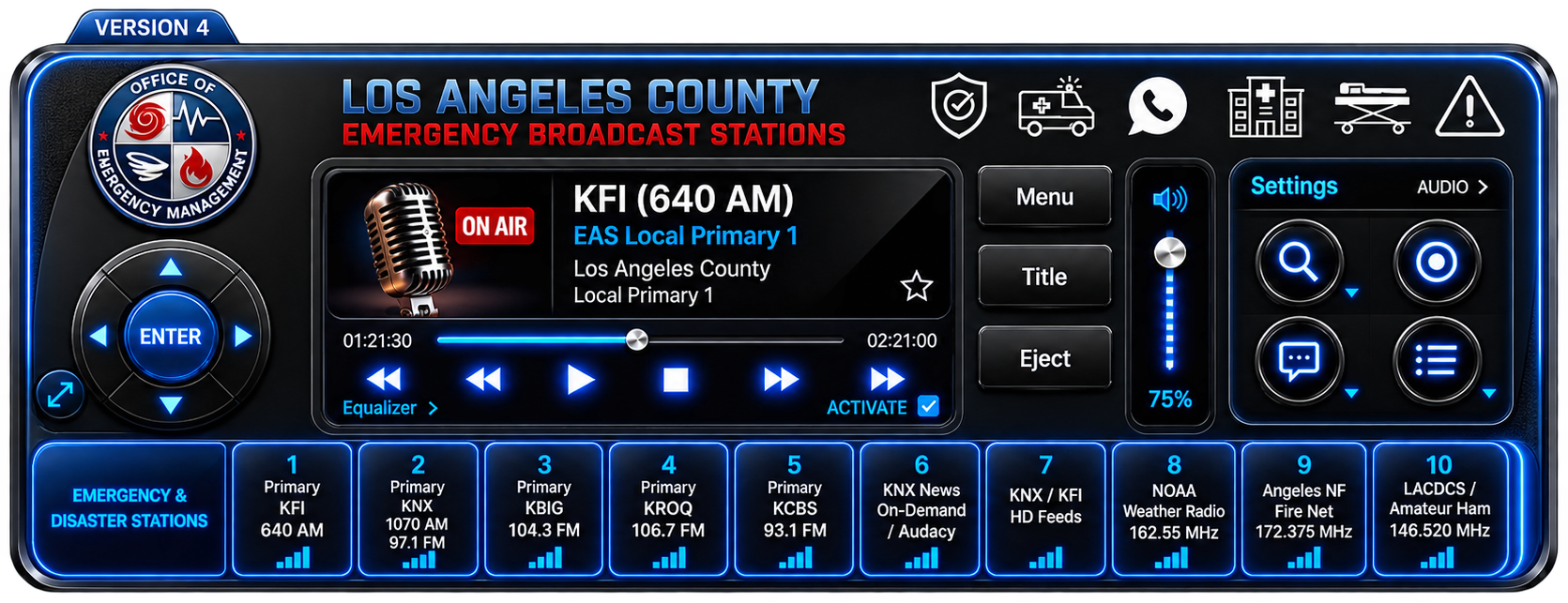
Emergency broadcast and reference channels for Los Angeles County. During an incident, use current official alerts and instructions as the controlling source.



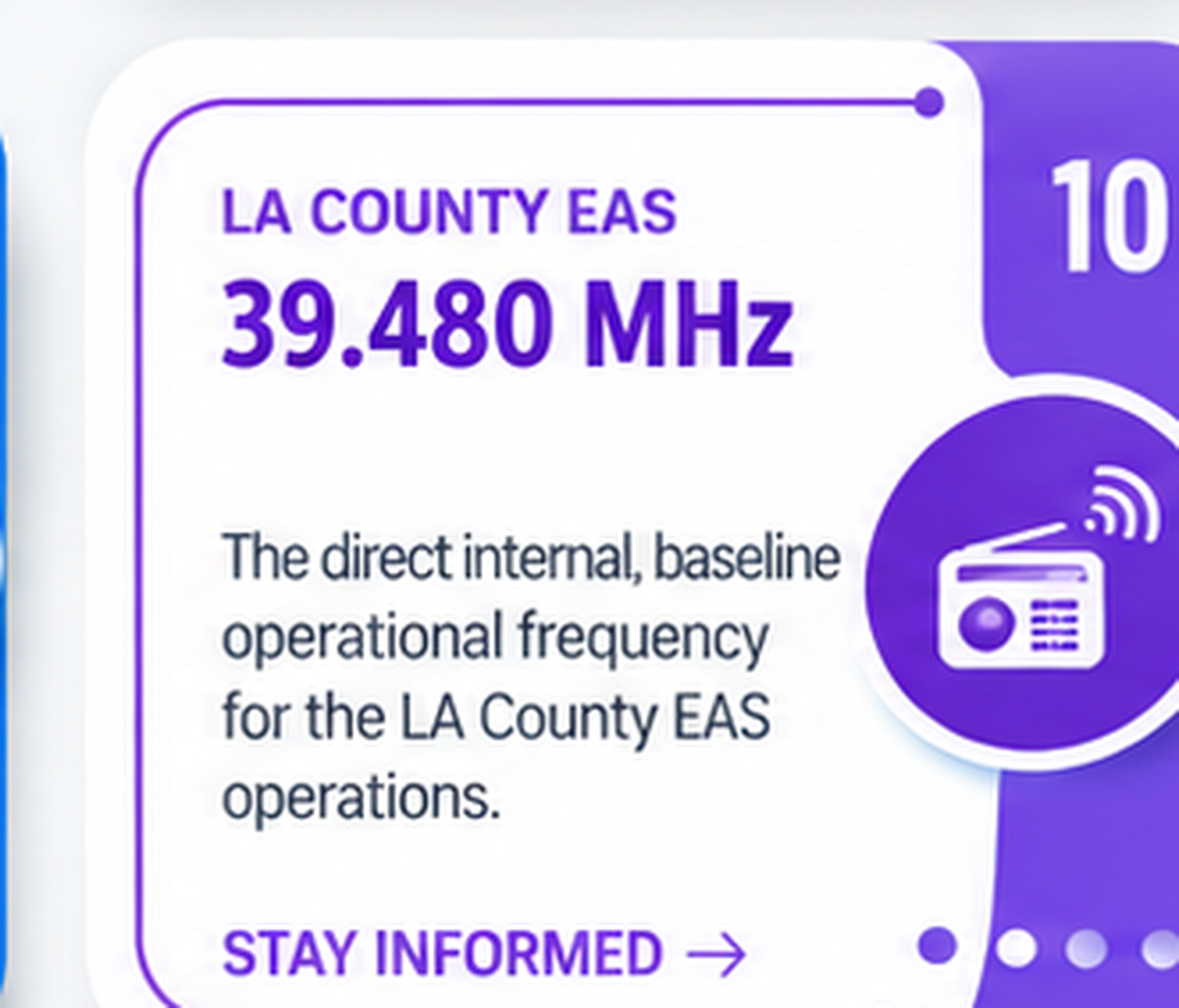
Official EAS Local Primaries: Ready LA County lists KFI 640 AM, KNX 1070 AM and KBIG 104.3 FM as Local Primary 1 stations, with KROQ 106.7 FM and KCBS 93.1 FM as Local Primary 2 stations. Other cards are community or frequency references and should be verified for current availability.
Emergency Contacts
10 Main Emergency Phone Numbers & Hotlines
Fast-access emergency and disaster contacts. For immediate life-threatening danger, call 9-1-1.
CITY OF LOS ANGELES DISASTER PREPAREDNESS GUIDE
Alerts & Notifications
How Los Angeles distributes time-sensitive emergency information and how residents can subscribe.
Primary alert channels
| System | Purpose | Action |
|---|---|---|
| NotifyLA | City mass notification system for emergency information and protective actions. | Register / review alerts |
| Wireless Emergency Alerts (WEA) | Short emergency alerts delivered through compatible mobile networks. | Keep emergency alerts enabled on your phone. |
| Emergency Alert System (EAS) | Broadcast alerts through radio and television. | Know local radio/TV news sources. |
| LADWP Outage Alerts | Power outage status and notifications. | Use LADWP outage resources. |
| NOAA / NWS | Weather watches, warnings and advisories. | Monitor weather.gov and NOAA Weather Radio. |
Alert readiness checklist
- Register every household phone number and email with NotifyLA.
- Add addresses important to you such as schools, workplaces and family locations.
- Keep a battery or hand-crank radio available.
- Enable Wireless Emergency Alerts on mobile devices.
- Use multiple information channels; do not rely on a single app.
COMPLETE ACTION GUIDE
Before · During · After
Register for multiple alert systems and keep Wireless Emergency Alerts enabled.
Read the entire alert, confirm the location affected, and follow protective-action instructions immediately.
Keep monitoring official updates until the incident is closed or authorities issue an all-clear.
CITY OF LOS ANGELES DISASTER PREPAREDNESS GUIDE
Hazards & Risks
Los Angeles faces natural, human-caused and technological hazards. Use the hazard pages below to prepare by type.
COMPLETE ACTION GUIDE
Before · During · After
Identify hazards at home, work, school and travel locations; note fire, flood, earthquake, heat and infrastructure risks.
Use the protective action appropriate to the actual hazard rather than relying on one generic response.
Document damage, avoid secondary hazards and follow recovery instructions.
CITY OF LOS ANGELES DISASTER PREPAREDNESS GUIDE
Earthquake Preparedness
Prepare for shaking, aftershocks, utility damage and building safety.
Before
- Secure furniture and heavy objects.
- Identify safe locations in each room.
- Create a family communication plan and support network.
- Organize disaster supplies and important documents.
During
DROP · COVER · HOLD ON
If using a wheelchair: lock wheels, cover head and neck, and hold on.
Do not use elevators during shaking.
After
- Expect aftershocks.
- Check for fire, gas, water and electrical hazards only when safe.
- Stay clear of downed lines and damaged structures.
- Follow public safety instructions and limit driving.
Building assessment placards
| Placard | Meaning |
|---|---|
| INSPECTED | No apparent structural hazard; minor damage may exist. |
| RESTRICTED USE | Entry or occupancy is restricted as specified. |
| UNSAFE | Do not enter or occupy. |
COMPLETE ACTION GUIDE
Before · During · After
Secure heavy furniture, keep shoes and supplies accessible, and practice Drop, Cover and Hold On.
Drop, Cover and Hold On; stay away from glass; if driving, pull over safely away from hazards.
Expect aftershocks, check injuries and hazards, avoid damaged structures and follow official instructions.
CITY OF LOS ANGELES DISASTER PREPAREDNESS GUIDE
Tsunami Preparedness
Know natural warning signs and move quickly to higher ground or inland when instructed.
Natural warning signs
- Strong or long earthquake shaking near the coast.
- Sudden rise or fall in ocean water level.
- Unusual roaring sound from the ocean.
If you observe natural warning signs, move inland or to higher ground immediately. Do not go to the shoreline to watch a tsunami.
Before / During / After
| Phase | Key actions |
|---|---|
| Before | Build a kit; make a family communication plan; learn evacuation routes. |
| During | Move to high ground or inland; follow signs and official instructions; help neighbors who need assistance. |
| After | Stay away from water and debris; return only when officials say it is safe. |
COMPLETE ACTION GUIDE
Before · During · After
Know whether you are in a tsunami hazard zone and identify routes to high ground or inland areas.
If warned—or after strong/long coastal shaking—move inland or to higher ground immediately and do not wait to see a wave.
Remain out of the hazard zone until officials say it is safe; multiple waves can occur.
CITY OF LOS ANGELES DISASTER PREPAREDNESS GUIDE
Weather & Natural Hazards
Prepare for extreme heat, cold, wind, air-quality impacts and other weather hazards.
Extreme heat
- Stay hydrated and reduce strenuous activity during peak heat.
- Use air-conditioned public facilities when needed.
- Check on older adults, people who are ill and others with limited cooling access.
- Never leave children, pets or vulnerable people in parked vehicles.
Extreme cold & carbon monoxide
- Never use a barbecue, stove or oven to heat a home.
- Use generators outdoors and far from occupied structures.
- Maintain carbon-monoxide alarms.
- Check heating appliances and ventilation.
COMPLETE ACTION GUIDE
Before · During · After
Monitor National Weather Service forecasts and prepare for heat, wind, cold, rain and lightning.
Follow watches/warnings, reduce travel when dangerous and protect people from temperature extremes.
Check for damage and secondary hazards and continue monitoring forecasts.
CITY OF LOS ANGELES DISASTER PREPAREDNESS GUIDE
Storms, Floods & Mudslides
Plan for heavy rain, drainage problems, debris flows and rapidly moving water.
Before
- Clear drains and gutters.
- Report blocked City infrastructure through MyLA311.
- Prepare sandbags early if appropriate.
- Plan multiple routes to higher ground.
During
- Do not cross rapidly flowing water.
- Avoid flooded roads and areas where pavement is not visible.
- Move to higher levels if trapped by rising water.
- Evacuate early if you require additional time.
After
- Return only after officials say it is safe.
- Watch for mud, debris, damaged roads and unstable hillsides.
- Inspect utilities and structures cautiously.
COMPLETE ACTION GUIDE
Before · During · After
Clear drains/gutters, prepare sandbags where appropriate, protect documents and avoid parking in flood-prone locations.
Never drive or walk through floodwater; avoid channels, debris flows and downed electrical lines.
Return only when safe, photograph damage and avoid contaminated water/mud.
CITY OF LOS ANGELES DISASTER PREPAREDNESS GUIDE
Fires & Wildfires
Use home hardening, defensible space, early evacuation and a household wildfire action plan.
Ready: harden your home
- Maintain a fire-resistant roof and protect vents from embers.
- Reduce combustible materials near decks, eaves and exterior walls.
- Keep roofs, gutters and surrounding vegetation maintained.
Set: build your action plan
- Choose several evacuation routes and an outside meeting place.
- Plan for pets, livestock and people needing extra assistance.
- Prepare emergency supply kits and a family communication plan.
- Keep the “Six Ps” ready: people/pets, papers, prescriptions, pictures, personal computer, plastic/cash.
Defensible space framework
| Zone | Distance | Focus |
|---|---|---|
| Zone 0 | 0–5 ft | Use noncombustible materials; remove dead vegetation and combustible items. |
| Zone 1 | 5–30 ft | Remove dead plants and debris; trim vegetation; separate fuels. |
| Zone 2 | 30–100 ft | Reduce grasses, space shrubs/trees, maintain surface fuels. |
Go: evacuation principles
Leave early when conditions warrant or when ordered. Do not wait for perfect information if you feel threatened or need additional evacuation time.
COMPLETE ACTION GUIDE
Before · During · After
Create defensible space where applicable, prepare evacuation routes and keep go-bags ready during fire weather.
Leave immediately when ordered; do not delay to gather belongings; keep roads clear for responders.
Watch for hotspots, unstable trees, ash and damaged utilities; follow re-entry instructions.
CITY OF LOS ANGELES DISASTER PREPAREDNESS GUIDE
Power Outages
Prepare for loss of electricity, refrigeration, communications and power-dependent equipment.
Before an outage
- Discuss backup power with equipment suppliers if you use power-dependent assistive technology.
- Plan for medication refrigeration requirements.
- Keep flashlights, batteries, charged power banks and a radio available.
- Learn how to manually operate garage doors or gates.
During an outage
- Turn off or unplug sensitive appliances; leave one light on.
- Keep refrigerator and freezer doors closed.
- Operate generators outdoors only and follow manufacturer safety guidance.
- Check on your support network and monitor LADWP outage information.
COMPLETE ACTION GUIDE
Before · During · After
Keep flashlights, batteries, backup charging and plans for refrigerated medications/medical devices.
Treat all downed wires as energized; use generators only outdoors well away from doors/windows.
Discard unsafe food, reset equipment carefully and replenish batteries/fuel safely.
CITY OF LOS ANGELES DISASTER PREPAREDNESS GUIDE
Residential Fire Safety
Prevent home fires, maintain working alarms and practice escape plans with every household member.
Home fire escape essentials
- Identify two ways out of rooms when possible.
- Choose a safe outside meeting place.
- Practice escape routes regularly.
- Get outside and stay outside until firefighters say it is safe.
Smoke alarm safety
- Install alarms on every level and near sleeping areas.
- Test alarms routinely and replace batteries/units as recommended.
- Teach children the sound of the alarm and how to evacuate.
- Use accessible alarms such as strobe or vibrating devices where needed.
HOME FIRE SAFETY
Escape fast and stay outside
Install and test smoke alarms, identify two ways out of sleeping areas, keep exits clear and choose an outdoor family meeting place.
Get out, stay out and call 9-1-1 from a safe location. Crawl low if smoke blocks visibility and never use elevators during a structure fire.
Do not re-enter until fire officials say it is safe. Use 211/Red Cross/community resources if displaced.
CITY OF LOS ANGELES DISASTER PREPAREDNESS GUIDE
Public Health & Disease Outbreaks
Prepare for contagious disease events through reliable information, hygiene, supplies and continuity planning.
Preparedness
- Maintain medications, hygiene supplies and essential household items.
- Know how to reach healthcare providers and public-health information.
- Plan for school, workplace and caregiving disruptions.
- Protect people at higher risk according to current public-health guidance.
Information discipline
During an outbreak, use official public-health sources and follow current instructions. Guidance can change as new information becomes available.
COMPLETE ACTION GUIDE
Before · During · After
Maintain routine health supplies, medications, hygiene items and trusted public-health information sources.
Follow current Public Health instructions on isolation, testing, vaccination, sanitation or protective equipment as applicable.
Continue monitoring recovery guidance and seek medical care for concerning symptoms.
CITY OF LOS ANGELES DISASTER PREPAREDNESS GUIDE
Terrorism & Active Threats
Use situational awareness, rapid protective action and official instructions during intentional threats.
Immediate priorities
- Move away from danger when a safe route exists.
- Call 9-1-1 when safe and provide location, description and known hazards.
- Follow law-enforcement instructions.
- Do not spread unverified information.
Preparedness
- Know exits and alternate routes at workplaces, schools and public venues.
- Plan family reunification and communication procedures.
- Keep emergency contacts and essential supplies accessible.
COMPLETE ACTION GUIDE
Before · During · After
Know exits, identify secure spaces and discuss age-appropriate family/workplace safety procedures.
Prioritize escape from immediate danger when possible; if escape is not possible, secure yourself and follow law-enforcement instructions.
Do not re-enter until cleared; account for family/coworkers and use trauma-support resources.
CITY OF LOS ANGELES DISASTER PREPAREDNESS GUIDE
Cybersecurity
Protect the information and systems you may depend on during emergencies.
Accounts
- Use unique passwords and multi-factor authentication.
- Store recovery codes securely.
Devices
- Keep operating systems and security software updated.
- Back up important files.
Emergency continuity
- Keep critical contact information available offline.
- Be cautious with emergency-themed phishing and misinformation.
COMPLETE ACTION GUIDE
Before · During · After
Use multifactor authentication, strong unique passwords, backups and device updates.
Disconnect compromised devices when safe, preserve evidence and do not pay/respond to suspicious demands without expert guidance.
Change credentials from a clean device, monitor accounts and report fraud or identity theft.
LOS ANGELES COUNTY · MAKE A PLAN
Family Emergency Plan
A complete household planning framework plus direct access to the full-screen Family Emergency Planner already built into this site.
16-STEP COMPLETE PLAN
Family planning focus
Assign clear adult responsibilities for children, older adults, pets, utilities, transportation and reunification.
0%Checklist completeSaved automatically in this browser.
Plan Profile
01
Profile & Responsibilities
Identify who this plan protects, where they spend time, and who is responsible for decisions during an emergency.
02
Know the Hazards
Identify earthquake, wildfire, flood, heat, power, public-health and other hazards that can affect home, school, work or community.
03
Alerts & Warnings
Register for Alert LA County and any city, school, employer or facility alert systems that apply.
04
Emergency Contacts
Record local and out-of-area contacts, medical providers, school/work contacts and essential service numbers.
05
Communication Plan
Decide how to text/call, what message to send, and what to do if normal networks are overloaded.
06
Meeting & Reunification
Choose a near-home meeting place, an out-of-neighborhood location and a regional backup location.
07
Evacuation Routes
Identify at least two routes and transportation options; never enter closed roads, floodwater, fire zones or downed-wire areas.
08
Shelter-in-Place
Choose the safest indoor location for smoke, hazardous air, severe weather or another incident requiring indoor protection.
09
Go-Bag & Essential Supplies
Prepare portable supplies for evacuation: water, food, medications, documents, chargers, hygiene, flashlight and appropriate clothing.
10
Medical & Functional Needs
Document medications, allergies, medical devices, mobility/communication needs, backup power and caregiver supports.
11
Food & Water Continuity
Maintain emergency water and shelf-stable food; plan for dietary, infant, medical and accessibility needs.
12
Home / Facility Safety
Know smoke/CO alarms, fire extinguishers, utility locations and safe shutoff procedures; do not shut utilities unless instructed or necessary and safe.
13
Transportation
Plan primary and backup transportation, fuel/charging, accessible transportation and what to do if roads or transit are disrupted.
14
Dependents, Pets & Service Animals
Plan for children, older adults, pets, livestock and service animals without separating people from essential supports.
15
Documents, Money & Recovery
Protect identification, insurance, prescriptions, emergency cash/payment methods and copies of critical records.
16
Practice, Review & Recover
Practice the plan, update it after moves/medical changes, document damage, follow official recovery guidance and support family emotional recovery.
Final review
Do not treat a plan as finished until the household, school, organization or individual has practiced the most important actions and updated contact information.
During an actual emergency, current instructions from public-safety authorities override this planning worksheet. Call 9-1-1 for immediate life-threatening emergencies. Use 2-1-1 for community-resource navigation and verify that shelters are open before traveling.
CITY OF LOS ANGELES DISASTER PREPAREDNESS GUIDE
Ready Your LA Neighborhood (RYLAN)
Organize neighbors to prepare together and support one another during the first hours after a disaster.
RYLAN purpose
RYLAN helps households and neighborhoods prepare for emergencies, identify local resources and organize a coordinated neighborhood response.
- Map neighborhood risks and resources.
- Identify neighbors who may need assistance.
- Choose gathering locations and communication methods.
- Assign preparedness and response roles.
- Practice the plan through neighborhood drills.
Neighborhood directory fields
| Category | Examples |
|---|---|
| People | Household contacts, support needs, skills |
| Resources | First aid, radios, tools, generators, water |
| Locations | Meeting area, hazards, utility shutoffs |
| Communications | Phone tree, radio plan, out-of-area contact |
NEIGHBORHOOD PREPAREDNESS
Organize neighbors without self-deploying into danger
Identify neighborhood skills, communication methods, people who may need assistance and safe gathering locations.
Protect your household first, then help neighbors only when conditions are safe and within your training. Do not enter restricted zones.
Share verified information, organize welfare checks safely and connect unmet needs to 211, CERT or official recovery channels.
CITY OF LOS ANGELES DISASTER PREPAREDNESS GUIDE
Family Communication Plan
Plan how household members will reconnect when local networks are overloaded or family members are separated.
Communication strategy
- Choose an out-of-area contact.
- Keep printed copies of important phone numbers.
- Text when networks are congested; short messages may go through more easily.
- Know school and workplace reunification procedures.
- Agree on meeting places if phones do not work.
Contact worksheet
| Role | Name | Phone / method |
|---|---|---|
| Out-of-area contact | ________________ | ________________ |
| Household contact | ________________ | ________________ |
| School / childcare | ________________ | ________________ |
| Medical provider | ________________ | ________________ |
| Neighbor / support network | ________________ | ________________ |
FAMILY COMMUNICATION
Short messages, paper backups, out-of-area contact
Choose one out-of-area contact, write key numbers on paper cards and decide how the family will report status.
Text brief messages when networks are congested. Include where you are, whether you are safe and when you will check in again.
Update the family status, preserve battery power and use reunification services if normal communication remains unavailable.
CITY OF LOS ANGELES DISASTER PREPAREDNESS GUIDE
Evacuation Plan
Plan multiple routes, transportation, meeting places, pet needs and additional time for people who may require assistance.
Before
- Identify at least two routes from home and neighborhood.
- Keep vehicles fueled and mobility equipment charged.
- Prepare a go-bag for every household member.
When instructed to evacuate
- Leave promptly and follow official routes.
- Take medications, identification, communication devices and essential supplies.
- Do not take shortcuts through closed or hazardous areas.
If extra time is needed
If you or someone in your household may need additional time or assistance, plan to act earlier when conditions become threatening and coordinate with your support network.
EVACUATION
Leave early, use verified routes, do not return until cleared
Plan two routes, accessible transportation, fuel/charging, go-bags, medications, animal transport and a destination outside the immediate hazard area.
Follow evacuation orders promptly. Do not drive around barricades, into floodwater, through active fire zones or toward emergency scenes.
Wait for official re-entry instructions and check road, utility and air-quality conditions before returning.
CITY OF LOS ANGELES DISASTER PREPAREDNESS GUIDE
Access & Functional Needs
Build preparedness around individual abilities, communication, mobility, medical equipment, transportation and support-network needs.
Support Network
A support network is a group of trusted people willing to help during an emergency.
- Share your emergency plan and key information.
- Teach support partners how to operate essential equipment.
- Plan backup transportation and communication.
- Keep written instructions with equipment and emergency supplies.
Accessibility planning
| Need | Plan for |
|---|---|
| Mobility | Transfer assistance, wheelchair safety, accessible routes |
| Communication | Interpreters, visual/vibrating alerts, backup communication |
| Medical | Medication, refrigeration, equipment power, provider contacts |
| Service animals | Food, water, harnesses, veterinary information |
| Transportation | Accessible vehicles, pickup locations, backup options |
ACCESS & FUNCTIONAL NEEDS
Plan for independence, communication and continuity
Document accommodations, DME, medications, communication preferences, caregivers, service animals, backup power and accessible transportation.
Bring essential devices and medications. Tell shelter/transportation staff what support is required and remain with service animals and essential caregivers.
Replace lost DME/medications quickly, restore accessible transportation and reconnect with support networks.
CITY OF LOS ANGELES DISASTER PREPAREDNESS GUIDE
Pets & Animals
Include pets, service animals and large animals in household preparedness and evacuation plans.
Pet go-kit
- Food, water and bowls.
- Medication and veterinary records.
- Carrier, leash, harness and identification.
- Photo of pet and owner together.
- Sanitation supplies and comfort items.
Evacuation planning
Identify destinations that accept animals, keep carriers readily accessible, and arrange backup caregivers. Large-animal owners should pre-plan transportation and destination options.
ANIMAL SAFETY PLAN
Keep pets and service animals with the family plan
Keep carriers/leashes, food, water, medications, vaccination records, identification and a photo of each animal with your emergency supplies.
Evacuate early when ordered. Never leave animals where they cannot escape danger. Service animals are not pets and should remain with the person they assist.
Use official animal sheltering/reunification channels and keep animals away from debris, ash, contaminated water and downed lines.
CITY OF LOS ANGELES DISASTER PREPAREDNESS GUIDE
School & Workplace Safety
Know existing emergency plans where you study, work, worship or receive care, and align household plans with them.
School planning
- Know emergency notification and reunification procedures.
- Keep authorized pickup contacts current.
- Ask how medications and accessibility needs are handled during emergencies.
- Do not self-deploy to a campus against official instructions.
Workplace planning
- Know alarms, evacuation routes and assembly areas.
- Identify continuity priorities and critical data/equipment.
- Plan alternate work locations and backup power where needed.
- Practice drills and update plans after exercises or incidents.
SCHOOL & WORKPLACE
Know the plan where you spend the day
Learn alarms, exits, assembly areas, shelter-in-place locations, accountability procedures and reunification rules.
Follow trained staff and official instructions; do not leave an accountability location without checking out through the established process.
Use official reunification and workplace continuity channels. Update family contacts if your normal destination changes.
CITY OF LOS ANGELES DISASTER PREPAREDNESS GUIDE
Emergency Supply Kit
Assemble supplies you can use when utilities, stores or transportation are disrupted.
Core supplies
- Water and nonperishable food.
- Battery or hand-crank radio and NOAA Weather Radio.
- Flashlights and batteries.
- First-aid supplies and essential medicines.
- Whistle, dust masks, sanitation items, manual can opener and local maps.
- Phone chargers and backup batteries.
Personalize the kit
- Dietary needs, infant supplies and pet supplies.
- Accessibility, mobility and communication equipment.
- Copies of important documents and emergency contacts.
- Climate-appropriate clothing and sturdy footwear.
- Cash and payment alternatives.
Store supplies in easy-to-carry containers, keep kits where you can reach them quickly, and review contents at least annually.
EMERGENCY SUPPLIES
Build for interruption, evacuation and special needs
Store emergency water and shelf-stable food appropriate to household size, dietary needs and likely service interruptions.
Include medications, first aid, backup charging, flashlights, batteries and plans for refrigerated medicine or powered medical devices.
Keep copies of identification, insurance, contacts, cash/payment backup, hygiene items, clothing and age-appropriate comfort supplies.
CITY OF LOS ANGELES DISASTER PREPAREDNESS GUIDE
Go-Bag Essentials
Create portable supplies for evacuation when you may have only minutes to leave.
Identity & communication
- ID copies
- Emergency contacts
- Phone charger / power bank
- Cash
Health & safety
- Medications
- First aid
- Mask / respirator as appropriate
- Glasses / hearing-device batteries
Immediate needs
- Water
- Ready-to-eat food
- Flashlight
- Clothing
- Pet/service-animal items
COMPLETE ACTION GUIDE
Before · During · After
Build one portable bag per person with water, food, medications, documents, chargers, hygiene and weather-appropriate clothing.
Take the bag only if doing so does not delay evacuation or place anyone in danger.
Restock used items, replace expired supplies and update documents/medications.
CITY OF LOS ANGELES DISASTER PREPAREDNESS GUIDE
Home & Vehicle Supplies
Keep emergency supplies at home and in vehicles because a disaster may prevent you from returning home.
Vehicle kit
- Water, food and first aid.
- Flashlight, charger, blanket and sturdy shoes.
- Local maps and emergency contacts.
- Vehicle emergency tools appropriate to your needs.
Home readiness
- Store supplies in accessible, cool, dry locations.
- Keep utility tools available and learn safe shutoff procedures.
- Maintain smoke and carbon-monoxide alarms.
- Keep a fire extinguisher appropriate for household use.
COMPLETE ACTION GUIDE
Before · During · After
Keep water, basic food, flashlight, first aid, charger, sturdy shoes, blanket and vehicle-specific safety items.
Stay with the vehicle when appropriate and safe; never drive into floodwater or around road closures.
Refuel/recharge, replace used supplies and inspect vehicle damage.
CITY OF LOS ANGELES DISASTER PREPAREDNESS GUIDE
Health & Medical Needs
Prepare for medication, refrigeration, durable medical equipment, power and care continuity.
Medical continuity checklist
- Maintain an up-to-date medication list.
- Know medication temperature requirements.
- Keep copies of prescriptions and provider contacts.
- Plan backup power for electricity-dependent equipment.
- Share equipment instructions with trusted support people.
Portable medical information
| Field | Record |
|---|---|
| Conditions / allergies | ________________ |
| Medications / doses | ________________ |
| Medical devices | ________________ |
| Primary provider | ________________ |
| Pharmacy | ________________ |
| Emergency contact | ________________ |
COMPLETE ACTION GUIDE
Before · During · After
Keep current medication lists, provider contacts, copies of prescriptions, backup power and mobility/communication plans.
Bring medications and essential devices during evacuation; tell shelter/medical staff about access and functional needs.
Replace lost medications/DME quickly and reconnect with care providers.
LOS ANGELES COUNTY · OFFICE OF EMERGENCY MANAGEMENT
DOWNLOAD THE OEM MOBILE APP
Emergency preparedness, family planning and offline-ready guidance designed for use before, during and after disasters.
18MOBILE SCREEN
CONCEPTS
CONCEPTS
Available Offline
Previously downloaded guides, the saved family disaster plan, saved contacts, saved evacuation guidance, survival instructions, scenario guides and locally stored checklists can remain available on the device when internet or cellular service is unavailable.
Live / Updated When Connected
Incident maps, shelter capacity, road closures, traffic, current family GPS/check-ins, live resource availability, volunteer openings and other changing information synchronize or refresh when electricity and Wi-Fi/cellular connectivity are available.
Offline does not mean live. Information that changes in real time can only be considered current after the app reconnects and successfully refreshes. Saved information is a continuity reference, not a substitute for current official emergency instructions.
Major Mobile App Features
| Major Feature | What It Does | Available Offline | Requires Connectivity / Live Update | Mode |
|---|---|---|---|---|
| Secure Sign-In & Account | Access personalized emergency tools, saved plans and user-specific information. | Previously stored offline content can remain on the device after setup. | Authentication, password recovery, new-account creation and synchronization require connectivity. | OFFLINE + LIVE SYNC |
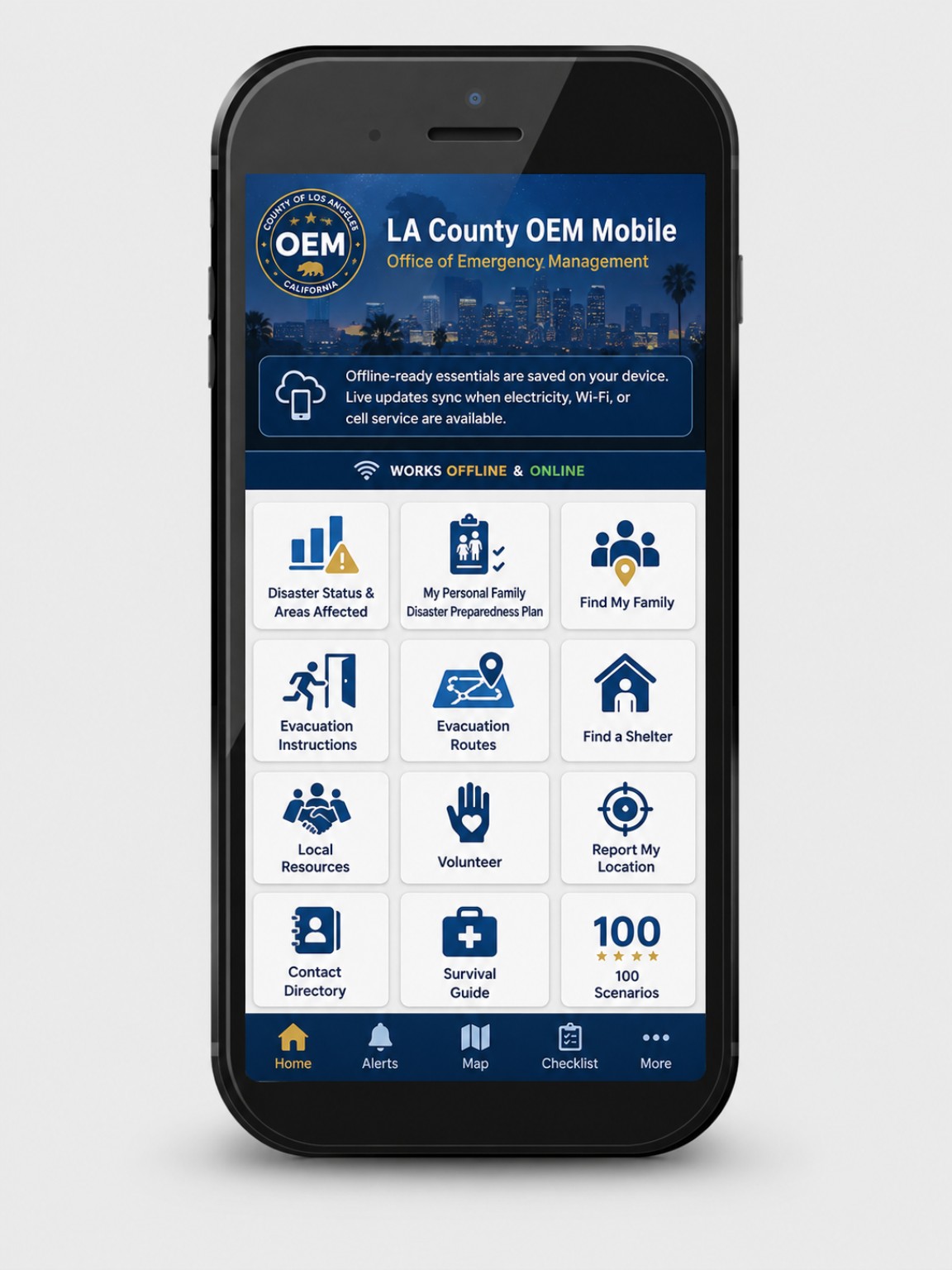
| Mobile Home Dashboard | Central launch point for major emergency tools and preparedness modules. | Previously downloaded/saved modules remain accessible as locally stored content. | Live status indicators, fresh maps and synchronized data require connectivity. | OFFLINE + LIVE SYNC |
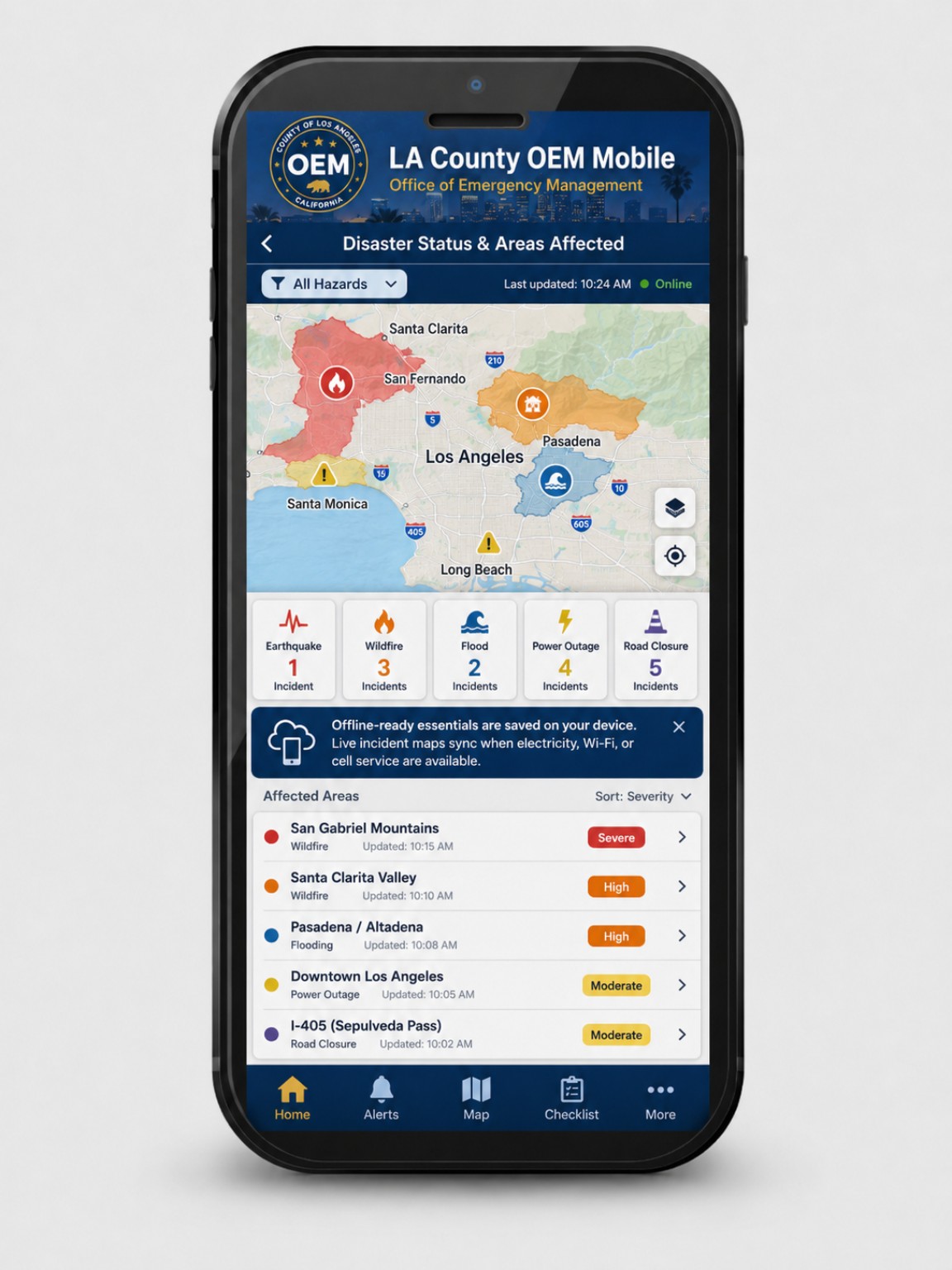
| Disaster Status & Areas Affected | View hazard type, affected areas, severity, incident counts and mapped impact areas. | Previously saved/cached incident essentials may remain viewable. | Current incident maps, severity, counts and affected areas must refresh online. | OFFLINE + LIVE SYNC |
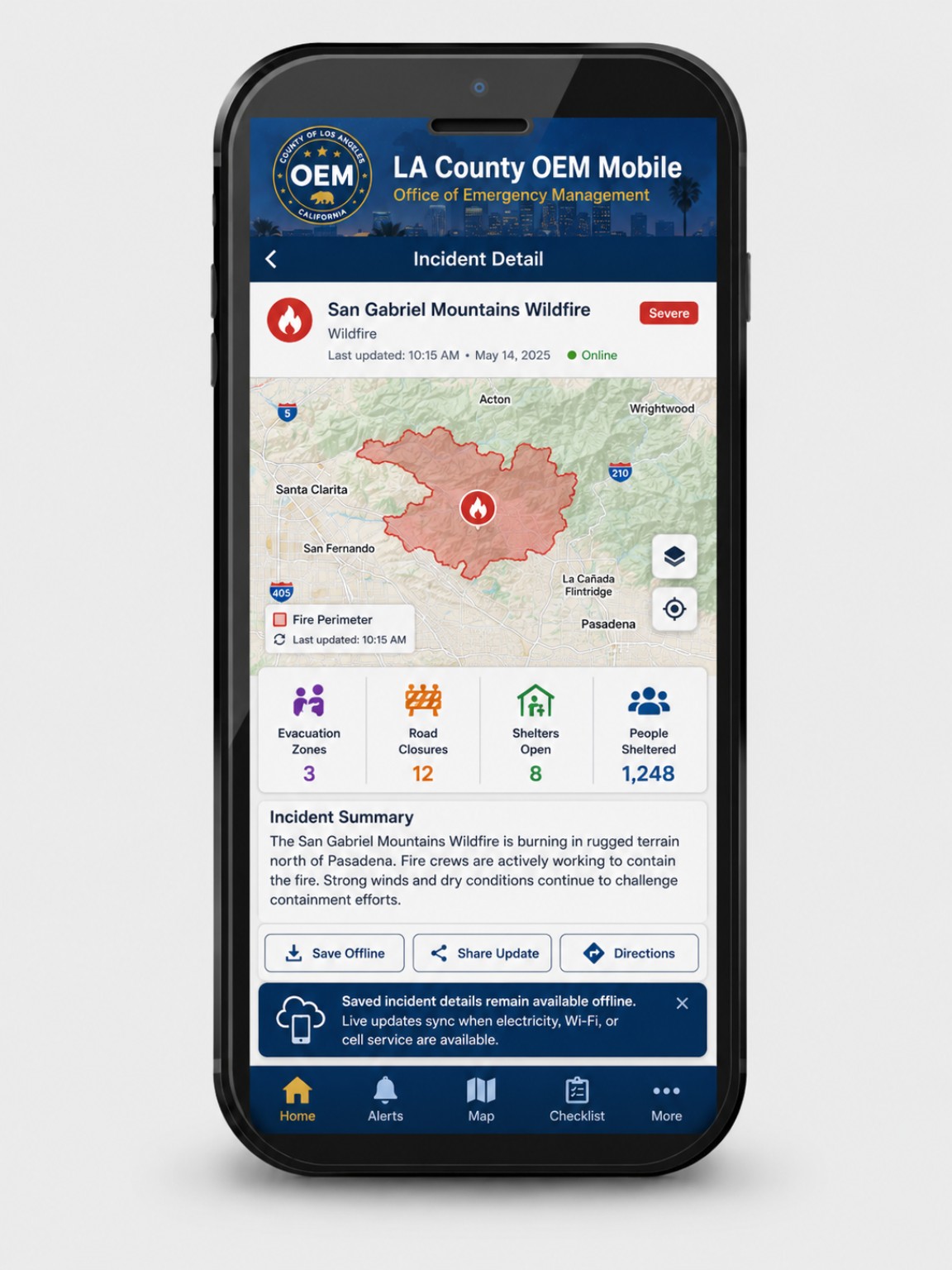
| Incident Detail | View a specific incident perimeter, summary, evacuation zones, closures and shelter activity. | Saved incident detail can remain available after explicit download/save. | Perimeters, closures, shelter counts and incident updates are live data and require connectivity to stay current. | OFFLINE + LIVE SYNC |
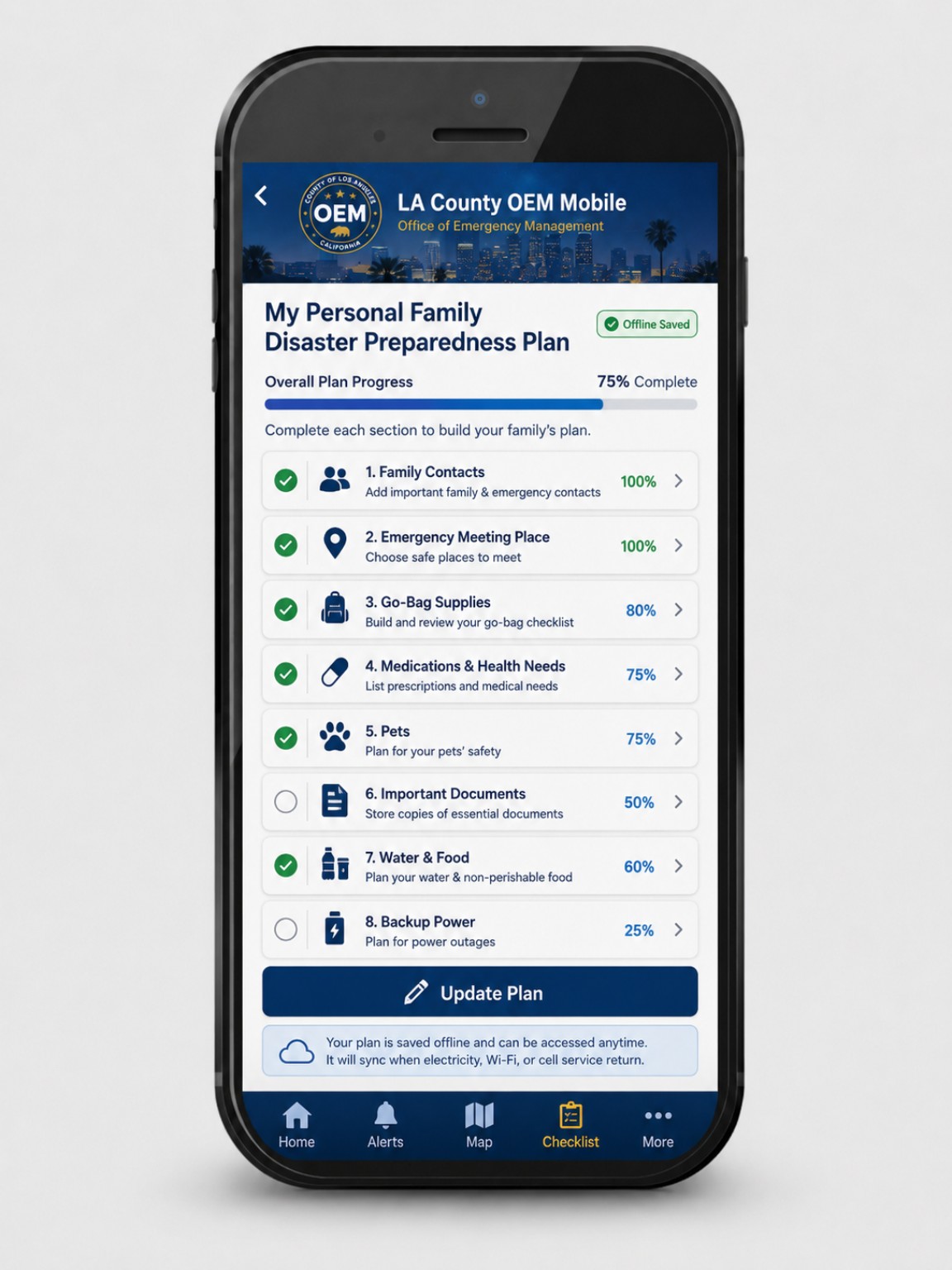
| Personal Family Disaster Plan | Build and maintain contacts, meeting places, go-bags, medications, pets, documents, food/water and backup-power plans. | Saved family plan and locally stored checklists remain available offline. | Cloud synchronization and cross-device updates require connectivity. | OFFLINE-READY |
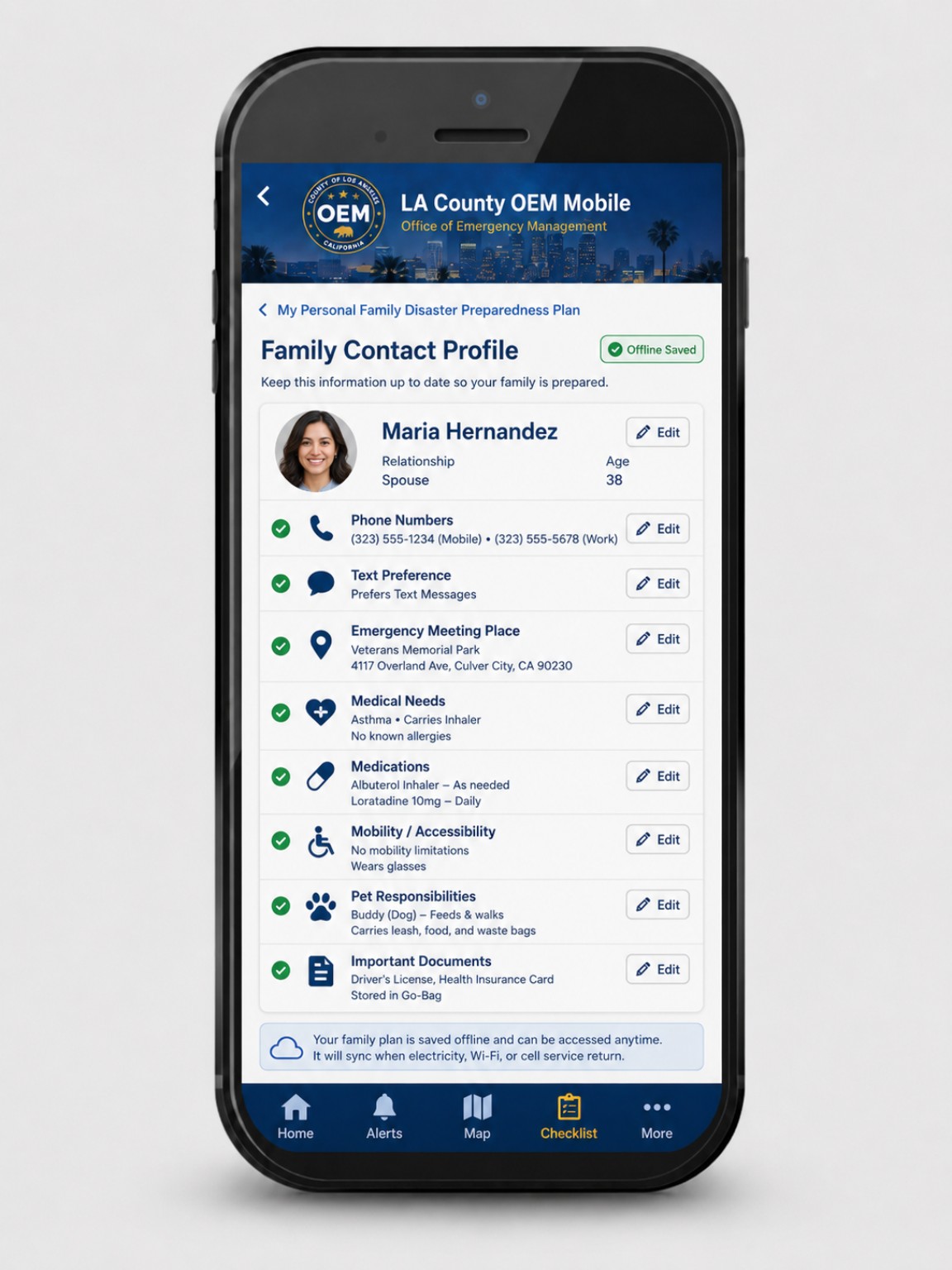
| Family Contact Profile | Store household contact, medical, medication, accessibility, pet and document information. | Saved profile data remains on the device for offline access. | Synchronization to other devices/accounts requires connectivity. | OFFLINE-READY |
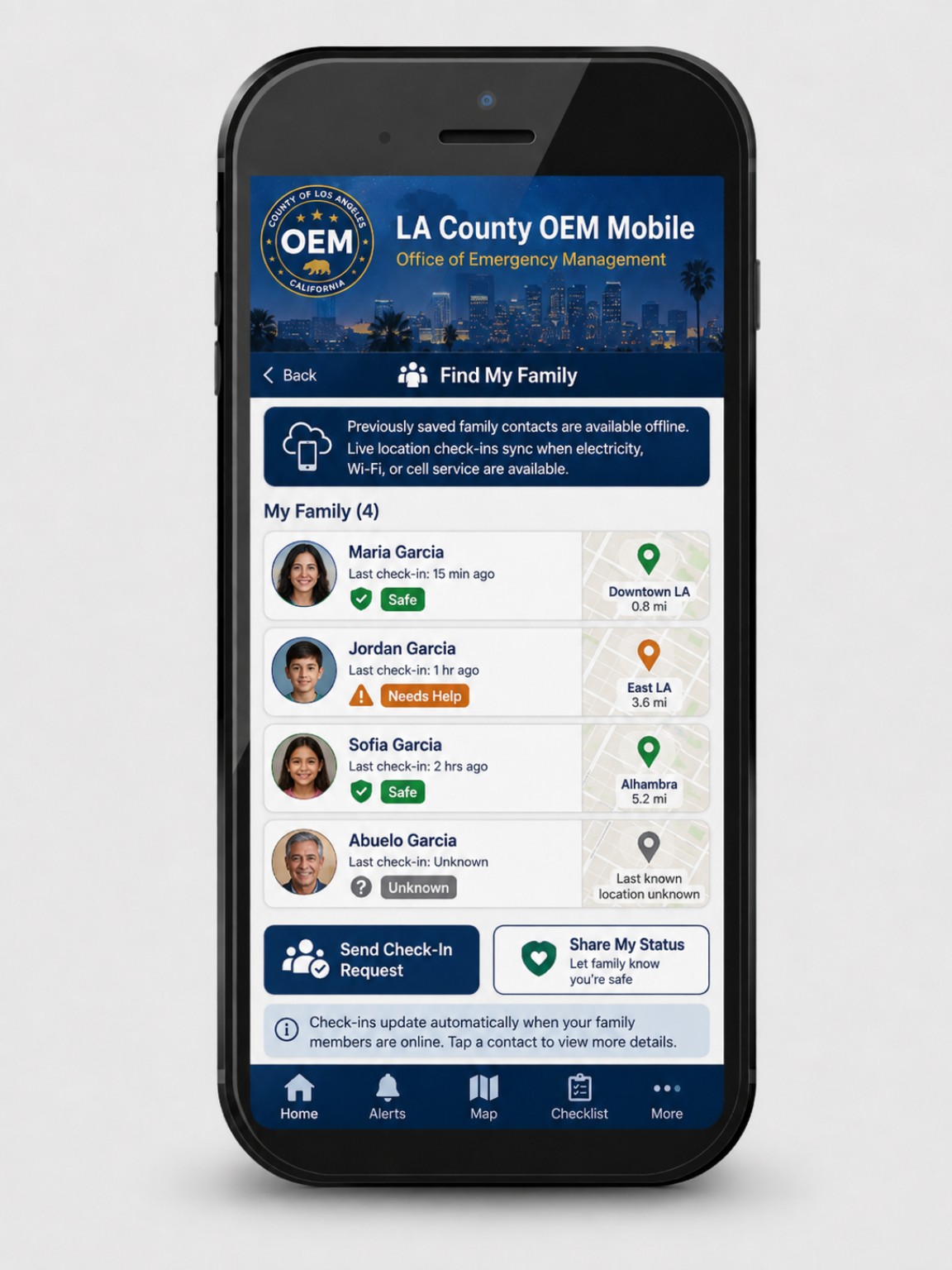
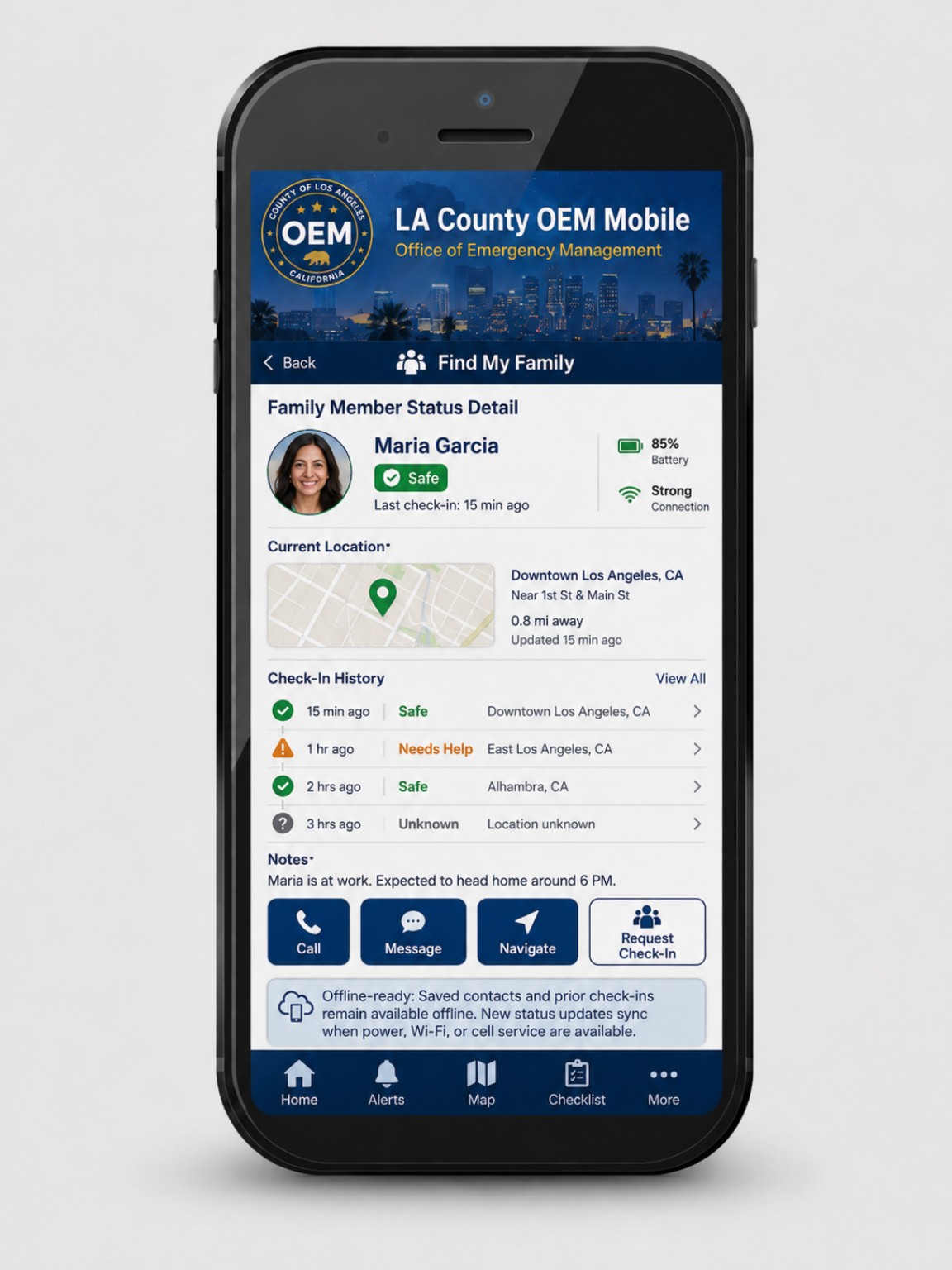
| Find My Family | Review saved family contacts, prior check-ins and status history. | Saved contacts and prior check-ins remain available offline. | New GPS locations, check-ins, messages and current status require connectivity. | OFFLINE + LIVE SYNC |
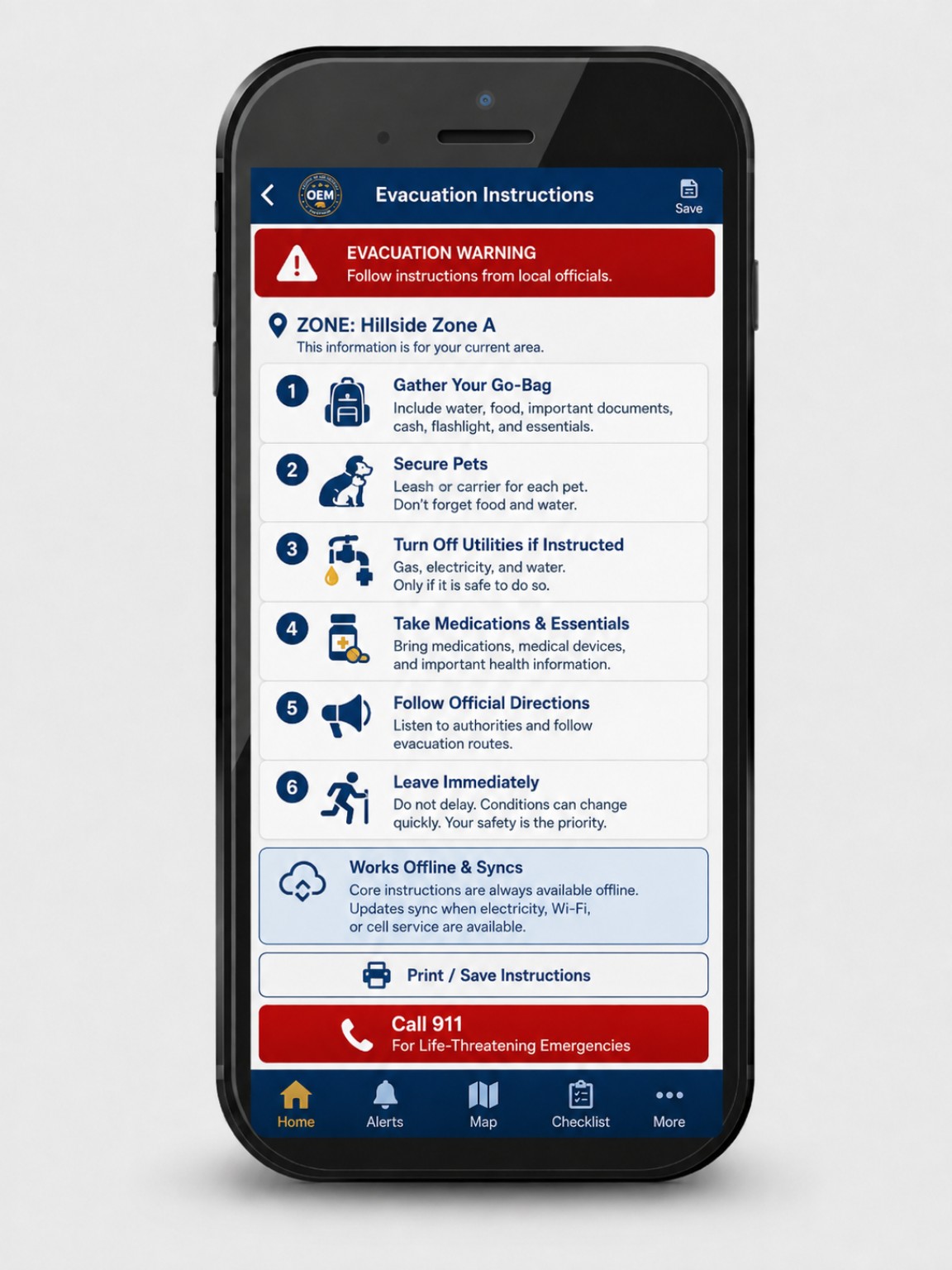
| Evacuation Instructions | Follow step-by-step evacuation actions for go-bags, pets, utilities, medications and official directions. | Downloaded/saved evacuation instructions remain available offline. | New zone-specific instructions or official changes require connectivity to update. | OFFLINE-READY |
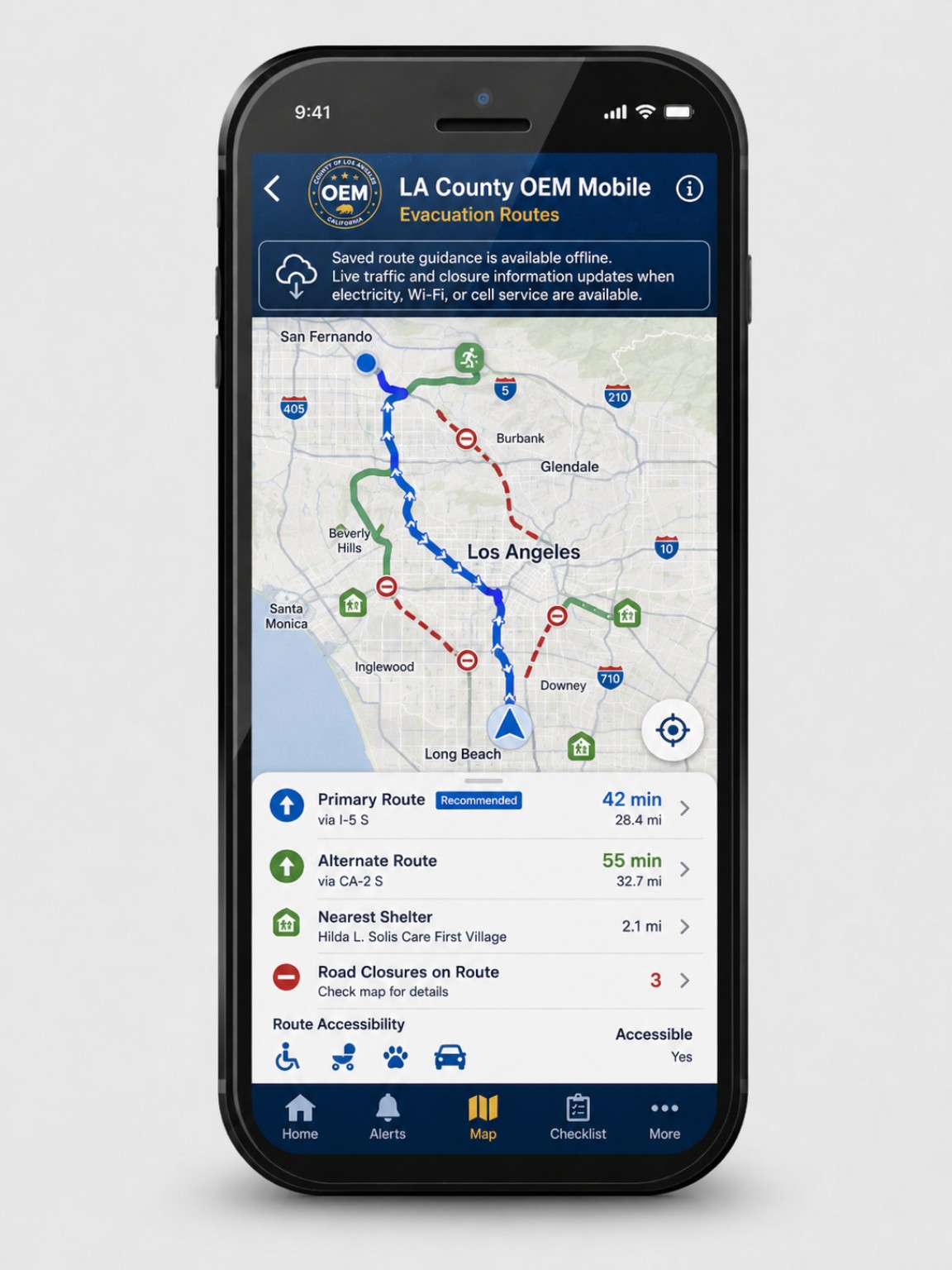
| Evacuation Routes | Review primary/alternate routes, shelter routing and accessibility considerations. | Previously saved route guidance may remain available offline as a reference. | Traffic, road closures, route travel times and rerouting are live and require connectivity. | OFFLINE + LIVE SYNC |
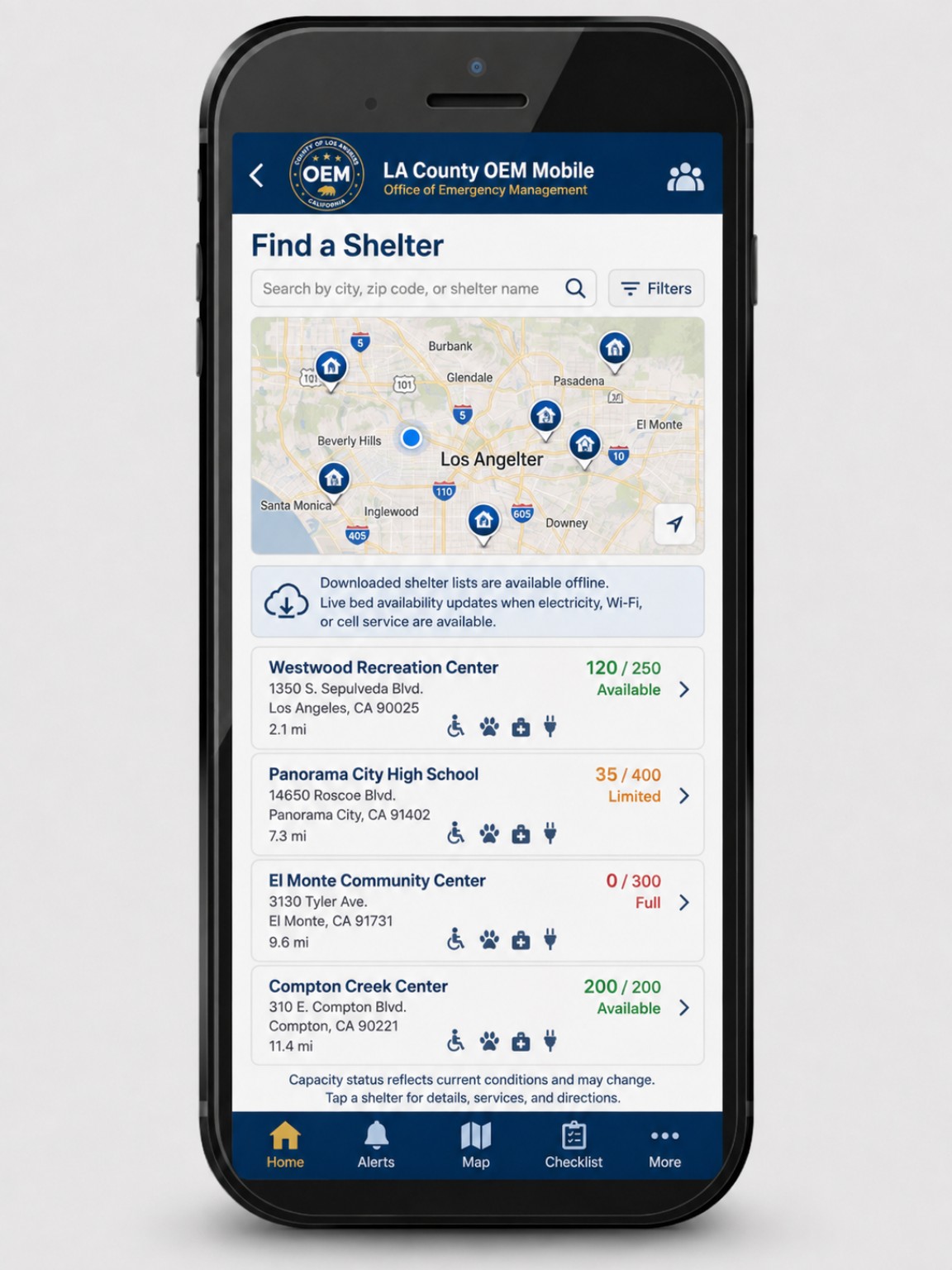
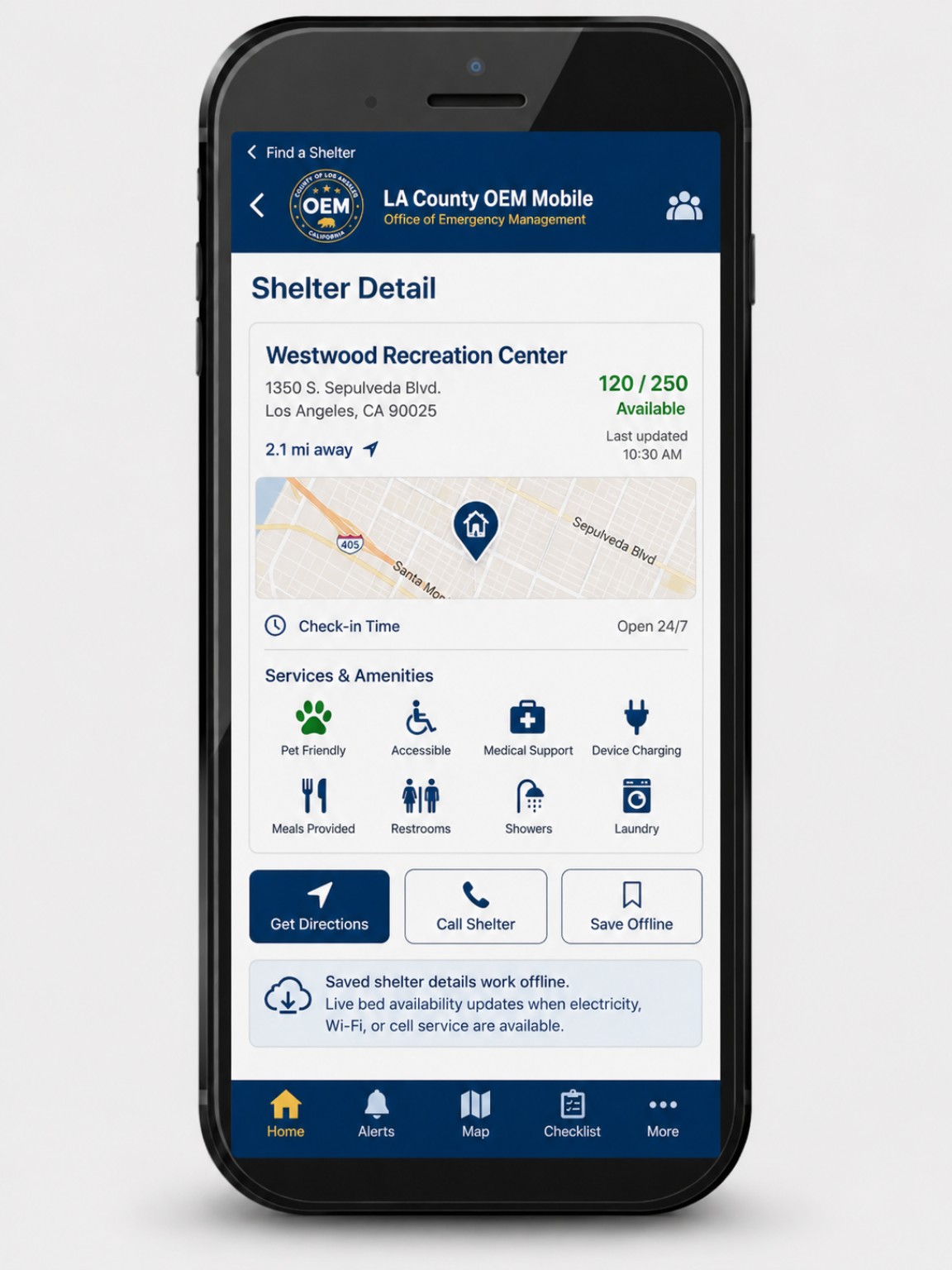
| Find a Shelter | Search downloaded shelter lists and review locations and services. | Downloaded shelter names, locations and saved service details can remain available offline. | Current capacity, availability, closures and live directions require connectivity. | OFFLINE + LIVE SYNC |
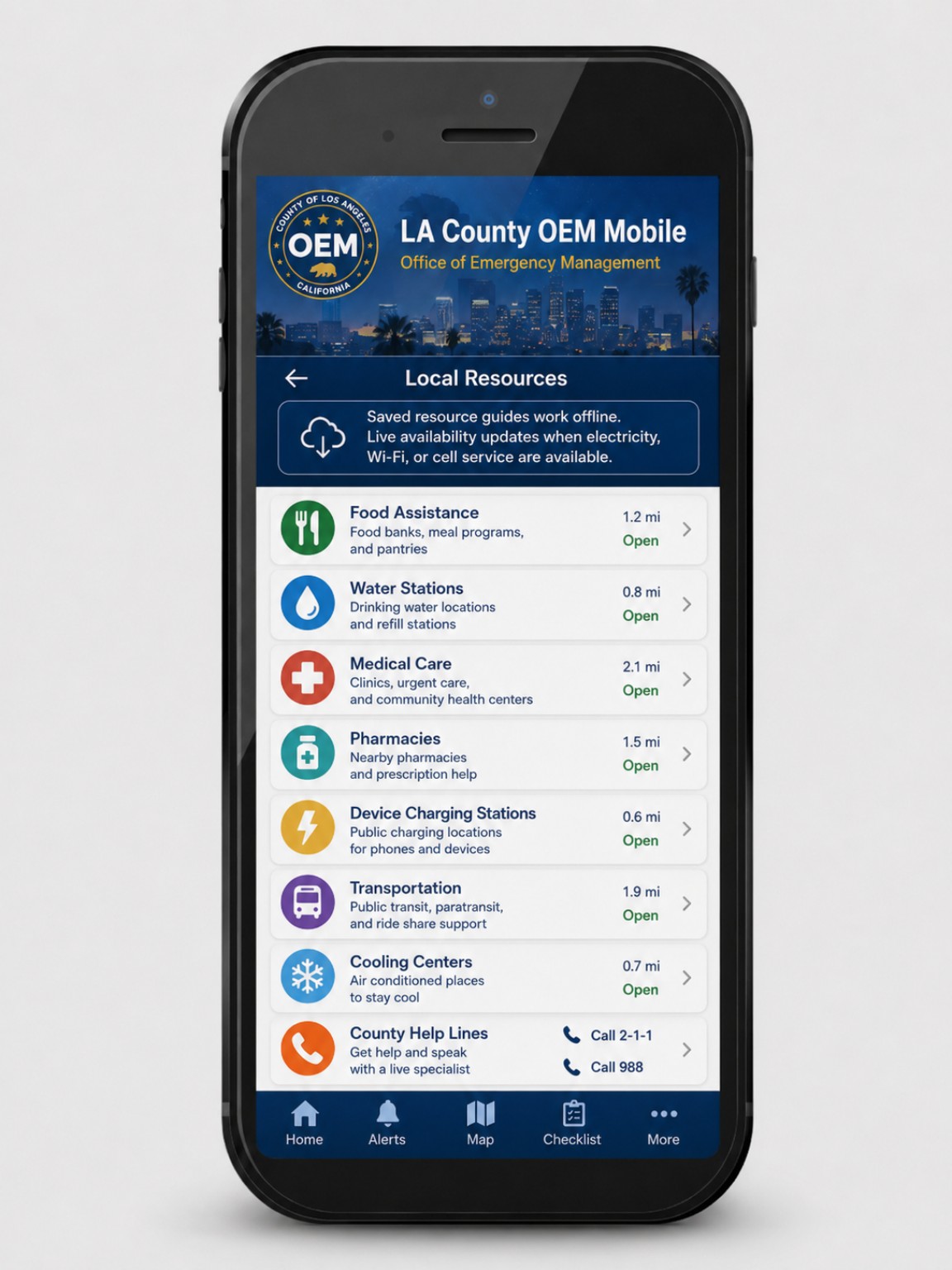
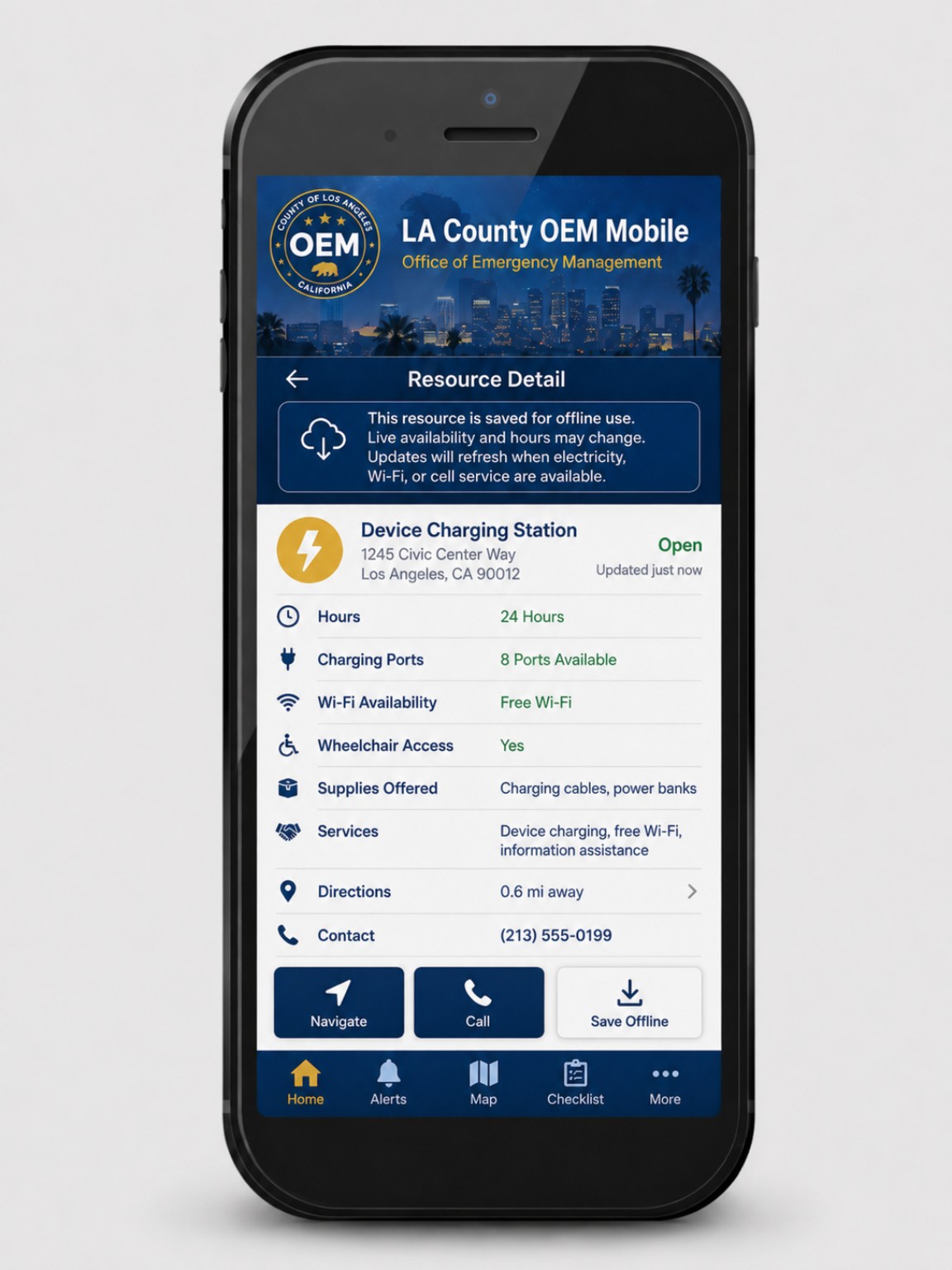
| Local Resources | Locate food, water, medical care, pharmacies, charging, transportation, cooling centers and help lines. | Saved resource guides and locally stored contacts remain available offline. | Current hours, availability and service status require connectivity to refresh. | OFFLINE + LIVE SYNC |
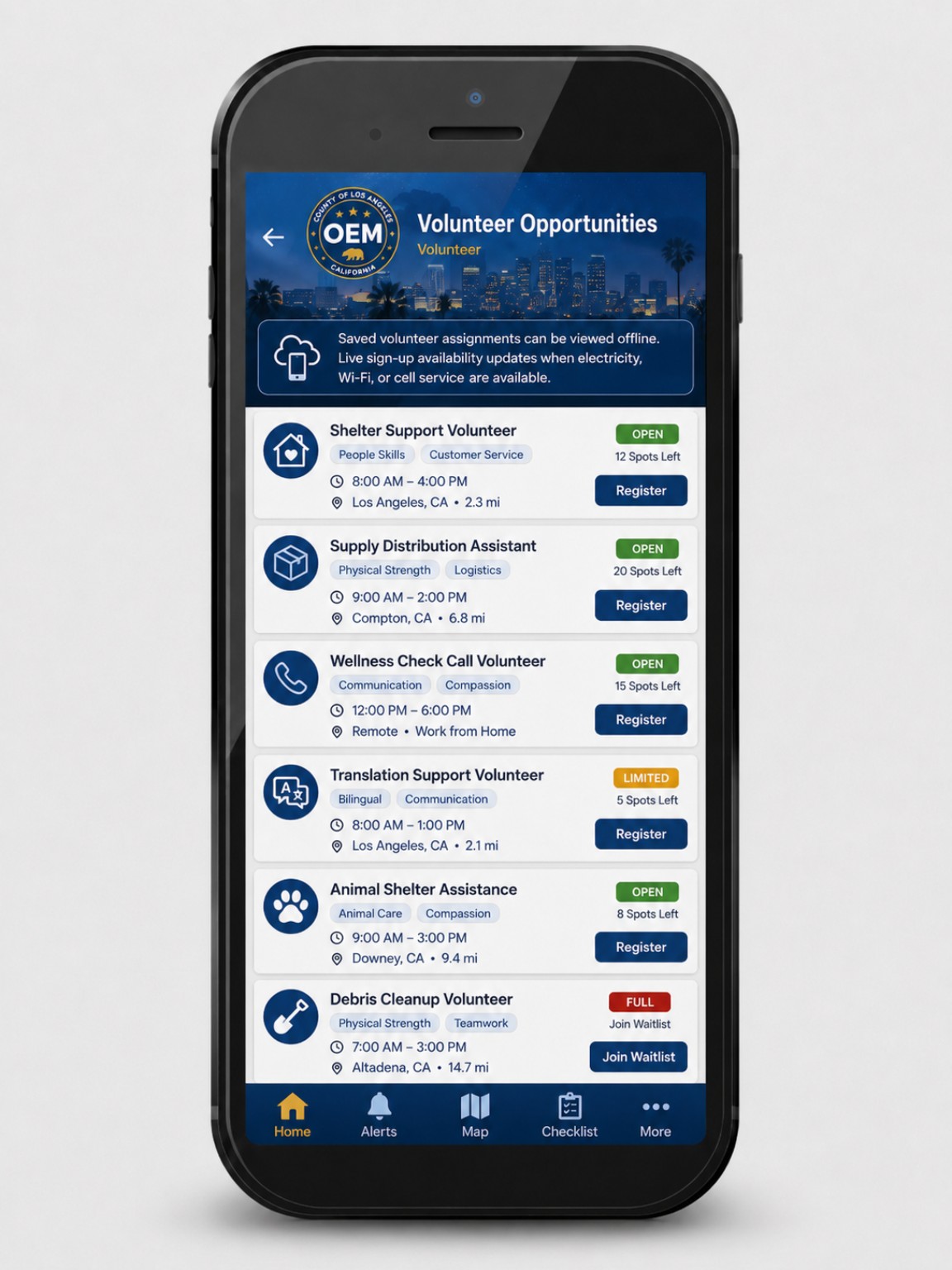
| Volunteer Opportunities | Review preparedness/response volunteer roles and assignment details. | Previously saved assignments can remain viewable offline. | Open slots, registration, waitlists and assignment changes require connectivity. | OFFLINE + LIVE SYNC |
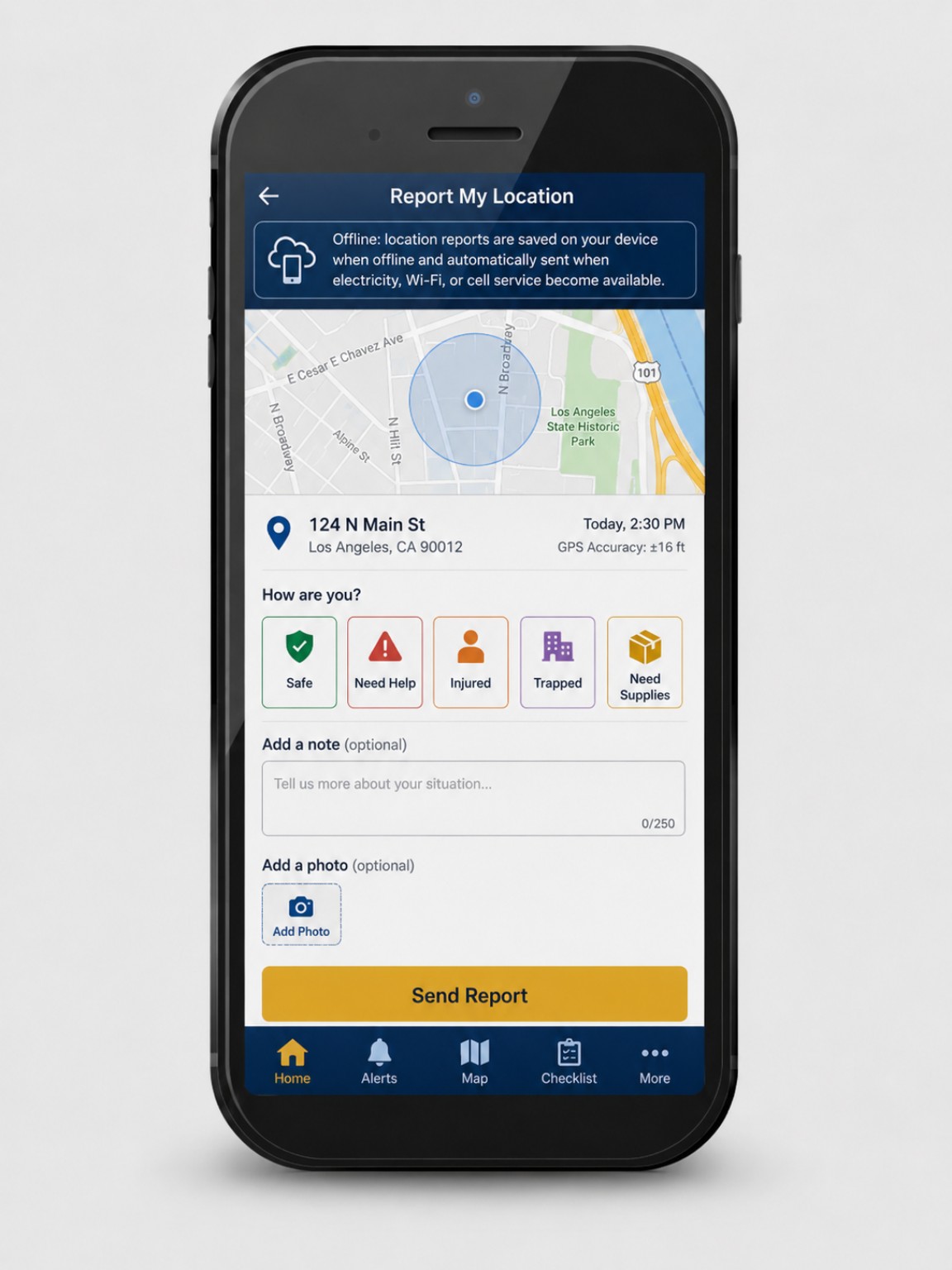
| Report My Location | Create a status report such as Safe, Need Help, Injured, Trapped or Need Supplies with notes/photo. | A report can be saved locally/queued while offline. | Transmission, receiving by others and refreshed map/location services require connectivity. | OFFLINE + LIVE SYNC |
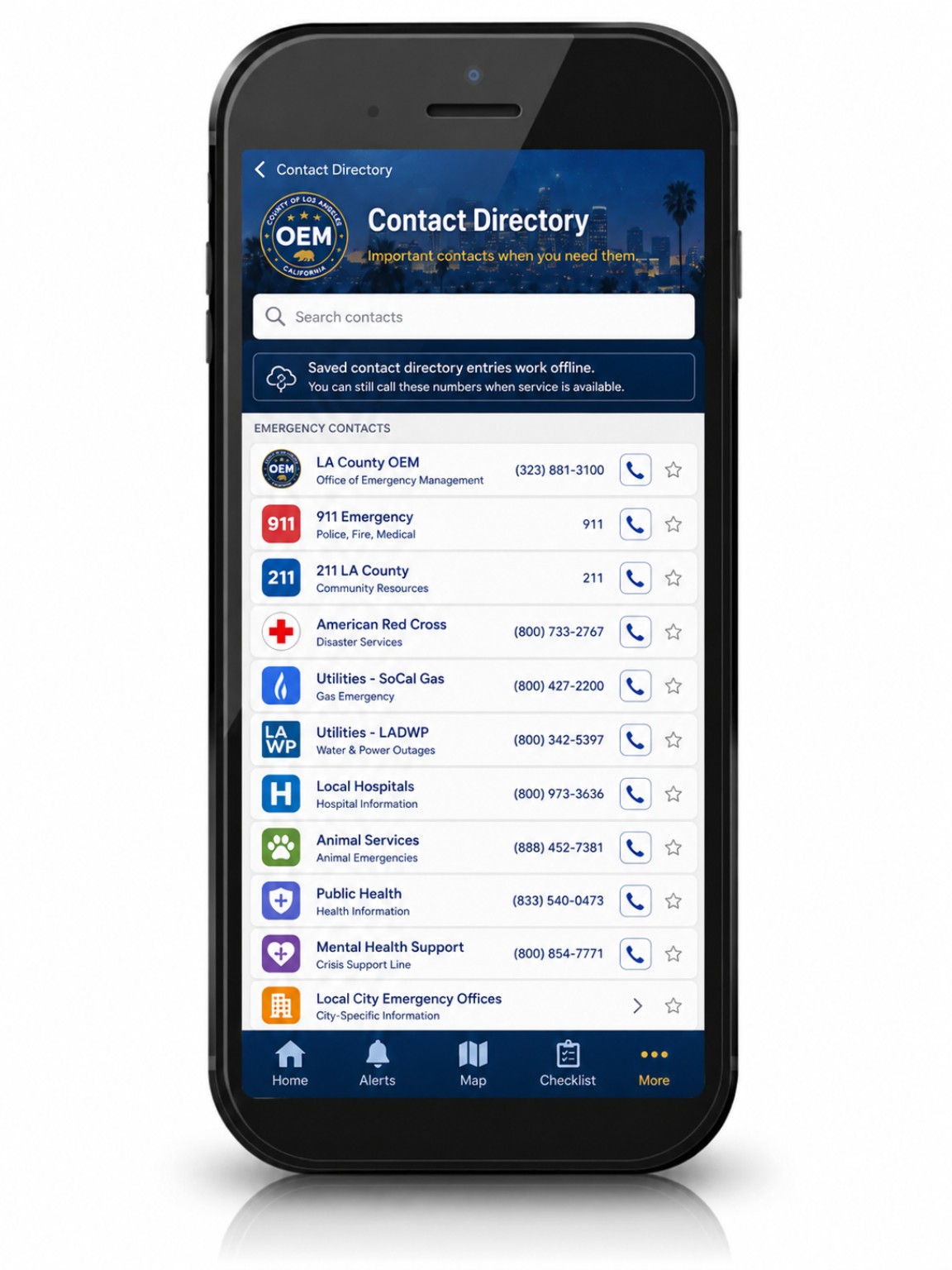
| Contact Directory | Store emergency, utility, health, animal and local emergency-office contacts. | Saved directory entries remain viewable offline. | Calling, texting or accessing current online directory information requires available service. | OFFLINE-READY |
| Survival Guide | Access preparedness and survival instructions for emergency conditions. | Downloaded survival guidance can remain available offline. | Updated editions and new content synchronize when connected. | OFFLINE-READY |
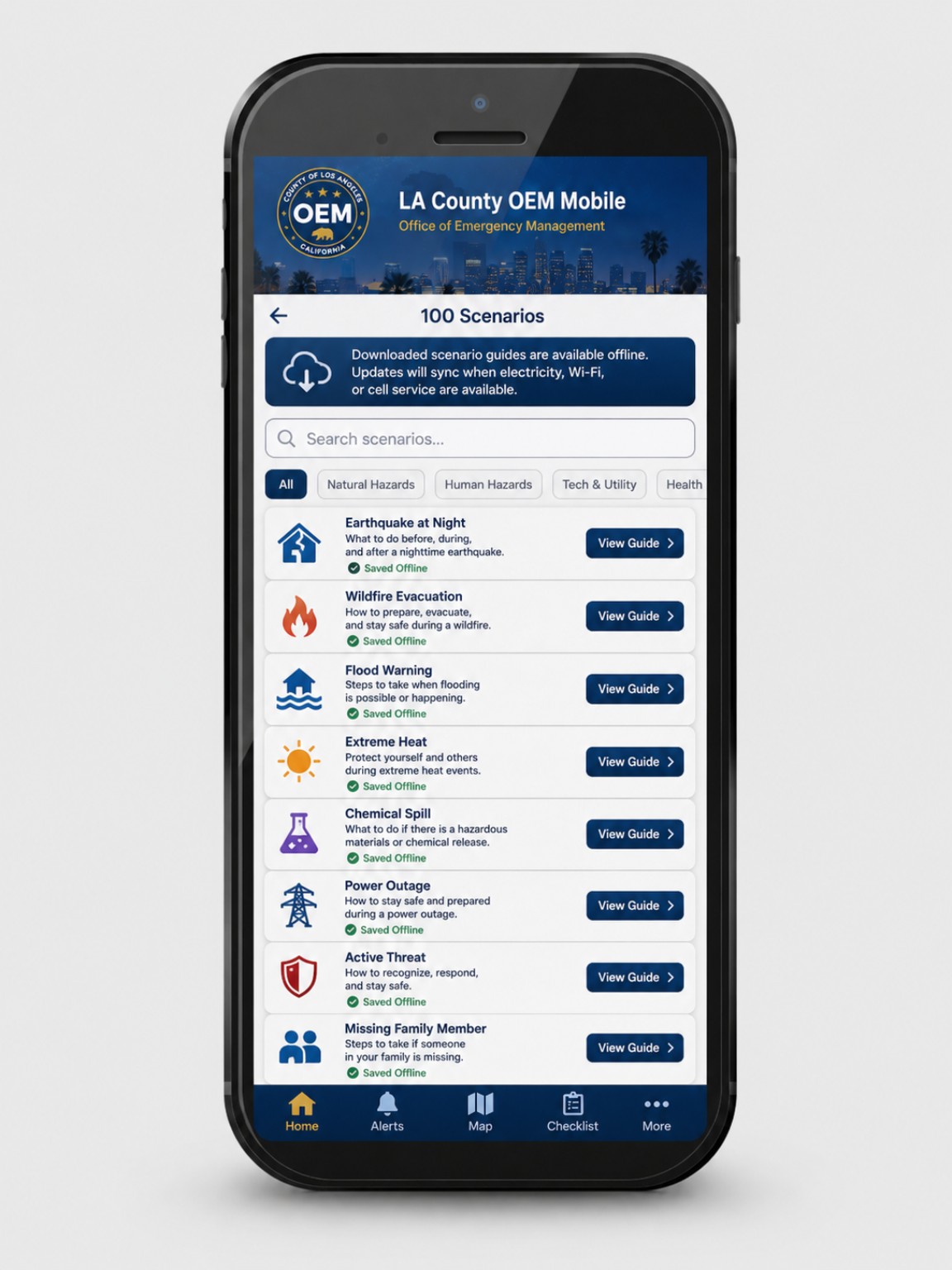
| 100 Emergency Scenarios | Search scenario-specific guidance for natural hazards, human-caused events, utilities, health and family emergencies. | Downloaded scenario guides remain available offline. | Scenario updates and newly published guidance synchronize when connected. | OFFLINE-READY |
| Alerts, Map & Checklist Navigation | Persistent bottom navigation provides quick access to alerts, map, checklists and additional tools. | Saved checklist content can remain available offline. | Current alerts and live map layers require connectivity. | OFFLINE + LIVE SYNC |
Mobile App Screen Gallery
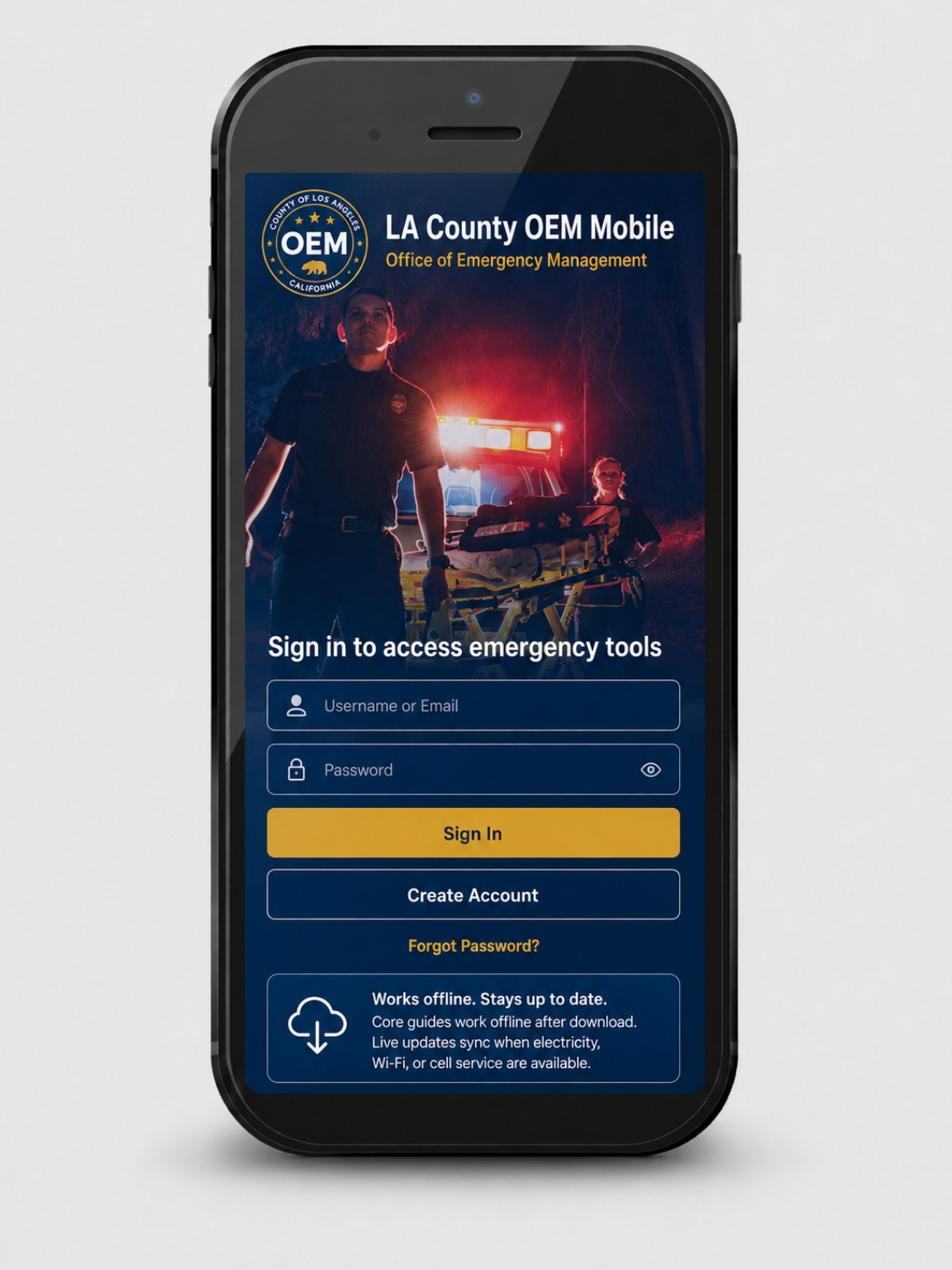
Screen concept gallery: The following screens illustrate the planned mobile experience and the intended offline/connected behavior. They are design concepts for the website presentation and should not be interpreted as evidence that a public production app, live data feed or app-store download is currently available.
Secure Sign-In / Account Access
Mobile Home / Emergency Tools
Disaster Status & Areas Affected
Incident Detail
My Personal Family Disaster Preparedness Plan
Family Contact Profile
Find My Family
Family Member Status Detail
Evacuation Instructions
Evacuation Routes
Find a Shelter
Shelter Detail
Local Resources
Resource Detail
Report My Location
Volunteer Opportunities
Contact Directory
100 Emergency Scenarios
CITY OF LOS ANGELES DISASTER PREPAREDNESS GUIDE
NotifyLA
The City of Los Angeles mass notification system for emergency information and protective actions.
What NotifyLA does
NotifyLA provides emergency information by recorded phone message, text message and email. It may be used for critical situations and protective actions such as evacuation orders.
Open NotifyLA registrationRegistration checklist
- Register every mobile and VoIP number associated with your household.
- Add email addresses.
- Add locations important to you, including work and school.
- Review notification settings periodically.
COMPLETE ACTION GUIDE
Before · During · After
Register phones/emails and keep contact information current.
Read alerts promptly and follow City of Los Angeles instructions when you are within City jurisdiction.
Keep monitoring until an all-clear or closure message.
CITY OF LOS ANGELES DISASTER PREPAREDNESS GUIDE
Information Sources
Use several official channels for emergency information and verify information before sharing it.
| Source | Use |
|---|---|
| NotifyLA | City emergency notifications and protective actions. |
| Wireless Emergency Alerts | Urgent alerts delivered to compatible mobile devices. |
| NOAA / NWS | Weather watches, warnings and forecasts. |
| LAFD / LAPD / City agencies | Agency-specific emergency information and operational updates. |
| LADWP | Power and water outage information. |
| MyLA311 | Non-emergency service requests and City information. |
| Radio / TV | Regional emergency broadcasting and public information. |
COMPLETE ACTION GUIDE
Before · During · After
Bookmark official County, city, NWS, utility and public-safety information sources.
Cross-check social-media claims against official sources before acting or sharing.
Save official recovery links and watch for fraud/misinformation.
CITY OF LOS ANGELES DISASTER PREPAREDNESS GUIDE
Maps & Risk Zones
Use official maps to understand hazards such as tsunami inundation, wildfire risk, flooding and evacuation areas.
TsunamiZone
Use tsunami preparedness and evacuation-zone resources for coastal areas.
Open TsunamiZoneEmergency Plans & Annexes
Review hazard-specific City plans and operational annexes.
Open City plansMyLA311 maps
Use City tools to locate nearby facilities and report service conditions.
Open MyLA311COMPLETE ACTION GUIDE
Before · During · After
Know your evacuation zones, flood/fire/tsunami exposure and multiple routes before an incident.
Use current official incident maps; do not rely on old screenshots or historical shelter lists.
Check re-entry, road closure and damage maps before returning.
CITY OF LOS ANGELES DISASTER PREPAREDNESS GUIDE
Media & Social Channels
Keep redundant information sources available when internet, cellular or power services are disrupted.
Broadcast
Keep a battery or hand-crank radio and know local AM/FM news sources. Emergency information may also be distributed through television and satellite radio.
Digital
Follow official City and agency websites/social channels. Treat crowdsourced reports as unverified until confirmed by an official source.
COMPLETE ACTION GUIDE
Before · During · After
Follow official County and first-responder channels and keep a battery-powered radio.
Use official updates for protective actions; avoid spreading unverified reports.
Continue monitoring recovery notices and scam warnings.
CITY OF LOS ANGELES DISASTER PREPAREDNESS GUIDE
MyLA311 Services
Connect to more than 1,500 City services and submit non-emergency requests online, by app or by phone.
Popular services
- Illegal dumping and trash collection issues.
- Bulky-item pickup.
- Potholes and street problems.
- Graffiti removal.
- Streetlight problems.
- Parking enforcement and animal services.
Contact
Dial: 3-1-1 or (213) 473-3231
Online: requests can be submitted 24/7.
For emergencies, call or text 9-1-1 instead of using 311.
COMPLETE ACTION GUIDE
Before · During · After
Know that 311 is for non-emergency City of Los Angeles service requests.
Use 9-1-1 for immediate danger; use 311 for eligible city service/reporting issues.
Track service requests and use official recovery channels for disaster-specific assistance.
CITY OF LOS ANGELES DISASTER PREPAREDNESS GUIDE
LADWP Emergency Preparedness
Prepare for water and power disruptions and learn outage-specific protective actions.
Make a plan
Discuss emergency plans with family and neighbors and learn emergency procedures for schools, care facilities and apartment buildings.
Make a kit
Maintain food, water, radio, lighting, first aid, medicines, clothing, batteries, sanitation items, maps, chargers and supplies tailored to disability, senior and pet needs.
Power
- Know outage information resources.
- Prepare safe backup power.
- Keep refrigerators closed during outages.
- Never operate generators indoors.
Water
Maintain emergency drinking water and prepare for disruptions caused by damaged infrastructure.
COMPLETE ACTION GUIDE
Before · During · After
Know water/power shutoff locations and maintain safe backup lighting/charging.
Stay away from downed lines, electrical equipment in water and unsafe generator use.
Follow utility instructions for restoration and water-quality notices.
CITY OF LOS ANGELES DISASTER PREPAREDNESS GUIDE
Shelters & Assistance
Plan where to go if you cannot safely remain at home and understand that shelter locations may change by incident.
During an incident
- Use current City/County announcements for shelter locations.
- Confirm accessibility and transportation needs.
- Bring medications, essential devices, identification and go-bags.
- Plan separately for pets when required.
Information channels
NotifyLA, Emergency Management Department updates, MyLA311 and official public-information channels may provide current shelter and assistance information.
COMPLETE ACTION GUIDE
Before · During · After
Know how to find an open shelter and plan accessible transportation, medications and pet/service-animal needs.
Verify the shelter is open before traveling unless officials directly route you there.
Use assistance centers and 211 for longer-term housing/resource navigation.
CITY OF LOS ANGELES DISASTER PREPAREDNESS GUIDE
Emergency Contacts
Know which number to use so urgent calls reach the right response system.
| Need | Contact | Notes |
|---|---|---|
| Life-threatening emergency | 9-1-1 / Text to 9-1-1 where available | Police, fire or emergency medical response. |
| City services / non-emergency | 3-1-1 or (213) 473-3231 | MyLA311 and City service information. |
| Emergency Management Department | (213) 484-4800 | Emergency preparedness programs and City emergency-management information. |
| California Relay | 7-1-1 | Relay service. |
| LADWP | Use official outage channels | Power and water outage information. |
COMPLETE ACTION GUIDE
Before · During · After
Keep a paper and digital contact list with local/out-of-area contacts and key services.
Use 9-1-1 only for emergencies; text family when networks are overloaded when possible.
Update family status and connect with recovery resources.
CITY OF LOS ANGELES DISASTER PREPAREDNESS GUIDE
Community Programs
Prepared neighborhoods recover faster when residents know one another, share plans and coordinate resources.
RYLAN
Neighborhood-level planning and immediate post-disaster coordination.
Explore RYLANCERT
Community Emergency Response Team training helps residents learn disaster response skills.
Explore CERT-LAPreparedness outreach
Share official materials, help neighbors plan and participate in drills.
COMPLETE ACTION GUIDE
Before · During · After
Learn neighborhood resources, CERT options and who may need additional assistance.
Follow official volunteer coordination; do not self-deploy into restricted areas.
Support organized recovery and check on neighbors safely.
CITY OF LOS ANGELES DISASTER PREPAREDNESS GUIDE
CERT & Training
Develop practical emergency-response skills and strengthen neighborhood capability.
CERT topics
- Disaster preparedness
- Fire safety
- Basic disaster medical operations
- Light search and rescue
- Team organization
Role
CERT training supports personal preparedness and organized community assistance while professional responders prioritize the most urgent needs.
Visit CERT-LACOMPLETE ACTION GUIDE
Before · During · After
Complete approved CERT training and maintain personal/family preparedness first.
Operate only within your training, assignment and safety limits.
Document activities and participate in after-action/recovery support.
CITY OF LOS ANGELES DISASTER PREPAREDNESS GUIDE
Training & Drills
Plans become more useful when they are practiced, evaluated and updated.
| Exercise | Recommended focus |
|---|---|
| Home evacuation drill | Routes, alarms, meeting place, children and pets. |
| Earthquake drill | Drop, Cover, Hold On; post-shaking checks. |
| Communication drill | Out-of-area contact and reunification. |
| Neighborhood drill | RYLAN roles, resources and communications. |
| Workplace / school drill | Evacuation, accountability and reunification. |
After each exercise, record what worked, what failed and what needs to change.
COMPLETE ACTION GUIDE
Before · During · After
Schedule family/workplace/school drills and define measurable objectives.
Practice realistic but safe protective actions and accountability.
Debrief, document gaps and update plans/supplies.
CITY OF LOS ANGELES DISASTER PREPAREDNESS GUIDE
Children & Family Fire Safety
Use simple, repeated messages and practice to help young children respond safely to fire and smoke.
Messages children can remember
- Hot things are not for play.
- Exit is the way out.
- Get low and go to your exit.
- A meeting place is a safe place away from fire and smoke.
- Get outside and stay outside.
Family practice
- Make a home fire escape map.
- Practice finding two ways out.
- Teach the sound of the smoke alarm.
- Practice your meeting place.
- Share the plan with caregivers.
COMPLETE ACTION GUIDE
Before · During · After
Teach age-appropriate fire/evacuation rules, two ways out and a family meeting place.
Children should follow trusted adults, crawl low under smoke when escaping fire and never hide from firefighters.
Reassure children, restore routines and monitor stress reactions.
CITY OF LOS ANGELES DISASTER PREPAREDNESS GUIDE
Business Readiness
Protect people, critical operations, data and facilities and plan how essential functions will continue after disruption.
Business continuity priorities
- Assess hazards and critical functions.
- Identify essential equipment, data and documentation.
- Plan alternative work locations and remote operations.
- Maintain emergency supplies and backup power.
- Coordinate with employees and first responders.
Ready Your LA Business
Los Angeles Emergency Management Department provides preparedness resources for local businesses through the Ready Your LA Business program.
Open business preparedness resourcesCOMPLETE ACTION GUIDE
Before · During · After
Create continuity plans for people, data, vendors, utilities, payroll and alternate work locations.
Protect life first, account for personnel and activate continuity priorities.
Document losses, communicate with staff/customers and restore critical functions in priority order.
CITY OF LOS ANGELES DISASTER PREPAREDNESS GUIDE
West Hollywood Emergency Preparedness
A neighboring-city preparedness resource useful for regional planning, especially for residents who live, work or travel across jurisdictional boundaries.
Regional coordination
Emergency conditions do not stop at city boundaries. Keep preparedness information for the jurisdictions where you live, work, study and regularly travel.
West Hollywood resource
Open City of West Hollywood preparedness pageCOMPLETE ACTION GUIDE
Before · During · After
Register for local alerts and know West Hollywood-specific city services and evacuation information.
Follow City/County emergency instructions applicable to your location.
Use city and County recovery/resource channels.
CITY OF LOS ANGELES DISASTER PREPAREDNESS GUIDE
City Emergency Operations Base Plan
The 2023 City of Los Angeles Base Emergency Operations Plan describes the Citywide all-hazards emergency-management framework.
Plan structure
- Purpose, Scope, Situation and Assumptions
- Concept of Operations
- Organization and Assignment of Responsibilities
- Direction, Control and Coordination
- Mutual Aid and Mutual Assistance
- Communications and Information
- Administrative Practices, Logistics and Finance
- Plan Development, Approval and Maintenance
- Authorities & References
- Terminology & Attachments
Core objectives
- Save lives and protect property.
- Provide continuity of government.
- Describe authorities, roles and functions.
- Coordinate operations and resources.
- Integrate nongovernmental partners.
- Support restoration of essential systems and services.
COMPLETE ACTION GUIDE
Before · During · After
Understand that an EOP is an operational framework, not a substitute for current incident instructions.
During activation, agencies use assigned roles, EOC coordination and field ICS/Unified Command.
After action, plans are evaluated and recovery authorities take effect.
CITY OF LOS ANGELES DISASTER PREPAREDNESS GUIDE
LAPD 2016 Emergency Plan
The Los Angeles Police Department emergency plan describes departmental preparedness, continuity and emergency-response functions within the Citywide system.
Plan purpose
The plan supports departmental emergency functions, continuity of operations, the Department’s role in Citywide emergency response/recovery, and preparedness.
Planning relationship
Departmental emergency plans support the City Emergency Operations Organization and are intended to integrate with the Citywide Emergency Operations Plan and related procedures.
Download LAPD Emergency PlanCOMPLETE ACTION GUIDE
Before · During · After
Know the difference between law-enforcement operational plans and household preparedness guidance.
Follow lawful evacuation, perimeter and public-safety instructions.
Use official channels for re-entry and incident information.
CITY OF LOS ANGELES DISASTER PREPAREDNESS GUIDE
Emergency Plans & Annexes
The City’s Emergency Operations Plan is supported by hazard-specific and functional annexes and appendices.
Annex directory
Adverse Weather AnnexBrush Fire AnnexCBRN AnnexCivil Disturbance AnnexCommunications AnnexCritical Infrastructure AnnexDebris Flow AnnexEarthquake AnnexEmergency Alert and Warning AnnexEmergency Public Information AnnexEvacuation AnnexLocal Assistance Center AnnexLogistics AnnexMass Care & Sheltering AnnexMedical Points of Dispensing AnnexOff-Airport Major Aircraft Response AnnexPandemic AnnexRecovery AnnexResettlement Processing Center AnnexTerrorism Prevention & Protection AnnexTsunami AnnexUrban Flooding Annex
Appendix directory
CBRN Biological AppendixCBRN Chemical AppendixCBRN Nuclear AppendixCBRN Radiological AppendixDam/Reservoir Failure AppendixDebris Management AppendixDistribution Management AppendixDonation Management AppendixFacilities AppendixFood & Potable Water AppendixFuel AppendixTransportation AppendixHealth & Medical AppendixLarge Animal Support AppendixSmall Animal Support AppendixMass Feeding AppendixTraditional Sheltering AppendixNon-Traditional Sheltering Appendix
CITY OF LOS ANGELES DISASTER PREPAREDNESS GUIDE
Hazard-Specific Annexes
Hazard-specific annexes provide operational details for particular threats and hazards.
Adverse Weather Annex
Hazard-specific operational planning resource within the City Emergency Operations Plan structure.
Brush Fire Annex
Hazard-specific operational planning resource within the City Emergency Operations Plan structure.
CBRN Annex
Hazard-specific operational planning resource within the City Emergency Operations Plan structure.
Civil Disturbance Annex
Hazard-specific operational planning resource within the City Emergency Operations Plan structure.
Debris Flow Annex
Hazard-specific operational planning resource within the City Emergency Operations Plan structure.
Earthquake Annex
Hazard-specific operational planning resource within the City Emergency Operations Plan structure.
Off-Airport Major Aircraft Response Annex
Hazard-specific operational planning resource within the City Emergency Operations Plan structure.
Pandemic Annex
Hazard-specific operational planning resource within the City Emergency Operations Plan structure.
Terrorism Prevention & Protection Annex
Hazard-specific operational planning resource within the City Emergency Operations Plan structure.
Tsunami Annex
Hazard-specific operational planning resource within the City Emergency Operations Plan structure.
Urban Flooding Annex
Hazard-specific operational planning resource within the City Emergency Operations Plan structure.
CITY OF LOS ANGELES DISASTER PREPAREDNESS GUIDE
Functional Support Annexes
Functional support annexes describe critical emergency functions that operate across multiple hazard types.
Communications Annex
Functional support planning resource within the City Emergency Operations Plan structure.
Critical Infrastructure Annex
Functional support planning resource within the City Emergency Operations Plan structure.
Emergency Alert and Warning Annex
Functional support planning resource within the City Emergency Operations Plan structure.
Emergency Public Information Annex
Functional support planning resource within the City Emergency Operations Plan structure.
Evacuation Annex
Functional support planning resource within the City Emergency Operations Plan structure.
Local Assistance Center Annex
Functional support planning resource within the City Emergency Operations Plan structure.
Logistics Annex
Functional support planning resource within the City Emergency Operations Plan structure.
Mass Care & Sheltering Annex
Functional support planning resource within the City Emergency Operations Plan structure.
Medical Points of Dispensing Annex
Functional support planning resource within the City Emergency Operations Plan structure.
Recovery Annex
Functional support planning resource within the City Emergency Operations Plan structure.
Resettlement Processing Center Annex
Functional support planning resource within the City Emergency Operations Plan structure.
CITY OF LOS ANGELES DISASTER PREPAREDNESS GUIDE
PDF Library
Download the official preparedness guides and plans included with this website.
| Document | Primary focus | Download |
|---|---|---|
| City of Los Angeles Base Emergency Operations Plan 2023 | Citywide all-hazards emergency-management framework | |
| LAPD 2016 Emergency Plan | Police Department emergency planning and continuity | |
| CAL FIRE Wildfire Action Plan – Ready, Set, Go! | Wildfire home hardening, defensible space, evacuation | |
| Emergency Preparedness Manual for People with Disabilities and Access & Functional Needs | Accessible and individualized preparedness | |
| LAFD Emergency Preparedness Guide | Hazards, alert systems, response and preparedness | |
| USFA / Sesame Street Fire Safety Family Guide | Fire safety for young children and caregivers |
COMPLETE ACTION GUIDE
Before · During · After
Download critical guides in advance so they remain available during internet outages.
Use current alerts and instructions over static documents when conditions change.
Replace old documents with updated editions as agencies publish them.
CITY OF LOS ANGELES DISASTER PREPAREDNESS GUIDE
Source Directory
Official websites and PDF documents used to organize this preparedness guide.
| Source | Access |
|---|---|
| ReadyLA / RYLAN | Open source |
| NotifyLA | Open source |
| Emergency Plans & Annexes | Open source |
| Emergency Contacts | Open source |
| LADWP Emergency Preparedness | Open source |
| MyLA311 | Open source |
| TsunamiZone | Open source |
| West Hollywood Emergency Preparedness | Open source |
| Ready.gov | Open source |
| LAFD | Open source |
| CERT-LA | Open source |
| City of Los Angeles Base Emergency Operations Plan 2023 | Download PDF |
| LAPD 2016 Emergency Plan | Download PDF |
| CAL FIRE Wildfire Action Plan – Ready, Set, Go! | Download PDF |
| Emergency Preparedness Manual for People with Disabilities and Access & Functional Needs | Download PDF |
| LAFD Emergency Preparedness Guide | Download PDF |
| USFA / Sesame Street Fire Safety Family Guide | Download PDF |
COMPLETE ACTION GUIDE
Before · During · After
Use primary government/nonprofit sources and record when information was last verified.
Prioritize current incident pages, alerts and official agency statements.
Check for updated recovery programs, deadlines and contact information.
LOS ANGELES COUNTY · RESPONSE & RECOVERY NETWORK
PARTNER RESOURCES
Government, nonprofit and community partners provide the specialized services that support preparedness, response, sheltering, health, infrastructure and recovery.
8CORE PARTNERS
One emergency system. Many specialized partners.
Los Angeles County emergency management depends on coordinated work among public safety agencies, humanitarian organizations, health and behavioral-health services, infrastructure departments, animal services and community networks. Open a partner card to see its role, public contacts and service information.
MASS CARE
American Red Cross
Sheltering, feeding, family support, immediate disaster relief, preparedness education and recovery referrals.
ANIMAL SUPPORT
Animal Care & Control
Pet evacuation, animal sheltering, reunification support and guidance for household animals during emergencies.
VOAD COORDINATION
Emergency Network Los Angeles
Connects nonprofit, faith-based and community organizations for coordinated disaster services and unmet-needs support.
FIRE & RESCUE
Fire
Fire suppression, rescue, emergency medical response, wildfire readiness and public life-safety information.
CRISIS SUPPORT
Mental Health
Psychological first aid, crisis services, disaster behavioral health support and referrals for affected residents.
COUNTY COORDINATION
Office of Emergency Management
Coordinates Operational Area preparedness, EOC activity, planning, warning, recovery and interagency emergency management.
INFRASTRUCTURE SUPPORT
Public Works
Roads, debris, flood control, public infrastructure, damage response and recovery support.
LAW ENFORCEMENT
Sheriff
Public safety, evacuation support, security, emergency operations and law-enforcement coordination across the County.
How partners support an incident
Fire, law enforcement, OEM and infrastructure agencies coordinate immediate life safety, evacuation, incident stabilization, public warning and resource requests.
Red Cross, animal services, mental-health teams and community organizations support sheltering, feeding, pets, crisis support, accessibility and unmet needs.
Public Works, OEM, nonprofits and community networks help restore services, document impacts, connect residents with assistance and support long-term recovery.
Partner Role Quick Reference
| Partner | Primary Role | Typical Public Need | Open Resource |
|---|---|---|---|
| American Red Cross | Mass care | Shelter / relief | |
| Animal Care & Control | Animal services | Pets / evacuation | |
| Emergency Network Los Angeles | VOAD coordination | Community support | |
| Fire | Fire / rescue | Life safety | |
| Mental Health | Crisis support | Behavioral health | |
| OEM | Area coordination | Emergency management | |
| Public Works | Infrastructure | Roads / debris | |
| Sheriff | Law enforcement | Public safety |
OEM PARTNER RESOURCE · HUMANITARIAN RELIEF
American Red Cross · Los Angeles Region
Disaster assistance, preparedness education, training, volunteer services and regional response resources consolidated for Los Angeles County residents.
ARC
Help Before, During and After Disaster
The Los Angeles Region serves more than 11 million people across Los Angeles, Santa Barbara, San Luis Obispo and Ventura counties. In disasters, the Red Cross provides immediate relief and connects affected households with longer-term resources.
Regional Services
Immediate Disaster Assistance
24/7 assistance for households displaced by home fires, wildfires, earthquakes, floods, hazardous-material incidents and other emergencies.
- Emergency shelter and food support
- Clothing, toiletries and cleanup supplies when applicable
- Help replacing prescriptions or medical equipment
- Referrals for longer-term recovery needs
Preparedness Education
Community education helps residents, workplaces and organizations prepare before disaster. Local presentations and preparedness outreach are available through the Los Angeles Region.
- Preparedness presentations
- Home fire safety education
- Community and workplace readiness
Health & Safety Training
Training programs include CPR, first aid, water safety and other lifesaving skills used before professional responders arrive.
- CPR and first aid
- Workplace safety training
- Water safety and lifeguarding programs
Volunteer Services
Trained volunteers support disaster action teams, shelters, preparedness outreach and other regional missions.
Volunteer Services: 866-548-8226
Service to the Armed Forces
The Red Cross provides 24/7 emergency communications between service members and families, plus referrals and support services.
Military emergency communications: 877-272-7337
Regional Footprint
The Los Angeles Region operates chapter offices serving Metro/Southeast LA, Greater Long Beach/South Bay, Western LA, San Gabriel/Pomona Valley, Northern Valleys and the Pacific Coast area.
Los Angeles Region Contacts
Immediate disaster relief800-675-5799 · 24/7
Regional general information310-445-9908
Preparedness education866-548-8226
Outreach.LosAngeles.CA@redcross.org
Outreach.LosAngeles.CA@redcross.org
Regional headquarters1450 S Central Ave, Los Angeles, CA 90021
Official sources: Los Angeles Region · Emergency Disaster Response Services · Contact Us. Content is organized and summarized for this OEM resource hub.
OEM PARTNER RESOURCE · ANIMAL EMERGENCY RESPONSE
Los Angeles County Animal Care & Control
Emergency planning, evacuation support, animal sheltering and reunification resources for pets and livestock.
DACC
Include Animals in Every Emergency Plan
County Animal Care & Control maintains emergency-response capability for animals, including displaced-animal sheltering and owner reunification after emergencies.
Animal Emergency Response
- Reduce animal suffering and loss of life
- Protect public health and safety
- Provide immediate care and control
- Shelter displaced animals
- Identify and reunite animals with owners
Prepare Pets
Build a pet evacuation kit, maintain identification and vaccination records, identify carriers and medications, and plan where animals can go if you must evacuate.
Horses & Large Animals
Large-animal evacuation requires earlier decisions, suitable trailers, destination planning and coordination with local animal-care resources.
24/7 South County Dispatch
Serves DACC's south-county animal care center areas.
24/7 North County Dispatch
Serves Santa Clarita/Castaic, Lancaster and Palmdale animal care center areas.
Know Your Jurisdiction
DACC serves unincorporated County areas and contracted cities. Animal-control jurisdiction differs across Los Angeles County, so residents should confirm which agency serves their address.
Official sources: DACC Emergency Response · DACC Contact Information.
OEM PARTNER RESOURCE · VOAD / COMMUNITY NETWORK
Emergency Network Los Angeles (ENLA)
Los Angeles County's Voluntary Organizations Active in Disaster network—connecting nonprofits, faith-based organizations, government and private-sector partners.
ENLA
Cooperation · Communication · Coordination · Collaboration
Founded after the Northridge Earthquake, ENLA strengthens the ability of community organizations to prepare for, respond to and recover from disasters across Los Angeles County.
The Four Cs
ENLA's emergency-management model centers on cooperation, communication, coordination and collaboration among community, nonprofit, government and private-sector organizations.
Activation Model
When activated by government, ENLA coordinates participating nonprofit partners, shares operational information and helps reduce duplication and gaps in community response.
Functional Committees
- Communications
- Emotional and Spiritual Care
- Donations Management
- Recovery / Case Management
- Volunteer Management
Member Network
The network includes more than 75 nonprofit members plus government partners. Member capabilities include food, legal assistance, disability support, mental health, shelter and long-term recovery.
Recovery Coordination
After major disasters, ENLA helps connect recovery groups, case-management organizations and community services with local, state and federal assistance systems.
Contact
OEM PARTNER RESOURCE · FIRE / EMS / RESCUE
Los Angeles County Fire Department
Fire suppression, emergency medical response, rescue, community preparedness and CERT resources.
FIRE
Life Safety and Community Preparedness
LACoFD is a primary operational response partner for fires, medical emergencies, technical rescue and major incidents, while also training residents through preparedness programs such as CERT.
Emergency Operations
Firefighters and EMS personnel respond to structural and wildland fires, medical emergencies, hazardous conditions, technical rescues and other incidents requiring rapid life-safety action.
CERT
The department offers free FEMA-approved Community Emergency Response Team training. Residents learn disaster preparedness, fire safety, medical operations, light search and rescue, team organization and disaster psychology.
Public Education
Community programs address fire safety, hands-only CPR, wildfire readiness, water safety and disaster preparedness for residents and families.
Wildfire Readiness
Residents in wildfire-prone communities should maintain defensible space, prepare evacuation plans and monitor official warnings. County fire resources connect with Ready LA County and local law enforcement evacuation systems.
Non-Emergency Information
323-881-2411
Public Information Office, 1320 N. Eastern Ave, Los Angeles, CA 90063.
Find Local Coverage
LACoFD provides station and division information by community. Incorporated-city coverage varies, so residents should verify the fire agency serving their address.
OEM PARTNER RESOURCE · DISASTER BEHAVIORAL HEALTH
Los Angeles County Department of Mental Health
24/7 behavioral-health access, disaster mental-health coordination, crisis assessment and field-response resources.
DMH
Behavioral Health During Disaster and Crisis
LACDMH coordinates disaster mental-health resources for affected communities and responders while maintaining continuity of care for existing clients.
Disaster Services Administration
Coordinates countywide mental-health resources during disasters and supports community services, responder wellbeing and continuity of existing care.
ACCESS Center
The 24/7 Help Line serves as an entry point for screening, assessment, referrals and crisis counseling. During County emergencies it also functions as a disaster support line.
Emergency Response Teams
Specialized teams can respond to critical incidents such as natural disasters, violence or terrorism, providing on-scene consultation and crisis intervention.
Field Response
The Emergency Outreach and Triage Division coordinates programs including PMRT, START, Emergency Response Teams and therapeutic transportation.
Disaster Mental Health Resources
Multilingual materials address trauma, stress, children and families, wildfire impacts, coping and recovery. Resources also connect residents to 988 and other support systems.
When to Call
For immediate behavioral-health support or service navigation: 800-854-7771. For life-threatening emergencies, call 9-1-1.
OEM PARTNER RESOURCE · INFRASTRUCTURE / ROADS / FLOOD
Los Angeles County Public Works
Road conditions, flooding and debris hazards, infrastructure response, building safety and recovery resources.
PW
Keep Critical Infrastructure and Routes Moving
Public Works supports emergency operations by monitoring and restoring roads and public infrastructure, addressing storm and debris hazards, and coordinating traffic-control and recovery activities.
24/7 Hazard Dispatch
Report urgent non-life-threatening flooding, debris, road hazards and related Public Works issues at 800-675-HELP (4357).
Road Closures & Disaster Routes
Public Works coordinates road closures, detours and traffic-control support and maintains planning for access to hospitals, shelters, airports and other critical facilities.
Storm & Debris Flow
Burn scars and steep terrain can create rapidly changing debris-flow risk. Public Works issues public guidance, monitors conditions and supports protective actions and cleanup.
Flood Control
Storm drains, flood-control infrastructure, hydrology and watershed functions are central to County storm readiness and response.
Building & Safety Recovery
After disasters, permitting, inspection and rebuilding functions help residents and communities safely restore damaged structures and infrastructure.
General Public Works
626-458-5100
900 S Fremont Ave, Alhambra, CA 91803.
Official sources: LA County Public Works Municipal Services · Road Closures. Public Works also directs urgent non-emergency requests to 800-675-HELP (4357).
OEM PARTNER RESOURCE · EVACUATION / SECURITY / LAW ENFORCEMENT
Los Angeles County Sheriff's Department
Evacuation, public-safety, law-enforcement and emergency-operations resources for County communities.
LASD
Evacuation and Public Safety During Emergencies
LASD works with County and regional partners on evacuations, security, emergency law-enforcement operations and public-safety information during major incidents.
Evacuation Orders
An evacuation order is mandatory and indicates imminent danger. Residents should leave immediately, follow official routes and avoid delaying for nonessential belongings.
Evacuation Warnings
A warning means prepare to leave. Gather people, pets, medications, essential documents, medical equipment and other critical items so you can move quickly if conditions worsen.
Emergency Operations Bureau
EOB maintains emergency-operations readiness, duty-status coverage and specialized capabilities supporting large-scale incidents and department coordination.
Security & Access Control
During incidents, law enforcement may establish evacuation zones, control access, protect affected areas and coordinate with fire and other agencies.
Official Evacuation Information
Residents should rely on official alerts, incident maps and law-enforcement instructions. Conditions and boundaries can change rapidly.
Headquarters
211 W Temple St, Los Angeles, CA 90012
213-229-1700
Official sources: Los Angeles County Sheriff's Department · Evacuation Information Tips · Contact Us.
LOS ANGELES COUNTY · ALL-HAZARDS PREPAREDNESS
TYPS OF DISASTERS
Select the hazard affecting your home, workplace, school or travel route. Each guide combines protective actions, official resources and recovery information.
9DISASTER GUIDES
Know the hazard. Know the action.
Los Angeles County faces earthquakes, wildfire, extreme temperatures, severe rain, flooding, debris flows, utility failures and coastal hazards. Use the cards below as the fastest route into the correct hazard guide, then monitor official alerts for incident-specific instructions.
WATER HAZARD
Flooding
Flash flooding, street flooding and rising water can isolate neighborhoods quickly. Know high-ground routes and never drive through flooded roadways.
UTILITY DISRUPTION
Power Outages
Prepare for loss of lighting, refrigeration, charging, medical-device power and communications. Keep backup power and battery-operated information sources available.
COASTAL HAZARD
Tsunami
If you are in a tsunami hazard area and feel strong or long shaking, move inland and uphill when safe and follow official evacuation instructions.
EXTREME WEATHER
Excessive Heat
Heat can become life-threatening quickly, especially for children, older adults, outdoor workers and people with health or access needs. Plan cooling, hydration and wellness checks.
EXTREME WEATHER
Extreme Cold
Cold weather can cause hypothermia, worsen medical conditions and threaten people without reliable heating. Prepare warm layers, safe heating and shelter options.
STORM HAZARD
Rain
Heavy rain can produce roadway hazards, debris flow, flooding and power disruption. Monitor forecasts and avoid low-lying or recently burned areas when warnings are issued.
FIRE HAZARD
Wildfires
Wildfire conditions can change rapidly. Maintain defensible space, prepare evacuation routes, keep go-bags ready and leave early when officials issue evacuation instructions.
SEISMIC HAZARD
Earthquakes
During shaking, Drop, Cover and Hold On. Afterward, expect aftershocks, check injuries and hazards, and use your family communication and reunification plan.
SLOPE HAZARD
Debris & Mudflows
Debris flows can occur with little warning, especially below wildfire burn scars. Follow evacuation warnings, avoid channels and canyons, and move away from flowing debris.
How to use the disaster guides
Identify the hazards most likely to affect your address, workplace, school and evacuation routes. Build supplies, save contacts and practice family communications.
Use the hazard-specific protective action first, then follow verified instructions from Los Angeles County, local public safety, utilities and emergency alert systems.
Account for household members, avoid secondary hazards, document damage and use 211 LA, County agencies, utilities and nonprofit partners for verified recovery assistance.
Disaster Quick Reference
| Disaster | Primary Immediate Action | Key Concern | Open Guide |
|---|---|---|---|
| Earthquake | Drop, Cover, Hold On | Aftershocks / damage | |
| Wildfire | Leave early when ordered | Fast-moving fire / smoke | |
| Flooding | Move to higher ground | Moving water / roads | |
| Debris & Mudflows | Leave channels / slopes | Burn scars / canyons | |
| Tsunami | Move inland / uphill | Coastal inundation | |
| Excessive Heat | Cool and hydrate | Heat illness | |
| Extreme Cold | Warm shelter / layers | Hypothermia | |
| Rain | Monitor storm warnings | Flood / debris risk | |
| Power Outage | Protect power-dependent needs | Medical / communications |
READY LA COUNTY · EMERGENCY PREPAREDNESS RESOURCES
Rain
Los Angeles County preparedness guidance.
Rain
Rainstorms can create dangerous driving conditions, localized flooding, debris flows, and electrical hazards. Stay alert to official warnings and avoid water-covered roads and channels.
Rain safety
- Follow instructions from emergency responders and emergency-alert notifications.
- Keep vehicle tires, brakes, lights, and windshield wipers in good condition; slow down on wet roads.
- Never walk or drive through moving floodwater. Even shallow water can knock people down or move vehicles.
- Stay away from flood-control channels, debris basins, riverbeds, and other fast-moving water areas.
- Keep well away from downed power lines and report them to 9-1-1.
Stay informed
- Monitor Los Angeles County Public Works storm, debris-flow, and road-condition information when heavy rain is forecast.
- Use the County emergency information page during active storms for evacuation, closure, shelter, and incident updates.
- Keep more than one way to receive emergency information in case power or cellular service is disrupted.
Official resources
Preparedness reference: This page reorganizes official Ready LA County guidance into a resident-friendly format. During an active emergency, follow current instructions from local authorities and official alert systems.
READY LA COUNTY · EMERGENCY PREPAREDNESS RESOURCES
Wildfires
Los Angeles County preparedness guidance.
Wildfires
Wildfire danger exists year-round in Southern California. Dry vegetation and strong Santa Ana winds can cause fires to spread rapidly, particularly in wildland-urban interface communities.
Before a wildfire
- Know whether your home is in a wildfire-prone area and sign up for local emergency alerts.
- Create and maintain defensible space around structures; remove dry vegetation, debris, and combustible materials.
- Prepare a family evacuation plan with more than one route and identify what you will take if you must leave quickly.
- Keep medications, important documents, pet supplies, protective masks, water, and essential items ready to go.
When fire threatens
- Follow evacuation orders immediately; do not wait until routes are blocked or visibility is poor.
- Close windows and doors if time permits, move combustible outdoor items away from structures, and keep driveways accessible for responders.
- Monitor official fire and law-enforcement information rather than relying on rumors or social media alone.
After a wildfire
- Return only when officials say the area is safe. Watch for damaged utilities, unstable trees, hot spots, ash, and weakened structures.
- After vegetation burns, hillsides can become more vulnerable to debris and mudflows during later storms.
Official resources
Preparedness reference: This page reorganizes official Ready LA County guidance into a resident-friendly format. During an active emergency, follow current instructions from local authorities and official alert systems.
READY LA COUNTY · EMERGENCY PREPAREDNESS RESOURCES
Earthquakes
Los Angeles County preparedness guidance.
Earthquakes
Earthquakes can occur without warning and can damage buildings, utilities, roads, and communications. Strong earthquakes may also trigger fires, landslides, and tsunamis.
Before an earthquake
- Practice DROP, COVER, and HOLD ON; wheelchair or walker users should LOCK, COVER, and HOLD ON.
- Secure heavy furniture and objects that could fall, and keep breakable or heavy items away from sleeping areas.
- Create household and workplace communication plans, include an out-of-area contact, and know evacuation routes.
- Maintain emergency supplies and know how to shut off utilities when instructed or when there is clear damage.
During shaking
- Indoors: stay inside, drop to the ground, take cover under sturdy furniture when available, and hold on.
- In bed: stay there and protect your head and neck with a pillow or blanket.
- In a vehicle: pull over in a safe location away from structures, trees, overpasses, and utility lines; set the parking brake.
- Outdoors: move away from buildings, exterior walls, glass, signs, and power lines.
After shaking
- Expect aftershocks and repeat protective actions when they occur.
- Avoid visibly damaged buildings and report gas odors, fires, downed lines, or other hazards.
- If you are near the coast and feel strong or long shaking, move to higher ground or inland because a tsunami may follow.
Official resources
Preparedness reference: This page reorganizes official Ready LA County guidance into a resident-friendly format. During an active emergency, follow current instructions from local authorities and official alert systems.
READY LA COUNTY · EMERGENCY PREPAREDNESS RESOURCES
Excessive Heat
Los Angeles County preparedness guidance.
Excessive Heat
Periods of excessive heat can cause serious illness and may strain the electric grid. Plan ahead for cooling, hydration, medications, pets, and people who are especially vulnerable.
Prepare for heat
- Identify nearby cooling options before temperatures rise, including County cooling centers and other air-conditioned public facilities.
- Keep your home as cool as practical with shades, insulation, fans, or air conditioning; prepare for possible power outages.
- Monitor National Weather Service forecasts and County public-health advisories.
During excessive heat
- Avoid direct sun and strenuous outdoor activity during the hottest part of the day when possible.
- Drink water regularly and do not wait until you are thirsty. Replace fluids and electrolytes during prolonged exertion.
- Wear light-colored, lightweight, loose-fitting clothing and a wide-brimmed hat outdoors.
- Check frequently on older adults, young children, people with disabilities or health conditions, neighbors who live alone, and pets.
- Never leave a child, adult needing assistance, or animal in a parked vehicle.
Know the warning signs
- Heat exhaustion can include heavy sweating, weakness, dizziness, nausea, or headache. Heat stroke is an emergency and may include confusion, loss of consciousness, or very high body temperature. Call 9-1-1 for life-threatening symptoms.
Official resources
Preparedness reference: This page reorganizes official Ready LA County guidance into a resident-friendly format. During an active emergency, follow current instructions from local authorities and official alert systems.
READY LA COUNTY · EMERGENCY PREPAREDNESS RESOURCES
Extreme Cold
Los Angeles County preparedness guidance.
Extreme Cold
Cold temperatures, winter storms, freezing rain, snow, ice, and high winds can create transportation, medical, and utility hazards, especially in mountain and desert areas.
During extreme cold
- Limit time outdoors and dress in layers. Protect hands, feet, head, and face with gloves, warm socks, a hat, and scarf.
- If your home is not adequately heated, use public indoor facilities such as community centers, libraries, or other designated locations when available.
- Bring pets indoors and provide warm shelter.
- Never use a gas stovetop or oven to heat a home because of fire and carbon-monoxide risks.
- Check on neighbors and others with limited access to heat, especially older adults, people who are ill, and people experiencing homelessness.
Cold-related illness
- Watch for hypothermia and frostbite. Warm the center of the body first, keep the person dry, and seek medical help for serious symptoms.
Official resources
Preparedness reference: This page reorganizes official Ready LA County guidance into a resident-friendly format. During an active emergency, follow current instructions from local authorities and official alert systems.
READY LA COUNTY · EMERGENCY PREPAREDNESS RESOURCES
Debris and Mudflows
Los Angeles County preparedness guidance.
Debris and Mudflows
Debris and mudflows are unpredictable and can move soil, rocks, brush, and trees into neighborhoods. Recently burned hillsides, steep slopes, canyons, and areas with limited vegetation may be especially vulnerable.
Prepare before storms
- Monitor Los Angeles County Public Works debris- and mudflow forecasts, especially near recent burn areas.
- Keep drainage paths clear and use protective measures to redirect—not trap—small flows where appropriate.
- Inspect slopes for new cracks, holes, bulging, or other changes and obtain professional advice when necessary.
- Prepare evacuation routes, emergency alerts, household supplies, and tools such as sandbags and a shovel well before rain begins.
When rain begins
- Be ready to evacuate quickly if officials instruct you to leave; you may also leave earlier if you believe conditions are unsafe.
- Use sandbags and barriers to channel runoff away from structures when it can be done safely.
- Watch rainfall intensity and physical changes to nearby hillsides or drainage channels.
- Stay informed through official alerts, local news, and County storm information.
After the storm
- Do not assume the hazard ends when rain stops. Saturated or burned slopes can remain unstable, and delayed slides can occur.
Official resources
Preparedness reference: This page reorganizes official Ready LA County guidance into a resident-friendly format. During an active emergency, follow current instructions from local authorities and official alert systems.
READY LA COUNTY · EMERGENCY PREPAREDNESS RESOURCES
Flooding
Los Angeles County preparedness guidance.
Flooding
Floods can develop slowly or very quickly. Flash floods may arrive with little warning and can carry mud, rocks, and debris while damaging roads, utilities, homes, and drinking-water systems.
Before flooding
- Know whether your home, workplace, or travel routes are in low-lying, drainage, river, coastal, or recent burn-area flood zones.
- Move valuables and important documents above likely flood levels and clear private drains and gutters.
- Review flood insurance separately from standard homeowners or renters coverage; most standard policies do not cover flood losses.
- Sign up for official alerts and plan alternate routes.
During flooding
- Do not walk or drive through moving water. A small depth can knock a person down, and deeper water can move vehicles.
- Stay away from streams, rivers, flood-control channels, and restricted areas.
- Follow local evacuation instructions and avoid unnecessary travel.
- Use flashlights rather than open flames when inspecting damaged buildings because gas or other flammables may be present.
After flooding
- Return only after authorities say the area is safe. Watch for contaminated water, damaged utilities, unstable structures, and hidden road damage.
Official resources
Preparedness reference: This page reorganizes official Ready LA County guidance into a resident-friendly format. During an active emergency, follow current instructions from local authorities and official alert systems.
READY LA COUNTY · EMERGENCY PREPAREDNESS RESOURCES
Power Outages
Los Angeles County preparedness guidance.
Power Outages
Extended power outages can disrupt communications, transportation, water service, businesses, food safety, and electrically powered medical equipment.
Before an outage
- Identify equipment and medical devices that require electricity and make backup-power plans. Discuss electrically powered medical equipment and refrigerated medications with your healthcare provider.
- Keep phones and backup batteries charged, maintain flashlights and spare batteries, and keep several days of food, water, and medications available.
- Use refrigerator and freezer thermometers so you can assess food safety when power returns.
- Know whether your home phone, internet equipment, garage doors, and other essential systems will work without utility power.
During an outage
- Keep refrigerator and freezer doors closed as much as possible.
- Never use a gas stovetop or oven to heat your home. Operate generators only according to manufacturer safety instructions and never where exhaust can enter a building.
- Check on neighbors, especially older adults, young children, and people who rely on powered medical equipment.
- If extreme heat or cold is present, relocate to an appropriate powered public facility when needed.
After power returns
- Discard food that has been held at unsafe temperatures or appears spoiled. Follow medication storage guidance and consult a pharmacist or healthcare provider when refrigerated medication may have warmed beyond safe limits.
Official resources
Preparedness reference: This page reorganizes official Ready LA County guidance into a resident-friendly format. During an active emergency, follow current instructions from local authorities and official alert systems.
READY LA COUNTY · EMERGENCY PREPAREDNESS RESOURCES
Tsunami
Los Angeles County preparedness guidance.
Tsunami
A tsunami is a series of powerful, long ocean waves caused by sudden displacement of water. It can produce dangerous coastal flooding and currents that continue for hours.
Before a tsunami
- Find out whether the places where you live, work, learn, or visit are in a tsunami hazard zone.
- Learn natural warning signs and official alert methods and know evacuation routes to higher ground or farther inland.
- Plan for family communication and keep a portable emergency kit available.
Natural warning: act immediately
- If you are in a tsunami hazard zone and feel an earthquake, first DROP, COVER, and HOLD ON. As soon as you can move safely, evacuate toward higher ground or inland.
- Do not wait for an official warning when strong or long shaking, sudden sea-level changes, or other natural warning signs indicate a possible tsunami.
- Follow posted tsunami-evacuation routes. If no designated safe place is available, move as high or as far inland as practical.
After a tsunami
- Stay out of the hazard and evacuation zone until local officials say it is safe. A warning cancellation does not always mean every local danger has ended.
- Avoid damaged buildings, downed utilities, contaminated areas, and blocked roads. Continue monitoring official information because multiple waves and dangerous currents can persist.
Official resources
Preparedness reference: This page reorganizes official Ready LA County guidance into a resident-friendly format. During an active emergency, follow current instructions from local authorities and official alert systems.
LOS ANGELES COUNTY · PREPAREDNESS
Ready LA County
Emergency preparedness information organized around the County's Ready LA structure.
READY
Ready LA County
Are you prepared?
News From LA County
Use the County emergency page for current incident information, evacuation notices, shelter information, and other official updates.
COUNTY EMERGENCY INFOUse the County emergency page for current incident information, evacuation notices, shelter information, and other official updates.
Sign Up for
Emergency Alerts
Register for County and local emergency notifications so critical instructions can reach you quickly.
Prepare for
the Unexpected
Build a household plan, keep essential supplies available, and know how you will communicate and evacuate.
Learn About
Your Hazards
Identify hazards that can affect the places where you live, work, learn, and spend time.
Your 4 Steps to Preparedness
Preparedness starts with a few repeatable actions. Use these four steps to organize your household, supplies, information sources, and community connections.
1
2
3
4
Emergency Preparedness Resources
Select a hazard or threat to open the related preparedness information already available in this guide.
Official source: Ready LA County | Are you prepared?
LOS ANGELES COUNTY · OFFICE OF EMERGENCY MANAGEMENT
About OEM
The Office of Emergency Management has broad responsibilities that include:
Complete OEM program directory
The County OEM functions that were previously buried inside this page are now full destinations.
Disaster Preparedness
Individual and household level preparedness for emergencies and disasters is an important step toward overall resilience. Los Angeles County has established various disaster preparedness programs to assist individuals and businesses to prepare for emergencies.
Please visit the following for more information:
- Visit Ready LA County for emergency preparedness tips, tricks, and information.
- Visit the Emergency Notifications page to register for Alert LA County and find information on other emergency alert systems utilized by cities within LA County.
- Visit the County Emergency Page during active incidents to find important details about evacuations, shelters, road closures, and other incident driven information.
Operations
- Maintaining the County/Operational Area Emergency Operations Center (EOC) in a state of operational readiness.
- Staffing the Watch Center Duty Officer program to provide 24/7/365 coverage to maintain situational awareness and provide support and coordination for incidents during the period between when an incident occurs and when the EOC can be formally activated.
- Issuing Emergency Alert and Warning messages to inform the public of a hazardous situation and provide guidance on protective actions being issued by Incident Commanders.
- Facilitating Unified Coordination Group (UCG) meetings and activities during incidents. UCGs are variable groups of senior County leaders, generally department heads or designee(s), who are assembled to provide strategic level guidance during an incident. Composition of a UCG is determined on a case-by-case basis.
- Deploying Agency Representatives to field Incident Command Posts to maintain situational awareness and enhance coordination efforts between the field and Emergency Operations Center, when activated.
- Managing the County/Operational Area Emergency Operations Center when activated in support of an incident(s) and staffing critical roles within the EOC organizational chart.
Planning and Coordination
- Coordinating the development and review of critical emergency management plans, including the County of Los Angeles Operational Area Emergency Operations Plan (OAEOP) and the County of Los Angeles All-Hazards Mitigation Plan.
- Providing ongoing leadership and coordination with all 88 cities, 137 special districts, and non-governmental organizations supporting emergency management within the Operational Area.
- Assisting County departments in the development of Department Emergency Plans that are consistent with the OAEOP.
- Guiding County departments in the development of Continuity of Operations plans to ensure critical functions provided by the County of Los Angeles are able to continue following an incident or disruption.
- Supporting and advising the Board of Supervisors, Emergency Management Council, and Unified Coordination Groups on emergency management related matters before, during, and after incidents.
Training and Exercise
- Ensuring all OEM staff complete ongoing training on an annual basis to maintain a qualified and efficient emergency management team.
- Maintaining a well-trained cadre of multi-disciplinary Emergency Operations Center responders from County departments and Operational Area partners.
- Coordinating with State and Federal partners, including the California Governor’s Office of Emergency Services (Cal OES) and the Federal Emergency Management Agency (FEMA), to conduct standardized training for local responders.
- Developing and executing training exercises that are conducted in a manner that is compliant with the Homeland Security Exercise and Evaluation Program (HSEEP).
- Coordinating with response partners, including field Incident Management Teams, to train, exercise, and remain prepared and ready for all hazards that could impact Los Angeles County.
- Ensuring operational readiness and personnel proficiency on all critical systems utilized to support public safety and enhance coordination, including the Integrated Public Alert and Warning System (IPAWS), Alert LA County, and WebEOC, the OA’s incident management coordination and information sharing software.
Recovery and Administration
- Coordinating initial disaster recovery services to the public following large scale emergency or disaster incidents, including managing Local Assistance Centers, Family Assistance Centers, and other support programs as appropriate.
- Advising on matters pertaining to Proclamations of a Local Emergency by the County of Los Angeles and coordinating proclamations between local jurisdictions within the Operational Area and the California Governor’s Office of Emergency Services (Cal OES).
- Completing Initial Damage Estimates (IDEs) and Preliminary Damage Assessments (PDAs) to determine extent of damages following an event. Results from IDEs and PDAs are provided to Cal OES and FEMA to determine eligibility for Public and Individual Assistance Programs.
- Leading Public Assistance cost recovery efforts for eligible disasters on behalf of the County in coordination with County departments, Cal OES, and FEMA.
- Managing and coordinating numerous emergency management grant programs, including the Urban Area Security Initiative (UASI), Homeland Security Grant Program (HSGP), and the Emergency Management Performance Grant (EMPG).
Public Education / Information
- Supporting public information during large scale emergency or disaster incidents. This includes providing trained Public Information Officers who help manage Joint Information System activities and staff Joint Information Centers.
- Ongoing coordination with County departments, local media, and other partners to enhance public preparedness efforts before a disaster and increase the public’s access to vital information once an incident has occurred.
- Developing and maintaining the Emergency Survival Program and associated materials, including the County of Los Angeles Emergency Survival Guide which is available in 15 languages.
- Conducting public education campaigns related to emergency preparedness for all hazards through presentations, expos, and various media presentations.
For more information on emergency preparedness in Los Angeles County, please visit Ready LA County.
Los Angeles County Chief Executive Office · Office of Emergency Management
For more information: communications@ceooem.lacounty.gov
For more information: communications@ceooem.lacounty.gov
Official source: Emergency Management – Los Angeles County
How the OEM Partner Network Fits Together
This website organizes the County emergency-management network by what residents need to accomplish, while preserving each partner agency's actual role. OEM remains the coordination hub; partner agencies deliver specialized life-safety, infrastructure, sheltering, behavioral-health, animal-care and community-recovery functions.
Before an Emergency · Preparedness
OEM coordinates planning and warnings; Fire builds community response capability through CERT; Animal Care supports pet and livestock planning; Red Cross provides preparedness education; DMH prepares disaster behavioral-health response; ENLA connects nonprofit and faith-based organizations; Public Works provides infrastructure and hazard information; and LASD supports public-safety and evacuation readiness.
During an Emergency · Response
OEM/EOC coordinates the Operational Area. Fire handles fire/EMS and rescue; LASD supports evacuations, security and law-enforcement coordination; Public Works manages roads, debris and infrastructure; Animal Care supports displaced animals; DMH deploys crisis and disaster mental-health resources; Red Cross supports immediate relief and mass care; ENLA coordinates participating nonprofits when activated.
After an Emergency · Recovery
OEM coordinates initial recovery and government assistance processes. Red Cross and ENLA connect survivors with relief and community recovery resources; Public Works supports infrastructure restoration and rebuilding; DMH provides ongoing behavioral-health support; and the other operational partners transition from response into restoration and community stabilization.
Life SafetyFire + Sheriff
Mass CareRed Cross + ENLA
Critical SupportDMH + Animal Care
InfrastructurePublic Works
LOS ANGELES COUNTY · OFFICE OF EMERGENCY MANAGEMENT
Disaster Preparedness
Individual and household level preparedness for emergencies and disasters is an important step toward overall resilience.
Los Angeles County has established various disaster preparedness programs to assist individuals and businesses to prepare for emergencies.
For more information, e-mail Los Angeles County Chief Executive Office, Office of Emergency Management at communications@ceooem.lacounty.gov.
HOUSEHOLD PREPAREDNESS
Three official County pathways
Use Ready LA County for emergency preparedness tips, household planning, supplies, hazard information and public education resources.
Register for Alert LA County and review city-specific alert systems for places where you live, work, learn and visit.
During active incidents, use the County emergency page for evacuation, shelter, road closure and incident-driven information.
LOS ANGELES COUNTY · COMMUNITY INFORMATION
211 LA County
A 24/7 countywide information and referral entry point for shelter navigation, food, transportation support, benefits, basic needs and other community services.
CALL 2-1-1 · 24/7
One number for community resource navigation
During disasters and everyday emergencies, 211 LA helps residents identify available services and connects callers with appropriate programs. Shelter availability changes rapidly, so 211 is especially useful for current navigation and referrals.
Dial 2-1-1orVisit 211LA.org→Assessment + Referral→Local service provider
Disaster information
- Current community resources and referrals
- Disaster assistance navigation
- Official information routing when available
Shelter & basic needs
- Shelter navigation and referrals
- Food and essential-needs programs
- Transportation support when available
Human services
- Housing and benefits navigation
- Family and individual support resources
- Connections to community agencies
When to use 211 vs. 911
Call 9-1-1
Immediate threats to life, active fire, serious injury, violence, or another emergency requiring police/fire/EMS.
Immediate threats to life, active fire, serious injury, violence, or another emergency requiring police/fire/EMS.
Call 2-1-1
Shelter, food, social services, disaster-resource navigation, benefits, community referrals and non-life-threatening support.
Shelter, food, social services, disaster-resource navigation, benefits, community referrals and non-life-threatening support.
READY LA COUNTY · EMERGENCY NOTIFICATIONS
Public Alerts
Sign up so that you are informed when there is a local emergency.
EMERGENCY ALERT
County of Los Angeles
Be prepared for an emergency! Register for emergency alerts where you live, work and visit often. It could save your life.
More preparedness info at ready.lacounty.gov
Emergency Notifications
We work with agencies across L.A. County to ensure you are receiving the most up-to-date information. You can also opt to use an emergency notification system specific to your community. Below are additional systems you can use to ensure you stay safe.
City and Community Emergency Alert Systems
- Alhambra – Alert Alhambra
- Agoura Hills – AH Alert
- Arcadia – Alert Arcadia
- Artesia – City of Artesia Alerts
- Avalon – Avalon Alerts
- Azusa – Notify Me
- Beverly Hills – Beverly Hills Emergency Alert
- Bradbury – Blackboard Connect
- Burbank – Alert Burbank
- Calabasas – Calabasas City Notification System
- Carson – Alert SouthBay
- Claremont – Claremont Police Department Alerts
- Compton – Alert Compton
- Culver City – Culver City Stay Informed
- Diamond Bar – Notify Me
- Downey – Downey Alerts
- El Monte – Alert LA County
- El Segundo – Alert SouthBay
- Gardena – Alert SouthBay
- Glendale – Glendale Emergency Alert
- Glendora – Rave Mobile Safety City of Glendora
- Hawthorne – Alert SouthBay
- Hermosa Beach – Alert SouthBay
- Hidden Hills – Blackboard Connect
- Huntington Park – Notify Me
- Inglewood – Alert SouthBay
- La Canada Flintridge – Alert LCF
- La Habra Heights – Alert LHH
- La Mirada – Alert LA County
- Lomita – Alert SouthBay
- Long Beach – Alert Long Beach
- Los Angeles – Notify LA
- Los Angeles County – Alert LA County
- Manhattan Beach – Alert SouthBay
- Malibu – Malibu Disaster Mass Notification
- Monterey Park – City of Monterey Park Emergency Alerts
- Palos Verdes Estates – Alert SouthBay
- Pasadena – PLEAS
- Pico Rivera – Alert LA County
- Rancho Palos Verdes – Alert SouthBay
- Redondo Beach – Alert SouthBay
- Rolling Hills – Alert SouthBay
- Rolling Hills Estates – Alert SouthBay
- Rosemead – Alert LA County
- San Dimas – Rave Mobile Alerts
- San Gabriel – Alert San Gabriel
- San Marino – San Marino Alerts and Notifications
- Santa Monica – SM Alerts
- Signal Hill – Notify Me
- South Pasadena – Connect South Pasadena
- Temple City – Blackboard Connect
- Torrance – TorranceAlerts
- Vernon – Vernon Notification System
- Walnut – Walnut Notification System
- West Covina – E-Notification System
- West Hollywood – Alert LA County
- Westlake Village – Blackboard Connect
- Whittier – Alert LA County
Nixle Emergency Alerts
Residents in the cities listed below can subscribe to receive emergency alerts by visiting Nixle.com.
- Bell
- Bellflower
- Commerce
- Covina
- Duarte
- Irwindale
- La Puente
- La Verne
- Lancaster
- Lawndale
- Monrovia
- Montebello
- Palmdale
- Paramount
- Pomona
- San Fernando
- Santa Clarita
- Sierra Madre
Official source: Ready LA County | Emergency Notifications
LOS ANGELES COUNTY · OFFICE OF EMERGENCY MANAGEMENT
OEM Staff & Functional Teams
A functional view of the Office of Emergency Management teams that keep the County/Operational Area prepared, connected and ready.
How OEM is organized for emergency-management work
The County OEM public page describes five major responsibility areas. Individual assignments can change by incident and activation, so this page organizes staff by function rather than presenting an unverified personnel roster.
Operations
- EOC operational readiness
- 24/7/365 Watch Center / Duty Officer coverage
- Emergency alert and warning coordination
- Agency representatives and UCG support
Planning & Coordination
- Operational Area Emergency Operations Plan
- All-Hazards Mitigation Plan
- Department emergency plans
- Continuity of Operations planning
Training & Exercise
- EOC responder training
- Cal OES/FEMA standardized training
- HSEEP-compliant exercises
- IPAWS, Alert LA County and WebEOC readiness
Recovery & Administration
- Local/Family Assistance Centers
- Initial Damage Estimates and PDAs
- Public Assistance cost recovery
- UASI, HSGP and EMPG grant management
Public Education / Information
- Joint Information System / JIC support
- Preparedness campaigns and presentations
- Emergency Survival Program
- Emergency Survival Guide
Executive oversight
OEM is part of the Chief Executive Office. County policy is established by the Board of Supervisors; the Chief Executive Officer oversees County administration and OEM.
Phone: (323) 980-2260
Fax: (323) 881-6897
Email: communications@ceooem.lacounty.gov
Address: 1275 N. Eastern Ave., Los Angeles, CA 90063
LOS ANGELES COUNTY · OFFICE OF EMERGENCY MANAGEMENT
Contact Los Angeles County OEM
Public contact information and routing guidance for the Los Angeles County Chief Executive Office, Office of Emergency Management.
1275 N. Eastern Ave.
Los Angeles, CA 90063
Phone: (323) 980-2260
Fax: (323) 881-6897
Email: communications@ceooem.lacounty.gov
Official County OEM page
Choose the right contact
- Immediate emergency: Call 9-1-1.
- Community resources / shelter navigation: Dial 2-1-1.
- County preparedness / OEM public information: OEM communications contact.
- Active County incident: Use the LA County Emergency page for current evacuation, shelter and road information.
- Alert registration: Use Ready LA County Emergency Notifications / Alert LA County.
OEM LEADERSHIP · REPORTING · OPERATIONS
Los Angeles County OEM Leadership & Operational Structure
Los Angeles County OEM operates within the Los Angeles County Chief Executive Office. OEM manages day-to-day emergency-management coordination for the Operational Area, while County executive authority and policy oversight remain with the Chief Executive Officer and Board of Supervisors.
CORE OEM EXECUTIVE LEADERSHIP
Kevin McGowan · Director
Los Angeles County Office of Emergency Management
Leads the County's all-hazards emergency-management program, including preparedness, planning, Operational Area coordination, training, response, recovery, mitigation, public warning and Emergency Operations Center readiness.
Public OEM phone: (323) 980-2260
Email: communications@ceooem.lacounty.gov
Office: 1275 N. Eastern Ave., Los Angeles, CA 90063
CHIEF EXECUTIVE OFFICE
Joseph M. Nicchitta · Chief Executive Officer
Appointed County CEO in May 2026. The CEO oversees County administration, implementation of Board priorities, countywide operational coordination, budget stewardship and executive management. OEM is a division of the Chief Executive Office.
ADMINISTRATIVE SERVICES
Amylen Clarke · Assistant Chief Executive Officer
Leads the CEO Administrative Services Branch, which includes contracts and procurement, Budget & Fiscal Services / Homeland Security Grant Program administration, information technology, human resources and facilities support.
LEGISLATIVE COORDINATION
Brigitte Mardigras · Published CEO Legislative Contact
Los Angeles County CEO legislative-contact directories have identified Brigitte Mardigras as the legislative contact for the Office of Emergency Management. Because the available published assignment list is older than the current executive roster, confirm the assignment through the Chief Executive Office before relying on it for time-sensitive legislative routing.
Published contact: (213) 974-1717
KEY OEM OPERATING FUNCTIONS
How the Office is organized operationally
Maintains County/Operational Area EOC readiness, the 24/7/365 Watch Center Duty Officer function, emergency alerting, Unified Coordination Group support, field agency representatives and EOC activation management.
Develops and maintains the Operational Area Emergency Operations Plan, All-Hazards Mitigation Plan, departmental emergency plans and Continuity of Operations planning while coordinating with all 88 cities, special districts and nongovernmental partners.
Maintains trained EOC personnel, coordinates standardized Cal OES/FEMA training, conducts HSEEP-compliant exercises and supports proficiency in systems such as IPAWS, Alert LA County and WebEOC.
Coordinates Local Assistance Centers and Family Assistance Centers, emergency proclamations, damage estimates and assessments, Public Assistance cost recovery and emergency-management grants including UASI, HSGP and EMPG.
Supports Joint Information System and Joint Information Center operations, public preparedness campaigns, Emergency Survival Program materials and coordination with County departments, media and community partners.
Los Angeles County Emergency Medical Services Agency
Director: Richard Tadeo, BSN, RN · (562) 378-1610 · rtadeo@dhs.lacounty.gov
Chief, Disaster Response & Coordination: Terry Crammer · (562) 378-2445 · tcrammer@dhs.lacounty.gov
EMS Agency Directory · Disaster Response Staff
ABOUT THIS GUIDE · SITE INTEGRITY
Complete Website Directory
Every content page and internal destination in this Los Angeles County OEM resource hub is exposed here and through the left navigation.
Full OEM website audit status
The master now contains 146 unique content pages. The left navigation reaches 146 of 146 pages, leaving 0 orphan pages after the OEM-specific completeness expansion.
18 navigation categories153 navigation links146 unique content pages0 orphan pages100 family scenarios150+ leadership rows38 new County OEM destinations
Second OEM completeness audit — newly exposed
The second audit compared this master against the current Los Angeles County OEM program structure, official OEM document library and County hazard framework. Subjects that previously appeared only as buried text are now direct pages and navigation links.
Interactive tools verified
Family Emergency Planner
The existing interactive family planner remains connected to the Family Emergency Plan page.
Teen Emergency Planner
The existing interactive teen planner remains connected to the Teen Emergency Plan page.
HOME
RESOURCES
PARTNER RESOURCES
NON-GOVERNMENT DIRECTORY
LAC OEM COMMAND
OFFICIAL OEM PROGRAMS
OEM OPERATIONS & RECOVERY
OEM HAZARDS & REFERENCE
SEMS COMMAND TIER
OEM FAMILY GUIDE
GET INFORMED
MAKE A PLAN
BUILD A KIT
STAY INFORMED
CITY SERVICES & RESOURCES
GET INVOLVED
SPECIALIZED GUIDES
OFFICIAL PLANS & ANNEXES
ABOUT THIS GUIDE
CITY OF LOS ANGELES DISASTER PREPAREDNESS GUIDE
How to Use This Site
This site is a structured guide and source directory. It summarizes official preparedness materials and links back to the underlying sources.
Use the left navigation
Topics are organized by preparedness function: Get Informed, Make a Plan, Build a Kit, Stay Informed, City Services, Community, specialized audiences, and official plans.
Use source links
Every major page includes an “Official source basis” panel. Use those links for current, authoritative instructions during an actual emergency.
This website is a preparedness reference and does not replace official emergency instructions. During an emergency, follow current directions from public-safety authorities.
HOW THIS HUB IS ORGANIZED
County OEM + partner systems in one place
Use HOME, RESOURCES, MAKE A PLAN, BUILD A KIT and OEM FAMILY GUIDE for household preparedness.
Use LAC OEM COMMAND and SEMS COMMAND TIER to understand governance, EOC coordination, field command, agencies, funding and mutual aid.
Use PARTNER RESOURCES, 211 LA, Public Alerts, Shelters and the Source Directory to reach operational resources.
LOS ANGELES COUNTY · NONPROFIT · NGO · COMMUNITY RESPONSE NETWORK
NON-GOVERNMENT DIRECTORY
A categorized operational directory of voluntary organizations, nonprofits, community networks and recovery partners that can support Los Angeles County preparedness, response and long-term recovery.
50Organizations
7Categories
Operational accuracy notice: leadership assignments, deployment locations, emails and phone numbers can change. This directory combines the supplied project information with known/current project corrections; verify a partner’s current contact and activation status before relying on it during an incident. Public or quasi-public partners included in the supplied list are clearly identified in their role descriptions.
Mass Care, Food & Logistics
9 DIRECTORY ENTRIESOrganizations supporting sheltering, feeding, emergency commodities, transportation and volunteer cleanup logistics.
| # | Organization | Leader / Contact | Phone | Address / Staging | Emergency Role | Call | Website | Map | Task | |
|---|---|---|---|---|---|---|---|---|---|---|
| 1 | American Red Cross - Los Angeles Region | Jacquelyn Clites · Regional leadership | (310) 445-9900 | 11355 Ohio Ave., Los Angeles, CA 90025 | Sheltering, feeding, reunification, mental-health support and immediate disaster relief. | ✉ | ☎ | 🌐 | ⌖ | |
| 2 | The Salvation Army - Southern California Division | Lt. Colonel Michael Dickinson · Divisional Commander | (562) 264-3600 | 180 E. Ocean Blvd., Suite 500, Long Beach, CA 90802 | Mobile feeding, distribution centers, emergency supplies and emotional/spiritual care. | ✉ | ☎ | 🌐 | ⌖ | |
| 3 | World Central Kitchen (WCK) - SoCal Deployment | José Andrés · Founder | (202) 844-6325 | 1342 Crossroads of the World, Los Angeles, CA 90028 | Rapid fresh-meal production near shelters, staging areas and disaster-affected communities. | ✉ | ☎ | 🌐 | ⌖ | |
| 4 | Los Angeles Regional Food Bank | Michael Flood · President & CEO | (323) 234-3030 | 1734 E. 41st St., Los Angeles, CA 90058 | Bulk food, cold-storage logistics and emergency grocery distribution through partner networks. | ✉ | ☎ | 🌐 | ⌖ | |
| 5 | Food Forward - Disaster Emergency Operations | Rick Nahmias · Founder/CEO | (818) 764-1022 | 7412 Fulton Ave., #3, North Hollywood, CA 91605 | Fresh-produce recovery and rapid redistribution to food-assistance partners during disruptions. | ✉ | ☎ | 🌐 | ⌖ | |
| 6 | Heart of Compassion Distribution | Eric S. Montoya · Executive Director | (323) 727-7997 | 600 S. Maple Ave., Montebello, CA 90640 | Bulk relief-goods transport, water, hygiene supplies and community distribution logistics. | ✉ | ☎ | 🌐 | ⌖ | |
| 7 | Saban Community Clinic - Disaster Resource Network | Adam Friedman · Chief Executive Officer | (323) 653-1990 | 8405 Beverly Blvd., Los Angeles, CA 90048 | Community health support, hygiene services and continuity assistance for vulnerable residents. | ✉ | ☎ | 🌐 | ⌖ | |
| 8 | Convoy of Hope - Greater Los Angeles Supply Hub | Hal Donaldson · President | (417) 823-8998 | Local staging designated during activation | Rapid-response trailers with water, cleanup supplies, tarps, lights and disaster commodities. | ✉ | ☎ | 🌐 | ⌖ | |
| 9 | All Hands and Hearts - California Response | Jessica Thompson · Chief Executive Officer | (508) 758-8211 | Deployment sites vary by incident | Volunteer teams for debris removal, mud-outs, sanitation, gutting and community cleanup. | ✉ | ☎ | 🌐 | ⌖ |
Medical Relief & Health Equity
8 DIRECTORY ENTRIESNonprofit and volunteer medical partners that can support medication, clinical surge, public health, behavioral health and medical logistics.
| # | Organization | Leader / Contact | Phone | Address / Staging | Emergency Role | Call | Website | Map | Task | |
|---|---|---|---|---|---|---|---|---|---|---|
| 10 | Direct Relief - Los Angeles Operations | Thomas Tighe · Chief Executive Officer | (805) 964-4767 | 6100 Wallace Becknell Rd., Santa Barbara, CA 93117 | Emergency medicines, diabetes supplies, portable oxygen and clinical support for health facilities. | ✉ | ☎ | 🌐 | ⌖ | |
| 11 | Americares - Southern California Emergency Unit | Christine Squires · President & CEO | (203) 658-9500 | Distribution coordinated through healthcare partners | Medication, trauma supplies, clinic support and emergency-health recovery assistance. | ✉ | ☎ | 🌐 | ⌖ | |
| 12 | International Medical Corps (IMC) | Executive leadership · verify current assignment | (310) 826-7800 | 12400 Wilshire Blvd., Suite 1500, Los Angeles, CA 90025 | Mobile medical capability, clinical surge support and emergency health services. | ✉ | ☎ | 🌐 | ⌖ | |
| 13 | Community Organized Relief Effort (CORE) | Ann Lee · Chief Executive Officer | (310) 906-4444 | 5042 Wilshire Blvd., Suite 32321, Los Angeles, CA 90036 | Localized relief hubs, masks, Wi-Fi, charging, health screenings and community outreach. | ✉ | ☎ | 🌐 | ⌖ | |
| 14 | Project HOPE - SoCal Emergency Response | Emergency Response Team | (540) 837-2100 | Field units deploy through regional health partners | Volunteer clinicians, chronic-care support, mental health and post-disaster medical assistance. | ✉ | ☎ | 🌐 | ⌖ | |
| 15 | St. John Volunteer Medical Support - Southern California | Regional operations contact · verify current assignment | (213) 741-2345 | 1330 S. Olive St., Los Angeles, CA 90015 | First-aid volunteers and non-emergency patient movement support when formally activated. | ✉ | ☎ | 🌐 | ⌖ | |
| 16 | Kedren Community Health Center - Emergency Outreach | Dr. John H. Griffith · President & CEO | (323) 234-0616 | 4211 Avalon Blvd., Los Angeles, CA 90011 | Behavioral-health and community-health outreach supporting high-need populations during crises. | ✉ | ☎ | 🌐 | ⌖ | |
| 17 | Los Angeles County Medical Volunteers (LACV) | EMS volunteer program contact | (562) 378-1500 | 10100 Pioneer Blvd., Suite 200, Santa Fe Springs, CA 90670 | County-supported volunteer registry for credentialed medical surge personnel. Public-sector partner included from supplied directory. | ✉ | ☎ | 🌐 | ⌖ |
Veteran, Tactical Response & Search/Rescue
6 DIRECTORY ENTRIESVeteran-led disaster teams, nonprofit public-safety foundations and specialized search/recovery organizations.
| # | Organization | Leader / Contact | Phone | Address / Staging | Emergency Role | Call | Website | Map | Task | |
|---|---|---|---|---|---|---|---|---|---|---|
| 18 | Team Rubicon - Southwest Territory | Jim Brooks · Executive leadership | (310) 640-8326 | Regional command locations vary by incident | Veteran-led chainsaw, debris, route-clearance, damage-assessment and disaster-response operations. | ✉ | ☎ | 🌐 | ⌖ | |
| 19 | National Disaster Search Dog Foundation (SDF) | Executive leadership · verify current assignment | (888) 459-4376 | 2300 Wright Rd., Santa Paula, CA 93060 | Trains and supports specialized canine search teams used for structural-collapse disaster response. | ✉ | ☎ | 🌐 | ⌖ | |
| 20 | Palisades Community Recovery / Radio Network | Current leadership · verify before activation | (310) 454-1412 | Pacific Palisades, CA 90272 | Community recovery and auxiliary communications support. Verify current coordinating organization before operational use. | ✉ | ☎ | 🌐 | ⌖ | |
| 21 | Los Angeles Police Foundation (LAPF) | Dana Katz · Executive Director | (213) 489-4636 | 633 W. 5th St., Suite 960, Los Angeles, CA 90071 | Nonprofit support for specialized police equipment, communications and emergency-response resources. | ✉ | ☎ | 🌐 | ⌖ | |
| 22 | Los Angeles Fire Department Foundation | Liz Lin · Executive Director | (310) 552-4139 | 1875 Century Park East, Suite 200, Los Angeles, CA 90067 | Funds firefighting, technical-rescue and life-safety equipment for Los Angeles firefighters. | ✉ | ☎ | 🌐 | ⌖ | |
| 23 | California Fire Foundation - Southern Region | Executive leadership · verify current assignment | (800) 890-3213 | Field support locations vary by incident | Disaster victim assistance, firefighter-family support and rapid emergency-aid programs. | ✉ | ☎ | 🌐 | ⌖ |
Vulnerable Populations & Children's Care
9 DIRECTORY ENTRIESOrganizations supporting children, people experiencing homelessness, immigrant communities, displaced students and other high-risk populations.
| # | Organization | Leader / Contact | Phone | Address / Staging | Emergency Role | Call | Website | Map | Task | |
|---|---|---|---|---|---|---|---|---|---|---|
| 24 | Baby2Baby - Disaster Relief | Kelly Sawyer Patricof & Norah Weinstein · Co-CEOs | (323) 933-2229 | 5830 W. Jefferson Blvd., Los Angeles, CA 90016 | Diapers, formula, hygiene items, clothing, cribs and child essentials for disaster-affected families. | ✉ | ☎ | 🌐 | ⌖ | |
| 25 | Volunteers of America Los Angeles (VOALA) | Orlando Ward · Public Affairs leadership | (213) 389-1500 | 3600 Wilshire Blvd., Suite 1500, Los Angeles, CA 90010 | Temporary housing, homelessness services, veteran stabilization and family support. | ✉ | ☎ | 🌐 | ⌖ | |
| 26 | Los Angeles Homeless Services Authority (LAHSA) | Executive leadership · verify current assignment | (213) 683-3333 | 707 Wilshire Blvd., 10th Floor, Los Angeles, CA 90017 | Public joint-powers homelessness system partner for severe-weather sheltering and outreach; included from supplied directory. | ✉ | ☎ | 🌐 | ⌖ | |
| 27 | Los Angeles Dream Center - Emergency Relief | Matthew Barnett · Co-Founder | (213) 273-7000 | 2301 Bellevue Ave., Los Angeles, CA 90026 | Community distribution of meals, water, bedding and relief supplies for displaced households. | ✉ | ☎ | 🌐 | ⌖ | |
| 28 | National Day Laborer Organizing Network (NDLON) | Pablo Alvarado · Co-Executive Director | (626) 799-3566 | 1030 S. Arroyo Pkwy., Suite 106, Pasadena, CA 91105 | Language access, worker outreach and emergency-safety support for immigrant and low-wage communities. | ✉ | ☎ | 🌐 | ⌖ | |
| 29 | Ktown for All - Homeless Disaster Support | Steering Committee | (213) 373-5139 | 3435 Wilshire Blvd., Suite 2700, Los Angeles, CA 90010 | Community outreach and basic emergency supplies for unhoused residents during severe conditions. | ✉ | ☎ | 🌐 | ⌖ | |
| 30 | Child Life Disaster Relief (CLDR) | Katie Nees · Executive Director | (415) 902-6134 | Shelter-based deployments vary by incident | Child-life specialists, safe play spaces and trauma-informed support for children in shelters. | ✉ | ☎ | 🌐 | ⌖ | |
| 31 | School on Wheels - Crisis Resource Unit | Executive leadership · verify current assignment | (805) 641-1678 | 3550 Wilshire Blvd., Suite 944, Los Angeles, CA 90010 | Educational supplies, tutoring support, digital devices and connectivity for displaced students. | ✉ | ☎ | 🌐 | ⌖ | |
| 32 | Save the Children - Southern California Emergency Team | Janti Soeripto · President & CEO | (800) 728-3843 | Emergency child-friendly spaces deploy by incident | Child-friendly spaces, family essentials and early-learning materials during large-scale displacement. | ✉ | ☎ | 🌐 | ⌖ |
Animal Rescue & Veterinary Logistics
4 DIRECTORY ENTRIESAnimal rescue, temporary pet sheltering, livestock evacuation and veterinary-support organizations.
| # | Organization | Leader / Contact | Phone | Address / Staging | Emergency Role | Call | Website | Map | Task | |
|---|---|---|---|---|---|---|---|---|---|---|
| 33 | Pasadena Humane - Emergency Animal Response | Dia DuVernet · President & CEO | (626) 792-7151 | 361 S. Raymond Ave., Pasadena, CA 91105 | Animal rescue, emergency sheltering, reunification and disaster support for companion animals. | ✉ | ☎ | 🌐 | ⌖ | |
| 34 | RedRover - Southern California Emergency Volunteers | Nicole Forsyth · President & CEO | (916) 429-2457 | Temporary animal-shelter locations vary by incident | Temporary pet sheltering and animal-assistance support near evacuation and recovery locations. | ✉ | ☎ | 🌐 | ⌖ | |
| 35 | spcaLA | Executive leadership · verify current assignment | (323) 730-5300 | 5026 W. Jefferson Blvd., Los Angeles, CA 90016 | Animal protection, field assistance, emergency pet food and rescue support. | ✉ | ☎ | 🌐 | ⌖ | |
| 36 | Humane Society of Ventura County - Mutual Aid | Executive leadership · verify current assignment | (805) 646-6505 | 402 Bryant St., Ojai, CA 93023 | Large-animal evacuation and inter-county livestock support for fire-prone border communities. | ✉ | ☎ | 🌐 | ⌖ |
Long-Term Recovery, Legal & Financial
8 DIRECTORY ENTRIESLong-term recovery organizations providing legal aid, insurance navigation, financial coaching, grants, cash assistance and rebuilding support.
| # | Organization | Leader / Contact | Phone | Address / Staging | Emergency Role | Call | Website | Map | Task | |
|---|---|---|---|---|---|---|---|---|---|---|
| 37 | California Community Foundation (CCF) | Miguel A. Santana · President & CEO | (213) 241-1170 | 221 S. Figueroa St., Suite 400, Los Angeles, CA 90012 | Disaster-response grants and philanthropic funding for frontline community organizations and recovery. | ✉ | ☎ | 🌐 | ⌖ | |
| 38 | United Policyholders (UP) | Amy Bach · Executive Director | (415) 393-9990 | Public workshops scheduled by disaster area | Insurance-claim education, survivor workshops and disaster-recovery financial guidance. | ✉ | ☎ | 🌐 | ⌖ | |
| 39 | Neighborhood Legal Services of Los Angeles County (NLSLA) | Yvonne Mariajimenez · President & CEO | (800) 433-6251 | 1102 E. Chevy Chase Dr., Glendale, CA 91205 | Disaster legal aid, housing protection, fraud prevention and FEMA administrative appeals. | ✉ | ☎ | 🌐 | ⌖ | |
| 40 | Legal Aid Foundation of Los Angeles (LAFLA) | Silvia R. Argueta · Executive Director | (800) 399-4529 | 1550 W. 8th St., Los Angeles, CA 90017 | Legal support for low-income survivors, housing access and public-benefit recovery issues. | ✉ | ☎ | 🌐 | ⌖ | |
| 41 | Los Angeles Region Community Recovery Organization (LARCRO) | Jenni Campbell · Executive Director | Verify | 5737 Kanan Road #127, Agoura Hills, CA 91301 | Long-term disaster case management, unmet-needs coordination and regional recovery partnerships. | ✉ | ☎ | 🌐 | ⌖ | |
| 42 | Operation HOPE - Emergency Financial Recovery | John Hope Bryant · Chairman & CEO | (213) 891-2900 | 707 Wilshire Blvd., Suite 3030, Los Angeles, CA 90017 | Financial coaching, credit recovery, budgeting and disaster-related household financial stabilization. | ✉ | ☎ | 🌐 | ⌖ | |
| 43 | Habitat for Humanity of Greater Los Angeles | Executive leadership · verify current assignment | (310) 323-4663 | 8739 Artesia Blvd., Bellflower, CA 90706 | Home repair, rebuilding support and long-term housing recovery for qualifying households. | ✉ | ☎ | 🌐 | ⌖ | |
| 44 | GiveDirectly - California Crisis Allocations | Rory Stewart · President | (646) 504-6331 | Digital distribution program | Direct cash assistance using disaster targeting and eligibility systems when programs activate. | ✉ | ☎ | 🌐 | ⌖ |
Faith-Based Voluntary Crisis Organizations
6 DIRECTORY ENTRIESFaith-based voluntary organizations that provide food, shelter support, commodities, volunteer labor, financial assistance and case management.
| # | Organization | Leader / Contact | Phone | Address / Staging | Emergency Role | Call | Website | Map | Task | |
|---|---|---|---|---|---|---|---|---|---|---|
| 45 | Buddhist Tzu Chi Foundation - Western Region | Dr. Han Huang · Chief Executive Officer | (909) 447-7799 | 1100 S. San Pedro St., Los Angeles, CA 90015 | Emergency cash assistance, blankets, clothing, meals and volunteer disaster relief. | ✉ | ☎ | 🌐 | ⌖ | |
| 46 | Catholic Charities of Los Angeles | Executive leadership · verify current assignment | (213) 251-3400 | 1531 James M. Wood Blvd., Los Angeles, CA 90015 | Food, rental assistance, case management and community support for disaster-affected families. | ✉ | ☎ | 🌐 | ⌖ | |
| 47 | Jewish Federation Los Angeles - Crisis Response | Rabbi Noah Farkas · President & CEO | (323) 761-8000 | 6505 Wilshire Blvd., Los Angeles, CA 90048 | Emergency assistance, volunteer coordination and community safety/resource support. | ✉ | ☎ | 🌐 | ⌖ | |
| 48 | Adventist Community Services (ACS) - SoCal | National/Regional leadership · verify current assignment | (800) 381-7171 | 1501 E. Chevy Chase Dr., Glendale, CA 91206 | Warehousing, donations management, volunteer staffing and disaster commodity distribution. | ✉ | ☎ | 🌐 | ⌖ | |
| 49 | Churches of Scientology Disaster Response | Volunteer Ministers disaster-response coordination | (323) 960-3100 | 4810 Sunset Blvd., Los Angeles, CA 90027 | Volunteer cleanup, logistics support and basic assistance at disaster-response locations. | ✉ | ☎ | 🌐 | ⌖ | |
| 50 | Episcopal Diocese of Los Angeles - Relief Network | Bishop John Harvey Taylor · Diocesan Leader | (213) 482-2040 | 840 Echo Park Ave., Los Angeles, CA 90026 | Church-based food, respite, vouchers, volunteer mobilization and neighborhood recovery support. | ✉ | ☎ | 🌐 | ⌖ |
County OEM & Ready LA
Use official County emergency-management information for incident coordination, alerts, plans and public instructions.
Emergency Network Los Angeles
ENLA is a key Los Angeles-area VOAD network connecting voluntary, faith-based and community organizations before, during and after disasters.
Resident Resource Navigation
For community-resource navigation, shelter referrals and basic-needs connections, use 211 LA. For immediate life safety, call 9-1-1.
LAC OEM COMMAND · COUNTY GOVERNANCE
Los Angeles County Board of Supervisors
The five-member Board of Supervisors is the governing body of Los Angeles County and provides the County's executive, legislative and quasi-judicial policy leadership.
LAC OEM COMMAND · GOVERNANCE
County Policy & Emergency Governance
The Board establishes County policy, exercises governing authority, acts on emergency authorities and recovery priorities, and provides district-level constituent leadership while field command remains with incident and department command structures.
5Districts
1County Board
24/7County Services
Policy & authority
Emergency policy, proclamations, budgets, contracts and major recovery priorities move through the County governing structure.
Operational boundary
Supervisors do not direct field tactics. Incident Command/Unified Command and department chains direct operations.
Resident connection
District offices support constituent communication while OEM, 211 and Ready LA provide emergency coordination and public preparedness information.
Top 10 Governance & Emergency Coordination Contacts
Top 10 priority contacts and resources| Agency / Resource | Agency Contact | Phone | Role | Call | Website | Map | Task | |
|---|---|---|---|---|---|---|---|---|
| Board Executive Office | Edward Yen, Executive Officer | (213) 974-1411 | Board operations | ☎ | ✉ | 🌐 | ⌖ | |
| Supervisor Hilda L. Solis | First District Office | (213) 974-4111 | District leadership | ☎ | 🌐 | ⌖ | ||
| Supervisor Holly J. Mitchell | Second District Office | (213) 974-2222 | District leadership | ☎ | 🌐 | ⌖ | ||
| Supervisor Lindsey P. Horvath | Third District Office | (213) 974-3333 | District leadership | ☎ | 🌐 | ⌖ | ||
| Supervisor Janice Hahn | Fourth District Office | (213) 974-4444 | District leadership | ☎ | 🌐 | ⌖ | ||
| Supervisor Kathryn Barger | Fifth District Office | (213) 974-5555 | District leadership | ☎ | 🌐 | ⌖ | ||
| Chief Executive Office | Joseph M. Nicchitta, CEO | (213) 974-1234 | County administration | ☎ | ✉ | 🌐 | ⌖ | |
| Office of Emergency Management | Kevin McGowan, Director | (323) 980-2260 | Emergency coordination | ☎ | ✉ | 🌐 | ⌖ | |
| 211 LA County | Community Resource Line | 211 | Resource routing | ☎ | 🌐 | ⌖ | ||
| Ready LA County | OEM Public Preparedness | (323) 980-2260 | Public preparedness | ☎ | ✉ | 🌐 | ⌖ |
☎ Call · ✉ Email · 🌐 Website · ⌖ Map · ✓ Jump to this page’s official document/resource tasks. During an active incident, use current incident/EOC contact rosters as the controlling operational source.
Official Websites, Plans & PDF Resources
10 source linksWEBBoard Contact InformationCurrent district offices and public phone numbers.↗WEBBoard of SupervisorsBoard meetings, agendas, public comment and governance.↗WEBChief Executive OfficeCounty administration and Board policy implementation.↗WEBOffice of Emergency ManagementCounty emergency-management structure and functions.↗PDFOperational Area Emergency Operations Plan145-page County/OA emergency-management framework.↗PDF2025 All-Hazards Mitigation PlanCurrent County mitigation base plan.↗WEBEmergency Plans & AnnexesCounty plans and mitigation-plan portal.↗WEBOEM Document LibraryPreparedness, DMAC, coordinator, proclamation and exercise resources.↗PDFEmergency Survival Guide 2026Resident preparedness, evacuation and shelter guidance.↗WEBReady LA CountyPublic alerts, hazards and four-step preparedness framework.↗
Command reference: The County OAEOP identifies the Board, CEO, Emergency Management Council, OEM, County departments, cities, Disaster Management Areas and partner organizations as distinct parts of the Operational Area emergency-management system.
LAC OEM COMMAND · 1 OF 7
COUNTY GOVERNING BODY
Where County emergency policy starts
Los Angeles County does not have a county mayor. Countywide policy, emergency proclamations, budget authority and strategic oversight begin with the five elected Supervisors. The Chief Executive Officer carries out Board policy and oversees County administration; OEM operates inside the Chief Executive Office.
Board of Supervisors↓Chief Executive Officer↓Office of Emergency Management↓County/Operational Area EOC
2026 Board of Supervisors
| District | Supervisor | Main office phone | Emergency-management relationship |
|---|---|---|---|
| 1st District | Hilda L. Solis | (213) 974-4111 | County policy, constituent leadership, emergency proclamations and oversight. |
| 2nd District | Holly J. Mitchell | (213) 974-2222 | County policy, constituent leadership, emergency proclamations and oversight. |
| 3rd District | Lindsey P. Horvath | (213) 974-3333 | County policy, constituent leadership, emergency proclamations and oversight. |
| 4th District | Janice Hahn | (213) 974-4444 | County policy, constituent leadership, emergency proclamations and oversight. |
| 5th District | Kathryn Barger | (213) 974-5555 | County policy, constituent leadership, emergency proclamations and oversight. |
General Board contact: Kenneth Hahn Hall of Administration, 500 W. Temple St., Los Angeles, CA 90012 · (213) 974-1411.
Board responsibilities during emergencies
- Establish County policy and approve major emergency/recovery actions.
- Act on proclamations and emergency authorities when required.
- Authorize budgets, contracts and recovery priorities.
- Represent affected communities and coordinate constituent support.
- Provide oversight of County departments and executive administration.
What the Board does not do
Supervisors do not normally direct firefighters, deputies, paramedics or field tactical operations. Those activities are managed through Incident Command / Unified Command and department command structures. The Board governs; the CEO administers; OEM coordinates; field incident commanders direct tactical response.
LAC OEM COMMAND · COUNTY ADMINISTRATION
Los Angeles County Chief Executive Office
County administration, resource management, Board policy implementation and executive coordination for emergency preparedness, response and recovery.
LAC OEM COMMAND · COUNTY ADMINISTRATION
Executive Coordination & County Resource Management
The Chief Executive Office converts Board policy into countywide administration, resource prioritization and cross-department coordination. OEM is housed within the CEO and manages the County/Operational Area emergency-management program.
$52B+Budget
38+Departments
1Operational Area
Executive coordination
The CEO aligns departments, Board priorities, fiscal decisions, legal authorities and executive-level incident coordination.
Emergency management
OEM maintains the EOC, Watch Center, alerts, planning, training, recovery administration and public information functions.
Recovery & finance
County administration supports proclamations, cost tracking, FEMA/Cal OES reimbursement, assistance centers and restoration priorities.
Top 10 Executive & Emergency Coordination Contacts
Top 10 priority contacts and resources| Agency / Resource | Agency Contact | Phone | Role | Call | Website | Map | Task | |
|---|---|---|---|---|---|---|---|---|
| Chief Executive Office | Joseph M. Nicchitta, CEO | (213) 974-1234 | County administration | ☎ | ✉ | 🌐 | ⌖ | |
| Office of Emergency Management | Kevin McGowan, Director | (323) 980-2260 | Emergency coordination | ☎ | ✉ | 🌐 | ⌖ | |
| Board Executive Office | Edward Yen, Executive Officer | (213) 974-1411 | Board operations | ☎ | ✉ | 🌐 | ⌖ | |
| LA County Fire Department | Anthony C. Marrone, Fire Chief | (323) 881-2411 | Fire rescue | ☎ | 🌐 | ⌖ | ||
| LA County Sheriff's Department | Robert G. Luna, Sheriff | (213) 229-1700 | Law enforcement | ☎ | 🌐 | ⌖ | ||
| EMS Agency | Richard Tadeo, Director | (562) 378-1610 | EMS coordination | ☎ | ✉ | 🌐 | ⌖ | |
| Department of Public Health | Public Health Infoline | (833) 540-0473 | Health protection | ☎ | 🌐 | ⌖ | ||
| LA County Public Works | 24-hour Dispatch Center | (800) 675-4357 | Infrastructure restoration | ☎ | 🌐 | ⌖ | ||
| Department of Public Social Services | Customer Service Center | (866) 613-3777 | Human services | ☎ | 🌐 | ⌖ | ||
| Department of Mental Health | 24/7 Help Line | (800) 854-7771 | Behavioral health | ☎ | 🌐 | ⌖ |
☎ Call · ✉ Email · 🌐 Website · ⌖ Map · ✓ Jump to this page’s official document/resource tasks. During an active incident, use current incident/EOC contact rosters as the controlling operational source.
Official Websites, Plans & PDF Resources
10 source linksWEBMeet Joseph M. NicchittaCurrent CEO biography and executive responsibilities.↗WEBCounty Contact Center24/7 County operator, service directory and language access.↗WEBOffice of Emergency ManagementOEM operations, planning, training, recovery and public information.↗PDFOperational Area Emergency Operations PlanCounty/OA direction, control, coordination and recovery framework.↗PDF2025 All-Hazards Mitigation PlanCurrent mitigation policy and risk-reduction base plan.↗WEBEmergency Plans & AnnexesOfficial County plan portal.↗WEBOEM Document LibraryOperational Area maps, coordinator roles and preparedness documents.↗WEBReady LA CountyPublic preparedness and hazard information.↗WEB211 LA PreparednessPreparedness and community-service routing.↗WEBWorker & Business Emergency ResourcesCounty Department of Economic Opportunity disaster resources.↗
Current executive leadership: Joseph M. Nicchitta was appointed Chief Executive Officer in May 2026. County services may also be reached through the 24/7 County Operator at (213) 974-1234.
LAC OEM COMMAND · 2 OF 7
COUNTY ADMINISTRATION
Chief Executive Officer: Joseph M. Nicchitta
Appointed in May 2026, the Chief Executive Officer oversees County administration and implementation of Board priorities. The Office of Emergency Management is a division of the Chief Executive Office.
Board of Supervisors↓Chief Executive Officer↓OEM↓County Departments / Operational Area Coordination
County administration
Coordinates day-to-day County government, budget and cross-department execution of Board policy.
Emergency resource management
Supports countywide prioritization, executive decision-making, emergency proclamations and resource coordination during major incidents.
Recovery leadership
Transitions County operations from immediate response toward initial recovery, cost recovery, rebuilding and restoration of services.
Emergency-management reporting relationship
| Function | Lead | Relationship |
|---|---|---|
| County policy | Board of Supervisors | Sets policy and exercises County governing authority. |
| County administration | Chief Executive Officer | Executes Board policy and oversees County operations. |
| Emergency preparedness / EOC coordination | Office of Emergency Management | Operates under the Chief Executive Office. |
| Activated emergency operations | Sheriff — Director of Emergency Operations | Coordinates emergency operations after CEOC/OAEOC activation under County plan. |
| Field tactical command | Incident Commander / Unified Command | Directs on-scene tactical operations. |

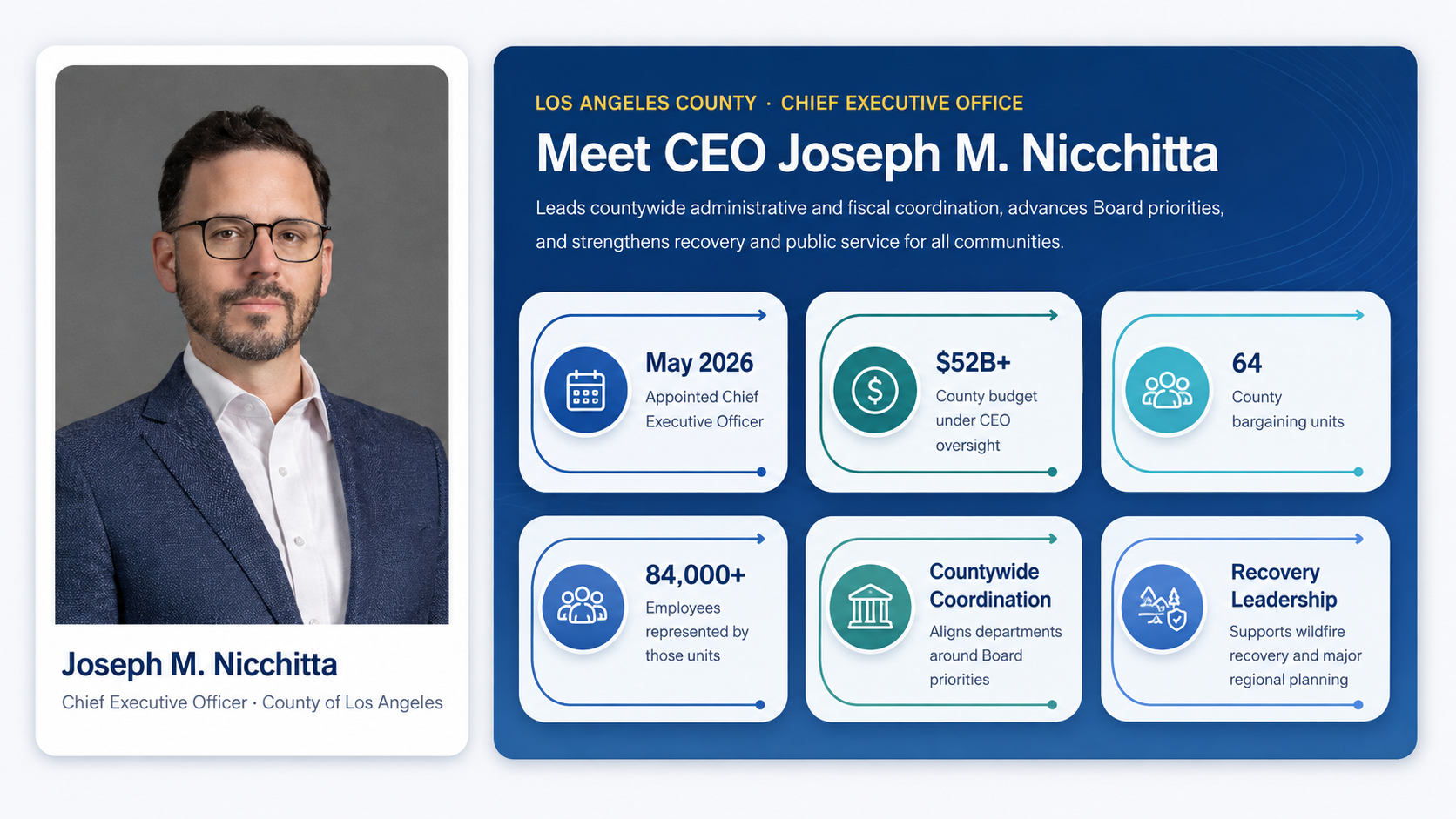
Countywide Responsibilities
Mr. Nicchitta’s responsibilities include stewardship of the County’s $52+ billion budget, federal and state advocacy related to public safety-net services, cross-department financial planning, labor relations, and implementation of priorities established by the Board of Supervisors.
His current portfolio also includes coordination for rebuilding communities affected by wildfires and countywide planning for major regional events, including the 2026 FIFA World Cup and the 2028 Olympic and Paralympic Games.
Budget & Fiscal Strategy
County budget oversight, financial sustainability and intergovernmental funding advocacy.
County budget oversight, financial sustainability and intergovernmental funding advocacy.
Board Priorities
Cross-department coordination to implement key priorities established by the Board of Supervisors.
Cross-department coordination to implement key priorities established by the Board of Supervisors.
Labor Relations
County labor relations involving 64 bargaining units representing more than 84,000 employees.
County labor relations involving 64 bargaining units representing more than 84,000 employees.
Major Event Coordination
Countywide public-safety and operational planning for the World Cup and Olympic/Paralympic Games.
Countywide public-safety and operational planning for the World Cup and Olympic/Paralympic Games.
Wildfire Recovery
Executive coordination supporting rebuilding in communities affected by major wildfires.
Executive coordination supporting rebuilding in communities affected by major wildfires.
Public Safety-Net Services
Federal and state advocacy to help protect essential County programs and services.
Federal and state advocacy to help protect essential County programs and services.
Education
Mr. Nicchitta’s academic background combines law and the humanities.
New York University School of LawJuris Doctor
University of California, BerkeleyBachelor of Arts, Comparative Literature
Los Angeles County Career
Chief Executive OfficerAppointed CEO in May 2026 after serving in senior executive leadership roles within the County.
Chief Deputy Chief Executive Officer / Chief Operating OfficerProvided operational, administrative and programmatic leadership for major County initiatives. His work included a central role in pandemic response and recovery and planning, allocation and distribution of more than $2 billion in federal relief funding.
Director, Department of Consumer and Business AffairsLed development and adoption of the Board-approved rent stabilization program for unincorporated Los Angeles County and helped advance the OneLA Initiative supporting small, minority-owned, women-owned and veteran-owned businesses competing for government contracts.
Office of Cannabis ManagementLed the County office following California’s 2016 legalization of commercial and personal-use cannabis under Proposition 64.
Office of County CounselBegan his County career working on land-use and environmental matters, affordable housing, First Amendment and Establishment Clause matters, public and civic art, and museum law.
Private PracticePracticed as a litigation attorney before joining Los Angeles County government.
Official source: Los Angeles County Chief Executive Office, “Meet Joseph M. Nicchitta.” Personnel, budget and organizational information can change; the linked County biography is the controlling current reference.

LOS ANGELES COUNTY · CHIEF EXECUTIVE OFFICE
Quick Links
A local quick-reference mirror of the current Los Angeles County Chief Executive Office navigation for executive information, County documents, County links, divisions and units.
Divisions + Units
9 CEO Divisions
Administrative Services, Asset Management, Budget and Operations Management, Budget Policy and Revenue Alignment, Countywide Communications, Labor and Compensation, Legislative Affairs, Risk Management, and Policy Implementation & Alignment.
3 CEO Units
Chief Information Office, DOJ Compliance Office, and Emergency Management.
Countywide Priority Work
Anti-Racism, Care First/Jail Last, Sustainability, Child/Youth/Family Well-Being, Jail Closure, Environmental Health, Healthcare Integration, Homeless Initiative, Immigration and Poverty Alleviation.
Open Official CEO SiteOfficial source: Current navigation on the Los Angeles County Chief Executive Office website. Open CEO.lacounty.gov ↗

LOS ANGELES COUNTY · CHIEF EXECUTIVE OFFICE
Divisions
Current Chief Executive Office divisions and their principal responsibilities, based on the County CEO website.
Administrative Services
Supports CEO operations through contracts and procurement, budget and fiscal services/Homeland Security Grant administration, information technology services, human resources and facilities.
Assistant CEO: Amylen Clarke
Official Division PageAsset Management
Oversees the County asset portfolio and aligns capital and maintenance recommendations with Board goals, strategic priorities and the County operating budget.
- Capital Programs
- Real Estate and Leasing
- Master Planning
Assistant CEO: John Cooke
Official Division PageBudget and Operations Management Branch
Assists the CEO and County departments in preparing the County budget for Board approval and supports Countywide operational and fiscal management.
Senior Assistant CEO: Mason Matthews
Official Division PageBudget Policy and Revenue Alignment
Optimizes County revenues, aligns Board priorities with State/Federal fiscal trends, evaluates structural risks and develops revenue and mitigation strategies for safety-net services.
Assistant CEO: Matthew Marlowe
Official Division PageCountywide Communications
Promotes public understanding of County operations and priorities; manages County digital/video content, County Channel, @CountyofLA social media, LACounty.gov and CEO public/media inquiries.
Acting Director: Andrew Veis
Official Division PageLabor and Compensation
Manages employee relations, benefits and leave policy, classification and compensation. Employee Relations negotiates and administers labor agreements; Classification and Compensation supports equitable staffing and pay structures.
Official Division PageLegislative Affairs & Intergovernmental Relations
Coordinates State and Federal legislative policy and strategy, develops legislative priorities with the Board and departments, tracks bills, and manages day-to-day advocacy through Sacramento and Washington, D.C. offices.
Acting Branch Manager: Angela Ovalle
Official Division PageRisk Management
Provides Countywide risk management functions including claims, risk mitigation, safety and risk-financing support to protect County operations and public resources.
Official Risk Management SitePolicy Implementation & Alignment
Coordinates mission-critical, large-scale and cross-departmental initiatives tied to the Board of Supervisors’ highest priorities, particularly work requiring centralized project management and policy alignment.
Senior Manager: Carrie Miller
Official Division PageOfficial source: Los Angeles County Chief Executive Office — Divisions + Units menu and current division pages. Personnel assignments can change; official linked pages control.
LOS ANGELES COUNTY · CHIEF EXECUTIVE OFFICE
Units
Current Chief Executive Office units, including the Office of Emergency Management and its County/Operational Area responsibilities.
Chief Information Office
Oversees County technology, data, security and privacy governance and aligns information assets with County priorities.
- Chief Data Office
- Privacy Office
- Chief Information Security Office
Leadership · Vision · Innovation · Excellence
Official Unit PageDOJ Compliance Office
Established in February 2023 to drive compliance with the remaining provisions of the County’s 2015 U.S. Department of Justice jail-conditions settlement and related court matters including Rutherford v. Luna and Rosas v. Luna.
Chief DOJ Compliance Officer: Maggie Carter
Official Unit PageEmergency Management
The Office of Emergency Management comprehensively plans for, responds to and supports recovery from large-scale emergencies and disasters affecting Los Angeles County in partnership with first responders, nonprofits, the private sector and government agencies.
Official OEM PageOEM at a Glance
Operations
Maintains the County/Operational Area EOC in readiness; staffs the 24/7/365 Watch Center Duty Officer program; issues emergency alerts and warnings; supports Unified Coordination Groups; deploys agency representatives to field Incident Command Posts; and manages the EOC when activated.
Planning & Coordination
Coordinates the Operational Area Emergency Operations Plan and All-Hazards Mitigation Plan; leads coordination with all 88 cities, 137 special districts and nongovernmental partners; supports departmental emergency plans and continuity planning; and advises the Board, Emergency Management Council and Unified Coordination Groups.
Training & Exercise
Maintains a trained OEM and EOC workforce, coordinates standardized training with Cal OES and FEMA, develops HSEEP-compliant exercises, trains with response partners, and maintains proficiency with IPAWS, Alert LA County and WebEOC.
Recovery & Administrative
Coordinates Local/Family Assistance Centers and recovery services; supports local emergency proclamations; completes damage estimates and assessments; leads Public Assistance cost recovery; and manages UASI, HSGP and EMPG grant programs.
Public Education / Information
Supports Joint Information System/Center operations, coordinates preparedness messaging with departments and media, maintains the Emergency Survival Program and multilingual Survival Guide, and conducts all-hazards preparedness outreach.
Public Preparedness Connections
Connects residents to Ready LA County, emergency notification registration and the County Emergency Page for active-incident information such as evacuations, shelters and road closures.
Official source: Los Angeles County Chief Executive Office — Emergency Management. OEM contact shown on the County site: communications@ceooem.lacounty.gov.

CHIEF EXECUTIVE OFFICE · COUNTY DOCUMENTS
County Documents
Official County governance, service, records, compensation and data resources surfaced through the Chief Executive Office Quick Info menu.
County Charter
Foundational charter governing the structure and powers of Los Angeles County.
Open CharterL.A. County Departments
Directory of departments, commissions and related County agencies.
Open Departments802 Forms
County Form 802 disclosure resources surfaced through the CEO Quick Info menu.
Open CEO Quick InfoDepartment Head Salaries
Official County compensation information for department heads.
Open Official SourceElected Officials Salaries
Official salary information for County elected officials.
Open Official SourceLA County by the Numbers
Countywide statistical and operational reference information.
Open Official SourceLA Alliance Documents
LA Alliance document resources linked through the County CEO site.
Open LA CountyOfficial source: County Documents list in the Los Angeles County Chief Executive Office Quick Info menu. Some documents are hosted on Municode, LA County or file.lacounty.gov.

CHIEF EXECUTIVE OFFICE · COUNTY LINKS
County Links
Frequently used County government destinations listed in the current Chief Executive Office Quick Info menu.
Board Correspondence
Letters, reports and formal correspondence transmitted to the Board of Supervisors.
Open County SiteLand Acknowledgment
Los Angeles County’s land acknowledgment and related information.
Open County SiteContracting with the County
Information for vendors and organizations seeking County contracting opportunities.
Open ContractingLive Board Meetings
Watch meetings of the Los Angeles County Board of Supervisors and access Board meeting resources.
Open Board SitePublic Records
Public records request pathways and County record-access information.
Open Public RecordsQuality & Productivity
County Quality and Productivity Commission information, programs and resources.
Open QPCOfficial source: County Links list in the Los Angeles County Chief Executive Office Quick Info menu.
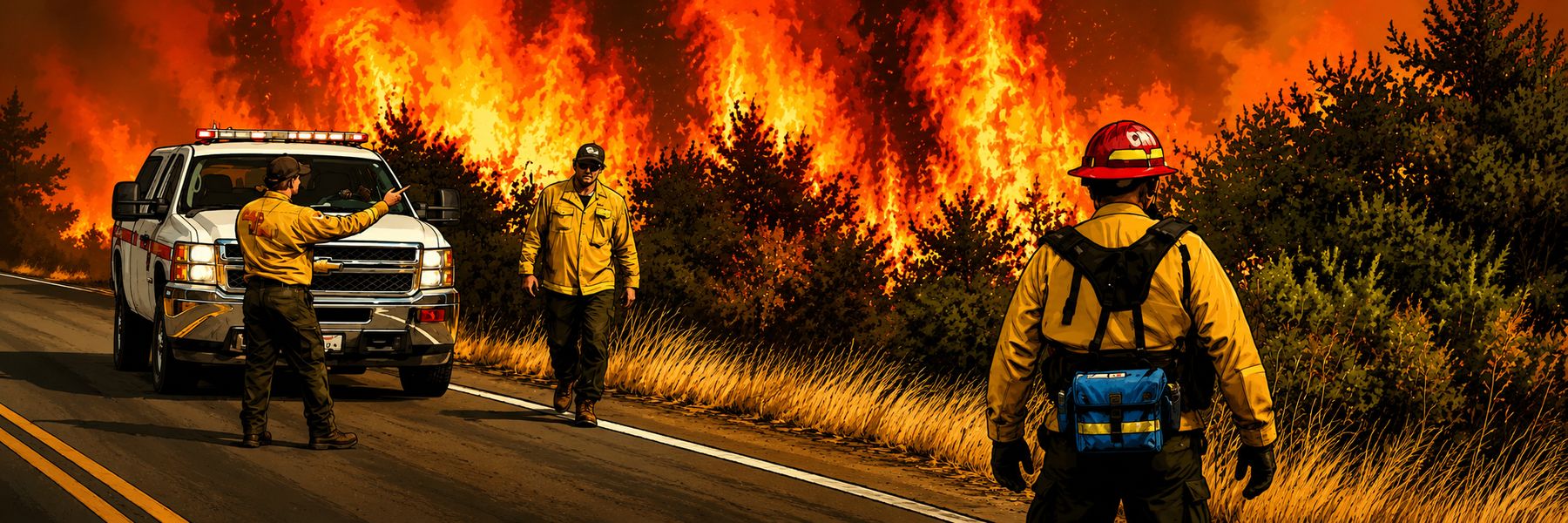
CHIEF EXECUTIVE OFFICE · AGENDAS
Agendas
Current meeting agendas and policy materials for Los Angeles County clusters and administrative committees.
EMAIL NOTIFICATIONS
Weekly Cluster Agenda Notifications
Subscribe to receive weekly e-mail notifications for cluster meeting agendas.
CURRENT LISTING
All Department Agendas
Showing 21 of 21 agendas
| Date | Department | Agenda |
|---|---|---|
| August 21, 2026 | Pension Savings Plan Administrative Committee | Agenda |
| August 21, 2026 | Savings 401(k) Plan Administrative Committee | Agenda |
| August 21, 2026 | 457 Horizons Plan Administrative Committee | Agenda |
| August 20, 2026 | Gender-Based Violence Cluster | Agenda |
| August 13, 2026 | Homelessness and Housing Cluster | Meeting Cancelled |
| August 12, 2026 | LACDA Board Deputies | Agenda |
| August 12, 2026 | Family and Social Services Cluster | Agenda |
| August 12, 2026 | Health and Mental Health Services Cluster | Agenda |
| August 12, 2026 | Community Services Cluster | Agenda |
| August 12, 2026 | Public Safety Cluster | Agenda |
| August 12, 2026 | Operations Cluster | Agenda |
| August 6, 2026 | Workforce and Economic Development Cluster | Agenda |
| July 23, 2026 | Real Estate Management Commission | Agenda |
| July 23, 2026 | Arts and Culture | Revised Agenda |
| July 23, 2026 | LA County Regional Identification System | Agenda |
| July 23, 2026 | Chief Sustainability Office | Agenda |
| June 26, 2026 | Executive Committee for Regional Homeless Alignment | Agenda |
| June 18, 2026 | Leadership Table for Regional Homeless Alignment | Agenda |
| June 17, 2026 | Permanent Steering Committee | Presentation |
| June 12, 2026 | Measure A Labor Council | Revised Agenda |
| June 4, 2026 | Youth Justice Work Group | Agenda |
Past meetings: To view agendas for past meetings, use the official archive or email info@ceo.lacounty.gov.
211 LA CountyCountywide information and resource navigation.
Public AlertsOfficial LA County emergency notification information.
OFFICIAL PAGE REFERENCE
County Site Information & Navigation
Chief Executive Office
Meet Joseph M. NicchittaAgendasBudget2024-2030 Strategic PlanContactOrg ChartPast Officers
County Documents
County CharterCounty CodeClaims BoardGuide to ServicesL.A. County DepartmentsPublic Records802 FormsDepartment Head SalariesElected Officials SalariesLA County by the NumbersLA Alliance Documents
County Links
Board CorrespondenceLand AcknowledgmentContracting with the CountyCounty NewsroomLive Board MeetingsJob OpportunitiesPublic RecordsQuality & Productivity
Divisions
Administrative ServicesAsset ManagementBudget and Operations Management BranchBudget Policy and Revenue AlignmentCountywide CommunicationsLabor and CompensationLegislative AffairsRisk ManagementPolicy Implementation & Alignment
Units
Chief Information OfficeDOJ Compliance OfficeEmergency Management
Board-Directed Priorities
Anti-Racism, Diversity, and InclusionCare First, Jail LastChief Sustainability OfficeChild, Youth, and Family Well-BeingJail Closure Implementation TeamEnvironmental HealthHealthcare IntegrationHomeless InitiativeImmigrationPoverty Alleviation Initiative
Budget & Agendas
BUDGETAGENDASCommittee AgendasBoard of Supervisors Agendas
Site Info
AccessibilityDisclaimerLanguagePrivacy PolicyLanguage Access
© 2026 County of Los Angeles — source terminology reproduced as a research/reference snapshot. For the latest posting, use the official CEO Agendas page.
Current official source: CEO Agendas. Access upcoming cluster and committee agendas, presentation/supplemental materials, the agenda archive and weekly email notifications. Open official Agendas page ↗
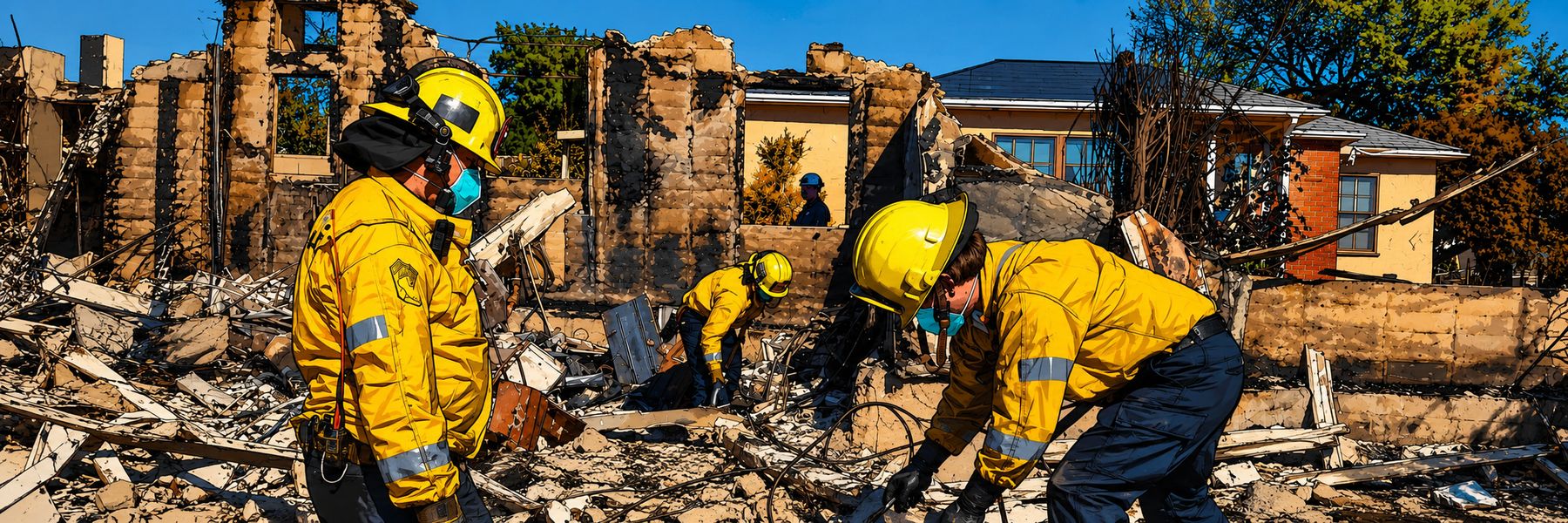
CHIEF EXECUTIVE OFFICE · BUDGET
Budgets
Current Los Angeles County budget information, major fiscal-year milestones, budget documents and public budget presentation resources.
Understanding the LA County Budget
Los Angeles County is the nation’s largest county government by population. The County budget is developed through a multi-phase process designed to produce a balanced budget under State law while funding services for a population of nearly 10 million residents.
$50.3BFY 2026–27 Adopted Budget
9.7M+Residents served
39County departments
115K+Budgeted positions
Key Budget Milestones
2026–27 Adopted Budget
$50.3 billion. The County describes the adopted budget as maintaining critical safety-net services while responding to federal funding cuts, AB 218 settlement obligations and growing service demand.
2026–27 Recommended Budget
$48.8 billion. The recommended phase was balanced without additional program/service cuts despite federal funding reductions, wildfire rebuilding costs and major liability obligations.
2025–26 Final Adopted Budget
$52.5 billion. The supplemental budget addressed funding pressures through 5.5% cuts and a net reduction of 1,125 budgeted positions while funding negotiated labor agreements.
Current Budget Document Library
2026–27 Adopted
Final Changes Board Letter, Final Changes Fact Sheet, Final Recommended Budget Charts, Final Recommended Budgeted Positions and Adopted Budget Resolution.
2026–27 Recommended
Transmittal letter, fact sheet, budget/positions by department, charts, positions, Recommended Budget Volumes I and II, Spanish materials and correction notices.
FY 2026–27 Public Presentations
Departmental budget presentations are organized by Family & Social Services, Operations, Community Services, Health & Mental Health Services and Public Safety.
Archives
Historical fiscal-year budget books, supplemental changes, presentations, charts and position data are available through the County budget archive.
Official source: Los Angeles County Chief Executive Office — LA County Budget. Fiscal values change by budget phase; the official budget portal is the controlling current source.
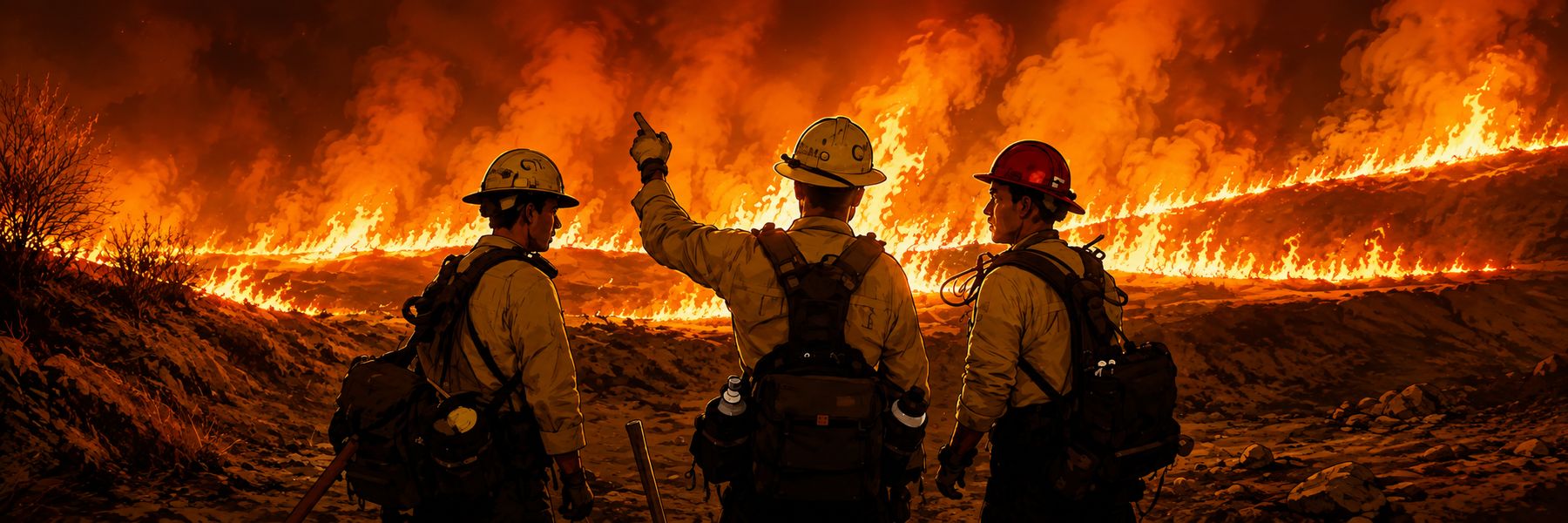
CHIEF EXECUTIVE OFFICE · STRATEGIC PLAN
2024–2030 Strategic Plan
Los Angeles County mission, vision, values, three North Stars and racial-equity principles from the current County Strategic Plan.
County Mission, Vision & Values
Establish superior services through inter-departmental and cross-sector collaboration that measurably improves quality of life for people and communities across Los Angeles County.
A value-driven culture characterized by extraordinary employee commitment to enrich lives through effective and caring service and empower people through knowledge and information.
Integrity · Inclusivity · Compassion · Customer Orientation · Equity
Three North Stars
Make investments that transform lives.
Invest in solutions to complex challenges affecting vulnerable communities.
- Healthy Individuals & Families
- Employment & Sustainable Wages
- Housing & Homelessness
- Support Vulnerable Populations
Foster vibrant and resilient communities.
Strengthen communities through County investment and partnerships.
- Public Health
- Care First, Jails Last
- Public Safety
- Sustainability
- Economic Health
- Community Connections
Realize tomorrow’s government today.
Build an innovative, flexible, transparent and fiscally responsible County government.
- Communication & Public Access
- Diverse & Inclusive Workforce
- Equity-Centered Policies & Practices
- Streamlined & Equitable Contracting
- Data-Driven Decision Making
- Flexible & Efficient Infrastructure
- Internal Controls & Processes
Racial Equity Principles
Reduce Disparities
Reduce racial disparities in life outcomes and public investment.
Effectively Support
Prioritize and support the most disadvantaged geographies and populations.
Engage Residents
Authentically engage residents, organizations and stakeholders in interventions and investments.
Improve Outcomes
Improve long-term outcomes intergenerationally and multi-generationally.
Effectively Assess
Use data to assess and communicate equity needs and progress.
Disaggregate Data
Analyze racial/ethnic and other demographic subgroup data.
Collaborate
Work intentionally across departments, leadership levels and decision-makers.
Act Boldly
Act urgently and boldly to achieve tangible results.
Align Policies
Align policies, processes and practices to address equity challenges across the workforce, contractors and vendors.
Intervene & Prevent
Intervene early and emphasize long-term prevention.
Official source: Los Angeles County Strategic Plan 2024–2030.
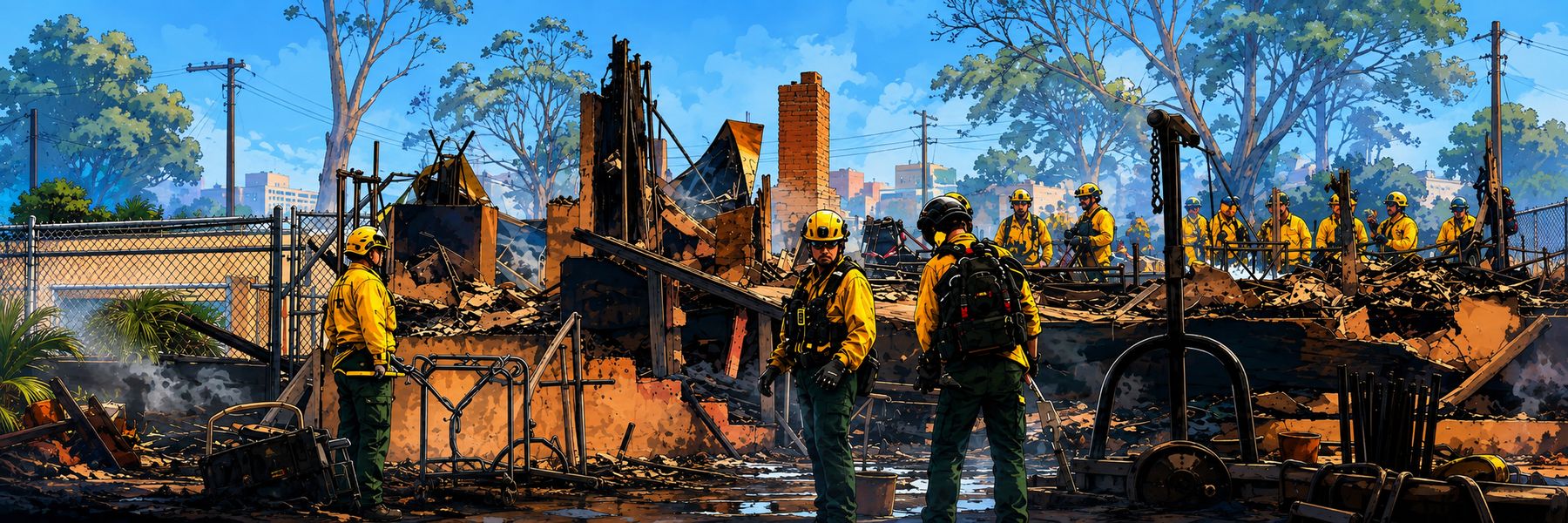
CHIEF EXECUTIVE OFFICE · ORGANIZATION
Organization Chart
Current CEO navigation structure shown as a readable organizational map for the divisions and units used throughout this portal.
CHIEF EXECUTIVE OFFICER
Joseph M. NicchittaCounty of Los Angeles
Divisions
Administrative Services
Asset Management
Budget and Operations Management Branch
Budget Policy and Revenue Alignment
Countywide Communications
Labor and Compensation
Legislative Affairs
Risk Management
Policy Implementation & Alignment
Units
Chief Information Office
DOJ Compliance Office
Emergency Management
Emergency Management within the CEO
The current CEO website lists Emergency Management as a CEO unit. The Office of Emergency Management is responsible for countywide/Operational Area emergency planning, response coordination, EOC operations, training, recovery administration and public emergency information.
County Government
Board of Supervisors → Chief Executive Officer → Office of Emergency Management → County/Operational Area Emergency Operations Center.
Official Organization Chart
The CEO website also provides a downloadable organization-chart image. Because organization charts can lag personnel changes, this portal prioritizes the current CEO identity and current website navigation structure.
Official source: Los Angeles County Chief Executive Office current Divisions + Units navigation and CEO organization-chart link.

CHIEF EXECUTIVE OFFICE · HISTORY
Past Officers
Chief Administrative Officers and Chief Executive Officers who have overseen Los Angeles County’s day-to-day administration since 1938.
According to the County CEO’s historical list, Los Angeles County has had 13 chief administrative or executive officers since August 1938, with interim appointments also shown below.
| Office | Name | Service |
|---|---|---|
| Chief Administrative Officer | General Wayne Allen | Sept. 9, 1938 – December 1951 |
| Chief Administrative Officer | Arthur J. Will | Dec. 11, 1951 – Dec. 1, 1957 |
| Chief Administrative Officer | Lin S. Hollinger | Jan. 14, 1958 – Dec. 11, 1970 |
| Chief Administrative Officer | Arthur G. Will | Dec. 12, 1970 – Sept. 3, 1974 |
| Chief Administrative Officer | Harry L. Hufford | Sept. 4, 1974 – Jan. 7, 1985 |
| Chief Administrative Officer | James C. Hankla | Feb. 14, 1985 – Feb. 27, 1987 |
| Chief Administrative Officer | Richard B. Dixon | March 1, 1987 – Feb. 2, 1993 |
| Chief Administrative Officer · Interim | Harry L. Hufford | Feb. 3, 1993 – Oct. 17, 1993 |
| Chief Administrative Officer | Sally R. Reed | Oct. 18, 1993 – June 1, 1996 |
| Chief Administrative Officer · Interim | Sandra M. Davis | June 2, 1996 – Aug. 24, 1996 |
| Chief Administrative Officer | David E. Janssen | Aug. 25, 1996 – July 19, 2007 |
| Chief Executive Officer | William T. Fujioka | July 20, 2007 – Nov. 30, 2014 |
| Chief Executive Officer | Sachi A. Hamai | Dec. 2, 2014 – Aug. 31, 2020 |
| Chief Executive Officer | Fesia Davenport | Sept. 1, 2020 – April 16, 2026 |
Official source: Los Angeles County Chief Executive Office — List of Officers. Joseph M. Nicchitta is the current CEO and is shown on the separate Meet CEO page.
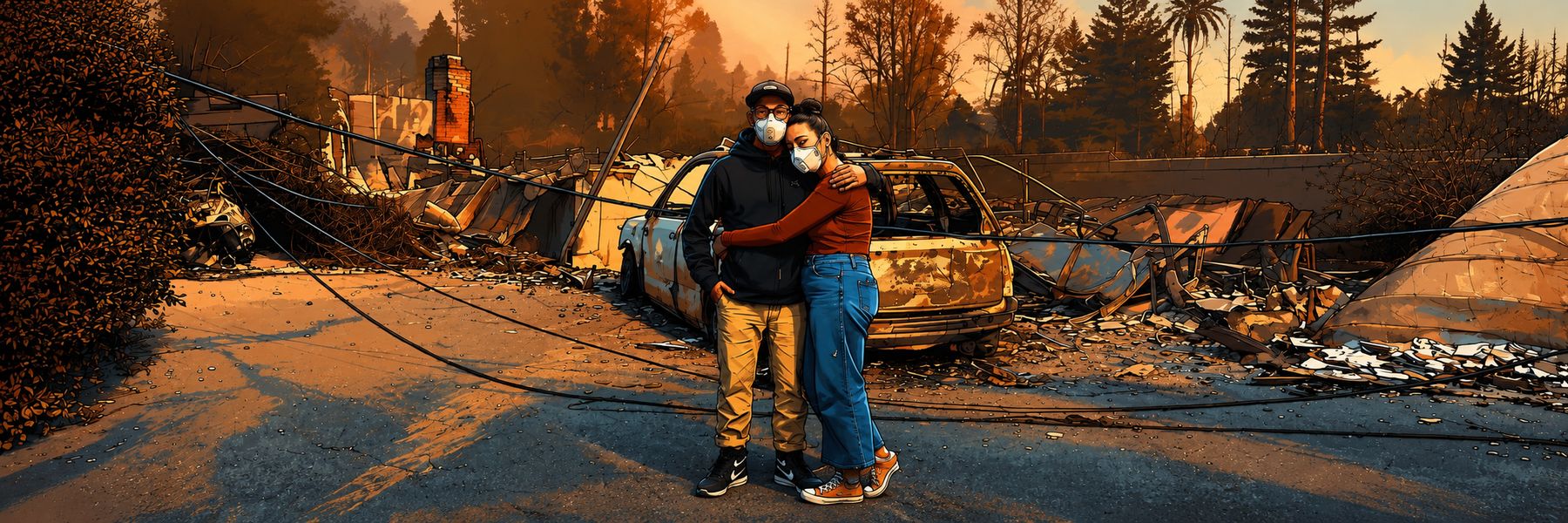
CHIEF EXECUTIVE OFFICE · CONTACT
Contact
County services, Chief Executive Office communications, interpretation, public records and service-location contacts from the current Los Angeles County CEO website.
Information about County Services
County Operator · 24/7(213) 974-1234County department and service routing.
General County Emailinfo@lacounty.govGeneral information and County service questions.
Public Counter500 W. Temple St., Room 358
Los Angeles, CA 90012
Weekdays, 8 a.m.–5 p.m.
Los Angeles, CA 90012
Weekdays, 8 a.m.–5 p.m.
Over-the-Phone Interpretation855-784-4523Dial and select a language.
211 LA County211LA.orgCountywide information and referral.
Additional Contact Resources
Public Information Officers
Directory of County department public-information contacts for media and public inquiries.
Open County SitePublic Alerts
Los Angeles County emergency alert information and registration resources.
Open Public AlertsOfficial source: Los Angeles County Chief Executive Office — Contact page. Open official contact page ↗
LAC OEM COMMAND
OEM Command & County Emergency Coordination
A plain-language map of how Los Angeles County coordinates a large emergency across leadership, the County/Operational Area EOC, departments, cities and field incident commands.
LAC OEM COMMAND · OPERATIONAL AREA
OEM Command, EOC & Operational Area Coordination
OEM is the County coordination hub for large-scale emergencies: maintaining EOC readiness, 24/7 situational awareness, alerts and warnings, planning, training, resource coordination, public information and initial recovery administration.
24/7Watch Center
88Cities
137Special Districts
Operations
Watch Center coverage, EOC activation, agency representatives, alerts/warnings and Unified Coordination Group support.
Planning & readiness
OAEOP, mitigation planning, departmental plans, COOP coordination, training, exercises, IPAWS, Alert LA County and WebEOC readiness.
Recovery & public information
Damage estimates, proclamations, Local Assistance Centers, Public Assistance coordination, JIS/JIC and public preparedness campaigns.
Top 10 OEM Operational Area Contacts
Top 10 priority contacts and resources| Agency / Resource | Agency Contact | Phone | Role | Call | Website | Map | Task | |
|---|---|---|---|---|---|---|---|---|
| Office of Emergency Management | Kevin McGowan, Director | (323) 980-2260 | EOC coordination | ☎ | ✉ | 🌐 | ⌖ | |
| Chief Executive Office | Joseph M. Nicchitta, CEO | (213) 974-1234 | Executive coordination | ☎ | ✉ | 🌐 | ⌖ | |
| LA County Sheriff's Department | Robert G. Luna, Sheriff | (213) 229-1700 | Emergency operations | ☎ | 🌐 | ⌖ | ||
| LA County Fire Department | Anthony C. Marrone, Fire Chief | (323) 881-2411 | Fire rescue | ☎ | 🌐 | ⌖ | ||
| EMS Agency | Richard Tadeo, Director | (562) 378-1610 | EMS coordination | ☎ | ✉ | 🌐 | ⌖ | |
| Department of Public Health | Public Health Infoline | (833) 540-0473 | Health protection | ☎ | 🌐 | ⌖ | ||
| LA County Public Works | 24-hour Dispatch Center | (800) 675-4357 | Infrastructure response | ☎ | 🌐 | ⌖ | ||
| Department of Public Social Services | Customer Service Center | (866) 613-3777 | Mass care | ☎ | 🌐 | ⌖ | ||
| Department of Mental Health | 24/7 Help Line | (800) 854-7771 | Crisis support | ☎ | 🌐 | ⌖ | ||
| Animal Care & Control | 24/7 South Dispatch | (562) 940-6898 | Animal response | ☎ | ✉ | 🌐 | ⌖ |
☎ Call · ✉ Email · 🌐 Website · ⌖ Map · ✓ Jump to this page’s official document/resource tasks. During an active incident, use current incident/EOC contact rosters as the controlling operational source.
Official Websites, Plans & PDF Resources
10 source linksWEBOEM at a GlanceOperations, planning, training, recovery and public information.↗PDFOperational Area Emergency Operations PlanPrimary County/OA response and recovery framework.↗PDF2025 All-Hazards Mitigation PlanCountywide mitigation and risk-reduction plan.↗WEBOEM Document LibraryDMAC, city coordinator, proclamation and exercise documents.↗WEBEmergency Plans & AnnexesOfficial County plan and annex portal.↗WEBReady LA CountyHazards, planning, supplies, alerts and community preparedness.↗PDFEmergency Survival Guide 2026Resident action guidance for evacuation, shelter and recovery.↗WEBEmergency NotificationsAlert LA County, WEA and local notification systems.↗PDFFive-Step Preparedness GuideCounty five-step preparedness reference supplied for this project.↗WEBCity of LA Disaster ResourcesCompanion municipal EMD resource library; City resource, not County OEM.↗
Operational Area principle: OEM coordinates; it does not replace the legal or tactical authority of fire, law enforcement, health, public works, cities, special districts or field Incident Command/Unified Command.
LAC OEM COMMAND · 3 OF 7
County/Operational Area Emergency Operations Center
OEM maintains the County/Operational Area EOC in a state of readiness, staffs the 24/7/365 Watch Center Duty Officer program, issues alerts and warnings, deploys agency representatives and manages EOC coordination when activated.
100+ Leadership & Command Directory
Open the full agency leadership table showing the emergency chain of command across Los Angeles County, municipal agencies, California, federal partners, and NGO/VOAD organizations.
Board / Executive PolicyBoard of Supervisors + CEO establish executive direction and policy priorities.
CEO / UCGThe CEO leads strategic coordination and convenes senior leaders through the Unified Coordination Group.
OEM / CEOC-OAEOCSituational awareness, resource coordination, planning, alerts, EOC management and recovery coordination.
Sheriff / Emergency OperationsUnder the County emergency framework, the Sheriff serves as Director of Emergency Operations after CEOC/OAEOC activation.
Field / Department OperationsIncident Command Posts, Department Operations Centers, cities, special districts and mutual-aid partners execute operations.
OEM operating functions
- 24/7/365 Watch Center situational awareness.
- County/Operational Area EOC readiness and activation support.
- Emergency alerts and warning coordination.
- Agency representatives at field Incident Command Posts.
- Unified Coordination Group facilitation.
- Operational Area planning across 88 cities and 137 special districts.
- Training, exercises and readiness for IPAWS, Alert LA County and WebEOC.
- Initial recovery, Local Assistance Centers, damage estimates and Public Assistance coordination.
Operational Area coordination
Los Angeles County is the Operational Area intermediate level of California’s SEMS structure. OEM coordinates across County departments, cities, special districts, nonprofit organizations, private-sector partners, Cal OES and FEMA.
Resident perspective: OEM is primarily a coordination hub. Fire, Sheriff, health, public works and other agencies perform operational missions while OEM helps create a common operating picture and coordinate resources across jurisdictional boundaries.
EOC functional structure
| Function | What it coordinates |
|---|---|
| Management | Executive direction, policy coordination, public information and interagency priorities. |
| Operations | Mission coordination across fire, law enforcement, care and shelter, health/medical and other operational branches. |
| Planning / Intelligence | Situation status, incident action planning, mapping, resource status, forecasts and recovery planning. |
| Logistics | Facilities, supplies, communications, equipment, staffing support and resource requests. |
| Finance / Administration | Costs, documentation, contracts, procurement, reimbursement and disaster-assistance records. |
LAC OEM COMMAND
Core Emergency Response Agencies
The principal County departments that carry preparedness, response, consequence-management and recovery responsibilities inside the Los Angeles County Operational Area.
LAC OEM COMMAND · COUNTY DEPARTMENTS
Core Emergency Response Agencies
The County emergency organization depends on department-specific legal authorities and capabilities. OEM coordinates the common operating picture and resource process while each department executes its assigned fire, law-enforcement, medical, public-health, infrastructure, human-services, logistics or animal-response mission.
10Priority Agencies
13EMC Members
38+County Departments
Response agencies
Fire, Sheriff, EMS and health agencies handle life safety, medical, rescue, evacuation, security and public-health missions.
Support agencies
Public Works, DPSS, Mental Health, Animal Care and Internal Services sustain infrastructure, mass care, crisis support, logistics and animal operations.
Mutual aid
When local capabilities are exceeded, resource requests move through SEMS/Operational Area channels to regional, state and federal partners.
Top 10 Core County Emergency Agencies
Top 10 priority contacts and resources| Agency / Resource | Agency Contact | Phone | Role | Call | Website | Map | Task | |
|---|---|---|---|---|---|---|---|---|
| Office of Emergency Management | Kevin McGowan, Director | (323) 980-2260 | EOC coordination | ☎ | ✉ | 🌐 | ⌖ | |
| Sheriff's Department | Robert G. Luna, Sheriff | (213) 229-1700 | Law enforcement | ☎ | 🌐 | ⌖ | ||
| Fire Department | Anthony C. Marrone, Fire Chief | (323) 881-2411 | Fire rescue | ☎ | 🌐 | ⌖ | ||
| EMS Agency | Richard Tadeo, Director | (562) 378-1610 | EMS coordination | ☎ | ✉ | 🌐 | ⌖ | |
| Department of Public Health | Public Health Infoline | (833) 540-0473 | Health protection | ☎ | 🌐 | ⌖ | ||
| Public Works | 24-hour Dispatch Center | (800) 675-4357 | Infrastructure response | ☎ | 🌐 | ⌖ | ||
| Public Social Services | Customer Service Center | (866) 613-3777 | Human services | ☎ | 🌐 | ⌖ | ||
| Mental Health | 24/7 Help Line | (800) 854-7771 | Behavioral health | ☎ | 🌐 | ⌖ | ||
| Animal Care & Control | 24/7 South Dispatch | (562) 940-6898 | Animal response | ☎ | ✉ | 🌐 | ⌖ | |
| Internal Services Department | Customer Center | (323) 267-2101 | Logistics support | ☎ | 🌐 | ⌖ |
☎ Call · ✉ Email · 🌐 Website · ⌖ Map · ✓ Jump to this page’s official document/resource tasks. During an active incident, use current incident/EOC contact rosters as the controlling operational source.
Official Websites, Plans & PDF Resources
10 source linksPDFOperational Area Emergency Operations PlanLists core County departments, ESFs and department responsibilities.↗WEBOEM Document LibraryCounty department links and emergency-planning documents.↗WEBReady LA CountyCounty hazards, alerts and preparedness resources.↗PDFReady! Set! Go!LACoFD wildfire defensible-space and evacuation action plan.↗WEBLAFD Disaster PreparednessCity fire preparedness companion resource.↗WEB211 LA PreparednessHousehold preparedness and community resource routing.↗WEBDepartment of Public HealthHealth emergencies, heat, disease and environmental safety.↗WEBWorker & Business Emergency ResourcesDEO recovery and business continuity assistance.↗WEBAnimal Care & Control24/7 dispatch and animal emergency resources.↗WEBEmergency NotificationsAlert LA County, WEA and local notification systems.↗
OAEOP source: The County OAEOP acknowledges Animal Care and Control, CEO/OEM, Fire, Health Services, Internal Services, Mental Health, Medical Examiner, Public Health, Public Social Services, Public Works, Regional Planning and Sheriff among the participating County departments.
LAC OEM COMMAND · 5 OF 7
This is an organizational reference, not an official ranking. During an incident, always use current official emergency instructions and agency contact channels.
12 Core Los Angeles County Agencies
| Agency | Primary emergency responsibilities |
|---|---|
| Los Angeles County Chief Executive Office — Office of Emergency Management (OEM) | Countywide coordination; CEOC/OAEOC readiness; 24/7 Watch Center; plans; warnings; resource coordination; initial recovery. |
| Los Angeles County Sheriff's Department (LASD) | Law-enforcement coordination, evacuations, security, traffic/crowd control, search functions and emergency operations coordination. |
| Los Angeles County Fire Department (LACoFD) | Fire suppression, EMS, urban search and rescue, hazardous materials, technical rescue, air operations and incident command. |
| Los Angeles County Department of Health Services — EMS Agency | Countywide EMS system, Medical Alert Center, MHOAC coordination, hospital surge, patient distribution and medical mutual aid. |
| Los Angeles County Department of Public Health | Public-health emergency preparedness, disease surveillance, environmental health, food/water safety, health alerts and population protection. |
| Los Angeles County Public Works | Roads, bridges, flood control, debris management, engineering, structural safety and restoration of public infrastructure. |
| Los Angeles County Department of Public Social Services (DPSS) | Emergency human services, public-benefit continuity, mass-care support, food/basic-needs assistance and Local Assistance Center support. |
| Los Angeles County Department of Mental Health (DMH) | Disaster behavioral health, crisis counseling, psychological first aid and shelter/assistance-center behavioral-health support. |
| Los Angeles County Internal Services Department (ISD) | Logistics, facilities, communications, IT, vehicles, equipment, emergency procurement, temporary power and supply support. |
| Los Angeles County Department of Medical Examiner | Fatality management, recovery and identification of decedents, mass-fatality operations and family-assistance coordination. |
| Los Angeles County Department of Animal Care and Control (DACC) | Animal rescue, evacuation, temporary sheltering, livestock/pet coordination and reunification. |
| Los Angeles County Office of Education (LACOE) | Education-sector preparedness, continuity, school safety, reunification planning and coordination with districts and responders. |
How they fit together
OEM / CEOCountywide coordination, policy support, EOC and resources.
Sheriff + FireLaw enforcement, evacuation, rescue, fire, EMS and field command.
Health SystemDHS/EMS, Public Health and Mental Health coordinate medical and population-health consequences.
Infrastructure / LogisticsPublic Works and ISD restore roads, facilities, communications and supplies.
Human / Recovery ServicesDPSS, DACC, Medical Examiner and LACOE protect people, animals, families and institutions.
Regional, municipal, state and federal partners
City of Los Angeles Emergency Management DepartmentLos Angeles Fire DepartmentLos Angeles Police DepartmentLos Angeles Department of Water and PowerLAUSD Emergency ManagementPort of Los Angeles Emergency ManagementCal OES Southern RegionFEMA Region 9National Weather Service Los Angeles/OxnardAmerican Red Cross Los Angeles RegionSalvation Army Southern CaliforniaEmergency Network Los Angeles211 LAHospital Association of Southern California
LAC OEM COMMAND
Disaster Relief Organizations
A working directory of nonprofit, community-based, nongovernmental and faith-based organizations that can support mass care, food, medical needs, volunteer operations, animal care and long-term recovery.
LAC OEM COMMAND · NGO / VOAD
Nonprofit, Community & Relief Organizations
Non-government organizations expand County capability in sheltering, feeding, volunteer management, medical support, animal welfare, legal assistance, donations and long-term recovery. Coordination should occur through established EOC/VOAD structures rather than spontaneous self-deployment.
10Priority Partners
VOADCoordination
WholeCommunity
Mass care & feeding
Red Cross, Salvation Army, food banks and meal organizations provide shelter, feeding and basic-needs support.
Volunteer & logistics
ENLA, Team Rubicon, CORE and other partners help organize volunteers, debris missions and community distribution.
Recovery network
Medical, legal, financial and community foundations can support recovery after immediate life-safety operations stabilize.
Top 10 NGO / Community Disaster Partners
Top 10 priority contacts and resources| Agency / Resource | Agency Contact | Phone | Role | Call | Website | Map | Task | |
|---|---|---|---|---|---|---|---|---|
| American Red Cross Los Angeles | Los Angeles Region | (310) 445-9900 | Mass care | ☎ | 🌐 | ⌖ | ||
| Emergency Network Los Angeles | VOAD Coordination | — | NGO coordination | 🌐 | ⌖ | |||
| Salvation Army Southern California | Southern California Division | (213) 553-3200 | Mass feeding | ☎ | 🌐 | ⌖ | ||
| Los Angeles Regional Food Bank | Michael Flood, President & CEO | (323) 234-3030 | Food distribution | ☎ | ✉ | 🌐 | ⌖ | |
| World Central Kitchen | Emergency Response Team | (202) 844-6330 | Emergency meals | ☎ | ✉ | 🌐 | ⌖ | |
| Team Rubicon | Disaster Operations | (310) 640-8782 | Debris response | ☎ | ✉ | 🌐 | ⌖ | |
| CORE | Community Response | (323) 934-4400 | Relief logistics | ☎ | ✉ | 🌐 | ⌖ | |
| Direct Relief | Emergency Response | (805) 964-4767 | Medical supplies | ☎ | ✉ | 🌐 | ⌖ | |
| 211 LA County | Community Resource Line | 211 | Resource routing | ☎ | 🌐 | ⌖ | ||
| United Way Greater LA | Community Impact | (213) 808-6500 | Recovery support | ☎ | ✉ | 🌐 | ⌖ |
☎ Call · ✉ Email · 🌐 Website · ⌖ Map · ✓ Jump to this page’s official document/resource tasks. During an active incident, use current incident/EOC contact rosters as the controlling operational source.
Official Websites, Plans & PDF Resources
10 source linksPDFOperational Area Emergency Operations PlanWhole-community roles for NGOs, private sector and households.↗WEBOEM Document LibraryLinks to Red Cross, ENLA, BICEPP and community preparedness partners.↗WEBAmerican Red Cross Los AngelesShelter, disaster health, feeding and recovery assistance.↗WEBEmergency Network Los AngelesLocal VOAD coordination for nonprofit and faith-based organizations.↗WEB211 LA CountyCommunity-resource routing and disaster referrals.↗WEBLA Regional Food BankEmergency food distribution network.↗WEBTeam RubiconVolunteer disaster operations and debris response.↗WEBDirect ReliefMedical supplies and health-system support.↗WEBReady LA CountyPublic preparedness and volunteer/community readiness.↗WEBWorker & Business Emergency ResourcesCounty economic recovery and business-assistance pathways.↗
Coordination rule: Public websites are useful for preparedness and general contact. During active operations, nonprofit missions should be coordinated through the incident/EOC/VOAD structure to avoid duplication, unsafe self-deployment and unmanaged donations.
LAC OEM COMMAND · 6 OF 7
Coordination model: Los Angeles County’s emergency framework includes nongovernmental partners as part of the broader County Emergency Organization. Emergency Network Los Angeles (ENLA) functions as the local VOAD network for nonprofit, community and faith-based disaster organizations. Contact and leadership details below are a working directory and should be re-verified before operational use.
Mass Feeding & Food Security Relief
World Central Kitchen (WCK)
Disaster role: Rapid deployment of fresh meals, water distribution and food-infrastructure support for survivors and responders.
Los Angeles Regional Food Bank
Disaster role: Emergency food boxes and distribution through a large regional partner-agency network.
Project Angel Food
Disaster role: Medically tailored emergency meals for homebound, disabled and medically vulnerable people.
Tactical, Volunteer & Debris Response
Team Rubicon
Disaster role: Veteran-led route clearance, muck-outs, chainsaw operations and structural stabilization.
Community Organized Relief Effort (CORE)
Disaster role: Community-centered emergency logistics, relief distribution and recovery support.
TreePeople
Disaster role: Community volunteer mobilization, stormwater/flood mitigation and hillside resilience support.
California Emergency Response Corps / California Volunteers
Disaster role: Trained service members supporting disaster management, logistics and volunteer coordination.
Medical, Health & Material Supply Aid
Direct Relief
Disaster role: Emergency medical modules, medications, trauma kits and power support for clinics and shelters.
Baby2Baby
Disaster role: Diapers, infant formula, blankets and children’s necessities for disaster-affected families.
International Medical Corps
Disaster role: Emergency medical training, mobile health support and psychological support services.
Operation USA
Disaster role: Emergency supplies, power-generation equipment and clinical tools for community organizations.
Animal Evacuation & Welfare Response
Pasadena Humane
Disaster role: Animal triage, emergency pet boarding and rescue support for evacuees.
spcaLA
Disaster role: Disaster animal search, rescue, sheltering and veterinary support.
Hope for Paws
Disaster role: Mobile rescue and emergency medical intervention for stranded or abandoned animals.
First Responder Support & Safety Funds
Los Angeles Fire Department Foundation
Disaster role: Off-budget field equipment, hydration, brush gear and tactical support for active crews.
California Fire Foundation
Disaster role: Immediate disaster assistance and support programs for fire-affected communities.
Faith-Based, Legal & Financial Recovery Networks
Buddhist Tzu Chi Foundation — Western Region
Disaster role: Emergency financial relief, meals, blankets and emotional support.
United Way of Greater Los Angeles
Disaster role: Regional relief funds and grants supporting community organizations and low-income families.
California Community Foundation
Disaster role: Disaster-recovery grants supporting shelter, legal services and long-term community recovery.
Legal Aid Foundation of Los Angeles (LAFLA)
Disaster role: Free legal assistance for disaster-related housing, insurance and FEMA appeal issues.
LAC OEM COMMAND
Emergency Shelters & Mass Care
Find, verify and understand emergency sheltering in Los Angeles County. Shelter locations are incident-specific and may change rapidly.
LAC OEM COMMAND · MASS CARE
Emergency Shelters, Evacuation & Mass Care
Shelter locations are incident-specific and can open, move or close quickly. Verify a shelter is open before traveling, follow evacuation orders and route instructions, and use 211/official incident information for current placement and transportation support.
211Routing
24/7Animal Dispatch
ADAAccess
Verify before travel
Do not travel to a facility because it served as a shelter in a previous incident. Confirm current status first.
Access & functional needs
General shelters must plan for accessibility, communication, mobility, medications, service animals and support-person needs.
Pets & animals
Service animals remain with their handlers. Household-pet arrangements vary by incident; verify co-location or animal sheltering before travel.
Top 10 Shelter, Evacuation & Mass-Care Resources
Top 10 priority contacts and resources| Agency / Resource | Agency Contact | Phone | Role | Call | Website | Map | Task | |
|---|---|---|---|---|---|---|---|---|
| LA County Emergency | County Emergency Information | — | Incident status | 🌐 | ⌖ | |||
| 211 LA County | Shelter / Resource Routing | 211 | Shelter routing | ☎ | 🌐 | ⌖ | ||
| American Red Cross | Open Shelter Locator | (310) 445-9900 | Shelter locator | ☎ | 🌐 | ⌖ | ||
| Ready LA County | OEM Preparedness | (323) 980-2260 | Evacuation guidance | ☎ | ✉ | 🌐 | ⌖ | |
| Alert LA County | Emergency Notifications | — | Public alerts | 🌐 | ⌖ | |||
| Public Social Services | Customer Service Center | (866) 613-3777 | Human services | ☎ | 🌐 | ⌖ | ||
| LA County Parks | County Parks & Recreation | (626) 588-5364 | Shelter facilities | ☎ | 🌐 | ⌖ | ||
| Animal Care & Control | 24/7 South Dispatch | (562) 940-6898 | Animal sheltering | ☎ | ✉ | 🌐 | ⌖ | |
| Animal Care & Control North | 24/7 North Dispatch | (661) 940-4191 | Animal sheltering | ☎ | 🌐 | ⌖ | ||
| Genasys Protect | Evacuation Information | — | Evacuation zones | 🌐 | ⌖ |
☎ Call · ✉ Email · 🌐 Website · ⌖ Map · ✓ Jump to this page’s official document/resource tasks. During an active incident, use current incident/EOC contact rosters as the controlling operational source.
Official Websites, Plans & PDF Resources
10 source linksPDFEmergency Survival Guide 2026Evacuation, shelter, pets, supplies and post-disaster actions.↗WEBEmergency Survival Guide PortalMultilingual and audio versions of the County guide.↗WEBReady LA CountyShelter/evacuation preparedness and hazard resources.↗WEBEmergency NotificationsAlert LA County and Wireless Emergency Alerts.↗WEB211 LA CountyCurrent shelter and community-resource routing.↗WEBRed Cross Open Shelter LocatorIncident-specific open shelter information.↗WEBAnimal Care & Control24/7 dispatch and animal care-center information.↗PDFFive-Step Preparedness GuideCounty preparedness checklist and household planning reference.↗WEBLA County EmergencyActive County emergency information and recovery links.↗WEBCity of LA Disaster ResourcesMunicipal EMD companion resources for City residents.↗
Current County guidance: The Emergency Survival Guide directs residents under an Evacuation Order to gather family, pets and disaster supplies, leave promptly, follow Sheriff/Fire directions and verify pet arrangements. People needing unique assistance should act early on evacuation warnings.
LAC OEM COMMAND · 7 OF 7
Verify that a shelter is OPEN before traveling. Do not rely on an old shelter address simply because that site was used during a previous emergency.
LA County EmergencyActive incidents, evacuations, shelters and road closures.211 LADial 2-1-1 for current shelter and community-resource routing.Red CrossOpen-shelter locator and disaster assistance.Genasys ProtectEvacuation-zone and emergency information when used by local jurisdictions.
FEMA TextText SHELTER [ZIP] to 43362 for nearby shelter information.
Shelter types
| Type | When used | What residents should know |
|---|---|---|
| Congregate emergency shelter | Evacuations and displacement requiring overnight mass care. | May provide basic sleeping areas, feeding, information and support services. |
| Temporary evacuation point | Short-duration staging while officials assess conditions or open a larger shelter. | May not provide overnight sleeping or full mass-care services. |
| Nontraditional shelter | When conventional facilities are insufficient or unsuitable. | Operations and services vary by incident and facility. |
| Animal shelter / co-located support | Pets, livestock or service-animal needs during evacuation. | Animal arrangements can differ from human sheltering; verify before travel. |
| Medical / access-support placement | When a resident’s health or functional needs cannot be safely supported in a general shelter. | Ask 211, shelter staff or emergency officials for the appropriate placement pathway. |
Before leaving for a shelter
- Confirm the location is open for the current incident.
- Follow evacuation orders and route instructions.
- Bring medications, identification, chargers, accessibility equipment and essential documents.
- Bring your go-bag and basic personal supplies when safe to do so.
- Ask about pets, service animals and transportation if needed.
- Tell an out-of-area contact where you are going.
- Do not drive through floodwater, fire zones, downed power lines or closed roads.
Mass-care coordination
County sheltering is scalable and incident-specific. Los Angeles County coordinates with departments, cities, the American Red Cross and other nongovernmental partners to establish sheltering, feeding, medical/access support, animal care and recovery connections based on the needs of each emergency.
SEMS COMMAND TIER
OMS · Operational Management Structure
How field command, local EOCs, the Los Angeles County Operational Area, Cal OES regions and federal support connect through SEMS.
SEMS COMMAND TIER · INTEGRATED RESPONSE STRUCTURE
OMS · Operational Management Structure
How field command, local EOCs, the Los Angeles County Operational Area, Cal OES regions and federal support connect through SEMS.
10Leaders / Roles
10Official Resources
1/15Tier Page
Top 10 Personnel & Leadership Command
Top 10 priority entries| Agency / Position | Leader / Personnel | Phone | Command Role | Call | Website | Map | Task | |
|---|---|---|---|---|---|---|---|---|
| LA County Office of Emergency Management | Kevin McGowan, Director | (323) 980-2260 | OA coordination | ☎ | ✉ | 🌐 | ⌖ | |
| Los Angeles County Chief Executive Office | Joseph M. Nicchitta, Chief Executive Officer | (213) 974-1101 | County executive | ☎ | ✉ | 🌐 | ⌖ | |
| Cal OES Emergency Management Systems Unit | Clifford Viernes, Program Manager | (916) 845-8779 | SEMS governance | ☎ | ✉ | 🌐 | ⌖ | |
| Cal OES SEMS Program | Megan Harriman, Senior Emergency Services Coordinator | (916) 845-8780 | SEMS coordination | ☎ | ✉ | 🌐 | ⌖ | |
| City of Los Angeles Emergency Management Department | Carol P. Parks, General Manager | (213) 484-4800 | City coordination | ☎ | 🌐 | ⌖ | ||
| Los Angeles County Sheriff's Department | Robert G. Luna, Sheriff | (213) 229-1850 | Law enforcement | ☎ | 🌐 | ⌖ | ||
| Los Angeles County Fire Department | Anthony C. Marrone, Fire Chief | (323) 881-2401 | All-risk response | ☎ | ✉ | 🌐 | ⌖ | |
| LA County EMS Agency | Richard Tadeo, BSN, RN, Director | (562) 378-1610 | Medical coordination | ☎ | ✉ | 🌐 | ⌖ | |
| LA County Public Works | Mark Pestrella, Director | (626) 458-5100 | Infrastructure response | ☎ | ✉ | 🌐 | ⌖ | |
| LA County Internal Services Department | Michael Owh, Director | (323) 267-2101 | Logistics support | ☎ | ✉ | 🌐 | ⌖ |
Top 10 Official Resources & Documents
Top 10 priority entries| Resource | Issuing Agency | Type | Operational Use | Call | Website | Map | Task | |
|---|---|---|---|---|---|---|---|---|
| LA County OAEOP | Los Angeles County OEM | Operational Area doctrine | ☎ | ✉ | 🌐 | ⌖ | ||
| SEMS Program & Guidance | Cal OES | Web/PDF | California response system | ☎ | ✉ | 🌐 | ⌖ | |
| SEMS Part I System Description | Cal OES | SEMS levels and functions | ☎ | ✉ | 🌐 | ⌖ | ||
| Cal OES Regional Operations | Cal OES | Web | Regional coordination | ☎ | 🌐 | ⌖ | ||
| National Incident Management System | FEMA | Web | National coordination doctrine | ☎ | 🌐 | ⌖ | ||
| IS-700.b NIMS Student Manual | FEMA EMI | NIMS command coordination | ☎ | 🌐 | ⌖ | |||
| OEM Document Library | Los Angeles County OEM | Web/PDF | Plans and job aids | ☎ | ✉ | 🌐 | ⌖ | |
| DMAC Role & Responsibilities | Los Angeles County OEM | Area/city liaison duties | ☎ | ✉ | 🌐 | ⌖ | ||
| NIMS EOC Quick Reference | FEMA | EOC structures and roles | ☎ | 🌐 | ⌖ | |||
| Emergency Plans & Annexes | Los Angeles County OEM | Web | County plans library | ☎ | ✉ | 🌐 | ⌖ |
Expanded Roles & Responsibilities
Operational responsibilities for this SEMS tierCoordinate levels
Maintain a clear escalation path from Field/ICP through Local Government, Operational Area, Region and State.
Preserve command
Field Incident Command retains tactical authority while EOCs coordinate policy, information and resources.
Escalate resources
Unfilled requests move upward through established mutual-aid and SEMS channels rather than bypassing coordination levels.
Share information
Situation status, damage information and resource needs must move in both directions to sustain a common operating picture.
Integrate partners
Government, special districts, NGOs and private-sector partners participate through agency representatives and coordination structures.
Document decisions
Each level maintains operational-period objectives, resource decisions and records for continuity and reimbursement.
Source framework: Los Angeles County Operational Area Emergency Operations Plan; LA County OEM Emergency Management and Document Library; Cal OES SEMS guidance; FEMA NIMS/EOC guidance. Incident-specific assignments must always be verified during activation.
SEMS COMMAND TIER · 1 OF 15
Terminology note: “OMS” is retained as the navigation label requested for this site. California SEMS formally recognizes five organizational response levels: Field Response, Local Government, Operational Area, Regional and State.
Field ICPIncident Commander / Unified Command directs tactical operations at the scene.
Local Government EOCCity or local jurisdiction coordinates policy, information and resources.
DMA A–HLos Angeles County cities collaborate through eight Disaster Management Areas for planning and mutual support.
County Operational Area / CEOCOEM coordinates countywide priorities, information and unfilled resource requests.
Cal OES Southern RegionRegional coordination and state resource support.
State / Federal SupportState-level coordination and, when authorized, FEMA/federal assistance.
Resource-request flow
| Level | Primary function | Escalation trigger |
|---|---|---|
| Field / ICP | Tactical life-safety operations | Needs exceed on-scene or agency resources |
| Local EOC | Jurisdiction-wide coordination | Local resources and mutual aid are insufficient |
| Operational Area | Countywide priorities, information and resource coordination | Countywide resources cannot satisfy the request |
| Cal OES Region / State | Regional and statewide mutual aid | State support is needed |
| Federal | Federal capabilities and disaster assistance | Authorized through applicable federal mechanisms |
SEMS COMMAND TIER
CEO · Chief Executive Office
County executive leadership connects Board policy, OEM coordination, department executives, emergency authorities and recovery priorities.
SEMS COMMAND TIER · COUNTY EXECUTIVE LEADERSHIP
CEO · Chief Executive Office
County executive leadership connects Board policy, OEM coordination, department executives, emergency authorities and recovery priorities.
10Leaders / Roles
10Official Resources
2/15Tier Page
Top 10 Personnel & Leadership Command
Top 10 priority entries| Agency / Position | Leader / Personnel | Phone | Command Role | Call | Website | Map | Task | |
|---|---|---|---|---|---|---|---|---|
| Los Angeles County Chief Executive Office | Joseph M. Nicchitta, Chief Executive Officer | (213) 974-1101 | County executive | ☎ | ✉ | 🌐 | ⌖ | |
| LA County Office of Emergency Management | Kevin McGowan, Director | (323) 980-2260 | OA coordination | ☎ | ✉ | 🌐 | ⌖ | |
| LA County Board Executive Office | Edward Yen, Executive Officer | (213) 974-1411 | Board continuity | ☎ | ✉ | 🌐 | ⌖ | |
| Los Angeles County Counsel | Dawyn R. Harrison, County Counsel | (213) 974-1811 | Emergency legal | ☎ | ✉ | 🌐 | ⌖ | |
| LA County Auditor-Controller | Oscar Valdez, Auditor-Controller | (213) 974-8302 | Cost documentation | ☎ | ✉ | 🌐 | ⌖ | |
| Los Angeles County Sheriff's Department | Robert G. Luna, Sheriff | (213) 229-1850 | Law enforcement | ☎ | 🌐 | ⌖ | ||
| Los Angeles County Fire Department | Anthony C. Marrone, Fire Chief | (323) 881-2401 | All-risk response | ☎ | ✉ | 🌐 | ⌖ | |
| LA County Public Works | Mark Pestrella, Director | (626) 458-5100 | Infrastructure response | ☎ | ✉ | 🌐 | ⌖ | |
| LA County Department of Public Social Services | Jackie Contreras, Director | (866) 613-3777 | Mass care | ☎ | ✉ | 🌐 | ⌖ | |
| LA County Internal Services Department | Michael Owh, Director | (323) 267-2101 | Logistics support | ☎ | ✉ | 🌐 | ⌖ |
Top 10 Official Resources & Documents
Top 10 priority entries| Resource | Issuing Agency | Type | Operational Use | Call | Website | Map | Task | |
|---|---|---|---|---|---|---|---|---|
| LA County OAEOP | Los Angeles County OEM | Operational Area doctrine | ☎ | ✉ | 🌐 | ⌖ | ||
| OEM Emergency Management | Los Angeles County OEM | Web | Operational Area coordination | ☎ | ✉ | 🌐 | ⌖ | |
| Emergency Plans & Annexes | Los Angeles County OEM | Web | County plans library | ☎ | ✉ | 🌐 | ⌖ | |
| OEM Document Library | Los Angeles County OEM | Web/PDF | Plans and job aids | ☎ | ✉ | 🌐 | ⌖ | |
| Emergency Plan Crosswalk | Los Angeles County OEM | Plan compliance crosswalk | ☎ | ✉ | 🌐 | ⌖ | ||
| SEMS Program & Guidance | Cal OES | Web/PDF | California response system | ☎ | ✉ | 🌐 | ⌖ | |
| National Incident Management System | FEMA | Web | National coordination doctrine | ☎ | 🌐 | ⌖ | ||
| Ready LA County | Los Angeles County | Web | Public preparedness | ☎ | 🌐 | ⌖ | ||
| Alert LA County | Los Angeles County OEM | Web | Public warning | ☎ | ✉ | 🌐 | ⌖ | |
| FEMA Public Assistance | FEMA | Web | Public recovery funding | ☎ | 🌐 | ⌖ |
Expanded Roles & Responsibilities
Operational responsibilities for this SEMS tierSet policy direction
Translate Board policy and emergency authorities into countywide executive priorities without replacing field tactical command.
Coordinate executives
Convene senior County leadership and Unified Coordination Groups when strategic multi-department direction is needed.
Support proclamations
Coordinate emergency proclamations, legal review, resource authorities and intergovernmental requests.
Allocate priorities
Balance scarce County resources against life safety, continuity, infrastructure and recovery requirements.
Guide recovery
Shift the County organization from immediate response toward recovery, restoration and reimbursement priorities.
Maintain accountability
Ensure executive decisions, fiscal commitments and delegated authorities are recorded and reportable.
Source framework: Los Angeles County Operational Area Emergency Operations Plan; LA County OEM Emergency Management and Document Library; Cal OES SEMS guidance; FEMA NIMS/EOC guidance. Incident-specific assignments must always be verified during activation.
SEMS COMMAND TIER · 2 OF 15
Strategic responsibilities
- Coordinates the County emergency organization and executive priorities.
- Supports emergency proclamations and strategic policy decisions.
- Convenes or supports Unified Coordination Group activity for major incidents.
- Coordinates across County departments, elected leadership and outside partners.
- Transitions the organization toward recovery priorities after immediate response.
Relationship to OEM
OEM operates under the Chief Executive Office and provides the emergency-management staff, EOC coordination, planning, alerts, watch-center coverage, training and recovery coordination that support County executive decisions.
SEMS COMMAND TIER
EOC · Emergency Operations Center
The off-site coordination center that supports field command with situational awareness, policy, resources, planning, logistics and finance.
SEMS COMMAND TIER · JURISDICTION COORDINATION CENTER
EOC · Emergency Operations Center
The off-site coordination center that supports field command with situational awareness, policy, resources, planning, logistics and finance.
10Leaders / Roles
10Official Resources
3/15Tier Page
Top 10 Personnel & Leadership Command
Top 10 priority entries| Agency / Position | Leader / Personnel | Phone | Command Role | Call | Website | Map | Task | |
|---|---|---|---|---|---|---|---|---|
| LA County Office of Emergency Management | Kevin McGowan, Director | (323) 980-2260 | OA coordination | ☎ | ✉ | 🌐 | ⌖ | |
| EOC Director / Manager | Incident-assigned / designated official | — | EOC management | 🌐 | ⌖ | |||
| Management Section | Incident-assigned / designated official | — | Policy coordination | 🌐 | ⌖ | |||
| Operations Section | Incident-assigned / designated official | — | Mission coordination | 🌐 | ⌖ | |||
| Planning/Intelligence Section | Incident-assigned / designated official | — | Situation planning | 🌐 | ⌖ | |||
| Logistics Section | Incident-assigned / designated official | — | Resource support | 🌐 | ⌖ | |||
| Finance/Admin Section | Incident-assigned / designated official | — | Cost tracking | 🌐 | ⌖ | |||
| Public Information / JIC | Incident-assigned / designated official | — | Public information | 🌐 | ⌖ | |||
| Agency Representative Coordinator | Incident-assigned / designated official | — | Agency liaison | 🌐 | ⌖ | |||
| OEM Watch Center | 24/7 Duty Officer | (323) 980-2260 | Situational awareness | ☎ | ✉ | 🌐 | ⌖ |
Top 10 Official Resources & Documents
Top 10 priority entries| Resource | Issuing Agency | Type | Operational Use | Call | Website | Map | Task | |
|---|---|---|---|---|---|---|---|---|
| LA County OAEOP | Los Angeles County OEM | Operational Area doctrine | ☎ | ✉ | 🌐 | ⌖ | ||
| OEM Emergency Management | Los Angeles County OEM | Web | Operational Area coordination | ☎ | ✉ | 🌐 | ⌖ | |
| NIMS EOC Quick Reference | FEMA | EOC structures and roles | ☎ | 🌐 | ⌖ | |||
| NIMS EOC Toolkit | FEMA | Web | EOC personnel tools | ☎ | 🌐 | ⌖ | ||
| SEMS Program & Guidance | Cal OES | Web/PDF | California response system | ☎ | ✉ | 🌐 | ⌖ | |
| SEMS Part I System Description | Cal OES | SEMS levels and functions | ☎ | ✉ | 🌐 | ⌖ | ||
| National Incident Management System | FEMA | Web | National coordination doctrine | ☎ | 🌐 | ⌖ | ||
| IS-700.b NIMS Student Manual | FEMA EMI | NIMS command coordination | ☎ | 🌐 | ⌖ | |||
| Emergency Plan Crosswalk | Los Angeles County OEM | Plan compliance crosswalk | ☎ | ✉ | 🌐 | ⌖ | ||
| OEM Document Library | Los Angeles County OEM | Web/PDF | Plans and job aids | ☎ | ✉ | 🌐 | ⌖ |
Expanded Roles & Responsibilities
Operational responsibilities for this SEMS tierActivate appropriately
Staff the EOC to a level proportionate to incident scope, complexity and coordination demand.
Build common picture
Collect field, departmental and partner information into a shared situation status and decision framework.
Set priorities
Establish jurisdiction-wide support priorities while respecting Incident Command tactical authority.
Coordinate resources
Receive, validate, prioritize, source and track resource requests and assignments.
Plan ahead
Develop objectives and contingencies for the next operational period, including recovery transition.
Document operations
Maintain logs, situation reports, action plans, costs, decisions and resource records.
Source framework: Los Angeles County Operational Area Emergency Operations Plan; LA County OEM Emergency Management and Document Library; Cal OES SEMS guidance; FEMA NIMS/EOC guidance. Incident-specific assignments must always be verified during activation.
SEMS COMMAND TIER · 3 OF 15
An EOC does not normally replace the Incident Commander at the scene. Field command retains tactical authority while the EOC coordinates jurisdiction-wide support, policy, information and resources.
Management
Executive direction, policy, legal, public information and multi-agency coordination.
Operations
Coordinates operational priorities and supports field missions.
Planning / Intelligence
Situation status, forecasting, mapping, documentation and action planning.
Logistics
Personnel, facilities, communications, supplies, transportation and equipment.
Finance / Administration
Time, procurement, contracts, cost tracking, claims and reimbursement documentation.
EOC operating cycle
- ActivateStaff the level appropriate to the incident.
- Build the common operating pictureCollect field and departmental status.
- Set prioritiesLife safety, incident stabilization, property/environment and continuity.
- Coordinate resourcesTrack requests, assignments and unmet needs.
- Plan aheadDevelop objectives for the next operational period.
- Demobilize / recoverTransition functions as conditions stabilize.
SEMS COMMAND TIER
CEOC · County Emergency Operations Center
The County/Operational Area coordination center that integrates County departments, cities, special districts and outside support during major incidents.
SEMS COMMAND TIER · OPERATIONAL AREA EOC
CEOC · County Emergency Operations Center
The County/Operational Area coordination center that integrates County departments, cities, special districts and outside support during major incidents.
10Leaders / Roles
10Official Resources
4/15Tier Page
Top 10 Personnel & Leadership Command
Top 10 priority entries| Agency / Position | Leader / Personnel | Phone | Command Role | Call | Website | Map | Task | |
|---|---|---|---|---|---|---|---|---|
| Los Angeles County Chief Executive Office | Joseph M. Nicchitta, Chief Executive Officer | (213) 974-1101 | County executive | ☎ | ✉ | 🌐 | ⌖ | |
| LA County Office of Emergency Management | Kevin McGowan, Director | (323) 980-2260 | OA coordination | ☎ | ✉ | 🌐 | ⌖ | |
| Los Angeles County Sheriff's Department | Robert G. Luna, Sheriff | (213) 229-1850 | Law enforcement | ☎ | 🌐 | ⌖ | ||
| Los Angeles County Fire Department | Anthony C. Marrone, Fire Chief | (323) 881-2401 | All-risk response | ☎ | ✉ | 🌐 | ⌖ | |
| LA County EMS Agency | Richard Tadeo, BSN, RN, Director | (562) 378-1610 | Medical coordination | ☎ | ✉ | 🌐 | ⌖ | |
| LA County Public Works | Mark Pestrella, Director | (626) 458-5100 | Infrastructure response | ☎ | ✉ | 🌐 | ⌖ | |
| LA County Internal Services Department | Michael Owh, Director | (323) 267-2101 | Logistics support | ☎ | ✉ | 🌐 | ⌖ | |
| LA County Department of Public Social Services | Jackie Contreras, Director | (866) 613-3777 | Mass care | ☎ | ✉ | 🌐 | ⌖ | |
| LA County Department of Mental Health | Lisa H. Wong, Psy.D., Director | (800) 854-7771 | Behavioral health | ☎ | ✉ | 🌐 | ⌖ | |
| LA County Auditor-Controller | Oscar Valdez, Auditor-Controller | (213) 974-8302 | Cost documentation | ☎ | ✉ | 🌐 | ⌖ |
Top 10 Official Resources & Documents
Top 10 priority entries| Resource | Issuing Agency | Type | Operational Use | Call | Website | Map | Task | |
|---|---|---|---|---|---|---|---|---|
| LA County OAEOP | Los Angeles County OEM | Operational Area doctrine | ☎ | ✉ | 🌐 | ⌖ | ||
| OEM Emergency Management | Los Angeles County OEM | Web | Operational Area coordination | ☎ | ✉ | 🌐 | ⌖ | |
| Emergency Plans & Annexes | Los Angeles County OEM | Web | County plans library | ☎ | ✉ | 🌐 | ⌖ | |
| NIMS EOC Quick Reference | FEMA | EOC structures and roles | ☎ | 🌐 | ⌖ | |||
| SEMS Program & Guidance | Cal OES | Web/PDF | California response system | ☎ | ✉ | 🌐 | ⌖ | |
| Cal OES Regional Operations | Cal OES | Web | Regional coordination | ☎ | 🌐 | ⌖ | ||
| California Mutual Aid System | Cal OES | Web | Mutual aid coordination | ☎ | 🌐 | ⌖ | ||
| OEM Document Library | Los Angeles County OEM | Web/PDF | Plans and job aids | ☎ | ✉ | 🌐 | ⌖ | |
| Emergency Plan Crosswalk | Los Angeles County OEM | Plan compliance crosswalk | ☎ | ✉ | 🌐 | ⌖ | ||
| Alert LA County | Los Angeles County OEM | Web | Public warning | ☎ | ✉ | 🌐 | ⌖ |
Expanded Roles & Responsibilities
Operational responsibilities for this SEMS tierCoordinate Operational Area
Integrate information and resource priorities across County departments, 88 cities, special districts and partners.
Support field missions
Coordinate countywide support without displacing Incident Command or local jurisdiction authority.
Manage scarce resources
Prioritize limited resources using countywide life-safety and incident-stabilization needs.
Connect to Cal OES
Elevate unmet requests and situation information to the Cal OES Southern Region and State level.
Support executive groups
Provide information and coordination support to CEO leadership and Unified Coordination Groups.
Transition to recovery
Maintain damage, cost, infrastructure and community-impact information needed for recovery decisions.
Source framework: Los Angeles County Operational Area Emergency Operations Plan; LA County OEM Emergency Management and Document Library; Cal OES SEMS guidance; FEMA NIMS/EOC guidance. Incident-specific assignments must always be verified during activation.
SEMS COMMAND TIER · 4 OF 15
Countywide coordination, not field tactical command
OEM maintains CEOC/OA EOC readiness and coordinates information, priorities, alerts, resource requests, mutual aid, agency representatives and recovery support across County departments, cities, special districts and partners.
Inputs to CEOC
- Field Incident Command Posts and Department Operations Centers.
- City and local-government EOCs.
- Disaster Management Areas A–H.
- County departments and special districts.
- Public health, medical, utility and infrastructure partners.
- NGO / VOAD / community partners.
Outputs from CEOC
- Prioritized countywide resource coordination.
- Operational-area situation status and common operating picture.
- Emergency alerts and public information coordination.
- Requests to Cal OES when Operational Area capabilities are exceeded.
- Recovery coordination, damage information and assistance-center support.
SEMS COMMAND TIER
SEMS · Standardized Emergency Management System
California’s required multiagency framework integrating ICS, mutual aid, multiagency coordination and the Operational Area concept.
SEMS COMMAND TIER · CALIFORNIA RESPONSE SYSTEM
SEMS · Standardized Emergency Management System
California’s required multiagency framework integrating ICS, mutual aid, multiagency coordination and the Operational Area concept.
10Leaders / Roles
10Official Resources
5/15Tier Page
Top 10 Personnel & Leadership Command
Top 10 priority entries| Agency / Position | Leader / Personnel | Phone | Command Role | Call | Website | Map | Task | |
|---|---|---|---|---|---|---|---|---|
| Cal OES Emergency Management Systems Unit | Clifford Viernes, Program Manager | (916) 845-8779 | SEMS governance | ☎ | ✉ | 🌐 | ⌖ | |
| Cal OES SEMS Program | Megan Harriman, Senior Emergency Services Coordinator | (916) 845-8780 | SEMS coordination | ☎ | ✉ | 🌐 | ⌖ | |
| LA County Office of Emergency Management | Kevin McGowan, Director | (323) 980-2260 | OA coordination | ☎ | ✉ | 🌐 | ⌖ | |
| Los Angeles County Chief Executive Office | Joseph M. Nicchitta, Chief Executive Officer | (213) 974-1101 | County executive | ☎ | ✉ | 🌐 | ⌖ | |
| City of Los Angeles Emergency Management Department | Carol P. Parks, General Manager | (213) 484-4800 | City coordination | ☎ | 🌐 | ⌖ | ||
| Los Angeles County Sheriff's Department | Robert G. Luna, Sheriff | (213) 229-1850 | Law enforcement | ☎ | 🌐 | ⌖ | ||
| Los Angeles County Fire Department | Anthony C. Marrone, Fire Chief | (323) 881-2401 | All-risk response | ☎ | ✉ | 🌐 | ⌖ | |
| LA County EMS Agency | Richard Tadeo, BSN, RN, Director | (562) 378-1610 | Medical coordination | ☎ | ✉ | 🌐 | ⌖ | |
| LA County Public Works | Mark Pestrella, Director | (626) 458-5100 | Infrastructure response | ☎ | ✉ | 🌐 | ⌖ | |
| LA County Internal Services Department | Michael Owh, Director | (323) 267-2101 | Logistics support | ☎ | ✉ | 🌐 | ⌖ |
Top 10 Official Resources & Documents
Top 10 priority entries| Resource | Issuing Agency | Type | Operational Use | Call | Website | Map | Task | |
|---|---|---|---|---|---|---|---|---|
| SEMS Program & Guidance | Cal OES | Web/PDF | California response system | ☎ | ✉ | 🌐 | ⌖ | |
| SEMS Part I System Description | Cal OES | SEMS levels and functions | ☎ | ✉ | 🌐 | ⌖ | ||
| Cal OES Regional Operations | Cal OES | Web | Regional coordination | ☎ | 🌐 | ⌖ | ||
| California Mutual Aid System | Cal OES | Web | Mutual aid coordination | ☎ | 🌐 | ⌖ | ||
| National Incident Management System | FEMA | Web | National coordination doctrine | ☎ | 🌐 | ⌖ | ||
| IS-700.b NIMS Student Manual | FEMA EMI | NIMS command coordination | ☎ | 🌐 | ⌖ | |||
| NIMS EOC Quick Reference | FEMA | EOC structures and roles | ☎ | 🌐 | ⌖ | |||
| NIMS EOC Toolkit | FEMA | Web | EOC personnel tools | ☎ | 🌐 | ⌖ | ||
| LA County OAEOP | Los Angeles County OEM | Operational Area doctrine | ☎ | ✉ | 🌐 | ⌖ | ||
| Emergency Plan Crosswalk | Los Angeles County OEM | Plan compliance crosswalk | ☎ | ✉ | 🌐 | ⌖ |
Expanded Roles & Responsibilities
Operational responsibilities for this SEMS tierUse five levels
Apply Field, Local Government, Operational Area, Regional and State levels as incident needs require.
Integrate ICS
Use ICS at the field level and compatible management functions at EOCs and coordination levels.
Coordinate agencies
Use multi/inter-agency coordination to align priorities, resource allocations and information.
Request mutual aid
Use established discipline and mutual-aid systems to obtain support beyond local capacity.
Maintain compliance
Local governments use SEMS to maintain eligibility for applicable State disaster reimbursement.
Integrate NIMS
Maintain compatibility with NIMS resource management, command/coordination and communications principles.
Source framework: Los Angeles County Operational Area Emergency Operations Plan; LA County OEM Emergency Management and Document Library; Cal OES SEMS guidance; FEMA NIMS/EOC guidance. Incident-specific assignments must always be verified during activation.
SEMS COMMAND TIER · 5 OF 15
Five official SEMS levels: Field Response → Local Government → Operational Area → Regional → State. SEMS incorporates ICS, multi/inter-agency coordination, mutual aid and the Operational Area concept.
1. Field Response
Emergency personnel carry out tactical decisions and activities under appropriate authority. ICS is required at the field response level.
2. Local Government
Cities, counties and special districts coordinate emergency response within their jurisdiction.
3. Operational Area
The county and all political subdivisions coordinate information, priorities and resources.
4. Regional
Cal OES administrative regions coordinate between Operational Areas and state resources.
5. State
State-level coordination supports regions, mutual aid and statewide priorities.
SEMS COMMAND TIER
ICS · Incident Command System
The standardized on-scene system for command, control and coordination of tactical incident operations.
SEMS COMMAND TIER · FIELD INCIDENT MANAGEMENT
ICS · Incident Command System
The standardized on-scene system for command, control and coordination of tactical incident operations.
10Leaders / Roles
10Official Resources
6/15Tier Page
Top 10 Personnel & Leadership Command
Top 10 priority entries| Agency / Position | Leader / Personnel | Phone | Command Role | Call | Website | Map | Task | |
|---|---|---|---|---|---|---|---|---|
| Incident Commander | Incident-assigned / designated official | — | Incident command | 🌐 | ⌖ | |||
| Unified Command Members | Incident-assigned / designated official | — | Unified command | 🌐 | ⌖ | |||
| Public Information Officer | Incident-assigned / designated official | — | Public information | 🌐 | ⌖ | |||
| Safety Officer | Incident-assigned / designated official | — | Responder safety | 🌐 | ⌖ | |||
| Liaison Officer | Incident-assigned / designated official | — | Agency liaison | 🌐 | ⌖ | |||
| Operations Section Chief | Incident-assigned / designated official | — | Tactical operations | 🌐 | ⌖ | |||
| Planning Section Chief | Incident-assigned / designated official | — | Incident planning | 🌐 | ⌖ | |||
| Logistics Section Chief | Incident-assigned / designated official | — | Incident logistics | 🌐 | ⌖ | |||
| Finance/Admin Section Chief | Incident-assigned / designated official | — | Cost administration | 🌐 | ⌖ | |||
| Agency Representatives | Incident-assigned / designated official | — | Agency coordination | 🌐 | ⌖ |
Top 10 Official Resources & Documents
Top 10 priority entries| Resource | Issuing Agency | Type | Operational Use | Call | Website | Map | Task | |
|---|---|---|---|---|---|---|---|---|
| National Incident Management System | FEMA | Web | National coordination doctrine | ☎ | 🌐 | ⌖ | ||
| IS-700.b NIMS Student Manual | FEMA EMI | NIMS command coordination | ☎ | 🌐 | ⌖ | |||
| SEMS Program & Guidance | Cal OES | Web/PDF | California response system | ☎ | ✉ | 🌐 | ⌖ | |
| SEMS Part I System Description | Cal OES | SEMS levels and functions | ☎ | ✉ | 🌐 | ⌖ | ||
| LA County OAEOP | Los Angeles County OEM | Operational Area doctrine | ☎ | ✉ | 🌐 | ⌖ | ||
| Emergency Plan Crosswalk | Los Angeles County OEM | Plan compliance crosswalk | ☎ | ✉ | 🌐 | ⌖ | ||
| NIMS EOC Quick Reference | FEMA | EOC structures and roles | ☎ | 🌐 | ⌖ | |||
| NIMS EOC Toolkit | FEMA | Web | EOC personnel tools | ☎ | 🌐 | ⌖ | ||
| Cal OES Regional Operations | Cal OES | Web | Regional coordination | ☎ | 🌐 | ⌖ | ||
| California Mutual Aid System | Cal OES | Web | Mutual aid coordination | ☎ | 🌐 | ⌖ |
Expanded Roles & Responsibilities
Operational responsibilities for this SEMS tierEstablish command
Identify Incident Command or Unified Command and transfer command formally when leadership changes.
Set objectives
Develop measurable incident objectives and strategies based on current hazards and priorities.
Organize functions
Scale Command, Operations, Planning, Logistics and Finance/Administration to incident complexity.
Maintain accountability
Track assigned resources, personnel safety, span of control and operational status.
Coordinate agencies
Use Liaison and Unified Command mechanisms when multiple agencies share authority or responsibility.
Interface with EOC
Send status and resource needs upward while retaining field tactical authority.
Source framework: Los Angeles County Operational Area Emergency Operations Plan; LA County OEM Emergency Management and Document Library; Cal OES SEMS guidance; FEMA NIMS/EOC guidance. Incident-specific assignments must always be verified during activation.
SEMS COMMAND TIER · 6 OF 15
Command
Incident Commander / Unified Command establishes incident objectives, approves strategies and is accountable for the incident organization.
- Public Information Officer
- Safety Officer
- Liaison Officer
General Staff
- Operations: executes tactical assignments.
- Planning: situation status, resources, documentation and IAP development.
- Logistics: facilities, communications, supplies and services.
- Finance/Administration: time, costs, procurement and claims.
Unified Command: When several agencies or jurisdictions share authority, they can establish one set of objectives and one coordinated incident organization without surrendering each agency’s legal authority.
INCIDENT COMMAND SYSTEM
Field management by objectives
The Incident Commander or Unified Command sets incident objectives and approves the field Incident Action Plan appropriate to the event.
ICS can organize Command, Operations, Planning, Logistics and Finance/Administration functions as incident complexity requires.
The EOC supports and coordinates policy, information and resources; it does not normally replace the on-scene Incident Commander’s tactical authority.
SEMS COMMAND TIER
ICP · Incident Command Post
The field command location where the Incident Commander or Unified Command manages tactical operations and coordinates response resources.
SEMS COMMAND TIER · FIELD COMMAND LOCATION
ICP · Incident Command Post
The field command location where the Incident Commander or Unified Command manages tactical operations and coordinates response resources.
10Leaders / Roles
10Official Resources
7/15Tier Page
Top 10 Personnel & Leadership Command
Top 10 priority entries| Agency / Position | Leader / Personnel | Phone | Command Role | Call | Website | Map | Task | |
|---|---|---|---|---|---|---|---|---|
| Incident Commander | Incident-assigned / designated official | — | Field command | 🌐 | ⌖ | |||
| Unified Command | Incident-assigned / designated official | — | Shared authority | 🌐 | ⌖ | |||
| Operations Section Chief | Incident-assigned / designated official | — | Tactical operations | 🌐 | ⌖ | |||
| Safety Officer | Incident-assigned / designated official | — | Responder safety | 🌐 | ⌖ | |||
| PIO | Incident-assigned / designated official | — | Public information | 🌐 | ⌖ | |||
| Liaison Officer | Incident-assigned / designated official | — | Agency liaison | 🌐 | ⌖ | |||
| Staging Area Manager | Incident-assigned / designated official | — | Resource staging | 🌐 | ⌖ | |||
| Planning Section | Incident-assigned / designated official | — | Situation status | 🌐 | ⌖ | |||
| Logistics Section | Incident-assigned / designated official | — | Field support | 🌐 | ⌖ | |||
| Supporting EOC | Jurisdiction EOC / OEM | — | Off-site support | 🌐 | ⌖ |
Top 10 Official Resources & Documents
Top 10 priority entries| Resource | Issuing Agency | Type | Operational Use | Call | Website | Map | Task | |
|---|---|---|---|---|---|---|---|---|
| National Incident Management System | FEMA | Web | National coordination doctrine | ☎ | 🌐 | ⌖ | ||
| IS-700.b NIMS Student Manual | FEMA EMI | NIMS command coordination | ☎ | 🌐 | ⌖ | |||
| SEMS Program & Guidance | Cal OES | Web/PDF | California response system | ☎ | ✉ | 🌐 | ⌖ | |
| LA County OAEOP | Los Angeles County OEM | Operational Area doctrine | ☎ | ✉ | 🌐 | ⌖ | ||
| Emergency Plan Crosswalk | Los Angeles County OEM | Plan compliance crosswalk | ☎ | ✉ | 🌐 | ⌖ | ||
| NIMS EOC Quick Reference | FEMA | EOC structures and roles | ☎ | 🌐 | ⌖ | |||
| NIMS EOC Toolkit | FEMA | Web | EOC personnel tools | ☎ | 🌐 | ⌖ | ||
| California Mutual Aid System | Cal OES | Web | Mutual aid coordination | ☎ | 🌐 | ⌖ | ||
| Cal OES Regional Operations | Cal OES | Web | Regional coordination | ☎ | 🌐 | ⌖ | ||
| OEM Document Library | Los Angeles County OEM | Web/PDF | Plans and job aids | ☎ | ✉ | 🌐 | ⌖ |
Expanded Roles & Responsibilities
Operational responsibilities for this SEMS tierLocate safely
Place the ICP where command can operate safely with access to communications and incident intelligence.
Control tactics
Direct field assignments, responder accountability, safety and tactical priorities.
Coordinate resources
Manage staging, assignments and resource status while forwarding unmet needs to support organizations.
Share situation status
Provide timely incident status, hazards, evacuation conditions and projected needs to the EOC.
Maintain security
Keep public and unauthorized personnel away from operationally restricted ICP areas.
Document command
Maintain command logs, objectives, assignments and transitions for continuity and after-action review.
Source framework: Los Angeles County Operational Area Emergency Operations Plan; LA County OEM Emergency Management and Document Library; Cal OES SEMS guidance; FEMA NIMS/EOC guidance. Incident-specific assignments must always be verified during activation.
SEMS COMMAND TIER · 7 OF 15
At the ICP
- Incident objectives
- Tactical assignments
- Responder accountability
- Safety coordination
- Staging / resource control
What flows upward
- Situation status
- Resource needs
- Damage / hazard information
- Evacuation and access issues
- Projected operational needs
What flows downward
- Approved resource support
- Policy and jurisdictional guidance
- Public-information coordination
- Mutual-aid resources
- Logistical support
FIELD COMMAND
Incident Command Post (ICP)
The ICP is the field location where the Incident Commander or Unified Command manages tactical incident operations under ICS.
Field command communicates incident status, priorities and resource needs upward through agency/local coordination and the EOC structure without transferring tactical command to the EOC.
Residents should never travel to an ICP unless specifically directed. ICPs are operational work locations and may be inside restricted or hazardous areas.
SEMS COMMAND TIER
EOS · EOC Organizational Sections
The standardized EOC functional organization for management, operations, planning/intelligence, logistics and finance/administration.
SEMS COMMAND TIER · EOC FUNCTIONAL SECTIONS
EOS · EOC Organizational Sections
The standardized EOC functional organization for management, operations, planning/intelligence, logistics and finance/administration.
10Leaders / Roles
10Official Resources
8/15Tier Page
Top 10 Personnel & Leadership Command
Top 10 priority entries| Agency / Position | Leader / Personnel | Phone | Command Role | Call | Website | Map | Task | |
|---|---|---|---|---|---|---|---|---|
| LA County Office of Emergency Management | Kevin McGowan, Director | (323) 980-2260 | OA coordination | ☎ | ✉ | 🌐 | ⌖ | |
| EOC Director / Manager | Incident-assigned / designated official | — | EOC management | 🌐 | ⌖ | |||
| Management Section Coordinator | Incident-assigned / designated official | — | Policy coordination | 🌐 | ⌖ | |||
| Operations Section Coordinator | Incident-assigned / designated official | — | Mission coordination | 🌐 | ⌖ | |||
| Planning/Intelligence Coordinator | Incident-assigned / designated official | — | Situation planning | 🌐 | ⌖ | |||
| Logistics Section Coordinator | Incident-assigned / designated official | — | Resource support | 🌐 | ⌖ | |||
| Finance/Admin Coordinator | Incident-assigned / designated official | — | Cost tracking | 🌐 | ⌖ | |||
| PIO / JIC Lead | Incident-assigned / designated official | — | Public information | 🌐 | ⌖ | |||
| Liaison / Agency Rep Lead | Incident-assigned / designated official | — | Agency liaison | 🌐 | ⌖ | |||
| GIS / Situation Unit | Incident-assigned / designated official | — | Common picture | 🌐 | ⌖ |
Top 10 Official Resources & Documents
Top 10 priority entries| Resource | Issuing Agency | Type | Operational Use | Call | Website | Map | Task | |
|---|---|---|---|---|---|---|---|---|
| NIMS EOC Quick Reference | FEMA | EOC structures and roles | ☎ | 🌐 | ⌖ | |||
| NIMS EOC Toolkit | FEMA | Web | EOC personnel tools | ☎ | 🌐 | ⌖ | ||
| LA County OAEOP | Los Angeles County OEM | Operational Area doctrine | ☎ | ✉ | 🌐 | ⌖ | ||
| SEMS Program & Guidance | Cal OES | Web/PDF | California response system | ☎ | ✉ | 🌐 | ⌖ | |
| SEMS Part I System Description | Cal OES | SEMS levels and functions | ☎ | ✉ | 🌐 | ⌖ | ||
| National Incident Management System | FEMA | Web | National coordination doctrine | ☎ | 🌐 | ⌖ | ||
| IS-700.b NIMS Student Manual | FEMA EMI | NIMS command coordination | ☎ | 🌐 | ⌖ | |||
| Emergency Plan Crosswalk | Los Angeles County OEM | Plan compliance crosswalk | ☎ | ✉ | 🌐 | ⌖ | ||
| OEM Document Library | Los Angeles County OEM | Web/PDF | Plans and job aids | ☎ | ✉ | 🌐 | ⌖ | |
| Emergency Plans & Annexes | Los Angeles County OEM | Web | County plans library | ☎ | ✉ | 🌐 | ⌖ |
Expanded Roles & Responsibilities
Operational responsibilities for this SEMS tierManagement
Set EOC policy, priorities, legal coordination, public information and multiagency direction.
Operations
Coordinate active missions, department status and operational resource priorities.
Planning/Intelligence
Maintain the common operating picture, forecasts, situation reports and EOC action planning.
Logistics
Source personnel, equipment, communications, facilities, transportation and services.
Finance/Administration
Track costs, procurement, time, claims, contracts and reimbursement documentation.
Scale by incident
Activate only the sections and positions necessary for the incident, expanding as complexity grows.
Source framework: Los Angeles County Operational Area Emergency Operations Plan; LA County OEM Emergency Management and Document Library; Cal OES SEMS guidance; FEMA NIMS/EOC guidance. Incident-specific assignments must always be verified during activation.
SEMS COMMAND TIER · 8 OF 15
| Section | Typical participants | Primary function |
|---|---|---|
| Management | Executive leadership, OEM, counsel, PIO/JIC, liaison | Policy, priorities, legal coordination, public information and interagency direction. |
| Operations | Fire, law enforcement, EMS/public health, public works and operational departments | Coordinate active missions and operational priorities. |
| Planning / Intelligence | OEM planners, GIS, weather/technical specialists, situation and documentation staff | Common operating picture, forecasts, action planning and documentation. |
| Logistics | ISD, human services, transportation, facilities, communications and supply partners | Obtain and track people, equipment, supplies, facilities and services. |
| Finance / Administration | Auditor/controller, procurement, time, cost and recovery staff | Track costs, contracts, claims, time and reimbursement records. |
SEMS COMMAND TIER
DMAs A–H · Disaster Management Areas
Los Angeles County city-coordination areas that strengthen information sharing, liaison staffing and mutual support across the Operational Area.
SEMS COMMAND TIER · CITY COORDINATION NETWORK
DMAs A–H · Disaster Management Areas
Los Angeles County city-coordination areas that strengthen information sharing, liaison staffing and mutual support across the Operational Area.
10Leaders / Roles
10Official Resources
9/15Tier Page
Top 10 Personnel & Leadership Command
Top 10 priority entries| Agency / Position | Leader / Personnel | Phone | Command Role | Call | Website | Map | Task | |
|---|---|---|---|---|---|---|---|---|
| LA County Office of Emergency Management | Kevin McGowan, Director | (323) 980-2260 | OA coordination | ☎ | ✉ | 🌐 | ⌖ | |
| City of Los Angeles Emergency Management Department | Carol P. Parks, General Manager | (213) 484-4800 | City coordination | ☎ | 🌐 | ⌖ | ||
| Disaster Management Area Coordinator | Area Coordinator / designee | — | City liaison | 🌐 | ⌖ | |||
| City Emergency Coordinator | Each city emergency manager | — | City coordination | 🌐 | ⌖ | |||
| Cal OES Emergency Management Systems Unit | Clifford Viernes, Program Manager | (916) 845-8779 | SEMS governance | ☎ | ✉ | 🌐 | ⌖ | |
| Los Angeles County Sheriff's Department | Robert G. Luna, Sheriff | (213) 229-1850 | Law enforcement | ☎ | 🌐 | ⌖ | ||
| Los Angeles County Fire Department | Anthony C. Marrone, Fire Chief | (323) 881-2401 | All-risk response | ☎ | ✉ | 🌐 | ⌖ | |
| LA County Public Works | Mark Pestrella, Director | (626) 458-5100 | Infrastructure response | ☎ | ✉ | 🌐 | ⌖ | |
| LA County Internal Services Department | Michael Owh, Director | (323) 267-2101 | Logistics support | ☎ | ✉ | 🌐 | ⌖ | |
| LA County EMS Agency | Richard Tadeo, BSN, RN, Director | (562) 378-1610 | Medical coordination | ☎ | ✉ | 🌐 | ⌖ |
Top 10 Official Resources & Documents
Top 10 priority entries| Resource | Issuing Agency | Type | Operational Use | Call | Website | Map | Task | |
|---|---|---|---|---|---|---|---|---|
| DMAC Role & Responsibilities | Los Angeles County OEM | Area/city liaison duties | ☎ | ✉ | 🌐 | ⌖ | ||
| OEM Document Library | Los Angeles County OEM | Web/PDF | Plans and job aids | ☎ | ✉ | 🌐 | ⌖ | |
| LA County OAEOP | Los Angeles County OEM | Operational Area doctrine | ☎ | ✉ | 🌐 | ⌖ | ||
| OEM Emergency Management | Los Angeles County OEM | Web | Operational Area coordination | ☎ | ✉ | 🌐 | ⌖ | |
| SEMS Program & Guidance | Cal OES | Web/PDF | California response system | ☎ | ✉ | 🌐 | ⌖ | |
| Cal OES Regional Operations | Cal OES | Web | Regional coordination | ☎ | 🌐 | ⌖ | ||
| California Mutual Aid System | Cal OES | Web | Mutual aid coordination | ☎ | 🌐 | ⌖ | ||
| LA City Emergency Management | City of Los Angeles EMD | Web | City EOC coordination | ☎ | 🌐 | ⌖ | ||
| Ready LA County | Los Angeles County | Web | Public preparedness | ☎ | 🌐 | ⌖ | ||
| Alert LA County | Los Angeles County OEM | Web | Public warning | ☎ | ✉ | 🌐 | ⌖ |
Expanded Roles & Responsibilities
Operational responsibilities for this SEMS tierConnect area cities
DMACs maintain relationships among assigned cities and the County Operational Area.
Report impacts
Rapidly identify city impacts and provide area-level status to supplement formal situation reporting.
Staff OAEOC liaison
Provide city liaison representation to the Operational Area EOC when requested or appropriate.
Share critical information
Distribute urgent County/OA information and requests among participating cities.
Support impacted areas
Help identify less-impacted areas that can provide personnel or support to heavily affected areas.
Maintain preparedness
Support planning, training, exercises and coordinator continuity before disasters occur.
Source framework: Los Angeles County Operational Area Emergency Operations Plan; LA County OEM Emergency Management and Document Library; Cal OES SEMS guidance; FEMA NIMS/EOC guidance. Incident-specific assignments must always be verified during activation.
SEMS COMMAND TIER · 9 OF 15
DMA A
Subregional city coordination and mutual-support pathway.
DMA B
Subregional city coordination and mutual-support pathway.
DMA C
Subregional city coordination and mutual-support pathway.
DMA D
Subregional city coordination and mutual-support pathway.
DMA E
Subregional city coordination and mutual-support pathway.
DMA F
Subregional city coordination and mutual-support pathway.
DMA G
Subregional city coordination and mutual-support pathway.
DMA H
Subregional city coordination and mutual-support pathway.
How a city request moves through the system
City / Local EOCUses its own resources and established mutual aid.
DMA CoordinationBuilds regional awareness and facilitates city-to-city support where applicable.
Operational Area / OEMCoordinates countywide priorities and unfilled resource requests.
Cal OESProvides regional/state support when Operational Area capabilities are exceeded.
SEMS COMMAND TIER
AFN · Access & Functional Needs
Operational responsibilities for accessible alerting, evacuation, sheltering, communication, transportation, medical support and service-animal accommodation.
SEMS COMMAND TIER · ACCESSIBLE EMERGENCY OPERATIONS
AFN · Access & Functional Needs
Operational responsibilities for accessible alerting, evacuation, sheltering, communication, transportation, medical support and service-animal accommodation.
10Leaders / Roles
10Official Resources
10/15Tier Page
Top 10 Personnel & Leadership Command
Top 10 priority entries| Agency / Position | Leader / Personnel | Phone | Command Role | Call | Website | Map | Task | |
|---|---|---|---|---|---|---|---|---|
| LA County Aging & Disabilities Department | Maral Karaccusian, Director | (800) 510-2020 | AFN coordination | ☎ | ✉ | 🌐 | ⌖ | |
| LA County Department of Public Social Services | Jackie Contreras, Director | (866) 613-3777 | Mass care | ☎ | ✉ | 🌐 | ⌖ | |
| LA County Animal Care & Control | Marcia Mayeda, Director | (562) 728-4610 | Animal response | ☎ | ✉ | 🌐 | ⌖ | |
| LA County Department of Mental Health | Lisa H. Wong, Psy.D., Director | (800) 854-7771 | Behavioral health | ☎ | ✉ | 🌐 | ⌖ | |
| LA County EMS Agency | Richard Tadeo, BSN, RN, Director | (562) 378-1610 | Medical coordination | ☎ | ✉ | 🌐 | ⌖ | |
| LA County Office of Emergency Management | Kevin McGowan, Director | (323) 980-2260 | OA coordination | ☎ | ✉ | 🌐 | ⌖ | |
| LA County Internal Services Department | Michael Owh, Director | (323) 267-2101 | Logistics support | ☎ | ✉ | 🌐 | ⌖ | |
| American Red Cross Los Angeles Region | Disaster leadership | (310) 445-9900 | Mass care | ☎ | 🌐 | ⌖ | ||
| Disability Information & Access Line | DIAL support | (888) 677-1199 | Disability access | ☎ | 🌐 | ⌖ | ||
| Shelter Management | Assigned shelter manager | — | Shelter operations | 🌐 | ⌖ |
Top 10 Official Resources & Documents
Top 10 priority entries| Resource | Issuing Agency | Type | Operational Use | Call | Website | Map | Task | |
|---|---|---|---|---|---|---|---|---|
| LA County OAEOP | Los Angeles County OEM | Operational Area doctrine | ☎ | ✉ | 🌐 | ⌖ | ||
| OEM Document Library | Los Angeles County OEM | Web/PDF | Plans and job aids | ☎ | ✉ | 🌐 | ⌖ | |
| Ready LA County | Los Angeles County | Web | Public preparedness | ☎ | 🌐 | ⌖ | ||
| Alert LA County | Los Angeles County OEM | Web | Public warning | ☎ | ✉ | 🌐 | ⌖ | |
| Red Cross LA Disaster Services | American Red Cross | Web | Mass care support | ☎ | 🌐 | ⌖ | ||
| OEM Emergency Management | Los Angeles County OEM | Web | Operational Area coordination | ☎ | ✉ | 🌐 | ⌖ | |
| NIMS EOC Quick Reference | FEMA | EOC structures and roles | ☎ | 🌐 | ⌖ | |||
| National Incident Management System | FEMA | Web | National coordination doctrine | ☎ | 🌐 | ⌖ | ||
| Emergency Plans & Annexes | Los Angeles County OEM | Web | County plans library | ☎ | ✉ | 🌐 | ⌖ | |
| LA City Emergency Management | City of Los Angeles EMD | Web | City EOC coordination | ☎ | 🌐 | ⌖ |
Expanded Roles & Responsibilities
Operational responsibilities for this SEMS tierPlan accessibility
Integrate physical, communication, programmatic and transportation access into emergency plans and exercises.
Preserve independence
Support personal assistance, medications, durable medical equipment and communication needs.
Provide accessible shelters
Ensure routes, sleeping arrangements, bathrooms, information and services are accessible.
Support service animals
Maintain service-animal access and avoid unnecessary separation from handlers.
Communicate accessibly
Use plain language, multilingual, ASL, large-print and other formats as needed.
Coordinate specialists
Use AFN subject-matter experts and partner agencies in EOC and shelter decision-making.
Source framework: Los Angeles County Operational Area Emergency Operations Plan; LA County OEM Emergency Management and Document Library; Cal OES SEMS guidance; FEMA NIMS/EOC guidance. Incident-specific assignments must always be verified during activation.
SEMS COMMAND TIER · 10 OF 15
Legal baseline: California Government Code §8593.3 requires counties, when updating emergency plans, to integrate AFN into emergency communications, evacuation/transportation and emergency sheltering. Designated shelters must be ADA compliant or capable of being made compliant, and showers and bathrooms must be fully accessible.
Physical Accessibility
- ADA-accessible routes and shelter layout.
- Accessible toilets, showers and hygiene facilities.
- Portable accessibility modifications when needed.
- Accessible cots, including raised/bariatric options and side-rail options.
- Accessible transportation connections.
Effective Communication
- ASL interpreters in person or remotely.
- Language translation services.
- Braille and large-print material.
- Readers and visual communication tools.
- TTY and accessible communications technology.
Functional Independence
- Keep survivors connected to caregivers and support systems.
- Service animals remain with the person they serve.
- Support DME, mobility devices and charging needs.
- Medication and oxygen continuity planning.
- FAST assessment and resource coordination when requested.
FAST — Functional Assessment Service Team
FAST members assist people with disabilities and others with AFN in general-population shelters. Cal OES guidance states that FAST can deploy when a request is made to the EOC and may remain until services are no longer needed. Teams assess functional needs and help connect survivors with services and equipment.
Wheelchair chargersWalkers / canesAccessible cotsToilet / shower chairsCommunication devicesHearing-aid batteriesVisual translatorsAdjustable tables
Accessible cot planning criteria
| Feature | Cal OES sheltering guidance |
|---|---|
| Height | 17–19 inches without mattress |
| Width | Minimum 27 inches |
| Weight capacity | 350+ pounds |
| Transfer access | Rails, if present, should permit wheelchair access; flexible head/feet positioning is recommended. |
Pets and service animals
Service animals are not pets and are handled under disability-access law. Separately, Government Code §8593.10 requires emergency plans to designate shelters able to accommodate people with pets, including at least one pet-accommodating shelter whenever shelters are designated. Cooling and warming center planning also includes pet-accommodation requirements to the extent specified by law.
Resident-facing shelter checklist
- Verify the shelter is open before traveling.
- Ask whether accessible transportation is available.
- Bring medication lists and essential equipment if safe to do so.
- Tell intake staff about communication, mobility, sensory or medical support needs.
- Ask for FAST or AFN support if functional needs cannot be met immediately.
SEMS COMMAND TIER
Mutual Aid · Emergency Communications
Interoperable communications and information coordination supporting field command, EOCs, mutual aid, alerts and public information.
SEMS COMMAND TIER · INTEROPERABLE COMMUNICATIONS
Mutual Aid · Emergency Communications
Interoperable communications and information coordination supporting field command, EOCs, mutual aid, alerts and public information.
10Leaders / Roles
10Official Resources
11/15Tier Page
Top 10 Personnel & Leadership Command
Top 10 priority entries| Agency / Position | Leader / Personnel | Phone | Command Role | Call | Website | Map | Task | |
|---|---|---|---|---|---|---|---|---|
| LA County Office of Emergency Management | Kevin McGowan, Director | (323) 980-2260 | OA coordination | ☎ | ✉ | 🌐 | ⌖ | |
| Los Angeles County Sheriff's Department | Robert G. Luna, Sheriff | (213) 229-1850 | Law enforcement | ☎ | 🌐 | ⌖ | ||
| Los Angeles County Fire Department | Anthony C. Marrone, Fire Chief | (323) 881-2401 | All-risk response | ☎ | ✉ | 🌐 | ⌖ | |
| LA County Internal Services Department | Michael Owh, Director | (323) 267-2101 | Logistics support | ☎ | ✉ | 🌐 | ⌖ | |
| City of Los Angeles Emergency Management Department | Carol P. Parks, General Manager | (213) 484-4800 | City coordination | ☎ | 🌐 | ⌖ | ||
| Cal OES Emergency Management Systems Unit | Clifford Viernes, Program Manager | (916) 845-8779 | SEMS governance | ☎ | ✉ | 🌐 | ⌖ | |
| Joint Information Center Lead | Incident-assigned / designated official | — | Joint information | 🌐 | ⌖ | |||
| Communications Unit Leader | Incident-assigned / designated official | — | Interoperable comms | 🌐 | ⌖ | |||
| 211 LA County | Disaster information | 211 | Public routing | ☎ | 🌐 | ⌖ | ||
| Alert LA County | OEM alerting system | — | Public warning | ✉ | 🌐 | ⌖ |
Top 10 Official Resources & Documents
Top 10 priority entries| Resource | Issuing Agency | Type | Operational Use | Call | Website | Map | Task | |
|---|---|---|---|---|---|---|---|---|
| LA County OAEOP | Los Angeles County OEM | Operational Area doctrine | ☎ | ✉ | 🌐 | ⌖ | ||
| OEM Emergency Management | Los Angeles County OEM | Web | Operational Area coordination | ☎ | ✉ | 🌐 | ⌖ | |
| Alert LA County | Los Angeles County OEM | Web | Public warning | ☎ | ✉ | 🌐 | ⌖ | |
| SEMS Program & Guidance | Cal OES | Web/PDF | California response system | ☎ | ✉ | 🌐 | ⌖ | |
| California Mutual Aid System | Cal OES | Web | Mutual aid coordination | ☎ | 🌐 | ⌖ | ||
| Cal OES Regional Operations | Cal OES | Web | Regional coordination | ☎ | 🌐 | ⌖ | ||
| National Incident Management System | FEMA | Web | National coordination doctrine | ☎ | 🌐 | ⌖ | ||
| IS-700.b NIMS Student Manual | FEMA EMI | NIMS command coordination | ☎ | 🌐 | ⌖ | |||
| NIMS EOC Quick Reference | FEMA | EOC structures and roles | ☎ | 🌐 | ⌖ | |||
| OEM Document Library | Los Angeles County OEM | Web/PDF | Plans and job aids | ☎ | ✉ | 🌐 | ⌖ |
Expanded Roles & Responsibilities
Operational responsibilities for this SEMS tierUse plain language
Favor clear terminology across agencies and disciplines when interoperating during incidents.
Maintain redundant paths
Use multiple approved communications methods because any single system may fail.
Coordinate mutual aid
Route requests through established discipline-specific and SEMS mutual-aid channels.
Support field/EOC links
Maintain reliable exchange of status, resource requests and safety information.
Coordinate public messaging
Use JIS/JIC processes to align public warnings and protective-action messaging.
Protect sensitive details
Public guidance should not publish tactical frequencies, keys or restricted configuration data.
Source framework: Los Angeles County Operational Area Emergency Operations Plan; LA County OEM Emergency Management and Document Library; Cal OES SEMS guidance; FEMA NIMS/EOC guidance. Incident-specific assignments must always be verified during activation.
SEMS COMMAND TIER · 11 OF 15
Public-safety communications note: This page explains interoperability concepts and official channel families. It intentionally does not publish tactical programming details, tones or local deployment configurations. Responders must use agency-approved communications plans and authorization.
Fire & Rescue Mutual Aid
California uses the VFIRE interoperability channel family for fire mutual-aid communications. Cal OES Operations Bulletin 28 establishes statewide policy and separates mutual-aid coordination from tactical use.
- VFIRE21: mutual-aid coordination / contact functions as authorized.
- VFIRE22–26: tactical interoperability channels under approved incident communications plans.
- Portable repeater use on VFIRE channels is restricted by statewide policy.
- Incident Communications Unit / dispatch coordination governs assignments.
Law Enforcement Mutual Aid
CLEMARS provides common law-enforcement mutual-aid communications across several public-safety radio bands so assisting agencies can communicate during emergencies and special operations.
- County Sheriff is the Operational Area law-enforcement mutual-aid coordinator under the statewide mutual-aid system.
- Agency authorization and communications plans govern use.
- Plain language is preferred for multiagency interoperability.
- Radio discipline and assigned channel use reduce interference and duplication.
Cross-Discipline Coordination
CALCORD is a statewide on-scene coordination resource used for cross-discipline interoperability when authorized. Regional systems and dispatch/communications units can also bridge otherwise incompatible systems.
Los Angeles Regional Interoperability
Los Angeles County agencies operate on different radio systems and bands. Regional interoperability can involve dispatch-console patches, gateway systems, mobile command assets and preplanned interoperable talkgroups/channels. These are activated under agency and incident communications plans.
Communications command workflow
Incident / Unified CommandDefines operational communications needs.
Communications Unit / DispatchBuilds or applies the incident communications plan.
Mutual-Aid CoordinatorCoordinates interoperable resources and authorizations.
Field ResourcesUse assigned channels/talkgroups and plain-language procedures.
EOC / Operational AreaSupports regional communications resources when needs exceed field capability.
SEMS COMMAND TIER
Leadership · Command Chain Directory
Priority executive, emergency-management and response leadership within the County/Operational Area and supporting SEMS system.
SEMS COMMAND TIER · COMMAND LEADERSHIP
Leadership · Command Chain Directory
Priority executive, emergency-management and response leadership within the County/Operational Area and supporting SEMS system.
10Leaders / Roles
10Official Resources
12/15Tier Page
Top 10 Personnel & Leadership Command
Top 10 priority entries| Agency / Position | Leader / Personnel | Phone | Command Role | Call | Website | Map | Task | |
|---|---|---|---|---|---|---|---|---|
| Los Angeles County Chief Executive Office | Joseph M. Nicchitta, Chief Executive Officer | (213) 974-1101 | County executive | ☎ | ✉ | 🌐 | ⌖ | |
| LA County Office of Emergency Management | Kevin McGowan, Director | (323) 980-2260 | OA coordination | ☎ | ✉ | 🌐 | ⌖ | |
| Los Angeles County Sheriff's Department | Robert G. Luna, Sheriff | (213) 229-1850 | Law enforcement | ☎ | 🌐 | ⌖ | ||
| Los Angeles County Fire Department | Anthony C. Marrone, Fire Chief | (323) 881-2401 | All-risk response | ☎ | ✉ | 🌐 | ⌖ | |
| LA County EMS Agency | Richard Tadeo, BSN, RN, Director | (562) 378-1610 | Medical coordination | ☎ | ✉ | 🌐 | ⌖ | |
| LA County Public Works | Mark Pestrella, Director | (626) 458-5100 | Infrastructure response | ☎ | ✉ | 🌐 | ⌖ | |
| LA County Internal Services Department | Michael Owh, Director | (323) 267-2101 | Logistics support | ☎ | ✉ | 🌐 | ⌖ | |
| LA County Department of Public Social Services | Jackie Contreras, Director | (866) 613-3777 | Mass care | ☎ | ✉ | 🌐 | ⌖ | |
| LA County Department of Mental Health | Lisa H. Wong, Psy.D., Director | (800) 854-7771 | Behavioral health | ☎ | ✉ | 🌐 | ⌖ | |
| Cal OES Emergency Management Systems Unit | Clifford Viernes, Program Manager | (916) 845-8779 | SEMS governance | ☎ | ✉ | 🌐 | ⌖ |
Top 10 Official Resources & Documents
Top 10 priority entries| Resource | Issuing Agency | Type | Operational Use | Call | Website | Map | Task | |
|---|---|---|---|---|---|---|---|---|
| LA County OAEOP | Los Angeles County OEM | Operational Area doctrine | ☎ | ✉ | 🌐 | ⌖ | ||
| OEM Emergency Management | Los Angeles County OEM | Web | Operational Area coordination | ☎ | ✉ | 🌐 | ⌖ | |
| SEMS Program & Guidance | Cal OES | Web/PDF | California response system | ☎ | ✉ | 🌐 | ⌖ | |
| National Incident Management System | FEMA | Web | National coordination doctrine | ☎ | 🌐 | ⌖ | ||
| NIMS EOC Quick Reference | FEMA | EOC structures and roles | ☎ | 🌐 | ⌖ | |||
| OEM Document Library | Los Angeles County OEM | Web/PDF | Plans and job aids | ☎ | ✉ | 🌐 | ⌖ | |
| Emergency Plans & Annexes | Los Angeles County OEM | Web | County plans library | ☎ | ✉ | 🌐 | ⌖ | |
| Cal OES Regional Operations | Cal OES | Web | Regional coordination | ☎ | 🌐 | ⌖ | ||
| California Mutual Aid System | Cal OES | Web | Mutual aid coordination | ☎ | 🌐 | ⌖ | ||
| Emergency Plan Crosswalk | Los Angeles County OEM | Plan compliance crosswalk | ☎ | ✉ | 🌐 | ⌖ |
Expanded Roles & Responsibilities
Operational responsibilities for this SEMS tierClarify authority
Distinguish elected policy authority, executive coordination, EOC management and field command.
Identify primary contacts
Maintain current leadership and public contact pathways for each responsible agency.
Separate tactics from policy
Do not confuse senior executive leadership with Incident Command tactical authority.
Support succession
Plans should identify alternates and delegated authority when primary leaders are unavailable.
Maintain liaison
Agency representatives connect leadership decisions with operational coordination structures.
Verify current assignments
Incident-specific command and EOC positions must be confirmed at activation rather than assumed.
Source framework: Los Angeles County Operational Area Emergency Operations Plan; LA County OEM Emergency Management and Document Library; Cal OES SEMS guidance; FEMA NIMS/EOC guidance. Incident-specific assignments must always be verified during activation.
SEMS COMMAND TIER · 12 OF 15
LAC OEM COMMAND · LEADERSHIP
Priority Emergency Leadership & Coordination
Use this priority table for rapid orientation, then use the full 152-entry directory already on this page for broader County, municipal, state, federal and NGO leadership relationships. Active incidents must use the current EOC/ICP assignment roster rather than a static public directory.
10Priority Leads
152Full Directory
5SEMS Levels
Policy leadership
The Board and CEO retain County governing and administrative authority.
Coordination leadership
OEM manages EOC coordination while agency executives retain their departmental authorities.
Tactical leadership
Incident Commander/Unified Command directs field tactics; mutual-aid and resource requests move through SEMS coordination levels.
Top 10 Priority Emergency Leadership Contacts
Top 10 priority contacts and resources| Agency / Resource | Agency Contact | Phone | Role | Call | Website | Map | Task | |
|---|---|---|---|---|---|---|---|---|
| Board of Supervisors | Five elected Supervisors | (213) 974-1411 | County policy | ☎ | ✉ | 🌐 | ⌖ | |
| Chief Executive Office | Joseph M. Nicchitta, CEO | (213) 974-1234 | County administration | ☎ | ✉ | 🌐 | ⌖ | |
| Office of Emergency Management | Kevin McGowan, Director | (323) 980-2260 | EOC coordination | ☎ | ✉ | 🌐 | ⌖ | |
| LA County Sheriff's Department | Robert G. Luna, Sheriff | (213) 229-1700 | Emergency operations | ☎ | 🌐 | ⌖ | ||
| LA County Fire Department | Anthony C. Marrone, Fire Chief | (323) 881-2411 | Fire rescue | ☎ | 🌐 | ⌖ | ||
| EMS Agency | Richard Tadeo, Director | (562) 378-1610 | EMS coordination | ☎ | ✉ | 🌐 | ⌖ | |
| Department of Public Health | Public Health Infoline | (833) 540-0473 | Health protection | ☎ | 🌐 | ⌖ | ||
| LA County Public Works | 24-hour Dispatch Center | (800) 675-4357 | Infrastructure response | ☎ | 🌐 | ⌖ | ||
| California OES | Southern Region / State Coordination | (916) 845-8510 | State coordination | ☎ | 🌐 | ⌖ | ||
| FEMA Region 9 | Regional Coordination | (510) 627-7100 | Federal coordination | ☎ | 🌐 | ⌖ |
☎ Call · ✉ Email · 🌐 Website · ⌖ Map · ✓ Jump to this page’s official document/resource tasks. During an active incident, use current incident/EOC contact rosters as the controlling operational source.
Official Websites, Plans & PDF Resources
10 source linksPDFOperational Area Emergency Operations PlanRoles, responsibilities, emergency organization and coordination.↗WEBBoard Contact InformationCurrent elected Board district contacts.↗WEBChief Executive OfficeCurrent County executive administration.↗WEBOffice of Emergency ManagementCounty emergency-management program and contact information.↗WEBOEM Document LibraryDMAC and city emergency coordinator role documents.↗WEBCal OESState emergency-management coordination and mutual aid.↗WEBFEMA Region 9Federal regional emergency-management coordination.↗WEBReady LA CountyPublic preparedness and emergency alerts.↗WEBEmergency Network Los AngelesNGO/VOAD disaster coordination.↗WEBAmerican Red Cross Los AngelesMass care and disaster-services partner.↗
Use the full directory below: The existing 152-entry leadership directory is preserved. Search and tier filters remain available for detailed relationships, phone numbers, email and official websites.
LAC OEM COMMAND · 4 OF 7
Who leads what during a disaster?
SEMS and ICS separate policy, coordination and tactical command. Agency executives retain their legal authorities, while field incidents are managed through Incident Command / Unified Command and multi-jurisdiction resource needs move upward through local EOCs, Disaster Management Areas, the Los Angeles County Operational Area, Cal OES and federal support.
County leadership functions
| Function | Lead |
|---|---|
| County government policy | Board of Supervisors |
| County administration | Chief Executive Officer |
| Emergency preparedness | CEO / OEM |
| EOC management & coordination | OEM |
| Activated emergency operations | Sheriff — Director of Emergency Operations |
| County resource management | CEO |
| Initial disaster recovery | CEO — Director of Recovery Operations |
| Field tactical command | Incident Commander / Unified Command |
How to read the directory
- Reports To describes the normal governance or operational coordination relationship; it does not imply that OEM commands independent field agencies.
- Lead identifies the primary command/coordination role associated with the entity during emergencies.
- Government and nonprofit leadership changes over time. Key command-level entries have been refreshed against current public sources where available; partner entries should still be confirmed from the linked official site before operational use.
- During an active emergency, use current EOC/ICP assignment rosters and official incident contacts—not a static website directory—as the controlling source.
100+ Agency & Partner Leadership Directory
152 of 152 entries shown
| Agency | Director name | Function | Lead | Reports to | Phone | Website | |
|---|---|---|---|---|---|---|---|
| County Governance / Operational AreaLos Angeles County Board of Supervisors | Hilda L. Solis, Chair (2026) | County government policy; emergency proclamations; budget and strategic oversight | Board of Supervisors | Los Angeles County voters | (213) 974-1411 | executiveoffice@bos.lacounty.gov | Open |
| County Governance / Operational AreaLos Angeles County Chief Executive Office | Joseph M. Nicchitta, Chief Executive Officer | County administration; resource management; recovery coordination | Chief Executive Officer | Board of Supervisors | (213) 974-1101 | info@lacounty.gov | Open |
| County Governance / Operational AreaLos Angeles County Office of Emergency Management (OEM) | Kevin McGowan, Director | Operational Area preparedness, EOC management, alerts, coordination and recovery planning | CEO / OEM | Chief Executive Officer / Board of Supervisors | (323) 980-2260 | communications@ceooem.lacounty.gov | Open |
| County Governance / Operational AreaLos Angeles County Sheriff's Department (LASD) | Robert G. Luna, Sheriff | Law-enforcement mutual aid, evacuations, security, search and rescue; Director of Emergency Operations when designated | Sheriff — Director of Emergency Operations | Los Angeles County voters; coordinates with County EOC/OEM during activation | (213) 229-1850 | Public contact via LASD website | Open |
| County Governance / Operational AreaLos Angeles County Fire Department (LACoFD) | Anthony C. Marrone, Fire Chief | All-risk fire, EMS, USAR, hazmat, air operations and field incident command | Fire Chief / Incident Commander as assigned | Board of Supervisors; coordinates with County EOC/OEM | (323) 881-2401 | info@fire.lacounty.gov | Open |
| County Governance / Operational AreaLA County Department of Health Services (DHS) | Dr. Christina R. Ghaly, Director | County healthcare system; disaster medical support and hospital operations | DHS Director | Board of Supervisors / County CEO | (213) 240-8101 | dhsportal@dhs.lacounty.gov | Open |
| County Governance / Operational AreaLA County EMS Agency | Richard Tadeo, Director | EMS system coordination, MHOAC functions, patient distribution and medical mutual aid | EMS Agency / MHOAC | Department of Health Services / County EOC medical-health coordination | (562) 378-1500 | ems@dhs.lacounty.gov | Open |
| County Governance / Operational AreaLA County Department of Public Health | Department Director / Health Officer leadership | Public-health emergency preparedness, disease surveillance, environmental health and protective guidance | Public Health | Board of Supervisors / County CEO; coordinates through Medical-Health Operational Area | (213) 240-8117 | media@ph.lacounty.gov | Open |
| County Governance / Operational AreaLA County Department of Mental Health | Lisa H. Wong, Psy.D., Director | Disaster behavioral health, crisis response, psychological first aid and recovery support | Mental Health Director | Board of Supervisors / County CEO; coordinates through County EOC | (213) 738-3700 | pio@dmh.lacounty.gov | Open |
| County Governance / Operational AreaLA County Public Works | Mark Pestrella, Director | Roads, flood control, debris, engineering, building safety and infrastructure restoration | Public Works Director | Board of Supervisors / County CEO; County EOC infrastructure coordination | (626) 458-5100 | info@pw.lacounty.gov | Open |
| County Governance / Operational AreaLA County Department of Public Social Services (DPSS) | Jackie Contreras, Director | Mass care, emergency benefits, shelter support and human services | DPSS Director / Care & Shelter lead as assigned | Board of Supervisors / County CEO; County EOC mass-care coordination | (866) 613-3777 | dpss_communications@dpss.lacounty.gov | Open |
| County Governance / Operational AreaLA County Department of Animal Care & Control | Marcia Mayeda, Director | Animal evacuation, rescue, emergency sheltering and reunification | DACC Director | Board of Supervisors / County CEO; coordinates with mass care | (562) 728-4610 | animalinfo@animalcare.lacounty.gov | Open |
| County Governance / Operational AreaLA County Aging & Disabilities Department | Maral Karaccusian, Director | Access and Functional Needs, older adult services and disability support | Aging & Disabilities Director | Board of Supervisors / County CEO; supports AFN coordination | (213) 291-0028 | info@ad.lacounty.gov | Open |
| County Governance / Operational AreaLA County Internal Services Department | Michael Owh, Director | Logistics, communications, IT, facilities, fleet, procurement and emergency support | ISD Director / Logistics support | Board of Supervisors / County CEO; County EOC logistics | (323) 267-2101 | isd@isd.lacounty.gov | Open |
| County Governance / Operational AreaLA County Department of Medical Examiner | Dr. Odey C. Ukpo, Chief Medical Examiner/Coroner | Fatality management, identification and mass-fatality operations | Chief Medical Examiner | Board of Supervisors / County CEO; coordinates with law enforcement and EOC | (323) 343-0520 | info@me.lacounty.gov | Open |
| County Governance / Operational AreaLos Angeles County Office of Education (LACOE) | Debra Duardo, MSW, EdD, Superintendent | Education-sector continuity, school emergency coordination and recovery | County Superintendent of Schools | LACOE Board / education governance; coordinates with Operational Area | (562) 922-6127 | Public contact via LACOE website | Open |
| County Governance / Operational AreaLA County Beaches & Harbors | Gary Jones, Director | Coastal facilities, marina operations, beach access, tsunami/coastal incident support | Department Director | Board of Supervisors / County CEO | (424) 526-7771 | info@bh.lacounty.gov | Open |
| County Governance / Operational AreaLA County Parks & Recreation | Norma Garcia, Director | Parks/facilities continuity; potential cooling, evacuation and community support sites | Department Director | Board of Supervisors / County CEO | (626) 588-5382 | Public contact via Parks website | Open |
| County Governance / Operational AreaLA County Agricultural Commissioner / Weights & Measures | Kurt Floren, Agricultural Commissioner | Agricultural impacts, pesticide/environmental hazards, food-system and animal/agricultural coordination | Agricultural Commissioner | Board of Supervisors / County CEO | (626) 575-5451 | feedback@acwm.lacounty.gov | Open |
| County Governance / Operational AreaLA County Auditor-Controller | Oscar Valdez, Auditor-Controller | Emergency expenditure controls, accounting, disaster cost documentation and reimbursement support | Auditor-Controller | Board of Supervisors / statutory County financial authority | (213) 974-8302 | constituent@auditor.lacounty.gov | Open |
| County Governance / Operational AreaLA County Counsel | Dawyn R. Harrison, County Counsel | Emergency legal advice, proclamations, contracts, authorities and liability support | County Counsel | Board of Supervisors | (213) 974-1811 | reply@counsel.lacounty.gov | Open |
| County Governance / Operational AreaLA County Treasurer & Tax Collector | Elizabeth Buenrostro Ginsberg, Treasurer & Tax Collector | County treasury, fiscal continuity and disaster-related tax/financial administration | Treasurer & Tax Collector | Board of Supervisors / statutory authority | (213) 974-2101 | Public contact via TTC website | Open |
| County Governance / Operational AreaLA County Homeless Services & Housing | Sarah Mahin, Director | Housing continuity, emergency shelter coordination for unhoused residents and recovery housing | Department Director | Board of Supervisors / County CEO | (213) 752-1900 | info@hsh.lacounty.gov | Open |
| County Governance / Operational AreaLA County Military & Veterans Affairs | Jim Zenner, LCSW, Director | Veteran outreach, benefits navigation and continuity support during disasters | MVA Director | Board of Supervisors / County CEO | (213) 765-9678 | jzenner@mva.lacounty.gov | Open |
| County Governance / Operational AreaLA County Department of Economic Opportunity | Kelly LoBianco, Director | Business recovery, workforce and economic stabilization support | Department Director | Board of Supervisors / County CEO | (844) 777-2059 | deo@opportunity.lacounty.gov | Open |
| County Governance / Operational AreaLA County Library | Skye Patrick, Library Director | Community information, continuity, public resource access and recovery support | Library Director | Board of Supervisors / County CEO | (562) 940-8400 | info@library.lacounty.gov | Open |
| County Governance / Operational AreaLA County Department of Children & Family Services | Brandon T. Nichols, Director | Child welfare continuity, emergency placement and family support | DCFS Director | Board of Supervisors / County CEO | (213) 351-5507 | pinquiries@dcfs.lacounty.gov | Open |
| County Governance / Operational AreaLA County Department of Human Resources | Lisa M. Garrett, Director | Disaster service worker policy, workforce continuity and employee deployment support | DHR Director | Board of Supervisors / County CEO | (213) 974-2406 | info@hr.lacounty.gov | Open |
| County Governance / Operational AreaLA County Justice, Care and Opportunities Department | Judge Songhai Armstead (Ret.), Director | Justice-system continuity and support for justice-impacted populations during emergencies | Department Director | Board of Supervisors / County CEO | (213) 584-4316 | info@jcod.lacounty.gov | Open |
| County Governance / Operational AreaLA County Registrar-Recorder / County Clerk | Dean C. Logan, Registrar-Recorder/County Clerk | Continuity of public records, elections and vital government services | Registrar-Recorder/County Clerk | Board of Supervisors / statutory authority | (562) 462-2716 | recorder@rrcc.lacounty.gov | Open |
| County Governance / Operational AreaLos Angeles County Development Authority (LACDA) | Emilio Salas, Executive Director | Housing authority continuity, affordable housing and disaster recovery support | Executive Director | LACDA Commission / County governance | (626) 586-1500 | executive.director@lacda.org | Open |
| County Governance / Operational AreaLA County Assessor | Jeffrey Prang, Assessor | Property assessment continuity and disaster-related property reassessment support | County Assessor | Los Angeles County voters | (213) 974-3211 | Public contact via Assessor website | Open |
| County Governance / Operational AreaLA County District Attorney | Nathan J. Hochman, District Attorney | Criminal justice continuity, fraud/prosecution support and emergency legal enforcement | District Attorney | Los Angeles County voters | (213) 974-3512 | info@da.lacounty.gov | Open |
| County Governance / Operational AreaExecutive Office, Board of Supervisors | Edward Yen, Executive Officer | Board continuity, agendas, public process and executive support during emergencies | Executive Officer | Board of Supervisors | (213) 974-1401 | executiveoffice@bos.lacounty.gov | Open |
| City / Regional / MunicipalCity of Los Angeles Mayor's Office | Karen Bass, Mayor | City executive authority; local emergency declarations and Citywide policy direction | Mayor / EOO Director | City of Los Angeles voters | 311 / (213) 473-3231 | mayor.helpdesk@lacity.org | Open |
| City / Regional / MunicipalCity of Los Angeles Emergency Management Department (EMD) | Carol P. Parks, General Manager | Citywide preparedness, EOC management, recovery and interdepartmental coordination | EMD General Manager / EOO Coordinator | Mayor; City Emergency Operations Board | (213) 484-4800 | emdcommunications@lacity.org | Open |
| City / Regional / MunicipalCity of Los Angeles Emergency Operations Board (EOB) | Jim McDonnell, LAPD Chief — permanent EOB Chair | Strategic supervision of the City Emergency Operations Organization | EOB Chair | Mayor / City emergency governance structure | (213) 484-4800 | emdcommunications@lacity.org | Open |
| City / Regional / MunicipalLos Angeles Police Department (LAPD) | Jim McDonnell, Chief of Police | Law enforcement, evacuation/security, traffic and City EOC public-safety operations | Chief of Police | Board of Police Commissioners / Mayor; EOB during emergency coordination | (213) 486-0150 | 23297@lapd.online | Open |
| City / Regional / MunicipalLos Angeles Fire Department (LAFD) | Jaime E. Moore, Fire Chief | Fire suppression, EMS, USAR, hazmat and field incident operations | Fire Chief | Mayor / Board of Fire Commissioners; City EOC/Unified Command | (213) 978-3800 | Public contact via LAFD website | Open |
| City / Regional / MunicipalLos Angeles Department of Water and Power (LADWP) | Janisse Quiñones, CEO & Chief Engineer | Electric and water lifeline restoration, emergency utility operations | LADWP CEO | Board of Water and Power Commissioners / Mayor; City EOC | 1-800-342-5397 | ladwp.communications@ladwp.com | Open |
| City / Regional / MunicipalLos Angeles World Airports (LAWA) | John Ackerman, Chief Executive Officer | Airport emergency management, aviation safety, continuity and mass-casualty coordination | LAWA CEO | Board of Airport Commissioners / Mayor; City EOC | (855) 463-5252 | laxpr@lawa.org | Open |
| City / Regional / MunicipalPort of Los Angeles / Harbor Department | Gene Seroka, Executive Director; Thomas E. Gazsi, Chief Public Safety & Emergency Management | Maritime emergency management, port police, supply-chain resilience and hazardous incidents | Harbor Department / Port Emergency Management | Harbor Commission / Mayor; City EOC | (310) 732-3508 | Public contact via Port website | Open |
| City / Regional / MunicipalCity of Los Angeles General Services Department | General Manager — see current City directory | Emergency logistics, facilities, fleet, warehousing and EOC logistics support | General Services | Mayor / City EOB / City EOC | 311 / (213) 473-3231 | mayor.helpdesk@lacity.org | Open |
| City / Regional / MunicipalLos Angeles Department of Building and Safety | General Manager — see current City directory | Structural safety, building inspections and post-disaster habitability support | Building & Safety | Mayor / governing commission; City EOC | 311 / (213) 473-3231 | mayor.helpdesk@lacity.org | Open |
| City / Regional / MunicipalLos Angeles Department of Transportation (LADOT) | General Manager — see current City directory | Traffic management, evacuation routes, transportation continuity and signal operations | Transportation | Mayor / City EOB / City EOC | 311 / (213) 473-3231 | mayor.helpdesk@lacity.org | Open |
| City / Regional / MunicipalLA Sanitation & Environment | Director / General Manager — see official leadership page | Wastewater, sanitation, environmental services and debris-related support | LA Sanitation | Board of Public Works / Mayor; City EOC | (800) 773-2489 | san.custsvc@lacity.org | Open |
| City / Regional / MunicipalLos Angeles Bureau of Engineering | City Engineer — see official leadership page | Emergency engineering, public infrastructure assessment and capital recovery | Bureau of Engineering | Board of Public Works / Mayor; City EOC | (213) 485-5252 | Public contact via BOE website | Open |
| City / Regional / MunicipalLos Angeles Recreation and Parks | General Manager — see official leadership page | Parks, recreation centers, cooling/relief facilities and continuity support | Recreation & Parks | Board of Recreation and Park Commissioners / Mayor; City EOC | (213) 202-2700 | rap.publicinfo@lacity.org | Open |
| City / Regional / MunicipalCity Administrative Officer (CAO) | Matt Szabo, City Administrative Officer | City budget, emergency finance, contracts and administrative coordination | CAO | Mayor / City Council | (213) 473-7500 | Public contact via CAO website | Open |
| City / Regional / MunicipalInformation Technology Agency (ITA) | General Manager — see official leadership page | City communications, technology continuity, public systems and EOC IT support | ITA | Mayor / City EOB / City EOC | 311 / (213) 473-3231 | mayor.helpdesk@lacity.org | Open |
| City / Regional / MunicipalLos Angeles Unified School District (LAUSD) | Alberto M. Carvalho, Superintendent | Student safety, school emergency operations, reunification and facility coordination | Superintendent | LAUSD Board of Education; coordinates with City/County emergency partners | (213) 241-1000 | emergency-operations@lausd.net | Open |
| City / Regional / MunicipalLos Angeles Homeless Services Authority (LAHSA) | Executive leadership — verify current official listing | Emergency shelter and outreach coordination for unhoused populations | LAHSA executive leadership | LAHSA Commission / City-County governance partners | (213) 683-3333 | communications@lahsa.org | Open |
| City / Regional / MunicipalHospital Association of Southern California (HASC) | George W. Greene, President & CEO | Regional hospital coordination, preparedness policy and healthcare system liaison | HASC President & CEO | HASC Board; coordinates with EMS Agency / healthcare coalition | (213) 538-0700 | hascinfo@hasc.org | Open |
| City / Regional / MunicipalLA County Healthcare Coalition | Coalition leadership / EMS Agency coordination | Healthcare preparedness, hospital/clinic coordination, resource sharing and surge support | Healthcare Coalition | LA County EMS Agency / participating healthcare organizations | (562) 378-1600 | info@lacountyhcc.org | Open |
| City / Regional / Municipal211 LA County | Maribel Marin, Executive Director | 24/7 public information, resource routing, shelter/resource lookup and rumor-control support | 211 LA Executive Director | 211 LA Board; operational coordination with County/City emergency agencies | 211 / (800) 339-6993 | mmarin@211la.org | Open |
| City / Regional / MunicipalEmergency Network Los Angeles (ENLA) | Lauren Meister, Director of Operations; ENLA Executive Committee | Los Angeles County VOAD coordination for nonprofits, CBOs and faith-based organizations | ENLA Executive Committee / Operations | ENLA Board; activated by government partners such as OEM/DPSS/EMD | (424) 240-5339 | info@enla.org | Open |
| City / Regional / MunicipalLos Angeles County Disaster Management Area A | Disaster Management Area Coordinator (DMAC) — current roster | Subregional planning, mutual aid and resource coordination for Northwest / participating cities | DMAC / member-city executives | Member city governing bodies; resource requests escalate to LA County Operational Area/OEM | See current DMA roster | See current DMA roster | Open |
| City / Regional / MunicipalLos Angeles County Disaster Management Area B | Disaster Management Area Coordinator (DMAC) — current roster | Subregional planning, mutual aid and resource coordination for West / participating cities | DMAC / member-city executives | Member city governing bodies; resource requests escalate to LA County Operational Area/OEM | See current DMA roster | See current DMA roster | Open |
| City / Regional / MunicipalLos Angeles County Disaster Management Area C | Disaster Management Area Coordinator (DMAC) — current roster | Subregional planning, mutual aid and resource coordination for North-Central / Verdugo area cities | DMAC / member-city executives | Member city governing bodies; resource requests escalate to LA County Operational Area/OEM | See current DMA roster | See current DMA roster | Open |
| City / Regional / MunicipalLos Angeles County Disaster Management Area D | Disaster Management Area Coordinator (DMAC) — current roster | Subregional planning, mutual aid and resource coordination for Central / participating cities | DMAC / member-city executives | Member city governing bodies; resource requests escalate to LA County Operational Area/OEM | See current DMA roster | See current DMA roster | Open |
| City / Regional / MunicipalLos Angeles County Disaster Management Area E | Disaster Management Area Coordinator (DMAC) — current roster | Subregional planning, mutual aid and resource coordination for Southeast / participating cities | DMAC / member-city executives | Member city governing bodies; resource requests escalate to LA County Operational Area/OEM | See current DMA roster | See current DMA roster | Open |
| City / Regional / MunicipalLos Angeles County Disaster Management Area F | Disaster Management Area Coordinator (DMAC) — current roster | Subregional planning, mutual aid and resource coordination for Southwest / participating cities | DMAC / member-city executives | Member city governing bodies; resource requests escalate to LA County Operational Area/OEM | See current DMA roster | See current DMA roster | Open |
| City / Regional / MunicipalLos Angeles County Disaster Management Area G | Disaster Management Area Coordinator (DMAC) — current roster | Subregional planning, mutual aid and resource coordination for South / participating cities | DMAC / member-city executives | Member city governing bodies; resource requests escalate to LA County Operational Area/OEM | See current DMA roster | See current DMA roster | Open |
| City / Regional / MunicipalLos Angeles County Disaster Management Area H | Disaster Management Area Coordinator (DMAC) — current roster | Subregional planning, mutual aid and resource coordination for East / participating cities | DMAC / member-city executives | Member city governing bodies; resource requests escalate to LA County Operational Area/OEM | See current DMA roster | See current DMA roster | Open |
| California / StateOffice of the Governor of California | Gavin Newsom, Governor | State emergency proclamations, executive authority and statewide resource activation | Governor | California voters | (916) 445-2841 | Public contact via Governor website | Open |
| California / StateCalifornia Governor's Office of Emergency Services (Cal OES) | Caroline Thomas Jacobs, Director | State SEMS coordination, mutual aid, recovery, grants and state operations | Cal OES Director | Governor of California | (916) 845-8510 | Public contact via Cal OES website | Open |
| California / StateCal OES Southern Region | Regional leadership — see Cal OES Southern Region | Regional conduit between Operational Areas and State Operations Center; mutual aid/resource coordination | Southern Region | Cal OES Director | (562) 795-2900 | Public contact via Cal OES website | Open |
| California / StateCAL FIRE | Joe Tyler, Director / Fire Chief | Wildland fire protection, state fire resources, incident management and mutual aid | CAL FIRE Director | California Natural Resources Agency / Governor; mutual aid via Cal OES | (916) 653-7772 | Public contact via CAL FIRE website | Open |
| California / StateCalifornia Highway Patrol (CHP) | Commissioner — see current CHP leadership | State highway safety, traffic control, evacuation support and law-enforcement mutual aid | CHP Commissioner | California State Transportation Agency / Governor | (916) 843-3000 | Public contact via CHP website | Open |
| California / StateCalifornia Department of Transportation (Caltrans) | Director — see current Caltrans leadership | State highways, bridges, emergency closures, debris and transportation recovery | Caltrans Director | California State Transportation Agency / Governor | (916) 654-2852 | Public contact via Caltrans website | Open |
| California / StateCalifornia Department of Public Health (CDPH) | Director / State Public Health Officer — see current leadership | State public-health emergency coordination, disease and medical countermeasures | CDPH Director | California Health & Human Services Agency / Governor | (916) 558-1784 | Public contact via CDPH website | Open |
| California / StateCalifornia Emergency Medical Services Authority (EMSA) | Director — see current EMSA leadership | State EMS mutual aid, medical disaster coordination and healthcare surge support | EMSA Director | California Health & Human Services Agency / Governor | (916) 322-4336 | Public contact via EMSA website | Open |
| California / StateCalifornia Department of Water Resources (DWR) | Karla Nemeth, Director | Flood operations, water infrastructure, levee/dam support and drought response | DWR Director | California Natural Resources Agency / Governor | (916) 653-5791 | Public contact via DWR website | Open |
| California / StateCalifornia Department of Social Services (CDSS) | Director — see current CDSS leadership | State mass care, human services, disaster assistance and shelter-related coordination | CDSS Director | California Health & Human Services Agency / Governor | (916) 651-8848 | piar@dss.ca.gov | Open |
| California / StateCalifornia National Guard | The Adjutant General — current state military leadership | Military support to civil authorities, logistics, aviation, communications and security when activated | Adjutant General | Governor of California | (916) 854-3000 | Public contact via Cal Guard website | Open |
| California / StateCalifornia Environmental Protection Agency (CalEPA) | Secretary — see current CalEPA leadership | Environmental emergency policy, hazardous materials and interagency cleanup coordination | CalEPA Secretary | Governor of California | (916) 323-2514 | Public contact via CalEPA website | Open |
| California / StateCalifornia Public Utilities Commission (CPUC) | President / Commissioners — see current leadership | Utility reliability, regulated electric/gas/communications emergency coordination | CPUC | Governor-appointed commission | (800) 649-7570 | Public contact via CPUC website | Open |
| California / StateCalifornia Department of Veterans Affairs (CalVet) | Secretary — see current CalVet leadership | Veteran services continuity, benefits and emergency support coordination | CalVet Secretary | Governor of California | (800) 952-5626 | Public contact via CalVet website | Open |
| California / StateCalifornia Volunteers / Office of the Governor | Chief Service Officer — see current leadership | AmeriCorps and volunteer mobilization for disaster preparedness and response | Chief Service Officer | Office of the Governor | (916) 323-7646 | info@californiavolunteers.ca.gov | Open |
| Federal / NationalFederal Emergency Management Agency (FEMA) Region 9 | Robert J. Fenton Jr., Regional Administrator | Federal regional disaster coordination for California; Public/Individual Assistance and mitigation | FEMA Region 9 Administrator | FEMA Administrator / U.S. Department of Homeland Security | (510) 627-7100 | Public contact via FEMA Region 9 | Open |
| Federal / NationalFederal Emergency Management Agency (FEMA) | FEMA Administrator — verify current official leadership | National disaster response, recovery, mitigation and grant administration | FEMA Administrator | Secretary of Homeland Security / President | (800) 621-3362 | Public contact via FEMA website | Open |
| Federal / NationalU.S. Department of Homeland Security (DHS) | Secretary of Homeland Security — current federal leadership | National homeland security, FEMA/CISA oversight, critical infrastructure and national coordination | DHS Secretary | President of the United States | (202) 282-8000 | Public contact via DHS website | Open |
| Federal / NationalU.S. Army Corps of Engineers — Los Angeles District | District Commander — see current USACE LA District leadership | Emergency power, debris, engineering, flood-control and infrastructure missions when tasked | District Commander | USACE South Pacific Division / Department of the Army | (213) 452-3333 | Public contact via USACE LA District | Open |
| Federal / NationalU.S. Department of Health and Human Services / ASPR | ASPR leadership — see official site | Federal medical/public-health incident coordination, strategic medical assets and healthcare preparedness | ASPR | HHS Secretary / President | (202) 205-2882 | Public contact via ASPR website | Open |
| Federal / NationalCenters for Disease Control and Prevention (CDC) | CDC Director — verify current official leadership | Disease surveillance, outbreak response, public-health guidance and laboratory support | CDC Director | HHS Secretary | (800) 232-4636 | Public contact via CDC-INFO | Open |
| Federal / NationalU.S. Environmental Protection Agency (EPA) Region 9 | Regional Administrator — see current EPA leadership | Hazardous materials, environmental cleanup, drinking water and air-quality support | EPA Region 9 | EPA Administrator | (415) 947-8000 | Public contact via EPA Region 9 | Open |
| Federal / NationalNational Weather Service — Los Angeles/Oxnard | Meteorologist in Charge — see current NWS office leadership | Weather warnings, forecasts, red-flag, flood and tsunami meteorological support | NWS Forecast Office | NOAA / U.S. Department of Commerce | (805) 988-6610 | Public contact via NWS LOX | Open |
| Federal / NationalU.S. Coast Guard — Sector Los Angeles/Long Beach | Sector Commander — see current USCG leadership | Maritime safety, port security, pollution response and search and rescue | Sector Commander | U.S. Coast Guard Pacific Area / DHS | (310) 521-3600 | Public contact via USCG sector website | Open |
| Federal / NationalU.S. Small Business Administration (SBA) — Disaster Assistance | Office of Disaster Recovery & Resilience leadership | Disaster loans and recovery assistance for businesses, homeowners and renters | SBA Disaster Assistance | SBA Administrator / President | (800) 659-2955 | disastercustomerservice@sba.gov | Open |
| Federal / NationalU.S. Department of Housing and Urban Development (HUD) | HUD Secretary / regional leadership — see official site | Housing recovery, public housing continuity and disaster housing programs | HUD | HUD Secretary / President | (800) 347-3735 | Public contact via HUD | Open |
| Federal / NationalU.S. Department of Transportation (DOT) | Transportation Secretary / Emergency Coordinator — see official site | Federal transportation emergency coordination and infrastructure support | DOT | Secretary of Transportation / President | (202) 366-4000 | Public contact via DOT | Open |
| Federal / NationalFederal Highway Administration (FHWA) | FHWA Administrator — see official site | Federal-aid highway emergency relief and transportation recovery | FHWA | U.S. DOT | (202) 366-4000 | Public contact via FHWA | Open |
| Federal / NationalFederal Aviation Administration (FAA) | FAA Administrator — see official site | Airspace safety, airport emergency coordination and aviation continuity | FAA | U.S. DOT | (866) 835-5322 | Public contact via FAA | Open |
| Federal / NationalU.S. Department of Agriculture / U.S. Forest Service | Forest Service Chief / Angeles NF leadership | Wildland fire, federal land incidents, aviation and mutual-aid firefighting | USFS | USDA Secretary / President | (202) 205-8333 | Public contact via USFS | Open |
| Federal / NationalFederal Bureau of Investigation — Los Angeles Field Office | Special Agent in Charge — current office leadership | Terrorism, major criminal incidents, intelligence and federal law-enforcement coordination | FBI Los Angeles SAC | FBI Director / U.S. Department of Justice | (310) 477-6565 | Public contact via FBI LA | Open |
| Federal / NationalCybersecurity and Infrastructure Security Agency (CISA) | CISA Director — verify current official leadership | Critical infrastructure cybersecurity, incident coordination and communications resilience | CISA Director | Secretary of Homeland Security | (888) 282-0870 | central@cisa.gov | Open |
| Federal / NationalOccupational Safety and Health Administration (OSHA) | Assistant Secretary / regional leadership — see official site | Worker safety during disaster response, hazardous worksites and recovery operations | OSHA | U.S. Department of Labor | (800) 321-6742 | Public contact via OSHA | Open |
| Federal / NationalSubstance Abuse and Mental Health Services Administration (SAMHSA) | SAMHSA Assistant Secretary — see official site | Disaster distress, behavioral-health grants and national crisis resources | SAMHSA | HHS Secretary | (800) 985-5990 | Public contact via SAMHSA | Open |
| NGO / VOAD / Community PartnersAmerican Red Cross — Los Angeles Region | Jacquelyn Clites, Regional Chief Executive Officer | Emergency sheltering, mass feeding, relief supplies, health/mental-health support and reunification | Red Cross Regional CEO | American Red Cross national leadership; coordinates with County/City emergency agencies | (310) 445-9900 | Public contact via Red Cross LA | Open |
| NGO / VOAD / Community PartnersThe Salvation Army — Southern California Division | Lt. Colonel Michael Dickinson, Divisional Commander | Emergency feeding, distribution, hydration, emotional/spiritual care and recovery services | Divisional Commander | The Salvation Army Western Territory; coordinates through ENLA/VOAD and government partners | (562) 264-3600 | Public contact via Salvation Army SoCal | Open |
| NGO / VOAD / Community PartnersWorld Central Kitchen (WCK) | Erin Gore, CEO; José Andrés, Founder | Rapid mass feeding, water and food-infrastructure support | WCK Executive Leadership | WCK Board / incident deployment leadership; coordinates with local partners | (202) 844-6330 | info@wck.org | Open |
| NGO / VOAD / Community PartnersLos Angeles Regional Food Bank | Michael Flood, President & CEO | Emergency food warehousing, distribution and partner-agency support | President & CEO | LA Regional Food Bank Board; ENLA/VOAD coordination | (323) 234-3030 | pr@lafoodbank.org | Open |
| NGO / VOAD / Community PartnersFood Forward | Rick Nahmias, Founder & CEO | Fresh produce recovery and disaster food distribution | CEO | Food Forward Board / partner network | (818) 764-1022 | info@foodforward.org | Open |
| NGO / VOAD / Community PartnersHeart of Compassion Distribution | Executive leadership — verify current official listing | Bulk food, water and relief-goods warehousing/distribution | Executive Director | Organization Board / local partner network | (323) 727-7997 | info@heartofcompassionca.org | Open |
| NGO / VOAD / Community PartnersSaban Community Clinic | Adam Friedman, Chief Executive Officer | Community healthcare, vulnerable-population care and continuity during disasters | CEO | Clinic Board / healthcare coalition partners | (323) 653-1990 | Public contact via clinic website | Open |
| NGO / VOAD / Community PartnersConvoy of Hope | Hal Donaldson, President | Emergency supplies, logistics, food, water and cleanup resources | President | Convoy of Hope Board / deployment leadership | (417) 823-8998 | info@convoyofhope.org | Open |
| NGO / VOAD / Community PartnersAll Hands and Hearts | Chief Executive Officer — see official leadership page | Volunteer debris removal, muck-outs, sanitation and long-term recovery | CEO | Organization Board / incident leadership | (508) 758-8211 | info@allhandsandhearts.org | Open |
| NGO / VOAD / Community PartnersDirect Relief | Thomas Tighe, President & CEO | Emergency medicines, medical supplies, power and clinic support | President & CEO | Direct Relief Board / healthcare partners | (805) 964-4767 | info@directrelief.org | Open |
| NGO / VOAD / Community PartnersAmericares | President & CEO — see official leadership page | Emergency medicines, clinical supplies and healthcare facility recovery | President & CEO | Americares Board / response leadership | (203) 658-9500 | emergencyresponse@americares.org | Open |
| NGO / VOAD / Community PartnersInternational Medical Corps | President & CEO — verify current official listing | Emergency medical teams, mobile clinics, training and mental-health support | President & CEO | IMC Board / incident leadership | (310) 826-7800 | info@internationalmedicalcorps.org | Open |
| NGO / VOAD / Community PartnersCommunity Organized Relief Effort (CORE) | Ann Lee, Chief Executive Officer | Localized disaster response, relief distribution, public-health and recovery support | CEO | CORE Board / incident leadership | (310) 906-4444 | info@coreresponse.org | Open |
| NGO / VOAD / Community PartnersProject HOPE | President / CEO — see official leadership page | Medical volunteers, clinical support and disaster health services | Executive Leadership | Project HOPE Board / deployment leadership | (540) 837-2100 | engage@projecthope.org | Open |
| NGO / VOAD / Community PartnersKedren Community Health Center | Dr. John H. Griffith, President & CEO | Community health, behavioral-health and vulnerable-population outreach | President & CEO | Kedren Board / health-system partners | (323) 234-0616 | Public contact via Kedren website | Open |
| NGO / VOAD / Community PartnersTeam Rubicon | Jim Brooks, Chief Executive Officer | Veteran-led disaster operations, debris, chainsaw, muck-out and recovery missions | CEO | Team Rubicon Board / incident command structure | Public contact via website | Public contact via Team Rubicon | Open |
| NGO / VOAD / Community PartnersNational Disaster Search Dog Foundation | Executive leadership — see official site | Trains and deploys canine search teams with fire/USAR partners | Executive Director | SDF Board / deployment partnerships | (888) 459-4376 | info@searchdogfoundation.org | Open |
| NGO / VOAD / Community PartnersLos Angeles Fire Department Foundation | Liz Lin, Executive Director | Equipment, responder support and emergency-resource fundraising for LAFD | Executive Director | Foundation Board; supports LAFD | (310) 552-4139 | info@supportlafd.org | Open |
| NGO / VOAD / Community PartnersCalifornia Fire Foundation | Executive Director — verify current official listing | Victim assistance, firefighter-family support and wildfire relief | Executive Director | Foundation Board / California Professional Firefighters | (800) 890-3213 | cafirefoundation@cpf.org | Open |
| NGO / VOAD / Community PartnersBaby2Baby | Kelly Sawyer Patricof & Norah Weinstein, Co-CEOs | Infant/child essentials, diapers, formula, hygiene, clothing and disaster distributions | Co-CEOs | Baby2Baby Board / disaster partners | (323) 933-2229 | info@baby2baby.org | Open |
| NGO / VOAD / Community PartnersVolunteers of America Los Angeles (VOALA) | Executive leadership — see official site | Shelter, homelessness, veteran and family stabilization services | Executive Leadership | VOALA Board / government contracts and partner networks | (213) 389-1500 | communications@voala.org | Open |
| NGO / VOAD / Community PartnersLos Angeles Dream Center | Matthew Barnett, Co-Founder | Emergency food, water, clothing, shelter and relief distribution | Executive Leadership | Dream Center Board / local response partners | (213) 273-7000 | info@dreamcenter.org | Open |
| NGO / VOAD / Community PartnersNational Day Laborer Organizing Network (NDLON) | Pablo Alvarado, Co-Executive Director | Language access, worker/immigrant community outreach and disaster-resource navigation | Co-Executive Director | NDLON Board / community partner network | (626) 799-3566 | info@ndlon.org | Open |
| NGO / VOAD / Community PartnersChild Life Disaster Relief | Executive Director — see official leadership page | Child-centered psychosocial support and safe play spaces in shelters/disasters | Executive Director | CLDR Board / shelter and response partners | Public contact via website | info@cldisasterrelief.org | Open |
| NGO / VOAD / Community PartnersSchool on Wheels | Executive leadership — see official site | Education continuity, devices and tutoring for students experiencing homelessness/displacement | Executive Leadership | Organization Board / school and shelter partners | (805) 641-1678 | info@schoolonwheels.org | Open |
| NGO / VOAD / Community PartnersSave the Children | Janti Soeripto, President & CEO | Child-friendly spaces, family supplies and child protection in disasters | President & CEO | Save the Children Board / response leadership | (800) 728-3843 | Public contact via Save the Children | Open |
| NGO / VOAD / Community PartnersPasadena Humane | Dia DuVernet, President & CEO | Animal rescue, emergency boarding, sheltering and veterinary support | President & CEO | Pasadena Humane Board / animal response partners | (626) 792-7151 | hello@pasadenahumane.org | Open |
| NGO / VOAD / Community PartnersRedRover | Nicole Forsyth, President & CEO | Emergency animal sheltering, volunteer support and disaster grants | President & CEO | RedRover Board / animal shelter partners | (916) 429-2457 | info@redrover.org | Open |
| NGO / VOAD / Community PartnersspcaLA | Madeline Bernstein, President | Animal rescue, disaster animal response, sheltering and veterinary support | President | spcaLA Board / local response partners | (323) 730-5300 | info@spcala.com | Open |
| NGO / VOAD / Community PartnersHumane Society of Ventura County | Executive Director — see official leadership page | Large-animal evacuation and cross-county animal shelter support | Executive Director | HSVC Board / mutual-aid partners | (805) 646-6505 | info@hsvc.org | Open |
| NGO / VOAD / Community PartnersCalifornia Community Foundation | Miguel A. Santana, President & CEO | Disaster philanthropy, community grants and long-term recovery funding | President & CEO | CCF Board | (213) 413-4130 | Public contact via CCF website | Open |
| NGO / VOAD / Community PartnersUnited Policyholders | Amy Bach, Executive Director | Insurance recovery education, survivor advocacy and claims guidance | Executive Director | United Policyholders Board | (415) 393-9990 | info@uphelp.org | Open |
| NGO / VOAD / Community PartnersNeighborhood Legal Services of Los Angeles County (NLSLA) | Yvonne Mariajimenez, President & CEO | Disaster legal assistance, housing, benefits, FEMA appeals and consumer protection | President & CEO | NLSLA Board / legal-aid network | (800) 433-6251 | Public contact via NLSLA | Open |
| NGO / VOAD / Community PartnersLegal Aid Foundation of Los Angeles (LAFLA) | Silvia R. Argueta, Executive Director | Disaster legal help, housing, benefits, FEMA/insurance and recovery advocacy | Executive Director | LAFLA Board / legal-aid network | (800) 399-4529 | info@lafla.org | Open |
| NGO / VOAD / Community PartnersOperation HOPE | John Hope Bryant, Founder, Chairman & CEO | Financial disaster recovery, credit, budgeting and small-business counseling | Chairman & CEO | Operation HOPE Board | (888) 388-4673 | Public contact via Operation HOPE | Open |
| NGO / VOAD / Community PartnersHabitat for Humanity of Greater Los Angeles | President & CEO — see official leadership page | Home repair, rebuilding and long-term housing recovery | President & CEO | Habitat LA Board / recovery partners | (310) 323-4663 | info@habitatla.org | Open |
| NGO / VOAD / Community PartnersProject Angel Food | Chief Executive Officer — see official leadership page | Medically tailored meals for vulnerable and homebound residents | CEO | Project Angel Food Board / health partners | (323) 845-1800 | info@angelfood.org | Open |
| NGO / VOAD / Community PartnersTreePeople | Chief Executive Officer — see official leadership page | Community resilience, watershed, heat, wildfire/flood mitigation and volunteer mobilization | CEO | TreePeople Board / community partners | (818) 753-4600 | info@treepeople.org | Open |
| NGO / VOAD / Community PartnersOperation USA | Executive leadership — see official site | Medical supplies, equipment, water and community disaster aid | Executive Leadership | Operation USA Board / response partners | (323) 658-8876 | info@opusa.org | Open |
| NGO / VOAD / Community PartnersBuddhist Tzu Chi Foundation — Western Region | Regional executive leadership — see official site | Emergency cash assistance, meals, blankets, medical and emotional support | Regional Leadership | Tzu Chi USA / disaster partners | (909) 447-7799 | info@tzuchi.us | Open |
| NGO / VOAD / Community PartnersUnited Way of Greater Los Angeles | President & CEO — see official leadership page | Community disaster funds, nonprofit grants and recovery coordination | President & CEO | United Way Board / community partners | (213) 808-6220 | info@unitedwayla.org | Open |
| NGO / VOAD / Community PartnersHope for Paws | Eldad Hagar, Founder | Animal rescue and emergency veterinary intervention | Founder / Executive Leadership | Organization leadership / animal response partners | (310) 880-1416 | info@hopeforpaws.org | Open |
| NGO / VOAD / Community PartnersDidi Hirsch Mental Health Services | Chief Executive Officer — see official site | Behavioral health, suicide prevention and disaster-related mental-health support | CEO | Didi Hirsch Board / county behavioral-health partners | (888) 807-7250 | Public contact via Didi Hirsch | Open |
| NGO / VOAD / Community PartnersService Center for Independent Life (SCIL) | Executive leadership — see official site | Disability access, independent living, AFN advocacy and disaster support | Executive Leadership | SCIL Board / ENLA AFN partners | (909) 621-6722 | info@scil-ilc.org | Open |
| NGO / VOAD / Community PartnersL.A. Works | Executive leadership — see official site | Spontaneous and affiliated volunteer coordination and community service mobilization | Executive Leadership | L.A. Works Board / ENLA partner network | (323) 224-6510 | info@laworks.com | Open |
| NGO / VOAD / Community PartnersCatholic Charities of Los Angeles | President & CEO — see official site | Shelter, food, immigration/family support and disaster recovery services | Executive Leadership | Catholic Charities Board / faith-based response network | (213) 251-3400 | Public contact via Catholic Charities LA | Open |
| NGO / VOAD / Community PartnersJewish Family Service LA | President & CEO — see official site | Older adult, mental health, domestic violence, food and community recovery services | Executive Leadership | JFSLA Board / community partners | (877) 275-4537 | Public contact via JFSLA | Open |
| NGO / VOAD / Community PartnersSociety of St. Vincent de Paul Los Angeles | Executive Director — see official site | Food, clothing, shelter, household goods and emergency assistance | Executive Director | SVDPLA Board / faith-based partner network | (888) 552-7872 | Public contact via SVDPLA | Open |
| NGO / VOAD / Community PartnersUnion Rescue Mission | President & CEO — see official site | Emergency shelter, meals, outreach and recovery services for unhoused residents | President & CEO | URM Board / community partners | (213) 347-6300 | Public contact via URM | Open |
| NGO / VOAD / Community PartnersLos Angeles Mission | President & CEO — see official site | Emergency shelter, meals, clothing and recovery support | President & CEO | Mission Board / community partners | (213) 629-1227 | Public contact via LA Mission | Open |
| NGO / VOAD / Community PartnersSt. John Ambulance / Southern California Volunteer Corps | Regional leadership — verify current operational contact | Volunteer first-aid and non-emergency patient support when formally activated through partner networks | Volunteer medical support | Internal organization leadership / requesting agency during deployment | (213) 741-2345 | Operational contact should be verified before deployment | Current official source should be verified |
| County Governance / Operational AreaLos Angeles County Medical Volunteers (LACV) / Disaster Healthcare Volunteers | EMS Agency disaster-program leadership | Credentialed disaster healthcare volunteer surge support for hospitals, clinics and medical response | EMS Agency volunteer surge program | LA County EMS Agency / DHS Medical-Health coordination | (562) 378-1500 | ems@dhs.lacounty.gov | Open |
| NGO / VOAD / Community PartnersPalisades Recovery Coalition (PRC) | Community-led coalition leadership | Community-led long-term wildfire recovery, resilience, civic collaboration and rebuilding coordination | Community recovery coalition | Community board / fiscal sponsor; coordinates with public agencies and recovery partners | Public contact via PRC website | info@palirecovery.org | Open |
| NGO / VOAD / Community PartnersLos Angeles Police Foundation (LAPF) | Dana Katz, Executive Director | Private nonprofit support for LAPD equipment, technology, training and public-safety capabilities | Executive Director | LAPF Board of Directors; supports LAPD but is not in the government command chain | (213) 489-4636 | email@supportlapd.org | Open |
SEMS COMMAND TIER
Governance · Emergency Reporting Structure
How County policy, executive administration, OEM coordination, field command, EOC reporting and recovery accountability fit together.
SEMS COMMAND TIER · AUTHORITY & ACCOUNTABILITY
Governance · Emergency Reporting Structure
How County policy, executive administration, OEM coordination, field command, EOC reporting and recovery accountability fit together.
10Leaders / Roles
10Official Resources
13/15Tier Page
Top 10 Personnel & Leadership Command
Top 10 priority entries| Agency / Position | Leader / Personnel | Phone | Command Role | Call | Website | Map | Task | |
|---|---|---|---|---|---|---|---|---|
| LA County Board Executive Office | Edward Yen, Executive Officer | (213) 974-1411 | Board continuity | ☎ | ✉ | 🌐 | ⌖ | |
| Los Angeles County Chief Executive Office | Joseph M. Nicchitta, Chief Executive Officer | (213) 974-1101 | County executive | ☎ | ✉ | 🌐 | ⌖ | |
| LA County Office of Emergency Management | Kevin McGowan, Director | (323) 980-2260 | OA coordination | ☎ | ✉ | 🌐 | ⌖ | |
| Los Angeles County Counsel | Dawyn R. Harrison, County Counsel | (213) 974-1811 | Emergency legal | ☎ | ✉ | 🌐 | ⌖ | |
| LA County Auditor-Controller | Oscar Valdez, Auditor-Controller | (213) 974-8302 | Cost documentation | ☎ | ✉ | 🌐 | ⌖ | |
| Los Angeles County Sheriff's Department | Robert G. Luna, Sheriff | (213) 229-1850 | Law enforcement | ☎ | 🌐 | ⌖ | ||
| Los Angeles County Fire Department | Anthony C. Marrone, Fire Chief | (323) 881-2401 | All-risk response | ☎ | ✉ | 🌐 | ⌖ | |
| LA County Public Works | Mark Pestrella, Director | (626) 458-5100 | Infrastructure response | ☎ | ✉ | 🌐 | ⌖ | |
| LA County Department of Public Social Services | Jackie Contreras, Director | (866) 613-3777 | Mass care | ☎ | ✉ | 🌐 | ⌖ | |
| LA County Internal Services Department | Michael Owh, Director | (323) 267-2101 | Logistics support | ☎ | ✉ | 🌐 | ⌖ |
Top 10 Official Resources & Documents
Top 10 priority entries| Resource | Issuing Agency | Type | Operational Use | Call | Website | Map | Task | |
|---|---|---|---|---|---|---|---|---|
| LA County OAEOP | Los Angeles County OEM | Operational Area doctrine | ☎ | ✉ | 🌐 | ⌖ | ||
| OEM Emergency Management | Los Angeles County OEM | Web | Operational Area coordination | ☎ | ✉ | 🌐 | ⌖ | |
| Emergency Plans & Annexes | Los Angeles County OEM | Web | County plans library | ☎ | ✉ | 🌐 | ⌖ | |
| OEM Document Library | Los Angeles County OEM | Web/PDF | Plans and job aids | ☎ | ✉ | 🌐 | ⌖ | |
| Emergency Plan Crosswalk | Los Angeles County OEM | Plan compliance crosswalk | ☎ | ✉ | 🌐 | ⌖ | ||
| SEMS Program & Guidance | Cal OES | Web/PDF | California response system | ☎ | ✉ | 🌐 | ⌖ | |
| National Incident Management System | FEMA | Web | National coordination doctrine | ☎ | 🌐 | ⌖ | ||
| FEMA Public Assistance | FEMA | Web | Public recovery funding | ☎ | 🌐 | ⌖ | ||
| Cal OES Recovery Directorate | Cal OES | Web | State disaster recovery | ☎ | 🌐 | ⌖ | ||
| Ready LA County | Los Angeles County | Web | Public preparedness | ☎ | 🌐 | ⌖ |
Expanded Roles & Responsibilities
Operational responsibilities for this SEMS tierBoard governance
The Board of Supervisors provides County policy, budget and emergency-governance authority.
CEO administration
The CEO coordinates County administration, executive priorities and recovery organization.
OEM coordination
OEM manages Operational Area preparedness, EOC coordination, alerts, planning and recovery support.
Field authority
Incident Command/Unified Command controls tactical response under applicable legal authority.
EOC accountability
EOCs document objectives, resource decisions, status and coordination actions.
Recovery reporting
Costs, damage, contracts and decisions must be preserved for audits and reimbursement.
Source framework: Los Angeles County Operational Area Emergency Operations Plan; LA County OEM Emergency Management and Document Library; Cal OES SEMS guidance; FEMA NIMS/EOC guidance. Incident-specific assignments must always be verified during activation.
SEMS COMMAND TIER · 13 OF 15
GOVERNANCE ≠ FIELD COMMAND
Los Angeles County emergency leadership
County government policy, executive administration, EOC coordination and field tactical command are separate functions. This distinction prevents one agency from being incorrectly shown as commanding every other agency.
Board of Supervisors↓Chief Executive Officer↓OEM / CEOC Coordination↔Incident Command / Unified Command
Function-to-lead table
| Function | Lead | Reports / coordinates to |
|---|---|---|
| County government policy | Board of Supervisors | Los Angeles County voters |
| County administration | Chief Executive Officer | Board of Supervisors |
| Emergency preparedness | CEO / OEM | Board policy and County executive structure |
| EOC management & coordination | OEM | Chief Executive Office / County Emergency Organization |
| Activated emergency operations | Sheriff — Director of Emergency Operations | County emergency organization / CEOC structure |
| County resource management | CEO | Board / County executive authority |
| Initial disaster recovery | CEO — Director of Recovery Operations | Board / County executive authority |
| Field tactical command | Incident Commander / Unified Command | Agency/jurisdiction command authorities at the incident |
SEMS resource escalation
Field / ICPIncident tactics
→Local Government EOCJurisdiction resources
→Operational Area / CEOCCountywide coordination
→Cal OES Region / StateState mutual aid
→FederalAuthorized federal support
SEMS COMMAND TIER
State/Federal · Government Response Partners
State and federal agencies that support the Los Angeles County Operational Area when local and County capabilities require regional, statewide or federal assistance.
SEMS COMMAND TIER · EXTERNAL GOVERNMENT SUPPORT
State/Federal · Government Response Partners
State and federal agencies that support the Los Angeles County Operational Area when local and County capabilities require regional, statewide or federal assistance.
10Leaders / Roles
10Official Resources
14/15Tier Page
Top 10 Personnel & Leadership Command
Top 10 priority entries| Agency / Position | Leader / Personnel | Phone | Command Role | Call | Website | Map | Task | |
|---|---|---|---|---|---|---|---|---|
| Cal OES Emergency Management Systems Unit | Clifford Viernes, Program Manager | (916) 845-8779 | SEMS governance | ☎ | ✉ | 🌐 | ⌖ | |
| Cal OES SEMS Program | Megan Harriman, Senior Emergency Services Coordinator | (916) 845-8780 | SEMS coordination | ☎ | ✉ | 🌐 | ⌖ | |
| FEMA Region 9 | Regional Administrator / duty leadership | — | Federal coordination | 🌐 | ⌖ | |||
| U.S. Army Corps of Engineers | Los Angeles District leadership | — | Federal engineering | 🌐 | ⌖ | |||
| National Weather Service | Los Angeles/Oxnard WFO | — | Weather intelligence | 🌐 | ⌖ | |||
| California Highway Patrol | Southern Division leadership | — | State law enforcement | 🌐 | ⌖ | |||
| Caltrans District 7 | District leadership | (213) 897-3656 | Transportation support | ☎ | 🌐 | ⌖ | ||
| California EMS Authority | State medical leadership | — | Medical mutual aid | 🌐 | ⌖ | |||
| California National Guard | Joint Force leadership | — | State military | 🌐 | ⌖ | |||
| U.S. Department of Homeland Security | Federal leadership | — | Federal support | 🌐 | ⌖ |
Top 10 Official Resources & Documents
Top 10 priority entries| Resource | Issuing Agency | Type | Operational Use | Call | Website | Map | Task | |
|---|---|---|---|---|---|---|---|---|
| Cal OES Regional Operations | Cal OES | Web | Regional coordination | ☎ | 🌐 | ⌖ | ||
| SEMS Program & Guidance | Cal OES | Web/PDF | California response system | ☎ | ✉ | 🌐 | ⌖ | |
| California Mutual Aid System | Cal OES | Web | Mutual aid coordination | ☎ | 🌐 | ⌖ | ||
| National Incident Management System | FEMA | Web | National coordination doctrine | ☎ | 🌐 | ⌖ | ||
| NIMS EOC Quick Reference | FEMA | EOC structures and roles | ☎ | 🌐 | ⌖ | |||
| LA County OAEOP | Los Angeles County OEM | Operational Area doctrine | ☎ | ✉ | 🌐 | ⌖ | ||
| Emergency Plans & Annexes | Los Angeles County OEM | Web | County plans library | ☎ | ✉ | 🌐 | ⌖ | |
| OEM Document Library | Los Angeles County OEM | Web/PDF | Plans and job aids | ☎ | ✉ | 🌐 | ⌖ | |
| FEMA Public Assistance | FEMA | Web | Public recovery funding | ☎ | 🌐 | ⌖ | ||
| Cal OES Recovery Directorate | Cal OES | Web | State disaster recovery | ☎ | 🌐 | ⌖ |
Expanded Roles & Responsibilities
Operational responsibilities for this SEMS tierRequest through SEMS
Unmet County/OA needs move to Cal OES regional/state coordination through established channels.
Use mission assignments
Federal assistance is coordinated under applicable authorities rather than by direct self-deployment.
Integrate specialists
State and federal technical agencies provide weather, engineering, health, transportation and other capabilities.
Maintain liaison
Agency representatives and liaison officers integrate external partners into EOC/field coordination.
Coordinate public information
State/federal messaging should align with local JIS/JIC processes when incidents overlap.
Document assistance
Track requested, approved, assigned and demobilized external resources and associated costs.
Source framework: Los Angeles County Operational Area Emergency Operations Plan; LA County OEM Emergency Management and Document Library; Cal OES SEMS guidance; FEMA NIMS/EOC guidance. Incident-specific assignments must always be verified during activation.
SEMS COMMAND TIER · 14 OF 15
Key principle: State and federal agencies normally support—not automatically replace—local and Operational Area command. Resource requests and authorities flow through SEMS, mutual-aid systems, declarations and program-specific mechanisms.
| Agency | Emergency role | Official website |
|---|---|---|
| California Governor’s Office of Emergency Services (Cal OES) | State SEMS coordination, regional/state resource support, recovery and mitigation | Official site |
| Cal OES Southern Region | Regional conduit between Southern California Operational Areas and the State | Official site |
| CAL FIRE | Wildland fire, fire mutual aid, incident support and prevention | Official site |
| California Highway Patrol | State highway public safety, traffic and evacuation-route support | Official site |
| Caltrans | State highway/bridge operations, closures, repair and transportation recovery | Official site |
| California Department of Public Health | State public-health emergency coordination | Official site |
| California EMS Authority | State EMS and medical mutual-aid coordination | Official site |
| California National Guard | State military support when activated by proper authority | Official site |
| California Department of Water Resources | Flood, water-system and dam/levee technical support | Official site |
| California Department of Social Services | Mass care and human-services coordination | Official site |
| FEMA Region 9 | Federal regional disaster coordination for California and other Region 9 jurisdictions | Official site |
| U.S. Department of Homeland Security / FEMA | National response coordination and Stafford Act disaster programs | Official site |
| U.S. Army Corps of Engineers | Emergency engineering, debris, infrastructure and emergency-power missions when tasked | Official site |
| U.S. Department of Health and Human Services / ASPR | Federal health and medical preparedness/response coordination | Official site |
| Centers for Disease Control and Prevention | Disease surveillance and public-health emergency technical support | Official site |
| U.S. Environmental Protection Agency | Hazardous materials, environmental response and cleanup support | Official site |
| U.S. Department of Transportation | Federal transportation Emergency Support Function coordination | Official site |
| Federal Highway Administration | Federal highway emergency repair/recovery programs | Official site |
| Federal Aviation Administration | Airspace and aviation safety coordination | Official site |
| U.S. Coast Guard | Maritime safety, pollution response, ports and waterways | Official site |
| NOAA / National Weather Service Los Angeles/Oxnard | Forecasts, watches and warnings for hazardous weather | Official site |
| U.S. Small Business Administration | Disaster loans for eligible businesses, homeowners, renters and nonprofits | Official site |
| U.S. Department of Housing and Urban Development | Housing recovery and community-development support | Official site |
| U.S. Department of Labor | Disaster unemployment and worker-related federal programs | Official site |
| Department of Veterans Affairs | Veteran healthcare and federal veteran-support continuity | Official site |
SEMS COMMAND TIER · RECOVERY & FINANCE
Disaster Funding · Recovery Reimbursement
Financial documentation, state/federal reimbursement, disaster assistance, procurement and recovery funding workflows supporting response and long-term restoration.
SEMS COMMAND TIER · FINANCE & RECOVERY
Disaster Funding · Recovery Reimbursement
Financial documentation, state/federal reimbursement, disaster assistance, procurement and recovery funding workflows supporting response and long-term restoration.
10Leaders / Roles
10Official Resources
15/15Tier Page
Top 10 Personnel & Leadership Command
Top 10 priority entries| Agency / Position | Leader / Personnel | Phone | Command Role | Call | Website | Map | Task | |
|---|---|---|---|---|---|---|---|---|
| Los Angeles County Chief Executive Office | Joseph M. Nicchitta, Chief Executive Officer | (213) 974-1101 | County executive | ☎ | ✉ | 🌐 | ⌖ | |
| LA County Auditor-Controller | Oscar Valdez, Auditor-Controller | (213) 974-8302 | Cost documentation | ☎ | ✉ | 🌐 | ⌖ | |
| LA County Office of Emergency Management | Kevin McGowan, Director | (323) 980-2260 | OA coordination | ☎ | ✉ | 🌐 | ⌖ | |
| Los Angeles County Counsel | Dawyn R. Harrison, County Counsel | (213) 974-1811 | Emergency legal | ☎ | ✉ | 🌐 | ⌖ | |
| LA County Internal Services Department | Michael Owh, Director | (323) 267-2101 | Logistics support | ☎ | ✉ | 🌐 | ⌖ | |
| Cal OES Recovery | State recovery staff | — | State reimbursement | 🌐 | ⌖ | |||
| FEMA Public Assistance | Region 9 PA staff | (800) 621-3362 | Federal reimbursement | ☎ | 🌐 | ⌖ | ||
| U.S. Small Business Administration | Disaster assistance staff | (800) 659-2955 | Disaster loans | ☎ | 🌐 | ⌖ | ||
| LA County Department of Economic Opportunity | Business recovery staff | (844) 777-2059 | Business recovery | ☎ | ✉ | 🌐 | ⌖ | |
| Los Angeles County Development Authority | Recovery housing staff | (626) 586-1500 | Housing recovery | ☎ | ✉ | 🌐 | ⌖ |
Top 10 Official Resources & Documents
Top 10 priority entries| Resource | Issuing Agency | Type | Operational Use | Call | Website | Map | Task | |
|---|---|---|---|---|---|---|---|---|
| FEMA Public Assistance | FEMA | Web | Public recovery funding | ☎ | 🌐 | ⌖ | ||
| Cal OES Recovery Directorate | Cal OES | Web | State disaster recovery | ☎ | 🌐 | ⌖ | ||
| SBA Disaster Assistance | U.S. SBA | Web | Business/home loans | ☎ | 🌐 | ⌖ | ||
| LA County Emergency Business Resources | LA County DEO | Web | Business recovery | ☎ | ✉ | 🌐 | ⌖ | |
| LA County OAEOP | Los Angeles County OEM | Operational Area doctrine | ☎ | ✉ | 🌐 | ⌖ | ||
| Emergency Plans & Annexes | Los Angeles County OEM | Web | County plans library | ☎ | ✉ | 🌐 | ⌖ | |
| OEM Document Library | Los Angeles County OEM | Web/PDF | Plans and job aids | ☎ | ✉ | 🌐 | ⌖ | |
| SEMS Program & Guidance | Cal OES | Web/PDF | California response system | ☎ | ✉ | 🌐 | ⌖ | |
| National Incident Management System | FEMA | Web | National coordination doctrine | ☎ | 🌐 | ⌖ | ||
| Emergency Plan Crosswalk | Los Angeles County OEM | Plan compliance crosswalk | ☎ | ✉ | 🌐 | ⌖ |
Expanded Roles & Responsibilities
Operational responsibilities for this SEMS tierTrack costs immediately
Record labor, equipment, contracts, materials and mutual-aid costs from the start of response.
Document damage
Preserve photographs, inspection records, work orders and estimates supporting damage claims.
Use eligible procurement
Follow emergency procurement rules and maintain contracts, scopes, invoices and payment records.
Separate funding programs
Public Assistance, Individual Assistance, SBA loans and State programs have different eligibility and applicants.
Coordinate recovery staff
CEO/OEM recovery, Auditor-Controller, departments, Cal OES and FEMA must reconcile documentation.
Retain audit trail
Preserve source records, approvals, timekeeping and cost allocation for reimbursement and audit review.
Source framework: Los Angeles County Operational Area Emergency Operations Plan; LA County OEM Emergency Management and Document Library; Cal OES SEMS guidance; FEMA NIMS/EOC guidance. Incident-specific assignments must always be verified during activation.
SEMS COMMAND TIER · 15 OF 15
NO SINGLE “EMERGENCY RELIEF FUND”
Disaster money comes from multiple programs
Local governments usually spend first, document eligible work, and then pursue state or federal reimbursement when declarations and program rules allow. Survivor assistance, government reimbursement and preparedness grants are separate funding streams.
Local / County Funds→California CDAA→FEMA / Stafford Act→Recovery + Mitigation
Funding directory
| Funding source | Who it supports | Typical purpose | Key point |
|---|---|---|---|
| County / City operating budgets & emergency reserves | Local government | Immediate personnel, equipment, contracts, shelters, supplies and protective measures | Local spending commonly occurs before reimbursement is known. |
| California Disaster Assistance Act (CDAA) | Eligible local governments and certain PNPs | Emergency work and repair/restoration of public facilities | Cal OES states the state share is generally no more than 75% of eligible costs. |
| FEMA Public Assistance (PA) | State/local governments and eligible private nonprofits | Debris removal, emergency protective measures and public infrastructure | Federal cost share is generally at least 75% for eligible PA work, subject to declaration/program rules. |
| FEMA Individual Assistance (IA) | Eligible disaster survivors | Housing and certain essential/other needs after qualifying declarations | Separate from government Public Assistance. |
| FEMA Hazard Mitigation Grant Program (HMGP) | State/local/eligible mitigation projects | Reduce future disaster losses | Post-disaster mitigation investment. |
| Fire Management Assistance Grants (FMAG) | State/local fire response | Eligible wildfire response costs | Cal OES describes a 75% federal / 25% state cost share for eligible FMAG costs. |
| SBA Disaster Loans | Eligible homeowners, renters, businesses and nonprofits | Repair/replacement and economic injury recovery | Loans, not grants. |
| UASI | Eligible urban-area homeland-security programs | Preparedness, prevention, protection and capability building | Managed through homeland-security grant structures. |
| HSGP | State/local homeland-security programs | Preparedness capabilities and risk reduction | Preparedness funding, not survivor disaster cash assistance. |
| EMPG | Emergency-management programs | Emergency-management capability, planning, training and staffing support | Preparedness grant stream. |
| Philanthropic / NGO disaster funds | Residents, community organizations or recovery projects depending on fund rules | Unmet needs, direct relief, food, legal aid and community recovery | Eligibility and availability vary by organization and incident. |
Why documentation matters
- Track personnel hours and equipment use.
- Retain contracts, invoices and procurement records.
- Document damage and emergency protective measures.
- Separate eligible disaster costs from normal operations.
- Follow Cal OES/FEMA applicant guidance for the specific declaration.
For families
Government Public Assistance usually repairs public infrastructure—it is not a household cash program. Families should check the specific disaster declaration, FEMA Individual Assistance status, SBA disaster lending, insurance, 211 LA and verified nonprofit recovery programs.
No incident saved
🚨
Emergency Alert / Harm ReportRapid safety triage, incident documentation, agency routing and follow-up. Nothing is sent automatically. Immediate danger → call 911.
PERSONAL SAFETY · FAMILY RESPONSE · CRISIS STABILIZATION
Top 100 Personal Crisis Guide
Recognize danger, find a safety zone, contact the right help, protect yourself and your family, and move from crisis toward stabilization using one consistent response framework.
Welcome to the Nation’s Only Top 100 Personal Crisis Guide. This organized response library brings together 100 everyday personal, family, behavioral-health, violence-prevention, medical, online, transportation, public-safety and disaster situations in one place. Each scenario will ultimately use the same universal structure so an individual or family can quickly understand the danger, identify a safer location, make the right emergency call, contact trusted support, preserve essential information and follow a clear path toward safety and stabilization.
Choose a Personal Crisis Scenario
100 organized scenario cards. Scenarios 01–25 now have complete detail pages. Domestic Violence remains the approved master-template page; each completed scenario is adapted to the actual crisis rather than forcing unrelated sections into a single template.
01Violence, Abuse & Personal Safety
How to Avoid and Respond to Road Rage
02Violence, Abuse & Personal Safety
Teenage Runaway / Youth Leaving Home
03Violence, Abuse & Personal Safety
Sex Trafficking
04Violence, Abuse & Personal Safety
Prostitution-Related Coercion / Commercial Sexual Exploitation
05Violence, Abuse & Personal Safety
Sexual Abuse or Sexual Assault
06Violence, Abuse & Personal Safety
Domestic Violence / Intimate-Partner Violence
07Violence, Abuse & Personal Safety
LGBTQ+ Harassment
08Violence, Abuse & Personal Safety
LGBTQ+ Discrimination
09Violence, Abuse & Personal Safety
LGBTQ+ Assault / Hate-Motivated Violence
10Violence, Abuse & Personal Safety
Elder Abuse / Dependent-Adult Abuse
11Violence, Abuse & Personal Safety
Missing Elderly Person / Wandering Senior
12Violence, Abuse & Personal Safety
School Bullying
13Violence, Abuse & Personal Safety
Death Threats / Credible Threats
14Violence, Abuse & Personal Safety
Profiling / Bias-Based Harassment
15Violence, Abuse & Personal Safety
Restraining Order / Protective-Order Safety
16Violence, Abuse & Personal Safety
Child Abuse or Neglect
17Violence, Abuse & Personal Safety
Stalking / Repeated Following
18Violence, Abuse & Personal Safety
Missing Child / Suspected Abduction
19Violence, Abuse & Personal Safety
Robbery / Street Assault
20Violence, Abuse & Personal Safety
Cyberbullying
21Public & Transportation Safety
Car Breakdown in an Unsafe Area
22Public & Transportation Safety
Stranger Following You / Suspicious Person
23Public & Transportation Safety
Attempted Kidnapping or Abduction
24Public & Transportation Safety
Active Shooter / Armed Attack
25Public & Transportation Safety
Workplace Violence
26Public & Transportation Safety
Lost Child in a Public Place
Scenario card
27Overdose & Acute Crisis
Opioid / Fentanyl Overdose
Scenario card
28Overdose & Acute Crisis
Prescription Medication or Unknown-Pill Overdose
Scenario card
29Overdose & Acute Crisis
Stimulant / Methamphetamine / Cocaine Overdose
Scenario card
30Overdose & Acute Crisis
Mixed-Substance Overdose
Scenario card
31Overdose & Acute Crisis
Alcohol Poisoning
Scenario card
32Overdose & Acute Crisis
Panic Attack / Acute Emotional Crisis in Public
Scenario card
33Disaster, Environmental & Access
Homeless, Displaced or Stranded Overnight
Scenario card
34Disaster, Environmental & Access
Severe Weather While Away From Home
Scenario card
35Disaster, Environmental & Access
Power Outage / Blackout
Scenario card
36Disaster, Environmental & Access
Earthquake
Scenario card
37Disaster, Environmental & Access
Wildfire Evacuation
Scenario card
38Disaster, Environmental & Access
Flood / Flash Flood
Scenario card
39Disaster, Environmental & Access
Lost While Hiking or in the Wilderness
Scenario card
40Disaster, Environmental & Access
Dangerous Animal Encounter / Bite / Sting
Scenario card
41Disaster, Environmental & Access
Poisoning / Medication Error / Chemical Exposure
Scenario card
42Disaster, Environmental & Access
Suspicious Package / Bomb Threat
Scenario card
43Disaster, Environmental & Access
Identity Theft / Financial Account Fraud
Scenario card
44Disaster, Environmental & Access
Stranded Without a Phone, Transportation or Battery
Scenario card
45Family, Behavioral & Cyber Safety
How to React When Confronted or Stopped by Law Enforcement
Scenario card
46Family, Behavioral & Cyber Safety
Emergency Mental Health Alert System
Scenario card
47Family, Behavioral & Cyber Safety
Family Mental Health Stabilization Crisis
Scenario card
48Family, Behavioral & Cyber Safety
Child Not Cooperating / Behavioral Escalation at Home
Scenario card
49Family, Behavioral & Cyber Safety
Gang Involvement / Recruitment / Gang Pressure
Scenario card
50Family, Behavioral & Cyber Safety
Addiction / Substance-Use Crisis
Scenario card
51Family, Behavioral & Cyber Safety
Alcoholism / Alcohol-Related Family Crisis
Scenario card
52Family, Behavioral & Cyber Safety
Online Hacking / Account Takeover / Cybercrime
Scenario card
53Family, Behavioral & Cyber Safety
Online Scams / Internet Fraud
Scenario card
54Enabling & Family Boundaries
Enabling #1 — Repeatedly Rescuing Someone
Scenario card
55Enabling & Family Boundaries
Enabling #2 — Covering Up Harmful Behavior
Scenario card
56Enabling & Family Boundaries
Enabling #3 — Financial Enabling
Scenario card
57Enabling & Family Boundaries
Enabling #4 — Removing Every Consequence
Scenario card
58Enabling & Family Boundaries
Enabling #5 — Making Excuses for Harmful Behavior
Scenario card
59Enabling & Family Boundaries
Enabling #6 — Taking Over Another Person's Responsibilities
Scenario card
60Enabling & Family Boundaries
Enabling #7 — Ignoring Dangerous Behavior
Scenario card
61Enabling & Family Boundaries
Enabling #8 — Normalizing Repeated Crisis
Scenario card
62Enabling & Family Boundaries
Enabling #9 — Keeping Harmful or Dangerous Secrets
Scenario card
63Enabling & Family Boundaries
Enabling #10 — Sacrificing Your Own Safety
Scenario card
64School, Home & Public Health
Falling Behind in Grades
Scenario card
65School, Home & Public Health
School Refusal / Chronic Absenteeism
Scenario card
66School, Home & Public Health
Stress, Arguments and Conflict at Home
Scenario card
67School, Home & Public Health
Head Lice Infection / Household Infestation
Scenario card
68School, Home & Public Health
Virus Epidemic / Community Infectious-Disease Outbreak
Scenario card
69Medical Emergencies
Choking Emergency
Scenario card
70Medical Emergencies
Heart Attack Warning Signs
Scenario card
71Medical Emergencies
Stroke Warning Signs
Scenario card
72Medical Emergencies
Severe Bleeding
Scenario card
73Medical Emergencies
Fainting / Loss of Consciousness
Scenario card
74Medical Emergencies
Seizure
Scenario card
75Medical Emergencies
Severe Allergic Reaction / Anaphylaxis
Scenario card
76Medical Emergencies
Diabetic Emergency
Scenario card
77Medical Emergencies
Lost, Forgotten or Unavailable Essential Medication
Scenario card
78Home, Property & Public Safety
House / Apartment Fire
Scenario card
79Home, Property & Public Safety
Natural Gas Leak
Scenario card
80Home, Property & Public Safety
Carbon Monoxide Alarm / Exposure
Scenario card
81Home, Property & Public Safety
Trapped in an Elevator
Scenario card
82Home, Property & Public Safety
Emergency Building Evacuation
Scenario card
83Home, Property & Public Safety
Lost or Stolen Wallet / Identification
Scenario card
84Home, Property & Public Safety
Lost or Stolen Cell Phone
Scenario card
85Home, Property & Public Safety
Lost Pet / Service Animal
Scenario card
86Home, Property & Public Safety
Dangerous Neighbor Confrontation
Scenario card
87Home, Property & Public Safety
Civil Disturbance / Riot Near Your Location
Scenario card
88Mental Health, Youth & Online Safety
Suicidal Thoughts / Self-Harm Crisis
Scenario card
89Mental Health, Youth & Online Safety
Psychosis / Paranoia / Severe Confusion Crisis
Scenario card
90Mental Health, Youth & Online Safety
Severe Depression / Emotional Shutdown / Family Member Not Responding
Scenario card
91Mental Health, Youth & Online Safety
Teen Dating Violence
Scenario card
92Mental Health, Youth & Online Safety
Sextortion / Online Sexual Exploitation
Scenario card
93Mental Health, Youth & Online Safety
Nonconsensual Intimate Images / Revenge Porn
Scenario card
94Mental Health, Youth & Online Safety
Doxxing / Cyberstalking / Online Location Exposure
Scenario card
95Mental Health, Youth & Online Safety
School Weapon / Threat Report
Scenario card
96Mental Health, Youth & Online Safety
Hazing / Dangerous Initiation
Scenario card
97Mental Health, Youth & Online Safety
Teen Substance Use / Intoxication
Scenario card
98Mental Health, Youth & Online Safety
Unsafe Party / Suspected Drugged Drink / Sexual-Assault Risk
Scenario card
99Mental Health, Youth & Online Safety
Food Poisoning / Contaminated Food
Scenario card
100Mental Health, Youth & Online Safety
Home Burglary / Home Invasion
Scenario card
Recognize the danger
Trust observable warning signs and act early. Do not wait for a situation to become violent before identifying an exit or asking for help.
Do not confront
Avoid escalating, threatening, chasing or physically challenging the person creating danger unless immediate self-protection is unavoidable.
Create distance
Move away from the threat and toward a safer, more visible location with exits, staff, security, cameras or other people.
Call 911 for immediate danger
Give your location first. Describe the danger, injuries, weapons, vehicles, suspects and direction of travel.
Stay connected with 911
If instructed, remain on the line, listen carefully and follow dispatcher directions until responders arrive or the dispatcher tells you to disconnect.
Find your Safety Zone
Use a police or sheriff station, fire station, hospital, staffed public facility, secure workplace, school office or other protected location.
Move toward people
If a secure building is not available, go toward a well-lit busy area with employees, witnesses, security and cameras rather than an isolated location.
Tell someone clearly
Say: “I am in danger. Please stay with me and call 911.” Make the emergency clear instead of assuming bystanders understand.
Observe your surroundings
Identify exits, landmarks, addresses, vehicles, witnesses, cameras, security staff and anything else responders may need to know.
Sit down only when safe
Once physically secure, sit if needed and reduce unnecessary movement. If danger is still active, continue moving toward safety.
Breathe and slow the reaction
Use controlled breathing with a slower exhale to reduce panic enough to think, communicate and make safer decisions.
Use HALT
Check whether you are Hungry, Angry, Lonely or Tired. These states can intensify distress, but never let this exercise delay emergency action.
Use the 6-senses grounding check
Notice what you can see, hear, feel, smell and taste, plus your breathing/body position. Use the exercise to regain orientation and clarity.
Find clarity
Ask: Where am I? What exactly happened? Is the threat still present? Am I injured? Who can help? What is the safest next move?
Call or text 988 when appropriate
Use 988 for emotional or behavioral-health crisis support after immediate physical danger has been addressed, or when a crisis needs urgent support but not emergency dispatch.
Contact a trusted person
Call a parent, guardian, spouse, family member, trusted friend, teacher, advocate, case worker or other dependable support person.
Share your location safely
Send your location, destination, transportation information and expected check-in time to someone you trust when doing so does not increase risk.
Preserve evidence safely
Keep threatening messages, photos, screenshots, dates, names, license plates, witness information and report numbers, but never collect evidence at the expense of safety.
Do not return alone
If the threat may still be present, use law enforcement, security, an advocate, trusted companions or arranged transportation before returning.
Activate your 10-location backup list
Maintain at least 10 preselected places you can go, with emergency contacts, transportation options, identification, medications, charger/power bank and a family code word.
National API & Public-Safety Integration Catalog
Verified APIs, standards, feeds and integration platforms that can strengthen the Personal Crisis Guide with emergency-response data, resource referral, treatment search, alerts, hazards, public health, safe-zone location, family messaging and evidence-support workflows.
Important: there is no general public website API that should be treated as a replacement for dialing 911. Public-safety integrations such as RapidSOS and NENA NG9-1-1 are controlled partner/agency systems. Read-only law-enforcement data APIs do not create police calls for service. No API key or secret should ever be embedded directly in this HTML file.
Nationwide / National-Scope Integrations
PARTNER ACCESS911 / FIRST RESPONDERS
RapidSOS Emergency API Suite
Commercial public-safety integration platform for sending verified emergency profile, incident, location and alert data into the RapidSOS safety network and participating 911/first-responder workflows.
- Potential future Alert-button escalation pathway
- Incident, profile and alert APIs
- Requires formal developer/partner access and emergency-flow design
OPEN STANDARDNG9-1-1
NENA i3 / EIDO API Standards
The technical architecture for Next Generation 9-1-1, including REST/JSON interfaces and Emergency Incident Data Objects used by PSAP and public-safety vendors.
- Interoperability standard rather than a consumer dispatch API
- Useful if the project later partners with a PSAP/NG911 vendor
- OpenAPI/interface definitions are published by NENA
PUBLIC DATA APILAW ENFORCEMENT
FBI Crime Data API
Read-only nationwide Uniform Crime Reporting data for crime trends, agencies, NIBRS/SRS measures and research dashboards.
- Useful for national/local safety statistics and education
- Does not report emergencies or dispatch police
- API-key access through federal developer infrastructure
API KEY / TRIALRESOURCE REFERRAL
211 National Data Platform V2
Search, Query, Export, Suggest and Filter APIs for community health and human-service resources across most of the United States.
- Domestic violence, shelter, food, housing and crisis-service discovery
- Location-aware resource search
- Strong candidate for the guide's live resource finder
ACCESS REQUESTMENTAL HEALTH / SUD
SAMHSA FindTreatment.gov API
Third-party API access to FindTreatment.gov treatment-facility data for mental-health and substance-use services.
- Treatment provider search and referral
- Useful for addiction, alcoholism and stabilization scenarios
- Requires registration and approved server access
OPEN / NO REGISTRATIONDISASTER DATA
OpenFEMA API
Machine-readable FEMA datasets for disaster declarations, assistance programs, recovery and other federal emergency-management information.
- Disaster status and historical context
- Can power disaster-related scenario cards
- No registration required for OpenFEMA API access
MOA / CONTROLLED ACCESSPUBLIC ALERTS
FEMA IPAWS All-Hazards Information Feed
Real-time CAP-format public alerts and warnings distributed through FEMA's national Integrated Public Alert & Warning System.
- Can feed official emergency-alert panels
- Internet-service access requires FEMA approval/MOA
- Not a citizen-originated alert/911 API
OPEN DATAWEATHER ALERTS
National Weather Service API
Official forecasts, watches, warnings, observations and other weather data from api.weather.gov.
- Extreme heat, storms, floods and evacuation context
- JSON-LD / GeoJSON / CAP formats
- Open federal data with reasonable rate limits
OPEN WEB SERVICEEARTHQUAKES
USGS Earthquake API & GeoJSON Feeds
Real-time and historical earthquake catalog web services with GeoJSON feeds and event-query APIs.
- Earthquake status, magnitude and location
- Useful for disaster-status and evacuation screens
- Designed for automated applications and live feeds
PUBLIC DATAPUBLIC HEALTH
CDC Open Data / Digital Gateway APIs
CDC developer endpoints and Socrata APIs for public-health surveillance, epidemic trends, injury, disability and other national health datasets.
- Virus epidemic and public-health scenarios
- Can support statistics and trend dashboards
- Some datasets permit anonymous access; app tokens improve limits
PUBLIC REST / GISMEDICAL VULNERABILITY
HHS emPOWER REST Service
Public nationwide geospatial data showing Medicare beneficiaries who rely on electricity-dependent medical equipment and health services.
- Power-outage and disaster planning for medically vulnerable people
- ZIP, county and state-level layers
- Designed for preparedness, response and recovery
FREE ACCOUNT / KEYAIR QUALITY
EPA AirNow API
Real-time air-quality observations, forecasts and feeds useful during wildfire smoke, hazardous air and respiratory-risk events.
- AQI and pollutant information
- Useful for wildfire and environmental-health scenarios
- API account/key required
COMMERCIAL APISAFETY ZONES
Google Maps Platform Places API
Nearby-place search can locate public police stations, hospitals, pharmacies, transit stations, stores and other staffed locations for a Safety Zone finder.
- Search by place type and distance
- Good fit for “Find My Safety Zone”
- Requires Google Maps Platform key/billing configuration
COMMERCIAL / SERVER-SIDESMS ALERTS
Twilio Programmable Messaging API
Programmatic SMS/MMS messaging for opt-in family, trusted-contact and case-documentation notifications.
- Could replace device-only SMS links with accountable server-side sends
- Supports delivery status/webhooks
- Requires secure server-side credentials and consent/compliance controls
COMMERCIAL / SERVER-SIDEEMAIL ALERTS
Twilio SendGrid Email API
REST email delivery API for opt-in crisis summaries, documentation packets and trusted-recipient notifications.
- Useful for incident-summary email delivery
- Can return delivery/error status
- Credentials must remain server-side—not in the browser
Los Angeles Law-Enforcement & Safety-Location Data Integrations
PUBLIC READ-ONLY APILAPD
LAPD Open Data / Socrata APIs
City of Los Angeles public-safety datasets include current Calls for Service plus NIBRS crime/victim datasets and historical crime data.
- Useful for research, context and non-real-time trend displays
- Does not create a police report or dispatch a unit
- Current Calls for Service dataset is available through the LA Open Data API
PUBLIC GIS RESTLA COUNTY
Los Angeles County Public Safety GIS REST
County GIS layers include sheriff/police stations, fire stations, hospitals, mental-health centers, safe havens, domestic-violence services, courthouses, libraries and other potential Safety Zone locations.
- Strong local complement to a nationwide Places search
- Supports JSON/GeoJSON queries
- Useful for verified public-facility pins and local resource mapping
No incident saved
🚨
Emergency Alert / Harm ReportRapid safety triage, incident documentation, agency routing and follow-up. Nothing is sent automatically. Immediate danger → call 911.
PERSONAL CRISIS GUIDE · SCENARIO 06 · UNIVERSAL MASTER TEMPLATE
Domestic Violence / Intimate-Partner Violence
Recognize danger before the first physical assault, understand when mental-health or substance-use crises may be adding risk, move yourself and your children toward a safer location, and connect with emergency, legal, advocacy and peer-support resources.
You Are Not Alone
What is happening to you matters. You deserve safety, dignity, respect and the opportunity to make decisions without fear or coercion. You can ask for help before violence becomes physical, and you do not have to solve everything at once. One safe decision, one trusted person and one step toward a Safety Zone can begin a path toward greater protection for you and your children.
Do Not Face This Alone — Tell Someone Now
DON’T BE AFRAID TO ASK FOR HELP
DON’T BE EMBARRASSED
TELL SOMEONE YOU TRUST NOW
Abuse can become more dangerous when it stays hidden. Tell a trusted family member, friend, advocate, clinician, teacher, faith leader, or law-enforcement professional what is happening. If you are in immediate danger, call 911. If using your phone or telling someone from your current location could increase danger, first move to a safer place or use a safer device when possible.
| # | Why You Matter | What This Means Right Now |
|---|---|---|
| 1 | Your safety matters. | You have the right to move away from danger, call for help and make a safety plan before an assault occurs. |
| 2 | Your children’s safety matters. | Children deserve protection from violence, threats, coercion and frightening situations, even when they are not the direct target. |
| 3 | Your voice matters. | You can tell a trusted person, advocate, clinician or law-enforcement professional what is happening and ask to be taken seriously. |
| 4 | Your instincts matter. | If behavior feels threatening, controlling or increasingly dangerous, you can respond to those warning signs without waiting for visible injuries. |
| 5 | Your health matters. | Fear, sleep disruption, injuries, anxiety and chronic stress can affect physical and emotional health; seeking care is a valid safety step. |
| 6 | Your choices matter. | You can decide whom to contact, where to go, what evidence to preserve and which supports feel safest for your circumstances. |
| 7 | You deserve respect, not control. | Threats, intimidation, isolation, financial control, stalking, sexual coercion and physical violence are not healthy relationship behaviors. |
| 8 | Support is available. | Advocates, hotlines, legal-aid programs, medical professionals, shelters, peer groups and trusted people can help you think through options. |
| 9 | Small safety steps count. | Saving a hotline number, identifying an exit, preparing documents or choosing a Safety Zone can improve readiness even if you are not ready to leave today. |
| 10 | Your future matters. | A safer future can be planned one step at a time. Asking for help is an action toward safety, not a failure. |
IMMEDIATE DANGER: Active violence, strangulation, a weapon, forced confinement, serious injury, a credible threat to kill, or a child in immediate danger → move to safety if possible and call 911. Give your location first and follow dispatcher instructions.
Digital safety: An abusive partner may monitor phones, accounts, browser history, location sharing or connected devices. If monitoring is possible, consider using a safer device or a trusted person’s phone for safety planning. No method can guarantee that all digital traces are erased.
National Domestic Violence Reality — Why Early Safety Planning Matters
These national statistics are presented to show scale and consequences, not to predict what will happen in any individual relationship. Early safety planning can begin before physical violence occurs.
Women — Lifetime IPV
Contact sexual violence, physical violence and/or stalking by an intimate partner.
34%
Nearly 43.5 million U.S. women reported one or more of these forms of intimate-partner violence during their lifetime.
CDC NISVS 2023/2024 · Source
Men — Lifetime IPV
Contact sexual violence, physical violence and/or stalking by an intimate partner.
17%
20.7 million U.S. men reported one or more of these forms of intimate-partner violence during their lifetime.
CDC NISVS 2023/2024 · Source
Severe Physical Violence
Lifetime severe physical violence by an intimate partner, by sex.
2×
The reported lifetime prevalence of severe physical IPV was more than twice as high among women as men in the 2023/2024 survey.
CDC NISVS 2023/2024 · Source
IPV & Homicide
Two national crime-report findings with different denominators.
CDC reports that about 1 in 5 homicide victims are killed by an intimate partner, and more than half of female homicide victims are killed by a current or former male intimate partner.
CDC / U.S. crime-report analysis · Source
How to Identify Red Flags & Warning Signs
Domestic violence is not limited to physical assault. A pattern of power, control, intimidation, isolation, sexual coercion, financial control, stalking or threats can be abuse before any physical act occurs.
| # | Red Flag | What It Can Look Like | Risk Level | What to Do |
|---|---|---|---|---|
| 1 | Extreme jealousy / possessiveness | Questions every contact, becomes angry when you spend time away, treats independence as betrayal. | WATCH | Start documenting patterns; tell a trusted person; review a safety plan. |
| 2 | Isolation from family, friends, work or school | Discourages or prevents outside relationships, transportation, employment or education. | WATCH | Protect at least one private support channel and one alternate place to go. |
| 3 | Humiliation, insults and blame | Regularly demeans you, says you cause the abuse, or attacks your parenting or identity. | WATCH | Recognize emotional abuse; do not wait for a physical assault to seek confidential advice. |
| 4 | Control of money, ID, transportation or phone | Takes income, blocks access to accounts, keys, identification, medication or devices. | ACT | Secure copies of ID, financial records, medication and emergency contacts somewhere safer. |
| 5 | Digital monitoring / location tracking | Checks devices without permission, demands passwords, tracks location or monitors messages. | ACT | Use a safer device when possible; review account, location-sharing and device security with an advocate. |
| 6 | Sexual pressure or reproductive control | Pressures or forces sexual acts, interferes with contraception, or uses pregnancy/children as control. | ACT | Seek confidential DV/sexual-assault support; get medical care when needed. |
| 7 | Pressure to use alcohol or drugs | Pushes you to become intoxicated, controls substances, or uses intoxication to lower your ability to resist or leave. | ACT | Avoid being isolated with the person while impaired; contact an advocate for a safer exit plan. |
| 8 | Threats involving children, relatives or pets | Threatens to take children, report you falsely, hurt loved ones or harm/kill pets. | DANGER | Treat threats as escalation; tell an advocate/law enforcement if credible and preserve evidence safely. |
| 9 | Property destruction / punching walls | Breaks phones, doors, furniture or belongings; throws objects; damages your car or home. | DANGER | Move toward an exit/safety zone. Destruction can signal escalating intimidation and danger. |
| 10 | Blocking exits / forced confinement | Stands in doorways, takes keys, prevents you from leaving, locks you in, or restrains movement. | EMERGENCY | Call 911 when you can do so safely; tell dispatcher you are being prevented from leaving. |
| 11 | Stalking / repeated following | Appears unexpectedly, follows your car, repeatedly contacts you, waits outside work/school or uses others to monitor you. | DANGER | Do not go home if followed; go to police/security or a busy staffed place and call for help. |
| 12 | Threats with weapons or weapon access | Displays or references guns, knives or other weapons to frighten you or control your actions. | EMERGENCY | Create distance; call 911; tell dispatch exactly what weapon is present and where it was last seen. |
| 13 | Threats to kill you or themselves | Makes specific homicide/suicide threats, says “if I can’t have you…” or describes a plan. | EMERGENCY | Do not manage this alone. Call 911 for imminent threats or weapons; use 988/DMH for crisis support when there is no immediate danger. |
| 14 | Escalation when you seek independence | Behavior intensifies when you work, reconnect with others, set boundaries, separate or prepare to leave. | DANGER | Use a confidential safety plan before announcing departure; separation can be a high-risk period. |
| 15 | Any first physical act | Pushes, grabs, pins, slaps, hits, kicks, bites, chokes/strangles or blocks breathing. | EMERGENCY | Get to safety and call 911 for immediate danger/injury. Seek medical care, especially after strangulation or head injury. |
Safety framework informed by the National Domestic Violence Hotline’s warning-sign, power/control, escalation and safety-planning resources. Warning Signs · Power & Control · Escalation
Know When Mental Health, Drugs or Alcohol Are Involved
Behavioral-health and substance-use crises can overlap with domestic violence and can increase danger, impairment or medical risk. They do not excuse abuse and should not be used to blame a diagnosis or a substance for a person’s choice to control or harm someone.
| Situation | What to Understand | Safer Response |
|---|---|---|
| Mental-health symptoms without violence | Confusion, hallucinations, severe depression, mania, panic or suicidal thinking can require urgent care. Mental illness by itself does not mean a person will be violent. | Give space, lower stimulation, listen without arguing. In LA County call 800-854-7771 for crisis assessment/field response; call 911 for a weapon, serious injury or immediate danger. |
| Alcohol intoxication | Alcohol can impair judgment and is a recognized IPV risk factor; intoxication can intensify an already abusive situation. Alcohol does not cause or excuse domestic violence. | Do not argue about the drinking during escalation. Increase distance, prevent impaired driving when safely possible, and leave/call 911 if threats, weapons or violence appear. |
| Drug intoxication | Drug use can affect judgment, impulse control and behavior and may increase danger in an abusive relationship. Substance use is not a justification for abuse. | Avoid confrontation while the person is intoxicated. Move children/dependents toward safety and use 911 for immediate danger or medical emergency. |
| Co-occurring mental-health + substance-use crisis | A person may be intoxicated while also severely depressed, psychotic, suicidal or medically unstable. This can create overlapping behavioral and medical risks. | Prioritize physical safety first. For LA County, 800-854-7771 can connect mental-health and substance-use services; 911 is appropriate for weapons, injury, overdose, unconsciousness or imminent harm. |
| Multiple substances / unknown pills | Combining substances can add overdose, confusion and unpredictable impairment to an already dangerous environment. | If breathing is abnormal, the person cannot be awakened, there is severe agitation, a seizure, collapse or suspected overdose, call 911. Do not let the medical crisis trap you in an unsafe setting. |
| Suicidal threats used during relationship conflict | A suicidal statement may reflect a genuine crisis and can also be used as a coercive tactic. Either way, you do not have to remain physically unsafe to keep another person safe. | If there is an imminent plan, weapon or threat to harm you/others, call 911. Otherwise contact 988 or LA County DMH while maintaining your own safety and distance. |
| Weapon access + intoxication / escalating threats | Weapons, threats to kill, strangulation history, stalking, escalating control and suicidality are high-danger indicators. | Do not attempt to take a weapon away. Leave if a safe route exists, call 911, tell the dispatcher about the weapon and do not return alone. |
Know When to Take Action — Before the First Physical Abuse
Use behavior and escalation, not visible injuries, as the trigger for planning. The safest response can change quickly; if your judgment says the situation is becoming dangerous, move toward safety.
| Level | What You May Be Seeing | Action |
|---|---|---|
| EARLY WARNING | Control, jealousy, humiliation, isolation, financial control, password demands, pressure around sex/substances. | Do not wait for a first punch. Speak privately with an advocate, identify two exits, establish a code word, protect documents/medications, and tell one trusted person. |
| ESCALATING DANGER | Stalking, property destruction, threats against children/pets, blocking movement, forced sex, repeated threats, escalating intoxication, weapon references. | Move your safety plan from “information” to “action.” Arrange transportation, a safety zone, child/pet plans and a confidential place to stay. Consider police/legal options. |
| LEAVE / SAFETY ZONE NOW | You feel trapped, the person is blocking exits, following you, driving dangerously, destroying property, making credible threats, or you believe violence is about to occur. | If a safe exit is available, leave without debating. Go to a confidential shelter, police/sheriff station, hospital, fire station or busy staffed location. Do not go to a predictable place if the person knows it. |
| 911 EMERGENCY | Active assault, strangulation, weapon, serious injury, forced confinement, threat to kill, child in immediate danger, fire, overdose/unconsciousness, or immediate threat to life. | Call 911. Give your location first. Say domestic violence is occurring, whether weapons are present, who is injured, whether children are present, and whether the person is still there. Follow dispatcher instructions. |
20-Step Safety Zone Action Plan
This is the universal safety-zone sequence used throughout the Personal Crisis Guide. It is designed to move from danger recognition to emergency response, grounding, trusted support, documentation and safer follow-up.
| Step | Action | What to Do |
|---|---|---|
| 1 | Recognize the danger | Trust observable warning signs. You do not need to wait for a physical injury before seeking help. |
| 2 | Do not confront during escalation | Avoid arguing about blame, substances, infidelity, money or leaving when the person is actively escalating. |
| 3 | Create distance | Move toward a safe exit and away from weapons, kitchens, garages, bathrooms or rooms where you can be trapped. |
| 4 | Call 911 for immediate danger | Give your location first; describe weapons, injuries, children, vehicles and whether the person is still present. |
| 5 | Stay connected with dispatch | If told to remain on the line, follow instructions and keep the phone open as long as it is safe. |
| 6 | Move to your Safety Zone | Use a confidential DV shelter, police/sheriff station, hospital, fire station or staffed secure location. |
| 7 | Move toward people if no secure building is available | Choose a well-lit, busy place with employees, security, witnesses and cameras. |
| 8 | Tell someone clearly | Say “I am in danger. Please stay with me and call 911.” Use plain language so the person understands. |
| 9 | Protect children/dependents | When safe, take children/dependents with you. If you cannot, tell 911 exactly where they are and what the danger is. |
| 10 | Observe surroundings | Notice exits, addresses, vehicles, license plates, weapons, witnesses and safe routes without stopping to collect evidence. |
| 11 | Sit and breathe only after you are physically safer | Once secure, slow your breathing and reduce panic; do not sit down while the threat is still approaching. |
| 12 | Use HALT | Check Hungry, Angry, Lonely, Tired to understand your own stress level, but never let HALT delay emergency action. |
| 13 | Use the 6-senses grounding check | Name what you can see, hear, feel, smell and taste, plus your breathing/body position to regain orientation. |
| 14 | Find clarity | Ask: Where am I? Is the person still near? Am I injured? Are the children safe? Who can help me next? |
| 15 | Use 988 / LA County DMH for behavioral crisis support | After immediate physical danger is addressed, use 988 or 800-854-7771 for emotional/behavioral-health crisis support. |
| 16 | Contact a trusted person | Call a parent, relative, friend, advocate, teacher, case worker or other dependable support person. |
| 17 | Share location safely | Send your location and destination only to trusted people and only if the abusive person cannot access that channel. |
| 18 | Preserve evidence safely | Save threatening messages, photos, dates, report numbers and medical records later; never remain in danger to gather proof. |
| 19 | Do not return alone | Use law enforcement, security, an advocate or trusted companions if you must return for property, medication, children or pets. |
| 20 | Activate your 10-location backup list | Maintain ten places you can go, plus transportation, ID, medication, keys, charger, money/payment access and a family code word. |
California Legal & Evidence Guide — What You Can Do, What Not to Do
A practical California-focused roadmap for emergency protection, restraining orders, evidence preservation, court preparation and enforcement. This is general legal information, not individualized legal advice.
Immediate danger comes before evidence. If violence, strangulation, forced confinement, a weapon, serious injury, a credible threat to kill, or immediate danger to a child is occurring, move toward safety if possible and call 911. Do not stay in danger to photograph, record, confront, or collect proof.
Emergency Protective Order (EPO)
When police respond, an officer can ask a judge for an Emergency Protective Order. California Courts says a judge is available 24/7 and an EPO usually lasts 5–7 days. It can include no-contact, stay-away, move-out and firearm-related orders.
Domestic Violence Restraining Order (DVRO)
You may ask the court for a DVRO without a filing fee and without being required to hire a lawyer. Temporary protection is generally decided quickly; a long-term order can last up to five years.
Keep Safety Separate From Litigation
A protective order can create enforceable legal boundaries, but it is not a physical barrier. Continue using a safety plan, confidential support, transportation options and safer locations even after an order is granted.
| # | Legal / Evidence Step | What You Can Do | What Not to Do | Official Help |
|---|---|---|---|---|
| 1 | Report immediate violence or threats | Call 911; state your location first; describe injuries, weapons, children present, forced confinement and whether the person is still there. Ask for the incident/report number. | Do not minimize a serious threat to protect the other person, and do not physically confront them to create a stronger case. | |
| 2 | Ask police about an EPO | If police respond to immediate danger, ask whether an Emergency Protective Order is appropriate for you or your children. | Do not assume an EPO is permanent; it is short-term protection designed to bridge an emergency. | |
| 3 | Request a DV restraining order | California Courts provides DVRO forms and step-by-step help. A DVRO may include no-contact, stay-away, move-out, firearm, child-custody/support, property or pet protections depending on the case. | Do not guess which forms or service rules apply; use the court self-help center or legal advocate if uncertain. | |
| 4 | Write a factual incident timeline | Record dates or estimated dates, locations, what happened, exact threats you remember, injuries, witnesses, property damage, police contacts and report numbers. California Courts advises describing the most recent abuse first and stating facts. | Do not embellish, speculate, alter dates to make them look exact, or combine events you cannot distinguish. | |
| 5 | Preserve messages and digital evidence | Keep original texts, emails, voicemails, social posts, call logs and screenshots. Preserve dates/usernames and store a copy somewhere the abusive person cannot easily delete when doing so is safe. | Do not edit screenshots to change meaning, delete unfavorable context, impersonate the other person, hack accounts or access devices/accounts without authorization. | |
| 6 | Photograph injuries or property damage safely | Photos of injuries, damaged property and relevant locations can help document events. Seek medical care when needed and preserve medical/discharge records. | Do not delay emergency medical care or remain near a dangerous person just to take photographs. | |
| 7 | Audio / video recordings | If you already have recordings, keep originals. California Courts specifically advises checking with the local self-help center about audio/video evidence and whether a transcript may be required. | Do not assume secretly recording a private conversation is lawful. California privacy/recording rules are fact-specific; get legal or self-help guidance before intentionally recording for evidence. | |
| 8 | Witnesses | Write down names/contact information for people who personally saw or heard relevant events. California Courts says witnesses can support your case and may attend the hearing. | Do not pressure witnesses to change what they remember or coordinate a story. | |
| 9 | Prepare for court | Bring court papers, notes, witnesses and copies of evidence. California Courts instructs parties to make three copies of documentary evidence: one for you, one for the other side and one for the court file/judge. | Do not post your evidence strategy publicly or contact the restrained person about the case except as allowed by court orders and legal advice. | |
| 10 | Enforce and carry the order | If a restraining order is granted, keep a current copy with you; California Courts recommends also keeping photos of all pages on your phone. Call 911 if you want police to enforce a violation. | Do not intentionally violate your own order terms or arrange prohibited contact because you believe the order is optional. |
Evidence Collection & Preservation Checklist
Gather only what can be obtained safely and lawfully. Preserve originals whenever possible.
| Evidence Type | Examples | Safer Preservation Method | Legal / Safety Caution |
|---|---|---|---|
| Written communications | Texts, emails, direct messages, letters | Keep originals; screenshot with sender/date visible; export or print when safe. | Do not alter content or access an account you are not authorized to use. |
| Photos | Injuries, damaged doors/phones/property, scene conditions | Keep original files; note date/context; back up to a safer location if appropriate. | Never return to danger or delay treatment to take a photo. |
| Medical records | ER/clinic notes, discharge papers, injury documentation | Request copies through the provider's normal records process. | Protect health information and account access. |
| Police / court records | Incident number, report number, EPO/DVRO, hearing notices | Keep paper/digital copies in more than one safe place. | Use the current signed/filed order; old copies may not reflect changes. |
| Witness information | Names, phone/email, what they personally observed | Record contact information and a factual note about what they observed. | Do not coach or pressure witnesses. |
| Timeline / journal | Dates, threats, stalking, coercion, injuries, child impacts | Use factual entries; mark estimated dates as estimates. | Store it where the abusive person cannot easily find/delete it if discovery could increase danger. |
| Audio/video | Existing recordings, doorbell/security video | Keep original files; ask court self-help/legal counsel about format/transcripts. | Do not assume intentional secret audio recording is lawful. |
| Financial / control evidence | Blocked accounts, withheld money, unauthorized transactions, damaged property | Keep lawful copies of statements/receipts and note context. | Do not enter accounts or devices you are not authorized to access. |
Official legal sources: California Courts Self-Help — Domestic Violence Restraining Orders, Protective Orders, court-date evidence preparation and enforcement; Los Angeles County District Attorney domestic-violence guide. Laws and court procedures can change. For case-specific advice, use a court self-help center, domestic-violence legal advocate or licensed attorney.
Police Resources & Instructions
Los Angeles County contains LASD jurisdictions and many municipal police departments. For an emergency, call 911; dispatch routes the call based on your location. Use non-emergency lines only when the danger is not immediate.
| Resource | When to Use It | What to Tell / Ask | Contact |
|---|---|---|---|
| 911 — Emergency Dispatch | Immediate violence, weapon, strangulation, forced confinement, serious injury, credible threat to kill, child in immediate danger. | Give location first. State “domestic violence.” Describe weapons, injuries, children, suspect location/vehicle and whether it is safe for responders to approach. | |
| Los Angeles County Sheriff’s Department | If the incident is in LASD jurisdiction or you need the local Sheriff’s Station after the immediate emergency. | Use 911 for emergencies. For non-emergency follow-up, contact the station serving the location. Ask for report/case information and victim-resource guidance. | |
| LAPD — City of Los Angeles | Non-emergency police response inside the City of Los Angeles. | Use 911 for emergencies. For non-emergency police response, use 877-ASK-LAPD. Domestic-violence detective contacts are organized by LAPD area. | |
| LA County District Attorney — Bureau of Victim Services | Crime-victim assistance whether or not a criminal case is ultimately filed. | Ask for crisis intervention, emergency assistance, counseling referrals, court orientation/escort, restitution or victim-compensation help. | |
| LA County Superior Court — DV Protective Order Help | Help with paperwork to request or respond to a Domestic Violence Protective Order. | Call the Self-Help line for assistance/appointment. If immediate danger exists, call 911 first; a court order is not a physical barrier. | |
| LA Crime Stoppers | Anonymous crime tips when there is no emergency. | Do not use Crime Stoppers instead of 911. Use for anonymous information/tips after you are safe. |
Top 10 National Hotline Resources to Call
Keep these numbers available on paper as well as in your phone. Availability and services can change; use the website button for current service details.
| # | Resource | Phone | Best For | Availability | Call / Text / Website |
|---|---|---|---|---|---|
| 1 | Emergency Services | 911 | Immediate danger, active violence, weapon, serious injury or life-threatening emergency. | Emergency | |
| 2 | National Domestic Violence Hotline | 800-799-7233 | Confidential DV support, safety planning and local referrals. Text START to 88788. | 24/7 | |
| 3 | 988 Suicide & Crisis Lifeline | 988 | Emotional, suicide and behavioral-health crisis support by call/text/chat; not a substitute for emergency dispatch. | 24/7 | |
| 4 | RAINN National Sexual Assault Hotline | 800-656-4673 | Sexual assault support and connection to local services. | 24/7 | |
| 5 | StrongHearts Native Helpline | 844-762-8483 | Domestic and sexual violence advocacy, peer support and safety planning; Native-centered services. | 24/7 | |
| 6 | love is respect | 866-331-9474 | Dating/relationship abuse support, especially for teens and young adults. Text LOVEIS to 22522. | 24/7 | |
| 7 | Childhelp National Child Abuse Hotline | 800-422-4453 | Support, safety planning and referrals for child abuse concerns. Text GO to the same number. | 24/7 | |
| 8 | National Human Trafficking Hotline | 888-373-7888 | Trafficking crisis support, safety planning and service connections. Text 233733. | 24/7 | |
| 9 | VictimConnect Resource Center | 855-484-2846 | National crime-victim information, emotional support, rights and referrals by call/text/chat. | See site for current hours | |
| 10 | SAMHSA National Helpline | 800-662-4357 | Mental-health and substance-use treatment information and referrals. | 24/7 information/referral |
Top 10 Los Angeles County Agencies & Services to Call
These countywide and local providers cover crisis response, shelter, victim services, behavioral health, advocacy, counseling and culturally responsive support.
| # | Agency / Service | Phone | What They Can Help With | Contact |
|---|---|---|---|---|
| 1 | LA County Domestic Violence Hotline | 800-978-3600 | Confidential countywide connection to local DV support, shelter and service providers. | |
| 2 | LA County Mental Health & Substance Use Help Line | 800-854-7771 | 24/7 behavioral-health crisis support, crisis assessment, referrals and field-response options. | |
| 3 | 211 LA County | 211 / 800-339-6993 | 24/7 health, human and social-service information and referrals throughout Los Angeles County. | |
| 4 | LA County District Attorney — Bureau of Victim Services | 800-380-3811 | Free crisis intervention, emergency assistance, counseling referrals, court support and victim-compensation assistance. | |
| 5 | Peace Over Violence — LA Rape & Battering Hotline | 213-626-3393 | 24-hour support for domestic violence, sexual assault and intimate-partner stalking; advocacy and referrals. | |
| 6 | Haven Hills — San Fernando Valley | 818-887-6589 | 24/7 DV crisis line; safety planning, shelter access, counseling and referrals. | |
| 7 | StrengthUnited — San Fernando Valley / Santa Clarita | 818-886-0453 / 661-253-0258 | 24-hour support/resource lines; crisis intervention, advocacy, counseling and violence-trauma services. | |
| 8 | Jenesse Center | 800-479-7328 | 24/7 confidential DV help; shelter, legal advocacy, counseling, peer/group/family support and transportation. | |
| 9 | Center for the Pacific Asian Family (CPAF) | 800-339-3940 | 24-hour multilingual crisis helpline and culturally responsive domestic/sexual violence services. | |
| 10 | Jewish Family Service LA — JFS Hope | 818-505-0900 / 323-681-2626 | 24-hour confidential DV crisis lines; shelter, individual/group counseling and community-resource connections. |
Local provider phone numbers cross-checked against LA County Public Health / Domestic Violence Council resources, LA County agency pages, City of Los Angeles DV resources, and current provider websites. Resource schedules and intake rules may change.
Top 10 Online Websites to Learn About Your Situation
Use these for education, warning signs, safety planning, technology safety, legal information and local service navigation. If your device may be monitored, use a safer device when possible.
| # | Website / Organization | What You Can Learn | Website |
|---|---|---|---|
| 1 | National Domestic Violence Hotline | Warning signs, power/control, personalized safety planning, digital safety and advocacy. | 🌐 Open Resource |
| 2 | CDC — Intimate Partner Violence Prevention | Definitions, health impacts, risk/protective factors and prevention science. | 🌐 Open Resource |
| 3 | LA County Domestic Violence Council | County domestic-violence hotline, local services, shelter resources and provider information. | 🌐 Open Resource |
| 4 | LA County Office of Violence Prevention | LA County intimate-partner/sexual violence resources, legal help and crisis contacts. | 🌐 Open Resource |
| 5 | RAINN | Sexual violence information, National Sexual Assault Hotline and local service connections. | 🌐 Open Resource |
| 6 | VictimConnect Resource Center | Crime-victim rights, safety, legal/financial effects and national/local referrals. | 🌐 Open Resource |
| 7 | love is respect | Dating abuse, healthy relationships, boundaries, digital safety and 24/7 advocacy. | 🌐 Open Resource |
| 8 | StrongHearts Native Helpline | Native-centered domestic/sexual violence education, peer support and personalized safety planning. | 🌐 Open Resource |
| 9 | NNEDV Safety Net Project | Technology-facilitated abuse, device privacy, location tracking and survivor technology safety. | 🌐 Open Resource |
| 10 | WomensLaw.org | Plain-language legal information on restraining orders, custody, immigration, court preparation and survivor resources. | 🌐 Open Resource |
Top 5 Local Survivor / Peer-Connected Support Groups
Group schedules, eligibility, language options, intake requirements and virtual/in-person formats change. Call first and ask specifically for the current domestic-violence survivor support-group cycle.
| # | Program | Area | Group / Support Focus | Intake Phone | Contact |
|---|---|---|---|---|---|
| 1 | Peace Over Violence — Survivor Support Groups | Los Angeles County | Psychoeducational survivor groups; topics include domestic violence, trauma, safety planning, parenting, empowerment and healthy relationships. Intake required before joining. | 213-955-9090 ext. 502 | |
| 2 | Haven Hills — Support Groups | San Fernando Valley / LA County | Day and evening survivor support groups; education on warning signs, barriers to leaving, legal resources and safety planning. | 818-887-7481 group info; 818-887-6589 crisis | |
| 3 | JFS Hope — Domestic Violence Counseling & Support | Los Angeles County | Free individual and group counseling plus trauma-informed support and community-resource connections. | 818-505-0900 / 323-681-2626 | |
| 4 | StrengthUnited — Group / Family Counseling | San Fernando Valley & Santa Clarita Valley | Interpersonal-violence support including group/family counseling, advocacy, crisis response and referrals. | 818-886-0453 / 661-253-0258 | |
| 5 | Jenesse Center — Peer, Group & Family Counseling | Los Angeles County | Individual, group, peer and family counseling plus DV education, empowerment, substance-use groups and legal advocacy. | 800-479-7328 |
How to Ask for Help
You do not need the perfect explanation. Start with your location, the danger, what you need and whether it is safe to contact you again.
| Who You Are Asking | Simple Words to Start With | Useful Information | Important Safety Note |
|---|---|---|---|
| Call 911 | “I am at [location]. I am in danger from my partner/ex-partner. [Weapon/no weapon] is involved. [Children] are here. [Injuries] have occurred.” | Location first; suspect name/description; weapons; injuries; children/dependents; vehicle; whether the person is still present. | Stay on the line if instructed. Do not minimize the danger to protect the other person. |
| Call a DV hotline/advocate | “I am not sure what to do, but I do not feel safe. I need help making a plan for me and my children.” | What has changed; threats; stalking; weapons; children; safe times to contact you; transportation; shelter/legal needs. | Use a safer phone/device if monitoring is possible. You control how much you share. |
| Ask a trusted person | “I need you to take this seriously. I may need a safe place, a ride, or someone to stay on the phone with me.” | Code word; safe pickup point; emergency contacts; whether the abuser knows their address; what to do if you stop responding. | Choose someone who will not confront the abusive person or reveal your location. |
| Ask school/childcare for help | “There is a family safety issue. Please follow the authorized pickup list and contact me/911 if [person] appears or threatens staff/children.” | Court orders if applicable; authorized pickup list; emergency contacts; photo/vehicle info if policy permits. | Follow school procedures and do not ask staff to physically confront anyone. |
| Ask workplace/security for help | “I have a personal safety concern involving someone who may come here. I need help with access, escort and emergency procedures.” | Photo/name if safe; vehicle; restraining order if relevant; parking/escort needs; who may receive calls/visits. | Request a private conversation with security/HR/supervisor. Limit disclosure to what supports safety. |
| Ask a hospital/clinic for help | “I was hurt/threatened by an intimate partner and I need to speak privately with someone about safety.” | Injuries, strangulation/choking, pregnancy, medications, children, sexual assault, safe contact method. | Ask to speak privately away from the partner. Request social work/advocacy support when available. |
Personal Domestic Violence Safety Checklist
Use this checklist privately. Completion is saved on this device/browser only. If the device may be monitored, do not rely on a stored checklist for confidential planning.
25 personal action steps · saved locally on this device
Verified Resource Sources
Operational contacts on this master template were reviewed against current official or provider sources on August 26, 2026.
| Source | Use in This Page | Website |
|---|---|---|
| National Domestic Violence Hotline | Warning signs, power/control, substance-use escalation, safety planning and national DV hotline. | 🌐 Open |
| CDC — Intimate Partner Violence Prevention | IPV definitions, health impacts and risk/protective factors. | 🌐 Open |
| LA County Domestic Violence Council / Public Health | County DV hotline and local provider/hotline resources. | 🌐 Open |
| LA County Department of Mental Health | 800-854-7771 Help Line, field response and behavioral-health crisis guidance. | 🌐 Open |
| LA County District Attorney — Victim Services | Victim-services phone and services. | 🌐 Open |
| LASD / LAPD / LA Superior Court | Local law-enforcement station/non-emergency contacts and protective-order self-help. |
Universal master-template status: Scenario 06 — Domestic Violence now establishes the expanded detail-page structure for the remaining Personal Crisis Guide scenarios: priority statement, national impact charts, red flags, complicating factors, action thresholds, universal 20-step safety-zone plan, California legal/evidence guide, police/agency tables, national/local hotlines, online learning, peer support, asking-for-help guidance, personal checklist, source control and Full Screen Mode.
PERSONAL CRISIS GUIDE · SCENARIO 01 OF 100
How to Avoid and Respond to Road Rage
Your goal is not to win the confrontation — it is to get yourself and your passengers home safely.
Stay Focused on Getting Away Safely
Aggressive driving can escalate quickly. Create distance, avoid eye contact or gestures, and do not drive home if you believe another driver is following you.
DON’T BE AFRAID TO ASK FOR HELP · DON’T BE EMBARRASSED · TELL SOMEONE YOU TRUST NOW
Red Flags & Warning Signs
- Tailgating, repeated horn use, yelling or threatening gestures
- A driver intentionally blocking, chasing or repeatedly cutting you off
- Someone following through several turns or exits
- A driver getting out of a vehicle to confront you
- Threats involving a vehicle or visible weapon
What To Do Now
- Keep doors locked and windows up when threatened
- Create space and let an aggressive driver pass
- Drive toward a police, fire or busy staffed location if followed
- Call 911 hands-free if there is an active threat, collision, weapon or pursuit
- Remember the vehicle description and plate only if you can do so without distraction
What Not To Do
- Do not brake-check, race, gesture, yell back or follow the other vehicle
- Do not stop in an isolated location to argue
- Do not drive to your home if you are being followed
Police / Emergency Instructions
| Situation | What to communicate or do |
|---|---|
| 1 | Tell dispatch your current road/location first |
| 2 | Describe the vehicle, direction of travel and whether a weapon was seen |
| 3 | Follow dispatcher instructions; do not attempt to detain or pursue the other driver |
Reporting & Evidence After Road Rage
Preserve / Document
- Vehicle description and license plate if safely observed
- Time, roadway, direction of travel and location
- Dashcam footage if already recording
- Witness/contact information after you are safe
Legal / Reporting Guidance
- If there was a collision, threat, assault or weapon, ask law enforcement how to make a report.
- Save dashcam/video and photographs after reaching safety.
- Avoid posting identifying allegations publicly before making your official report.
General information only: laws, reporting duties and protective-order options depend on the facts and jurisdiction. Use official agencies, court self-help services or qualified legal counsel for individualized guidance.
5 Safer Places / Safety Zones
1Police or sheriff station
2Fire station
3Hospital emergency department
4Staffed public building or business with security
5Trusted location that the threatening person cannot easily access
20-Step Universal Safety Zone Action Plan
Use this universal sequence as the base response. Skip any step that would delay emergency action or does not fit the situation.
Recognize the danger
Trust observable warning signs and act early.
Do not escalate
Avoid confrontation when it would increase risk.
Create distance
Move toward exits, staff, security, witnesses or a protected place.
Call 911 for immediate danger
Give your location first and describe the active threat.
Stay connected with 911
Follow dispatcher instructions when told to remain on the line.
Find a Safety Zone
Use police, fire, hospital, staffed public facilities or another secure location.
Move toward people
Prefer well-lit staffed areas over isolated locations.
Tell someone clearly
Say you are in danger and need them to stay with you and call for help.
Observe surroundings
Notice exits, addresses, vehicles, witnesses and cameras.
Sit only when physically safe
If danger is active, keep moving toward safety.
Slow your breathing
Use controlled breathing to reduce panic enough to make decisions.
Use HALT
Check hunger, anger, loneliness and fatigue without delaying emergency action.
Use a six-senses grounding check
Notice sight, sound, touch, smell, taste and body/breath position.
Find clarity
Ask what happened, what is still dangerous and what the safest next move is.
Use 988 when appropriate
Use 988 for urgent emotional/behavioral crisis support, not as a substitute for 911 dispatch.
Contact a trusted person
Reach a parent, family member, friend, clinician, advocate or other dependable support.
Share your location safely
Only share location with people you trust when doing so will not increase danger.
Preserve evidence safely
Save messages, photos, names and report numbers only after safety is addressed.
Do not return alone
Use law enforcement, security, advocates or trusted companions when danger may remain.
Use your backup-location list
Maintain at least 10 places you can go plus contacts, transportation, ID, medications and charging options.
Phone & Online Resource Directory
National / Nationwide Help
| Organization | Phone | Action |
|---|---|---|
| Emergency ServicesImmediate danger, active violence, serious injury, weapon, fire, or life-threatening emergency. | 911 | ☎ Call |
| 988 Suicide & Crisis LifelineCall or text for urgent emotional or behavioral-health crisis support. | 988 | ☎ Call |
| 211Local health, shelter, food, victim-service and human-service referrals. | 211 | ☎ Call |
| VictimConnect Resource CenterCrime-victim information, options, referrals and support. | 855-484-2846 | ☎ Call |
Los Angeles County / Local Help
Official Websites to Learn More
How to Ask for Help
Use simple, direct words:
“I need help with a personal safety situation. Please stay with me while I explain what happened and help me reach the right person.”
If speaking is unsafe, use the Quick Alert form to organize the facts and share the summary only with recipients you choose.
Personal Action Checklist
PERSONAL CRISIS GUIDE · SCENARIO 02 OF 100
Teenage Runaway / Youth Leaving Home
The immediate goal is to confirm the young person’s safety, not to punish or shame them.
Your Teen Needs a Safe Way Back
A youth who leaves home may be responding to conflict, abuse, exploitation, mental-health distress, substance use, peer pressure or another problem. Keep communication open and activate help early.
DON’T BE AFRAID TO ASK FOR HELP · DON’T BE EMBARRASSED · TELL SOMEONE YOU TRUST NOW
Red Flags & Warning Signs
- Sudden talk about leaving or having nowhere safe to stay
- Packing belongings, giving away possessions or secretly arranging transportation
- New older contacts, unexplained money or gifts
- Escalating family conflict, abuse concerns or school disengagement
- Statements suggesting hopelessness, self-harm or fear of returning home
What To Do Now
- If the child is missing, contact local law enforcement promptly
- Give law enforcement a recent photo, clothing description, phone/account information and likely locations
- After reporting to law enforcement, contact NCMEC when appropriate
- Use the National Runaway Safeline for crisis planning and family communication
- If the youth contacts you, prioritize safety and a calm return plan over threats or punishment
What Not To Do
- Do not wait for an arbitrary 24-hour period before reporting a missing child
- Do not publicly post sensitive information that could expose the youth to exploitation
- Do not threaten the youth with violence or humiliation for returning
Police / Emergency Instructions
| Situation | What to communicate or do |
|---|---|
| 1 | Report the youth missing and ask what information investigators need |
| 2 | Tell officers about exploitation, abuse, self-harm, medical or trafficking concerns |
| 3 | Keep the case/report number and update law enforcement with verified new information |
Missing-Youth Reporting & Family Rights
Preserve / Document
- Recent photo and physical description
- Last known location/time and clothing
- Known friends, vehicles, online usernames and destinations
- Medical/mental-health needs and medications
- Law-enforcement report/case number
Legal / Reporting Guidance
- Ask law enforcement for the missing-person report number.
- If abuse or neglect may be involved, contact the appropriate child-protection authority.
- Do not conduct a dangerous confrontation with a person suspected of exploiting the youth.
General information only: laws, reporting duties and protective-order options depend on the facts and jurisdiction. Use official agencies, court self-help services or qualified legal counsel for individualized guidance.
5 Safer Places / Safety Zones
1Police or sheriff station
2Fire station
3Hospital emergency department
4Staffed public building or business with security
5Trusted location that the threatening person cannot easily access
20-Step Universal Safety Zone Action Plan
Use this universal sequence as the base response. Skip any step that would delay emergency action or does not fit the situation.
Recognize the danger
Trust observable warning signs and act early.
Do not escalate
Avoid confrontation when it would increase risk.
Create distance
Move toward exits, staff, security, witnesses or a protected place.
Call 911 for immediate danger
Give your location first and describe the active threat.
Stay connected with 911
Follow dispatcher instructions when told to remain on the line.
Find a Safety Zone
Use police, fire, hospital, staffed public facilities or another secure location.
Move toward people
Prefer well-lit staffed areas over isolated locations.
Tell someone clearly
Say you are in danger and need them to stay with you and call for help.
Observe surroundings
Notice exits, addresses, vehicles, witnesses and cameras.
Sit only when physically safe
If danger is active, keep moving toward safety.
Slow your breathing
Use controlled breathing to reduce panic enough to make decisions.
Use HALT
Check hunger, anger, loneliness and fatigue without delaying emergency action.
Use a six-senses grounding check
Notice sight, sound, touch, smell, taste and body/breath position.
Find clarity
Ask what happened, what is still dangerous and what the safest next move is.
Use 988 when appropriate
Use 988 for urgent emotional/behavioral crisis support, not as a substitute for 911 dispatch.
Contact a trusted person
Reach a parent, family member, friend, clinician, advocate or other dependable support.
Share your location safely
Only share location with people you trust when doing so will not increase danger.
Preserve evidence safely
Save messages, photos, names and report numbers only after safety is addressed.
Do not return alone
Use law enforcement, security, advocates or trusted companions when danger may remain.
Use your backup-location list
Maintain at least 10 places you can go plus contacts, transportation, ID, medications and charging options.
Phone & Online Resource Directory
National / Nationwide Help
| Organization | Phone | Action |
|---|---|---|
| Emergency ServicesImmediate danger, active violence, serious injury, weapon, fire, or life-threatening emergency. | 911 | ☎ Call |
| National Runaway SafelineCrisis support and planning for youth and concerned adults. | 800-786-2929 | ☎ Call |
| National Center for Missing & Exploited Children24-hour support after a missing child is reported to law enforcement. | 800-843-5678 | ☎ Call |
| 988 Suicide & Crisis LifelineCall or text for urgent emotional or behavioral-health crisis support. | 988 | ☎ Call |
| 211Local health, shelter, food, victim-service and human-service referrals. | 211 | ☎ Call |
Official Websites to Learn More
How to Ask for Help
Use simple, direct words:
“I need help with a personal safety situation. Please stay with me while I explain what happened and help me reach the right person.”
If speaking is unsafe, use the Quick Alert form to organize the facts and share the summary only with recipients you choose.
Personal Action Checklist
PERSONAL CRISIS GUIDE · SCENARIO 03 OF 100
Sex Trafficking
Your safety comes first. If you are being controlled, threatened or exploited, you deserve confidential help and a safe exit plan.
You Are Not Alone
Trafficking can involve force, fraud, coercion, threats, debt, isolation, monitoring, control of money or documents, or commercial sexual exploitation of a minor. You do not have to confront the trafficker alone.
DON’T BE AFRAID TO ASK FOR HELP · DON’T BE EMBARRASSED · TELL SOMEONE YOU TRUST NOW
Red Flags & Warning Signs
- Someone controls your identification, money, phone or transportation
- Threats against you, children, family, pets or immigration status
- You are watched, moved, isolated or prevented from leaving
- You are pressured or forced to perform commercial sex
- A minor is involved in commercial sex or sexual exploitation
What To Do Now
- Call 911 if there is immediate danger
- Use the National Human Trafficking Hotline from a safe device/location
- Move toward a trusted advocate, hospital, police station or confidential service provider
- Use a code word with trusted people if direct disclosure is unsafe
- Preserve evidence only when it can be done without increasing danger
What Not To Do
- Do not confront a suspected trafficker or attempt a solo rescue
- Do not announce an escape plan where the trafficker can hear or monitor it
- Do not share a confidential shelter location publicly
Police / Emergency Instructions
| Situation | What to communicate or do |
|---|---|
| 1 | Tell 911 if you are being held, followed, threatened or transported against your will |
| 2 | Tell officers if children/minors are involved |
| 3 | Ask for a victim advocate and explain any immediate medical or language needs |
Trafficking, Evidence & Victim Assistance
Preserve / Document
- Threatening texts/messages, dates, locations and names
- Photos of injuries when safe
- Vehicle/phone/account information already known
- Medical records and law-enforcement report numbers
Legal / Reporting Guidance
- Ask for a trained victim advocate before making complex decisions when possible.
- Keep copies of reports, medical records and court information in a safe location.
- A minor involved in commercial sexual exploitation needs child-protection and law-enforcement response, not punishment.
General information only: laws, reporting duties and protective-order options depend on the facts and jurisdiction. Use official agencies, court self-help services or qualified legal counsel for individualized guidance.
5 Safer Places / Safety Zones
1Police or sheriff station
2Fire station
3Hospital emergency department
4Staffed public building or business with security
5Trusted location that the threatening person cannot easily access
20-Step Universal Safety Zone Action Plan
Use this universal sequence as the base response. Skip any step that would delay emergency action or does not fit the situation.
Recognize the danger
Trust observable warning signs and act early.
Do not escalate
Avoid confrontation when it would increase risk.
Create distance
Move toward exits, staff, security, witnesses or a protected place.
Call 911 for immediate danger
Give your location first and describe the active threat.
Stay connected with 911
Follow dispatcher instructions when told to remain on the line.
Find a Safety Zone
Use police, fire, hospital, staffed public facilities or another secure location.
Move toward people
Prefer well-lit staffed areas over isolated locations.
Tell someone clearly
Say you are in danger and need them to stay with you and call for help.
Observe surroundings
Notice exits, addresses, vehicles, witnesses and cameras.
Sit only when physically safe
If danger is active, keep moving toward safety.
Slow your breathing
Use controlled breathing to reduce panic enough to make decisions.
Use HALT
Check hunger, anger, loneliness and fatigue without delaying emergency action.
Use a six-senses grounding check
Notice sight, sound, touch, smell, taste and body/breath position.
Find clarity
Ask what happened, what is still dangerous and what the safest next move is.
Use 988 when appropriate
Use 988 for urgent emotional/behavioral crisis support, not as a substitute for 911 dispatch.
Contact a trusted person
Reach a parent, family member, friend, clinician, advocate or other dependable support.
Share your location safely
Only share location with people you trust when doing so will not increase danger.
Preserve evidence safely
Save messages, photos, names and report numbers only after safety is addressed.
Do not return alone
Use law enforcement, security, advocates or trusted companions when danger may remain.
Use your backup-location list
Maintain at least 10 places you can go plus contacts, transportation, ID, medications and charging options.
Phone & Online Resource Directory
National / Nationwide Help
| Organization | Phone | Action |
|---|---|---|
| Emergency ServicesImmediate danger, active violence, serious injury, weapon, fire, or life-threatening emergency. | 911 | ☎ Call |
| National Human Trafficking HotlineConfidential trafficking support; text 233733 when safe. | 888-373-7888 | ☎ Call |
| RAINN National Sexual Assault HotlineConfidential 24/7 sexual-assault support; text HOPE to 64673. | 800-656-4673 | ☎ Call |
| VictimConnect Resource CenterCrime-victim information, options, referrals and support. | 855-484-2846 | ☎ Call |
| 988 Suicide & Crisis LifelineCall or text for urgent emotional or behavioral-health crisis support. | 988 | ☎ Call |
Los Angeles County / Local Help
| Agency / Service | Phone | Action |
|---|---|---|
| Emergency ServicesImmediate danger or active crime. | 911 | ☎ Call |
| LA County Child Protection Hotline24/7 reports of suspected child abuse or neglect in California. | 800-540-4000 | ☎ Call |
| LA County DA Bureau of Victim ServicesFree victim assistance, crisis intervention, court support and referrals. | 800-380-3811 | ☎ Call |
| 211 LA County24/7 Los Angeles County resource navigation. | 211 | ☎ Call |
Official Websites to Learn More
How to Ask for Help
Use simple, direct words:
“I need help with a personal safety situation. Please stay with me while I explain what happened and help me reach the right person.”
If speaking is unsafe, use the Quick Alert form to organize the facts and share the summary only with recipients you choose.
Personal Action Checklist
PERSONAL CRISIS GUIDE · SCENARIO 04 OF 100
Prostitution-Related Coercion / Commercial Sexual Exploitation
The emergency issue is coercion, violence, exploitation, trafficking, or a minor being involved — not judgment.
You Deserve Safety Without Shame
If someone is forcing, threatening, controlling or exploiting you in commercial sex, or if a minor is involved, confidential victim services and trafficking resources can help.
DON’T BE AFRAID TO ASK FOR HELP · DON’T BE EMBARRASSED · TELL SOMEONE YOU TRUST NOW
Red Flags & Warning Signs
- Force, threats, debt bondage or confiscated money/documents
- A person controls customers, movement, lodging, transportation or communications
- Physical or sexual violence tied to commercial sex
- A minor is involved in commercial sexual activity
- Threats to expose, deport, harm or arrest you to keep you compliant
What To Do Now
- Get to a staffed safe location if possible
- Call 911 for immediate violence or confinement
- Contact trafficking or sexual-assault support from a safe device
- Ask for an advocate if interacting with law enforcement or medical providers
- Make an exit plan that does not alert the controlling person
What Not To Do
- Do not confront an exploiter alone
- Do not blame or shame a person seeking help
- Do not assume an adult engaged in commercial sex is automatically trafficked; focus on force, fraud, coercion and safety
Police / Emergency Instructions
| Situation | What to communicate or do |
|---|---|
| 1 | Explain whether force, threats, confinement or a minor is involved |
| 2 | Request victim-services or trafficking advocacy support |
| 3 | Tell responders about weapons, injuries, children or immediate retaliation risk |
Coercion, Exploitation & Reporting Options
Preserve / Document
- Threats, messages, payments, injuries and locations when safely available
- Names/nicknames and vehicle information already known
- Medical and police records
- A timeline of coercion or control
Legal / Reporting Guidance
- Victim-centered assistance should focus on safety and coercion, not shame.
- Preserve records in a location the controlling person cannot access.
- Ask an advocate about legal, housing, medical and immigration resources that fit your circumstances.
General information only: laws, reporting duties and protective-order options depend on the facts and jurisdiction. Use official agencies, court self-help services or qualified legal counsel for individualized guidance.
5 Safer Places / Safety Zones
1Police or sheriff station
2Fire station
3Hospital emergency department
4Staffed public building or business with security
5Trusted location that the threatening person cannot easily access
20-Step Universal Safety Zone Action Plan
Use this universal sequence as the base response. Skip any step that would delay emergency action or does not fit the situation.
Recognize the danger
Trust observable warning signs and act early.
Do not escalate
Avoid confrontation when it would increase risk.
Create distance
Move toward exits, staff, security, witnesses or a protected place.
Call 911 for immediate danger
Give your location first and describe the active threat.
Stay connected with 911
Follow dispatcher instructions when told to remain on the line.
Find a Safety Zone
Use police, fire, hospital, staffed public facilities or another secure location.
Move toward people
Prefer well-lit staffed areas over isolated locations.
Tell someone clearly
Say you are in danger and need them to stay with you and call for help.
Observe surroundings
Notice exits, addresses, vehicles, witnesses and cameras.
Sit only when physically safe
If danger is active, keep moving toward safety.
Slow your breathing
Use controlled breathing to reduce panic enough to make decisions.
Use HALT
Check hunger, anger, loneliness and fatigue without delaying emergency action.
Use a six-senses grounding check
Notice sight, sound, touch, smell, taste and body/breath position.
Find clarity
Ask what happened, what is still dangerous and what the safest next move is.
Use 988 when appropriate
Use 988 for urgent emotional/behavioral crisis support, not as a substitute for 911 dispatch.
Contact a trusted person
Reach a parent, family member, friend, clinician, advocate or other dependable support.
Share your location safely
Only share location with people you trust when doing so will not increase danger.
Preserve evidence safely
Save messages, photos, names and report numbers only after safety is addressed.
Do not return alone
Use law enforcement, security, advocates or trusted companions when danger may remain.
Use your backup-location list
Maintain at least 10 places you can go plus contacts, transportation, ID, medications and charging options.
Phone & Online Resource Directory
National / Nationwide Help
| Organization | Phone | Action |
|---|---|---|
| Emergency ServicesImmediate danger, active violence, serious injury, weapon, fire, or life-threatening emergency. | 911 | ☎ Call |
| National Human Trafficking HotlineConfidential trafficking support; text 233733 when safe. | 888-373-7888 | ☎ Call |
| RAINN National Sexual Assault HotlineConfidential 24/7 sexual-assault support; text HOPE to 64673. | 800-656-4673 | ☎ Call |
| VictimConnect Resource CenterCrime-victim information, options, referrals and support. | 855-484-2846 | ☎ Call |
| 988 Suicide & Crisis LifelineCall or text for urgent emotional or behavioral-health crisis support. | 988 | ☎ Call |
Los Angeles County / Local Help
| Agency / Service | Phone | Action |
|---|---|---|
| Emergency ServicesImmediate danger or active crime. | 911 | ☎ Call |
| LA County DA Bureau of Victim ServicesFree victim assistance, crisis intervention, court support and referrals. | 800-380-3811 | ☎ Call |
| LA County Child Protection Hotline24/7 reports of suspected child abuse or neglect in California. | 800-540-4000 | ☎ Call |
| 211 LA County24/7 Los Angeles County resource navigation. | 211 | ☎ Call |
Official Websites to Learn More
How to Ask for Help
Use simple, direct words:
“I need help with a personal safety situation. Please stay with me while I explain what happened and help me reach the right person.”
If speaking is unsafe, use the Quick Alert form to organize the facts and share the summary only with recipients you choose.
Personal Action Checklist
PERSONAL CRISIS GUIDE · SCENARIO 05 OF 100
Sexual Abuse or Sexual Assault
Your immediate safety, medical needs and choices come first.
You Are Not Alone
Sexual assault is not your fault. You can seek confidential support, medical care and information about reporting options. You do not have to make every decision at once.
DON’T BE AFRAID TO ASK FOR HELP · DON’T BE EMBARRASSED · TELL SOMEONE YOU TRUST NOW
Red Flags & Warning Signs
- Sexual contact without freely given consent
- Force, threats, incapacitation, coercion or inability to consent
- Unwanted touching or penetration
- Sexual activity involving a child or vulnerable person
- Threats or retaliation after an assault
What To Do Now
- Get to a safe location
- Call 911 for immediate danger or serious injury
- Contact RAINN or a local rape-crisis program for confidential support
- Seek medical care; ask about a sexual-assault forensic exam where available
- If you may want evidence collected, avoid unnecessary washing/changing when possible—but medical care and safety come first
What Not To Do
- Do not blame yourself or the survivor
- Do not confront the suspected offender alone
- Do not pressure a survivor to report before they are ready unless mandatory reporting or immediate child/vulnerable-person safety applies
Police / Emergency Instructions
| Situation | What to communicate or do |
|---|---|
| 1 | Tell officers if the offender is nearby, armed or threatening retaliation |
| 2 | Ask about a victim advocate and forensic medical options |
| 3 | Request the report number and information about next steps |
Medical, Evidence & Reporting Choices
Preserve / Document
- Save clothing/items as advised by medical or forensic professionals
- Preserve texts, messages and photos
- Write down what you remember when you feel able
- Keep medical records and report numbers
Legal / Reporting Guidance
- Medical treatment can be important even if you are undecided about reporting.
- Ask an advocate or medical provider about forensic-evidence options and timing.
- Keep evidence in a secure location and do not post sensitive case details publicly.
General information only: laws, reporting duties and protective-order options depend on the facts and jurisdiction. Use official agencies, court self-help services or qualified legal counsel for individualized guidance.
5 Safer Places / Safety Zones
1Police or sheriff station
2Fire station
3Hospital emergency department
4Staffed public building or business with security
5Trusted location that the threatening person cannot easily access
20-Step Universal Safety Zone Action Plan
Use this universal sequence as the base response. Skip any step that would delay emergency action or does not fit the situation.
Recognize the danger
Trust observable warning signs and act early.
Do not escalate
Avoid confrontation when it would increase risk.
Create distance
Move toward exits, staff, security, witnesses or a protected place.
Call 911 for immediate danger
Give your location first and describe the active threat.
Stay connected with 911
Follow dispatcher instructions when told to remain on the line.
Find a Safety Zone
Use police, fire, hospital, staffed public facilities or another secure location.
Move toward people
Prefer well-lit staffed areas over isolated locations.
Tell someone clearly
Say you are in danger and need them to stay with you and call for help.
Observe surroundings
Notice exits, addresses, vehicles, witnesses and cameras.
Sit only when physically safe
If danger is active, keep moving toward safety.
Slow your breathing
Use controlled breathing to reduce panic enough to make decisions.
Use HALT
Check hunger, anger, loneliness and fatigue without delaying emergency action.
Use a six-senses grounding check
Notice sight, sound, touch, smell, taste and body/breath position.
Find clarity
Ask what happened, what is still dangerous and what the safest next move is.
Use 988 when appropriate
Use 988 for urgent emotional/behavioral crisis support, not as a substitute for 911 dispatch.
Contact a trusted person
Reach a parent, family member, friend, clinician, advocate or other dependable support.
Share your location safely
Only share location with people you trust when doing so will not increase danger.
Preserve evidence safely
Save messages, photos, names and report numbers only after safety is addressed.
Do not return alone
Use law enforcement, security, advocates or trusted companions when danger may remain.
Use your backup-location list
Maintain at least 10 places you can go plus contacts, transportation, ID, medications and charging options.
Phone & Online Resource Directory
National / Nationwide Help
| Organization | Phone | Action |
|---|---|---|
| Emergency ServicesImmediate danger, active violence, serious injury, weapon, fire, or life-threatening emergency. | 911 | ☎ Call |
| RAINN National Sexual Assault HotlineConfidential 24/7 sexual-assault support; text HOPE to 64673. | 800-656-4673 | ☎ Call |
| VictimConnect Resource CenterCrime-victim information, options, referrals and support. | 855-484-2846 | ☎ Call |
| 988 Suicide & Crisis LifelineCall or text for urgent emotional or behavioral-health crisis support. | 988 | ☎ Call |
| 211Local health, shelter, food, victim-service and human-service referrals. | 211 | ☎ Call |
Los Angeles County / Local Help
| Agency / Service | Phone | Action |
|---|---|---|
| Emergency ServicesImmediate danger or active crime. | 911 | ☎ Call |
| East LA Women’s Center Rape HotlineSexual-assault crisis support and services. | 800-585-6231 | ☎ Call |
| LA Rape & Battering HotlineSexual-assault and interpersonal-violence crisis support. | 213-626-3393 | ☎ Call |
| LA County DA Bureau of Victim ServicesFree victim assistance, crisis intervention, court support and referrals. | 800-380-3811 | ☎ Call |
| 211 LA County24/7 Los Angeles County resource navigation. | 211 | ☎ Call |
Official Websites to Learn More
How to Ask for Help
Use simple, direct words:
“I need help with a personal safety situation. Please stay with me while I explain what happened and help me reach the right person.”
If speaking is unsafe, use the Quick Alert form to organize the facts and share the summary only with recipients you choose.
Personal Action Checklist
PERSONAL CRISIS GUIDE · SCENARIO 07 OF 100
LGBTQ+ Harassment
Your identity does not reduce your right to safety, dignity and equal treatment.
You Are Not Alone
Harassment can occur at school, work, home, online or in public. Document patterns, get to supportive people, and treat threats or violence as a safety issue—not merely a disagreement.
DON’T BE AFRAID TO ASK FOR HELP · DON’T BE EMBARRASSED · TELL SOMEONE YOU TRUST NOW
Red Flags & Warning Signs
- Repeated slurs, humiliation, intimidation or unwanted outing threats
- Threats tied to sexual orientation, gender identity or expression
- Bullying that isolates you from school, work or community
- Online harassment that reveals your location or private information
- Escalation from words to stalking, property damage or violence
What To Do Now
- Move toward supportive adults, supervisors, security or trusted people
- Call 911 for credible threats or violence
- Document messages and witnesses
- Use LGBTQ+ crisis/peer supports
- Report school/workplace harassment through the appropriate process
What Not To Do
- Do not meet a threatening person alone to “work it out”
- Do not retaliate with threats
- Do not expose your private location or personal information while documenting online abuse
Police / Emergency Instructions
| Situation | What to communicate or do |
|---|---|
| 1 | Explain specific threats, violence, stalking or property damage |
| 2 | State if you believe bias motivated the incident |
| 3 | Ask how to obtain the report number and victim-service referral |
Harassment, Civil Rights & Hate-Incident Documentation
Preserve / Document
- Screenshots, emails, messages and usernames
- Dates, locations and witnesses
- School/work reports and responses
- Police report numbers if a crime or threat occurred
Legal / Reporting Guidance
- Bias harassment may involve school/work policies, civil-rights protections or criminal conduct depending on what occurred.
- If violence or a crime appears bias-motivated, report the facts to local law enforcement and consider FBI reporting.
- Keep copies of internal complaints and responses.
General information only: laws, reporting duties and protective-order options depend on the facts and jurisdiction. Use official agencies, court self-help services or qualified legal counsel for individualized guidance.
5 Safer Places / Safety Zones
1Police or sheriff station
2Fire station
3Hospital emergency department
4Staffed public building or business with security
5Trusted location that the threatening person cannot easily access
20-Step Universal Safety Zone Action Plan
Use this universal sequence as the base response. Skip any step that would delay emergency action or does not fit the situation.
Recognize the danger
Trust observable warning signs and act early.
Do not escalate
Avoid confrontation when it would increase risk.
Create distance
Move toward exits, staff, security, witnesses or a protected place.
Call 911 for immediate danger
Give your location first and describe the active threat.
Stay connected with 911
Follow dispatcher instructions when told to remain on the line.
Find a Safety Zone
Use police, fire, hospital, staffed public facilities or another secure location.
Move toward people
Prefer well-lit staffed areas over isolated locations.
Tell someone clearly
Say you are in danger and need them to stay with you and call for help.
Observe surroundings
Notice exits, addresses, vehicles, witnesses and cameras.
Sit only when physically safe
If danger is active, keep moving toward safety.
Slow your breathing
Use controlled breathing to reduce panic enough to make decisions.
Use HALT
Check hunger, anger, loneliness and fatigue without delaying emergency action.
Use a six-senses grounding check
Notice sight, sound, touch, smell, taste and body/breath position.
Find clarity
Ask what happened, what is still dangerous and what the safest next move is.
Use 988 when appropriate
Use 988 for urgent emotional/behavioral crisis support, not as a substitute for 911 dispatch.
Contact a trusted person
Reach a parent, family member, friend, clinician, advocate or other dependable support.
Share your location safely
Only share location with people you trust when doing so will not increase danger.
Preserve evidence safely
Save messages, photos, names and report numbers only after safety is addressed.
Do not return alone
Use law enforcement, security, advocates or trusted companions when danger may remain.
Use your backup-location list
Maintain at least 10 places you can go plus contacts, transportation, ID, medications and charging options.
Phone & Online Resource Directory
National / Nationwide Help
| Organization | Phone | Action |
|---|---|---|
| Emergency ServicesImmediate danger, active violence, serious injury, weapon, fire, or life-threatening emergency. | 911 | ☎ Call |
| The Trevor Project24/7 crisis support for LGBTQ+ young people; text START to 678678. | 866-488-7386 | ☎ Call |
| LGBT National HotlineConfidential peer support, information and resources. | 888-843-4564 | ☎ Call |
| VictimConnect Resource CenterCrime-victim information, options, referrals and support. | 855-484-2846 | ☎ Call |
| 988 Suicide & Crisis LifelineCall or text for urgent emotional or behavioral-health crisis support. | 988 | ☎ Call |
Los Angeles County / Local Help
| Agency / Service | Phone | Action |
|---|---|---|
| Emergency ServicesImmediate danger or active crime. | 911 | ☎ Call |
| 211 LA / Hate Violence SupportLocal hate-violence and discrimination referrals. | 211 | ☎ Call |
| LA County DA Bureau of Victim ServicesFree victim assistance, crisis intervention, court support and referrals. | 800-380-3811 | ☎ Call |
| 211 LA County24/7 Los Angeles County resource navigation. | 211 | ☎ Call |
Official Websites to Learn More
How to Ask for Help
Use simple, direct words:
“I need help with a personal safety situation. Please stay with me while I explain what happened and help me reach the right person.”
If speaking is unsafe, use the Quick Alert form to organize the facts and share the summary only with recipients you choose.
Personal Action Checklist
PERSONAL CRISIS GUIDE · SCENARIO 08 OF 100
LGBTQ+ Discrimination
Discrimination can be serious even when there is no immediate physical danger. Document the conduct and choose the correct reporting channel.
You Have Rights and Support
Separate an immediate safety emergency from an employment, housing, school, healthcare or service discrimination complaint. Use 911 only for immediate danger or criminal conduct.
DON’T BE AFRAID TO ASK FOR HELP · DON’T BE EMBARRASSED · TELL SOMEONE YOU TRUST NOW
Red Flags & Warning Signs
- Denial of service or opportunity tied to protected identity
- Unequal discipline, treatment, housing or employment decisions
- Retaliation after reporting discrimination
- Harassment that interferes with school/work participation
- Threats or violence mixed with discriminatory conduct
What To Do Now
- Get physically safe first if threats are present
- Write down the decision, statement, date, location and people involved
- Preserve policies, emails, notices and screenshots
- Use the organization’s complaint process when appropriate
- Seek civil-rights or legal guidance for formal complaints
What Not To Do
- Do not make a false emergency report for a non-emergency discrimination dispute
- Do not destroy original documents or edit screenshots
- Do not sign documents you do not understand without seeking help
Police / Emergency Instructions
| Situation | What to communicate or do |
|---|---|
| 1 | Call 911 only for threats, violence or criminal conduct |
| 2 | If a hate crime may have occurred, report the facts and bias indicators |
| 3 | For non-criminal discrimination, use the appropriate civil-rights/administrative process |
Discrimination Complaints & Documentation
Preserve / Document
- Policies/notices and written decisions
- Emails/texts and screenshots
- Witness names
- Complaint numbers and responses
- Timeline showing adverse action and retaliation
Legal / Reporting Guidance
- The correct agency depends on whether the issue involves employment, housing, education, healthcare, public accommodations or criminal conduct.
- Keep originals and submit copies when possible.
- Track retaliation after a complaint and seek legal help if needed.
General information only: laws, reporting duties and protective-order options depend on the facts and jurisdiction. Use official agencies, court self-help services or qualified legal counsel for individualized guidance.
5 Safer Places / Safety Zones
1Police or sheriff station
2Fire station
3Hospital emergency department
4Staffed public building or business with security
5Trusted location that the threatening person cannot easily access
20-Step Universal Safety Zone Action Plan
Use this universal sequence as the base response. Skip any step that would delay emergency action or does not fit the situation.
Recognize the danger
Trust observable warning signs and act early.
Do not escalate
Avoid confrontation when it would increase risk.
Create distance
Move toward exits, staff, security, witnesses or a protected place.
Call 911 for immediate danger
Give your location first and describe the active threat.
Stay connected with 911
Follow dispatcher instructions when told to remain on the line.
Find a Safety Zone
Use police, fire, hospital, staffed public facilities or another secure location.
Move toward people
Prefer well-lit staffed areas over isolated locations.
Tell someone clearly
Say you are in danger and need them to stay with you and call for help.
Observe surroundings
Notice exits, addresses, vehicles, witnesses and cameras.
Sit only when physically safe
If danger is active, keep moving toward safety.
Slow your breathing
Use controlled breathing to reduce panic enough to make decisions.
Use HALT
Check hunger, anger, loneliness and fatigue without delaying emergency action.
Use a six-senses grounding check
Notice sight, sound, touch, smell, taste and body/breath position.
Find clarity
Ask what happened, what is still dangerous and what the safest next move is.
Use 988 when appropriate
Use 988 for urgent emotional/behavioral crisis support, not as a substitute for 911 dispatch.
Contact a trusted person
Reach a parent, family member, friend, clinician, advocate or other dependable support.
Share your location safely
Only share location with people you trust when doing so will not increase danger.
Preserve evidence safely
Save messages, photos, names and report numbers only after safety is addressed.
Do not return alone
Use law enforcement, security, advocates or trusted companions when danger may remain.
Use your backup-location list
Maintain at least 10 places you can go plus contacts, transportation, ID, medications and charging options.
Phone & Online Resource Directory
National / Nationwide Help
| Organization | Phone | Action |
|---|---|---|
| Emergency ServicesImmediate danger, active violence, serious injury, weapon, fire, or life-threatening emergency. | 911 | ☎ Call |
| LGBT National HotlineConfidential peer support, information and resources. | 888-843-4564 | ☎ Call |
| The Trevor Project24/7 crisis support for LGBTQ+ young people; text START to 678678. | 866-488-7386 | ☎ Call |
| VictimConnect Resource CenterCrime-victim information, options, referrals and support. | 855-484-2846 | ☎ Call |
| 988 Suicide & Crisis LifelineCall or text for urgent emotional or behavioral-health crisis support. | 988 | ☎ Call |
Los Angeles County / Local Help
| Agency / Service | Phone | Action |
|---|---|---|
| Emergency ServicesImmediate danger or active crime. | 911 | ☎ Call |
| 211 LA / Hate Violence SupportLocal hate-violence and discrimination referrals. | 211 | ☎ Call |
| 211 LA County24/7 Los Angeles County resource navigation. | 211 | ☎ Call |
| LA County DA Bureau of Victim ServicesFree victim assistance, crisis intervention, court support and referrals. | 800-380-3811 | ☎ Call |
Official Websites to Learn More
How to Ask for Help
Use simple, direct words:
“I need help with a personal safety situation. Please stay with me while I explain what happened and help me reach the right person.”
If speaking is unsafe, use the Quick Alert form to organize the facts and share the summary only with recipients you choose.
Personal Action Checklist
PERSONAL CRISIS GUIDE · SCENARIO 09 OF 100
LGBTQ+ Assault / Hate-Motivated Violence
Treat violence as an emergency first; bias motivation can be documented after immediate safety and medical needs are addressed.
You Deserve Safety and Respect
If you are assaulted because of perceived sexual orientation, gender identity or expression, get safe, seek medical care, preserve evidence and tell responders why you believe bias may have motivated the attack.
DON’T BE AFRAID TO ASK FOR HELP · DON’T BE EMBARRASSED · TELL SOMEONE YOU TRUST NOW
Red Flags & Warning Signs
- Threats using anti-LGBTQ+ slurs before or during violence
- Targeting of LGBTQ+ venues, symbols or people
- Repeated following or intimidation tied to identity
- Property damage with bias messages
- Escalating harassment that becomes physical
What To Do Now
- Call 911 for active or recent violence
- Seek medical care for injuries
- Preserve clothing/photos/messages if safe
- Tell law enforcement facts suggesting bias motivation
- Contact LGBTQ+ crisis and victim-service supports
What Not To Do
- Do not chase or confront attackers
- Do not post your location while the threat is active
- Do not clean or discard potential evidence before asking medical/law-enforcement professionals if you may want it preserved
Police / Emergency Instructions
| Situation | What to communicate or do |
|---|---|
| 1 | Give location, suspect description and direction of travel |
| 2 | Tell officers about weapons and injuries |
| 3 | Explain specific facts suggesting bias motivation and ask for the report number |
Hate-Crime Reporting & Evidence
Preserve / Document
- Photos of injuries/damage
- Slurs or threats used
- Witness information
- Video already captured by cameras
- Medical records and police report number
Legal / Reporting Guidance
- Local law enforcement handles immediate crime reporting; the FBI also accepts hate-crime reports.
- Preserve exact words, symbols or conduct showing possible bias motivation.
- Victim services may assist even if a criminal case is not filed.
General information only: laws, reporting duties and protective-order options depend on the facts and jurisdiction. Use official agencies, court self-help services or qualified legal counsel for individualized guidance.
5 Safer Places / Safety Zones
1Police or sheriff station
2Fire station
3Hospital emergency department
4Staffed public building or business with security
5Trusted location that the threatening person cannot easily access
20-Step Universal Safety Zone Action Plan
Use this universal sequence as the base response. Skip any step that would delay emergency action or does not fit the situation.
Recognize the danger
Trust observable warning signs and act early.
Do not escalate
Avoid confrontation when it would increase risk.
Create distance
Move toward exits, staff, security, witnesses or a protected place.
Call 911 for immediate danger
Give your location first and describe the active threat.
Stay connected with 911
Follow dispatcher instructions when told to remain on the line.
Find a Safety Zone
Use police, fire, hospital, staffed public facilities or another secure location.
Move toward people
Prefer well-lit staffed areas over isolated locations.
Tell someone clearly
Say you are in danger and need them to stay with you and call for help.
Observe surroundings
Notice exits, addresses, vehicles, witnesses and cameras.
Sit only when physically safe
If danger is active, keep moving toward safety.
Slow your breathing
Use controlled breathing to reduce panic enough to make decisions.
Use HALT
Check hunger, anger, loneliness and fatigue without delaying emergency action.
Use a six-senses grounding check
Notice sight, sound, touch, smell, taste and body/breath position.
Find clarity
Ask what happened, what is still dangerous and what the safest next move is.
Use 988 when appropriate
Use 988 for urgent emotional/behavioral crisis support, not as a substitute for 911 dispatch.
Contact a trusted person
Reach a parent, family member, friend, clinician, advocate or other dependable support.
Share your location safely
Only share location with people you trust when doing so will not increase danger.
Preserve evidence safely
Save messages, photos, names and report numbers only after safety is addressed.
Do not return alone
Use law enforcement, security, advocates or trusted companions when danger may remain.
Use your backup-location list
Maintain at least 10 places you can go plus contacts, transportation, ID, medications and charging options.
Phone & Online Resource Directory
National / Nationwide Help
| Organization | Phone | Action |
|---|---|---|
| Emergency ServicesImmediate danger, active violence, serious injury, weapon, fire, or life-threatening emergency. | 911 | ☎ Call |
| The Trevor Project24/7 crisis support for LGBTQ+ young people; text START to 678678. | 866-488-7386 | ☎ Call |
| LGBT National HotlineConfidential peer support, information and resources. | 888-843-4564 | ☎ Call |
| VictimConnect Resource CenterCrime-victim information, options, referrals and support. | 855-484-2846 | ☎ Call |
| FBI Civil Rights / Hate Crime ReportingReport suspected federal civil-rights or hate crimes; 1-800-CALL-FBI. | 800-225-5324 | ☎ Call |
Los Angeles County / Local Help
| Agency / Service | Phone | Action |
|---|---|---|
| Emergency ServicesImmediate danger or active crime. | 911 | ☎ Call |
| 211 LA / Hate Violence SupportLocal hate-violence and discrimination referrals. | 211 | ☎ Call |
| LA County DA Bureau of Victim ServicesFree victim assistance, crisis intervention, court support and referrals. | 800-380-3811 | ☎ Call |
| 211 LA County24/7 Los Angeles County resource navigation. | 211 | ☎ Call |
Official Websites to Learn More
How to Ask for Help
Use simple, direct words:
“I need help with a personal safety situation. Please stay with me while I explain what happened and help me reach the right person.”
If speaking is unsafe, use the Quick Alert form to organize the facts and share the summary only with recipients you choose.
Personal Action Checklist
PERSONAL CRISIS GUIDE · SCENARIO 10 OF 100
Elder Abuse / Dependent-Adult Abuse
Protect the older or dependent adult from immediate harm while preserving dignity, autonomy and needed care.
You Are Not Alone
Elder/dependent-adult abuse can be physical, emotional, sexual, financial, neglectful or exploitative. Sudden changes in injuries, finances, caregiving or behavior deserve attention.
DON’T BE AFRAID TO ASK FOR HELP · DON’T BE EMBARRASSED · TELL SOMEONE YOU TRUST NOW
Red Flags & Warning Signs
- Unexplained injuries or repeated “accidents”
- Fear of a caregiver or sudden isolation
- Missing money, unusual transfers or pressured signatures
- Poor hygiene, dehydration, untreated medical problems or unsafe living conditions
- A caregiver preventing private conversation or access to others
What To Do Now
- Call 911 for immediate danger or serious injury
- Contact Adult Protective Services for suspected abuse/neglect in the community
- Seek medical evaluation when injuries or neglect are suspected
- Preserve financial and care records
- Use a victim advocate if a crime may have occurred
What Not To Do
- Do not confront a potentially violent caregiver alone
- Do not move money or property without lawful authority
- Do not assume cognitive impairment makes the person unreliable or undeserving of being heard
Police / Emergency Instructions
| Situation | What to communicate or do |
|---|---|
| 1 | Explain the adult’s age/disability, immediate danger and injuries |
| 2 | Describe suspected financial exploitation, neglect or violence |
| 3 | Ask for victim-services information and the report number |
APS, Financial Evidence & Protective Options
Preserve / Document
- Bank statements/transaction records
- Photos of injuries or living conditions when appropriate
- Medication/care records
- Witnesses and caregiver names
- APS/police report numbers
Legal / Reporting Guidance
- Adult Protective Services investigates qualifying reports involving older and dependent adults.
- Financial institutions and law enforcement may need account records when exploitation is suspected.
- Emergency protective/court options depend on the relationship and circumstances; use official legal/self-help resources.
General information only: laws, reporting duties and protective-order options depend on the facts and jurisdiction. Use official agencies, court self-help services or qualified legal counsel for individualized guidance.
5 Safer Places / Safety Zones
1Hospital emergency department
2Police or sheriff station
3Trusted family/caregiver location that is genuinely safe
4Adult day/senior center with staff
5Emergency shelter or protective placement arranged by professionals
20-Step Universal Safety Zone Action Plan
Use this universal sequence as the base response. Skip any step that would delay emergency action or does not fit the situation.
Recognize the danger
Trust observable warning signs and act early.
Do not escalate
Avoid confrontation when it would increase risk.
Create distance
Move toward exits, staff, security, witnesses or a protected place.
Call 911 for immediate danger
Give your location first and describe the active threat.
Stay connected with 911
Follow dispatcher instructions when told to remain on the line.
Find a Safety Zone
Use police, fire, hospital, staffed public facilities or another secure location.
Move toward people
Prefer well-lit staffed areas over isolated locations.
Tell someone clearly
Say you are in danger and need them to stay with you and call for help.
Observe surroundings
Notice exits, addresses, vehicles, witnesses and cameras.
Sit only when physically safe
If danger is active, keep moving toward safety.
Slow your breathing
Use controlled breathing to reduce panic enough to make decisions.
Use HALT
Check hunger, anger, loneliness and fatigue without delaying emergency action.
Use a six-senses grounding check
Notice sight, sound, touch, smell, taste and body/breath position.
Find clarity
Ask what happened, what is still dangerous and what the safest next move is.
Use 988 when appropriate
Use 988 for urgent emotional/behavioral crisis support, not as a substitute for 911 dispatch.
Contact a trusted person
Reach a parent, family member, friend, clinician, advocate or other dependable support.
Share your location safely
Only share location with people you trust when doing so will not increase danger.
Preserve evidence safely
Save messages, photos, names and report numbers only after safety is addressed.
Do not return alone
Use law enforcement, security, advocates or trusted companions when danger may remain.
Use your backup-location list
Maintain at least 10 places you can go plus contacts, transportation, ID, medications and charging options.
Phone & Online Resource Directory
National / Nationwide Help
| Organization | Phone | Action |
|---|---|---|
| Emergency ServicesImmediate danger, active violence, serious injury, weapon, fire, or life-threatening emergency. | 911 | ☎ Call |
| Eldercare LocatorConnects older adults and families to aging and community services. | 800-677-1116 | ☎ Call |
| VictimConnect Resource CenterCrime-victim information, options, referrals and support. | 855-484-2846 | ☎ Call |
| 988 Suicide & Crisis LifelineCall or text for urgent emotional or behavioral-health crisis support. | 988 | ☎ Call |
| 211Local health, shelter, food, victim-service and human-service referrals. | 211 | ☎ Call |
Los Angeles County / Local Help
| Agency / Service | Phone | Action |
|---|---|---|
| Emergency ServicesImmediate danger or active crime. | 911 | ☎ Call |
| LA County Adult Protective ServicesReports of abuse, neglect or exploitation of older/dependent adults. | 877-477-3646 | ☎ Call |
| LA County DA Bureau of Victim ServicesFree victim assistance, crisis intervention, court support and referrals. | 800-380-3811 | ☎ Call |
| 211 LA County24/7 Los Angeles County resource navigation. | 211 | ☎ Call |
Official Websites to Learn More
How to Ask for Help
Use simple, direct words:
“I need help with a personal safety situation. Please stay with me while I explain what happened and help me reach the right person.”
If speaking is unsafe, use the Quick Alert form to organize the facts and share the summary only with recipients you choose.
Personal Action Checklist
PERSONAL CRISIS GUIDE · SCENARIO 11 OF 100
Missing Elderly Person / Wandering Senior
Act quickly. A person with dementia, autism or other cognitive impairment can be at serious risk from traffic, weather, falls or inability to seek help.
Bring Them Home Safely
Do not assume a wandering older adult will return on their own. Start with 911/local law enforcement and provide a recent photo, description, medical risks and last known location.
DON’T BE AFRAID TO ASK FOR HELP · DON’T BE EMBARRASSED · TELL SOMEONE YOU TRUST NOW
Red Flags & Warning Signs
- History of wandering or getting lost
- Confusion about home, time or familiar routes
- Leaving to “go to work” or another past routine
- Restlessness, exit-seeking or trying doors
- Missing medication, mobility aid or weather-appropriate clothing
What To Do Now
- Call 911/local law enforcement promptly
- Provide recent photo, clothing, medical/cognitive information and last known location
- Search immediate hiding areas only when safe while another person coordinates with responders
- Contact LA Found if enrolled or for wandering-risk support
- Notify caregivers and likely destinations without creating conflicting search activity
What Not To Do
- Do not delay because you expect the person to return
- Do not send vulnerable family members into unsafe search areas
- Do not post sensitive medical details or home access information publicly
Police / Emergency Instructions
| Situation | What to communicate or do |
|---|---|
| 1 | Tell dispatch about dementia/cognitive impairment and medical risks |
| 2 | Provide clothing, photo, likely destinations and any tracking-device information |
| 3 | Follow search instructions and designate one family contact for updates |
Missing-Person Coordination & Caregiver Documentation
Preserve / Document
- Recent photo and physical description
- Last known time/location and direction
- Vehicle/transit information
- Medical conditions, medications and mobility needs
- Law-enforcement report number
Legal / Reporting Guidance
- Ask law enforcement for the report/case number and update them with verified information.
- Keep current photos and a medical/wandering profile in the family emergency plan.
- Consider caregiver enrollment in local wandering-prevention programs such as LA Found/Project Lifesaver where eligible.
General information only: laws, reporting duties and protective-order options depend on the facts and jurisdiction. Use official agencies, court self-help services or qualified legal counsel for individualized guidance.
5 Safer Places / Safety Zones
1Police/sheriff command post
2Fire station
3Hospital
4Senior/community center with staff
5Designated family reunification point
20-Step Universal Safety Zone Action Plan
Use this universal sequence as the base response. Skip any step that would delay emergency action or does not fit the situation.
Recognize the danger
Trust observable warning signs and act early.
Do not escalate
Avoid confrontation when it would increase risk.
Create distance
Move toward exits, staff, security, witnesses or a protected place.
Call 911 for immediate danger
Give your location first and describe the active threat.
Stay connected with 911
Follow dispatcher instructions when told to remain on the line.
Find a Safety Zone
Use police, fire, hospital, staffed public facilities or another secure location.
Move toward people
Prefer well-lit staffed areas over isolated locations.
Tell someone clearly
Say you are in danger and need them to stay with you and call for help.
Observe surroundings
Notice exits, addresses, vehicles, witnesses and cameras.
Sit only when physically safe
If danger is active, keep moving toward safety.
Slow your breathing
Use controlled breathing to reduce panic enough to make decisions.
Use HALT
Check hunger, anger, loneliness and fatigue without delaying emergency action.
Use a six-senses grounding check
Notice sight, sound, touch, smell, taste and body/breath position.
Find clarity
Ask what happened, what is still dangerous and what the safest next move is.
Use 988 when appropriate
Use 988 for urgent emotional/behavioral crisis support, not as a substitute for 911 dispatch.
Contact a trusted person
Reach a parent, family member, friend, clinician, advocate or other dependable support.
Share your location safely
Only share location with people you trust when doing so will not increase danger.
Preserve evidence safely
Save messages, photos, names and report numbers only after safety is addressed.
Do not return alone
Use law enforcement, security, advocates or trusted companions when danger may remain.
Use your backup-location list
Maintain at least 10 places you can go plus contacts, transportation, ID, medications and charging options.
Phone & Online Resource Directory
National / Nationwide Help
| Organization | Phone | Action |
|---|---|---|
| Emergency ServicesImmediate danger, active violence, serious injury, weapon, fire, or life-threatening emergency. | 911 | ☎ Call |
| Eldercare LocatorConnects older adults and families to aging and community services. | 800-677-1116 | ☎ Call |
| 211Local health, shelter, food, victim-service and human-service referrals. | 211 | ☎ Call |
| 988 Suicide & Crisis LifelineCall or text for urgent emotional or behavioral-health crisis support. | 988 | ☎ Call |
| VictimConnect Resource CenterCrime-victim information, options, referrals and support. | 855-484-2846 | ☎ Call |
Los Angeles County / Local Help
| Agency / Service | Phone | Action |
|---|---|---|
| Emergency ServicesImmediate danger or active crime. | 911 | ☎ Call |
| LA Found HotlineWandering-risk support and Project Lifesaver coordination through 211 LA. | 833-569-7651 | ☎ Call |
| 211 LA County24/7 Los Angeles County resource navigation. | 211 | ☎ Call |
| LA County DA Bureau of Victim ServicesFree victim assistance, crisis intervention, court support and referrals. | 800-380-3811 | ☎ Call |
Official Websites to Learn More
How to Ask for Help
Use simple, direct words:
“I need help with a personal safety situation. Please stay with me while I explain what happened and help me reach the right person.”
If speaking is unsafe, use the Quick Alert form to organize the facts and share the summary only with recipients you choose.
Personal Action Checklist
PERSONAL CRISIS GUIDE · SCENARIO 12 OF 100
School Bullying
A child should not have to choose between attending school and feeling safe. Act early, document patterns and involve responsible adults.
Tell an Adult — Keep Telling Until Someone Helps
Bullying can be physical, verbal, social or online. Repeated behavior, power imbalance, threats, discriminatory harassment or severe emotional impact may require escalating beyond informal problem-solving.
DON’T BE AFRAID TO ASK FOR HELP · DON’T BE EMBARRASSED · TELL SOMEONE YOU TRUST NOW
Red Flags & Warning Signs
- Repeated insults, exclusion, humiliation or rumors
- Fear of school, unexplained absences or falling grades
- Lost/damaged belongings or unexplained injuries
- Cyberbullying, impersonation or group harassment
- Threats, extortion, weapons or discriminatory targeting
What To Do Now
- Tell a teacher, counselor, administrator or trusted adult
- Document dates, screenshots and witnesses
- Ask the school for its bullying/harassment policy and reporting process
- Call 911 for immediate danger, weapons or serious threats
- Use 988 if the child is in an emotional or suicidal crisis
What Not To Do
- Do not tell a child simply to fight back
- Do not retaliate online
- Do not force face-to-face mediation when there is a credible safety threat
Police / Emergency Instructions
| Situation | What to communicate or do |
|---|---|
| 1 | Use 911 for crime or immediate risk of harm |
| 2 | For non-emergency bullying, start with school safety/administrative reporting |
| 3 | If discriminatory harassment may violate civil-rights protections, seek appropriate civil-rights guidance |
School Reporting, Civil Rights & Documentation
Preserve / Document
- Screenshots/messages
- Incident dates and locations
- Witness/student/staff names
- School reports and responses
- Medical or counseling records if relevant
Legal / Reporting Guidance
- Keep copies of written school complaints and responses.
- Bullying can overlap with discriminatory harassment or criminal conduct; the reporting path depends on what occurred.
- If a child is being abused or neglected outside the bullying context, use child-protection resources.
General information only: laws, reporting duties and protective-order options depend on the facts and jurisdiction. Use official agencies, court self-help services or qualified legal counsel for individualized guidance.
5 Safer Places / Safety Zones
1Teacher/classroom
2School counselor office
3Principal/administration office
4Campus security/school police office where applicable
5Library or other supervised school area
20-Step Universal Safety Zone Action Plan
Use this universal sequence as the base response. Skip any step that would delay emergency action or does not fit the situation.
Recognize the danger
Trust observable warning signs and act early.
Do not escalate
Avoid confrontation when it would increase risk.
Create distance
Move toward exits, staff, security, witnesses or a protected place.
Call 911 for immediate danger
Give your location first and describe the active threat.
Stay connected with 911
Follow dispatcher instructions when told to remain on the line.
Find a Safety Zone
Use police, fire, hospital, staffed public facilities or another secure location.
Move toward people
Prefer well-lit staffed areas over isolated locations.
Tell someone clearly
Say you are in danger and need them to stay with you and call for help.
Observe surroundings
Notice exits, addresses, vehicles, witnesses and cameras.
Sit only when physically safe
If danger is active, keep moving toward safety.
Slow your breathing
Use controlled breathing to reduce panic enough to make decisions.
Use HALT
Check hunger, anger, loneliness and fatigue without delaying emergency action.
Use a six-senses grounding check
Notice sight, sound, touch, smell, taste and body/breath position.
Find clarity
Ask what happened, what is still dangerous and what the safest next move is.
Use 988 when appropriate
Use 988 for urgent emotional/behavioral crisis support, not as a substitute for 911 dispatch.
Contact a trusted person
Reach a parent, family member, friend, clinician, advocate or other dependable support.
Share your location safely
Only share location with people you trust when doing so will not increase danger.
Preserve evidence safely
Save messages, photos, names and report numbers only after safety is addressed.
Do not return alone
Use law enforcement, security, advocates or trusted companions when danger may remain.
Use your backup-location list
Maintain at least 10 places you can go plus contacts, transportation, ID, medications and charging options.
Phone & Online Resource Directory
National / Nationwide Help
| Organization | Phone | Action |
|---|---|---|
| Emergency ServicesImmediate danger, active violence, serious injury, weapon, fire, or life-threatening emergency. | 911 | ☎ Call |
| 988 Suicide & Crisis LifelineCall or text for urgent emotional or behavioral-health crisis support. | 988 | ☎ Call |
| Childhelp National Child Abuse Hotline24/7 call/text guidance and support concerning child abuse. | 800-422-4453 | ☎ Call |
| The Trevor Project24/7 crisis support for LGBTQ+ young people; text START to 678678. | 866-488-7386 | ☎ Call |
| 211Local health, shelter, food, victim-service and human-service referrals. | 211 | ☎ Call |
Los Angeles County / Local Help
| Agency / Service | Phone | Action |
|---|---|---|
| Emergency ServicesImmediate danger or active crime. | 911 | ☎ Call |
| 211 LA County24/7 Los Angeles County resource navigation. | 211 | ☎ Call |
| LA County Child Protection Hotline24/7 reports of suspected child abuse or neglect in California. | 800-540-4000 | ☎ Call |
| LA County Mental Health & Substance Use Help LineBehavioral-health and substance-use access and crisis support. | 800-854-7771 | ☎ Call |
Official Websites to Learn More
How to Ask for Help
Use simple, direct words:
“I need help with a personal safety situation. Please stay with me while I explain what happened and help me reach the right person.”
If speaking is unsafe, use the Quick Alert form to organize the facts and share the summary only with recipients you choose.
Personal Action Checklist
PERSONAL CRISIS GUIDE · SCENARIO 13 OF 100
Death Threats / Credible Threats
Do not meet, confront or test a person who has threatened to kill or seriously harm you. Treat credible threats as a safety problem.
Take Threats Seriously
A threat may be spoken, written, online, sent through another person or accompanied by stalking, weapons, prior violence or location information. You do not need to prove the threat before asking law enforcement for help.
DON’T BE AFRAID TO ASK FOR HELP · DON’T BE EMBARRASSED · TELL SOMEONE YOU TRUST NOW
Red Flags & Warning Signs
- Specific threats naming you, family, location, time or method
- References to weapons or prior violence
- Repeated stalking/following after threats
- Threats escalating during separation, firing, school/work conflict or legal disputes
- A person appearing at your home, work or school after threatening you
What To Do Now
- Call 911 if the threat is immediate or the person is nearby
- Move to a secure staffed location
- Save the original message/voicemail without engaging
- Tell trusted people and relevant security/school/work officials
- Ask law enforcement about report, protective-order and victim-service options
What Not To Do
- Do not respond with counter-threats
- Do not agree to meet privately
- Do not delete threatening communications
Police / Emergency Instructions
| Situation | What to communicate or do |
|---|---|
| 1 | Give your location first and state that you received a death/serious-harm threat |
| 2 | Describe whether the person is nearby, armed or has a violence history |
| 3 | Ask for the report number and protective-order/victim-service information |
Threat Evidence & Protective Options
Preserve / Document
- Original messages, voicemails and envelopes
- Screenshots with usernames/phone numbers and timestamps
- Witness names
- Prior incident/report numbers
- Known weapon statements or stalking incidents
Legal / Reporting Guidance
- Preserve the threat in its original form whenever possible.
- California court/self-help resources can explain protective-order options based on the relationship and conduct.
- A threat tied to bias or federal criminal conduct may also be reportable to the FBI.
General information only: laws, reporting duties and protective-order options depend on the facts and jurisdiction. Use official agencies, court self-help services or qualified legal counsel for individualized guidance.
5 Safer Places / Safety Zones
1Police or sheriff station
2Fire station
3Hospital emergency department
4Staffed public building or business with security
5Trusted location that the threatening person cannot easily access
20-Step Universal Safety Zone Action Plan
Use this universal sequence as the base response. Skip any step that would delay emergency action or does not fit the situation.
Recognize the danger
Trust observable warning signs and act early.
Do not escalate
Avoid confrontation when it would increase risk.
Create distance
Move toward exits, staff, security, witnesses or a protected place.
Call 911 for immediate danger
Give your location first and describe the active threat.
Stay connected with 911
Follow dispatcher instructions when told to remain on the line.
Find a Safety Zone
Use police, fire, hospital, staffed public facilities or another secure location.
Move toward people
Prefer well-lit staffed areas over isolated locations.
Tell someone clearly
Say you are in danger and need them to stay with you and call for help.
Observe surroundings
Notice exits, addresses, vehicles, witnesses and cameras.
Sit only when physically safe
If danger is active, keep moving toward safety.
Slow your breathing
Use controlled breathing to reduce panic enough to make decisions.
Use HALT
Check hunger, anger, loneliness and fatigue without delaying emergency action.
Use a six-senses grounding check
Notice sight, sound, touch, smell, taste and body/breath position.
Find clarity
Ask what happened, what is still dangerous and what the safest next move is.
Use 988 when appropriate
Use 988 for urgent emotional/behavioral crisis support, not as a substitute for 911 dispatch.
Contact a trusted person
Reach a parent, family member, friend, clinician, advocate or other dependable support.
Share your location safely
Only share location with people you trust when doing so will not increase danger.
Preserve evidence safely
Save messages, photos, names and report numbers only after safety is addressed.
Do not return alone
Use law enforcement, security, advocates or trusted companions when danger may remain.
Use your backup-location list
Maintain at least 10 places you can go plus contacts, transportation, ID, medications and charging options.
Phone & Online Resource Directory
National / Nationwide Help
| Organization | Phone | Action |
|---|---|---|
| Emergency ServicesImmediate danger, active violence, serious injury, weapon, fire, or life-threatening emergency. | 911 | ☎ Call |
| VictimConnect Resource CenterCrime-victim information, options, referrals and support. | 855-484-2846 | ☎ Call |
| 988 Suicide & Crisis LifelineCall or text for urgent emotional or behavioral-health crisis support. | 988 | ☎ Call |
| FBI Civil Rights / Hate Crime ReportingReport suspected federal civil-rights or hate crimes; 1-800-CALL-FBI. | 800-225-5324 | ☎ Call |
| 211Local health, shelter, food, victim-service and human-service referrals. | 211 | ☎ Call |
Los Angeles County / Local Help
| Agency / Service | Phone | Action |
|---|---|---|
| Emergency ServicesImmediate danger or active crime. | 911 | ☎ Call |
| LA County DA Bureau of Victim ServicesFree victim assistance, crisis intervention, court support and referrals. | 800-380-3811 | ☎ Call |
| 211 LA County24/7 Los Angeles County resource navigation. | 211 | ☎ Call |
| LA County Mental Health & Substance Use Help LineBehavioral-health and substance-use access and crisis support. | 800-854-7771 | ☎ Call |
Official Websites to Learn More
How to Ask for Help
Use simple, direct words:
“I need help with a personal safety situation. Please stay with me while I explain what happened and help me reach the right person.”
If speaking is unsafe, use the Quick Alert form to organize the facts and share the summary only with recipients you choose.
Personal Action Checklist
PERSONAL CRISIS GUIDE · SCENARIO 14 OF 100
Profiling / Bias-Based Harassment
Get safe first. Then separate what happened into facts: words, actions, detention, force, denial of service, threats, witnesses and possible bias indicators.
Your Experience Deserves to Be Documented
Bias-based harassment can occur in public, employment, housing, school or encounters with institutions. Some conduct is offensive but not criminal; some may be discriminatory; threats or violence may be crimes.
DON’T BE AFRAID TO ASK FOR HELP · DON’T BE EMBARRASSED · TELL SOMEONE YOU TRUST NOW
Red Flags & Warning Signs
- Slurs or bias statements linked to adverse treatment
- Repeated targeting while similarly situated people are treated differently
- Threats, intimidation or following tied to race, religion, disability, national origin, sex, sexual orientation, gender identity or other protected status
- Retaliation after reporting bias
- Physical force or property damage accompanied by bias language
What To Do Now
- Stay calm and prioritize physical safety
- Write down exact words and actions as soon as practical
- Identify witnesses and preserve video already lawfully obtained
- Use the relevant complaint/civil-rights process
- Call 911 for violence, active threats or crime
What Not To Do
- Do not physically obstruct or escalate a law-enforcement encounter
- Do not alter recordings or screenshots
- Do not label something a crime in your report when you can instead describe the specific facts you observed
Police / Emergency Instructions
| Situation | What to communicate or do |
|---|---|
| 1 | For immediate danger, call 911 |
| 2 | If reporting a hate crime, describe the criminal conduct and specific bias indicators |
| 3 | For concerns about law-enforcement conduct, use the agency complaint process and seek legal guidance if needed |
Bias, Civil Rights & Complaint Records
Preserve / Document
- Exact statements and actions
- Date/time/location
- Names/badge numbers when lawfully visible
- Witnesses and video
- Complaint/report numbers
Legal / Reporting Guidance
- Different rules apply to hate crimes, discrimination and complaints about official conduct; document the facts before choosing the channel.
- Keep complaint confirmations and copies of supporting records.
- Seek qualified legal advice for individualized rights questions.
General information only: laws, reporting duties and protective-order options depend on the facts and jurisdiction. Use official agencies, court self-help services or qualified legal counsel for individualized guidance.
5 Safer Places / Safety Zones
1Police or sheriff station
2Fire station
3Hospital emergency department
4Staffed public building or business with security
5Trusted location that the threatening person cannot easily access
20-Step Universal Safety Zone Action Plan
Use this universal sequence as the base response. Skip any step that would delay emergency action or does not fit the situation.
Recognize the danger
Trust observable warning signs and act early.
Do not escalate
Avoid confrontation when it would increase risk.
Create distance
Move toward exits, staff, security, witnesses or a protected place.
Call 911 for immediate danger
Give your location first and describe the active threat.
Stay connected with 911
Follow dispatcher instructions when told to remain on the line.
Find a Safety Zone
Use police, fire, hospital, staffed public facilities or another secure location.
Move toward people
Prefer well-lit staffed areas over isolated locations.
Tell someone clearly
Say you are in danger and need them to stay with you and call for help.
Observe surroundings
Notice exits, addresses, vehicles, witnesses and cameras.
Sit only when physically safe
If danger is active, keep moving toward safety.
Slow your breathing
Use controlled breathing to reduce panic enough to make decisions.
Use HALT
Check hunger, anger, loneliness and fatigue without delaying emergency action.
Use a six-senses grounding check
Notice sight, sound, touch, smell, taste and body/breath position.
Find clarity
Ask what happened, what is still dangerous and what the safest next move is.
Use 988 when appropriate
Use 988 for urgent emotional/behavioral crisis support, not as a substitute for 911 dispatch.
Contact a trusted person
Reach a parent, family member, friend, clinician, advocate or other dependable support.
Share your location safely
Only share location with people you trust when doing so will not increase danger.
Preserve evidence safely
Save messages, photos, names and report numbers only after safety is addressed.
Do not return alone
Use law enforcement, security, advocates or trusted companions when danger may remain.
Use your backup-location list
Maintain at least 10 places you can go plus contacts, transportation, ID, medications and charging options.
Phone & Online Resource Directory
National / Nationwide Help
| Organization | Phone | Action |
|---|---|---|
| Emergency ServicesImmediate danger, active violence, serious injury, weapon, fire, or life-threatening emergency. | 911 | ☎ Call |
| VictimConnect Resource CenterCrime-victim information, options, referrals and support. | 855-484-2846 | ☎ Call |
| FBI Civil Rights / Hate Crime ReportingReport suspected federal civil-rights or hate crimes; 1-800-CALL-FBI. | 800-225-5324 | ☎ Call |
| LGBT National HotlineConfidential peer support, information and resources. | 888-843-4564 | ☎ Call |
| 988 Suicide & Crisis LifelineCall or text for urgent emotional or behavioral-health crisis support. | 988 | ☎ Call |
Los Angeles County / Local Help
| Agency / Service | Phone | Action |
|---|---|---|
| Emergency ServicesImmediate danger or active crime. | 911 | ☎ Call |
| 211 LA / Hate Violence SupportLocal hate-violence and discrimination referrals. | 211 | ☎ Call |
| LA County DA Bureau of Victim ServicesFree victim assistance, crisis intervention, court support and referrals. | 800-380-3811 | ☎ Call |
| 211 LA County24/7 Los Angeles County resource navigation. | 211 | ☎ Call |
Official Websites to Learn More
How to Ask for Help
Use simple, direct words:
“I need help with a personal safety situation. Please stay with me while I explain what happened and help me reach the right person.”
If speaking is unsafe, use the Quick Alert form to organize the facts and share the summary only with recipients you choose.
Personal Action Checklist
PERSONAL CRISIS GUIDE · SCENARIO 15 OF 100
Restraining Order / Protective-Order Safety
A court order is an important legal tool, but it is not a physical barrier. Keep using a real-world safety plan.
Use the Order and the Safety Plan Together
Know the terms of the order, keep an accessible copy, tell trusted people who need to know, and call 911 if the restrained person creates immediate danger or violates the order in a way requiring emergency response.
DON’T BE AFRAID TO ASK FOR HELP · DON’T BE EMBARRASSED · TELL SOMEONE YOU TRUST NOW
Red Flags & Warning Signs
- The restrained person contacts, follows, approaches or threatens you contrary to the order
- Repeated third-party contact or online harassment
- Appearance at protected home/work/school locations
- Weapon access or threats
- Escalation around court dates, service or separation
What To Do Now
- Keep a copy of the order with you and where trusted people can access it
- Call 911 for immediate danger or active violation
- Document each suspected violation
- Tell school/work/security about relevant protected locations when appropriate
- Use California Courts Self-Help or legal aid for filing/enforcement questions
What Not To Do
- Do not meet the restrained person privately to negotiate the order
- Do not violate the order yourself based on informal promises
- Do not rely only on the paper order if the person is actively dangerous
Police / Emergency Instructions
| Situation | What to communicate or do |
|---|---|
| 1 | Tell dispatch there is a restraining/protective order and whether the restrained person is present |
| 2 | Have the order available if safe to do so |
| 3 | Ask for the incident/report number and follow-up instructions |
Understanding, Enforcing & Documenting an Order
Preserve / Document
- Copy of current order and proof of service when available
- Violation dates, messages and witnesses
- Police report numbers
- Court filings/hearing dates
Legal / Reporting Guidance
- Read the exact terms of the current order; do not assume all protective orders contain the same restrictions.
- California Courts Self-Help provides official forms and process information.
- Keep a violation log and copies of police reports for court follow-up.
General information only: laws, reporting duties and protective-order options depend on the facts and jurisdiction. Use official agencies, court self-help services or qualified legal counsel for individualized guidance.
5 Safer Places / Safety Zones
1Police or sheriff station
2Fire station
3Hospital emergency department
4Staffed public building or business with security
5Trusted location that the threatening person cannot easily access
20-Step Universal Safety Zone Action Plan
Use this universal sequence as the base response. Skip any step that would delay emergency action or does not fit the situation.
Recognize the danger
Trust observable warning signs and act early.
Do not escalate
Avoid confrontation when it would increase risk.
Create distance
Move toward exits, staff, security, witnesses or a protected place.
Call 911 for immediate danger
Give your location first and describe the active threat.
Stay connected with 911
Follow dispatcher instructions when told to remain on the line.
Find a Safety Zone
Use police, fire, hospital, staffed public facilities or another secure location.
Move toward people
Prefer well-lit staffed areas over isolated locations.
Tell someone clearly
Say you are in danger and need them to stay with you and call for help.
Observe surroundings
Notice exits, addresses, vehicles, witnesses and cameras.
Sit only when physically safe
If danger is active, keep moving toward safety.
Slow your breathing
Use controlled breathing to reduce panic enough to make decisions.
Use HALT
Check hunger, anger, loneliness and fatigue without delaying emergency action.
Use a six-senses grounding check
Notice sight, sound, touch, smell, taste and body/breath position.
Find clarity
Ask what happened, what is still dangerous and what the safest next move is.
Use 988 when appropriate
Use 988 for urgent emotional/behavioral crisis support, not as a substitute for 911 dispatch.
Contact a trusted person
Reach a parent, family member, friend, clinician, advocate or other dependable support.
Share your location safely
Only share location with people you trust when doing so will not increase danger.
Preserve evidence safely
Save messages, photos, names and report numbers only after safety is addressed.
Do not return alone
Use law enforcement, security, advocates or trusted companions when danger may remain.
Use your backup-location list
Maintain at least 10 places you can go plus contacts, transportation, ID, medications and charging options.
Phone & Online Resource Directory
National / Nationwide Help
| Organization | Phone | Action |
|---|---|---|
| Emergency ServicesImmediate danger, active violence, serious injury, weapon, fire, or life-threatening emergency. | 911 | ☎ Call |
| National Domestic Violence HotlineConfidential domestic-violence safety planning and referrals. | 800-799-7233 | ☎ Call |
| VictimConnect Resource CenterCrime-victim information, options, referrals and support. | 855-484-2846 | ☎ Call |
| 988 Suicide & Crisis LifelineCall or text for urgent emotional or behavioral-health crisis support. | 988 | ☎ Call |
| 211Local health, shelter, food, victim-service and human-service referrals. | 211 | ☎ Call |
Los Angeles County / Local Help
| Agency / Service | Phone | Action |
|---|---|---|
| Emergency ServicesImmediate danger or active crime. | 911 | ☎ Call |
| LA County Domestic Violence Hotline24/7 domestic-violence shelter and support referrals. | 800-978-3600 | ☎ Call |
| LA County DA Bureau of Victim ServicesFree victim assistance, crisis intervention, court support and referrals. | 800-380-3811 | ☎ Call |
| 211 LA County24/7 Los Angeles County resource navigation. | 211 | ☎ Call |
Official Websites to Learn More
How to Ask for Help
Use simple, direct words:
“I need help with a personal safety situation. Please stay with me while I explain what happened and help me reach the right person.”
If speaking is unsafe, use the Quick Alert form to organize the facts and share the summary only with recipients you choose.
Personal Action Checklist
PERSONAL CRISIS GUIDE · SCENARIO 16 OF 100
Child Abuse or Neglect
A child’s immediate safety comes first. You do not need to conduct your own investigation before asking for help.
A Child Should Be Safe at Home and Everywhere Else
Child abuse can include physical, sexual or emotional abuse and neglect. If a child is in immediate danger, call 911. In Los Angeles County, suspected abuse/neglect can be reported to the Child Protection Hotline.
DON’T BE AFRAID TO ASK FOR HELP · DON’T BE EMBARRASSED · TELL SOMEONE YOU TRUST NOW
Red Flags & Warning Signs
- Unexplained or patterned injuries
- Child expresses fear of a caregiver or going home
- Sexual behavior/knowledge not expected for age or disclosure of sexual contact
- Severe hunger, poor hygiene, unsafe supervision or untreated medical needs
- Extreme withdrawal, hypervigilance or sudden behavioral changes
What To Do Now
- Call 911 for immediate danger or serious injury
- Contact the LA County Child Protection Hotline for suspected abuse/neglect
- Listen calmly if a child discloses; use the child’s words
- Get medical care when needed
- Preserve evidence without repeatedly questioning the child
What Not To Do
- Do not confront the suspected abuser in front of the child
- Do not promise absolute secrecy; explain that you may need to get safe adults involved
- Do not repeatedly interview or coach the child
Police / Emergency Instructions
| Situation | What to communicate or do |
|---|---|
| 1 | Call 911 if the child is in immediate danger |
| 2 | For a child-protection report, provide the child’s location, safety concerns and known facts |
| 3 | Let trained investigators conduct detailed interviewing |
Child-Protection Reporting & Evidence
Preserve / Document
- Child’s spontaneous words as accurately as possible
- Observed injuries/conditions
- Dates, locations and involved adults
- Medical records and report/referral numbers
Legal / Reporting Guidance
- California reporting duties differ for mandated reporters and members of the public; use official DCFS guidance.
- Urgent reports should be made through the Child Protection Hotline.
- Avoid contaminating a child’s account with repeated or leading questions.
General information only: laws, reporting duties and protective-order options depend on the facts and jurisdiction. Use official agencies, court self-help services or qualified legal counsel for individualized guidance.
5 Safer Places / Safety Zones
1Police or sheriff station
2Fire station
3Hospital emergency department
4Staffed public building or business with security
5Trusted location that the threatening person cannot easily access
20-Step Universal Safety Zone Action Plan
Use this universal sequence as the base response. Skip any step that would delay emergency action or does not fit the situation.
Recognize the danger
Trust observable warning signs and act early.
Do not escalate
Avoid confrontation when it would increase risk.
Create distance
Move toward exits, staff, security, witnesses or a protected place.
Call 911 for immediate danger
Give your location first and describe the active threat.
Stay connected with 911
Follow dispatcher instructions when told to remain on the line.
Find a Safety Zone
Use police, fire, hospital, staffed public facilities or another secure location.
Move toward people
Prefer well-lit staffed areas over isolated locations.
Tell someone clearly
Say you are in danger and need them to stay with you and call for help.
Observe surroundings
Notice exits, addresses, vehicles, witnesses and cameras.
Sit only when physically safe
If danger is active, keep moving toward safety.
Slow your breathing
Use controlled breathing to reduce panic enough to make decisions.
Use HALT
Check hunger, anger, loneliness and fatigue without delaying emergency action.
Use a six-senses grounding check
Notice sight, sound, touch, smell, taste and body/breath position.
Find clarity
Ask what happened, what is still dangerous and what the safest next move is.
Use 988 when appropriate
Use 988 for urgent emotional/behavioral crisis support, not as a substitute for 911 dispatch.
Contact a trusted person
Reach a parent, family member, friend, clinician, advocate or other dependable support.
Share your location safely
Only share location with people you trust when doing so will not increase danger.
Preserve evidence safely
Save messages, photos, names and report numbers only after safety is addressed.
Do not return alone
Use law enforcement, security, advocates or trusted companions when danger may remain.
Use your backup-location list
Maintain at least 10 places you can go plus contacts, transportation, ID, medications and charging options.
Phone & Online Resource Directory
National / Nationwide Help
| Organization | Phone | Action |
|---|---|---|
| Emergency ServicesImmediate danger, active violence, serious injury, weapon, fire, or life-threatening emergency. | 911 | ☎ Call |
| Childhelp National Child Abuse Hotline24/7 call/text guidance and support concerning child abuse. | 800-422-4453 | ☎ Call |
| National Center for Missing & Exploited Children24-hour support after a missing child is reported to law enforcement. | 800-843-5678 | ☎ Call |
| 988 Suicide & Crisis LifelineCall or text for urgent emotional or behavioral-health crisis support. | 988 | ☎ Call |
| 211Local health, shelter, food, victim-service and human-service referrals. | 211 | ☎ Call |
Los Angeles County / Local Help
| Agency / Service | Phone | Action |
|---|---|---|
| Emergency ServicesImmediate danger or active crime. | 911 | ☎ Call |
| LA County Child Protection Hotline24/7 reports of suspected child abuse or neglect in California. | 800-540-4000 | ☎ Call |
| LA County DA Bureau of Victim ServicesFree victim assistance, crisis intervention, court support and referrals. | 800-380-3811 | ☎ Call |
| 211 LA County24/7 Los Angeles County resource navigation. | 211 | ☎ Call |
Official Websites to Learn More
How to Ask for Help
Use simple, direct words:
“I need help with a personal safety situation. Please stay with me while I explain what happened and help me reach the right person.”
If speaking is unsafe, use the Quick Alert form to organize the facts and share the summary only with recipients you choose.
Personal Action Checklist
PERSONAL CRISIS GUIDE · SCENARIO 17 OF 100
Stalking / Repeated Following
Repeated unwanted following, monitoring or contact can escalate. Take patterns seriously and reduce predictable exposure.
You Are Not Overreacting by Planning for Safety
Stalking may involve physical following, unwanted calls/messages, surveillance, GPS/location tracking, workplace/home appearances, threats or third-party contact.
DON’T BE AFRAID TO ASK FOR HELP · DON’T BE EMBARRASSED · TELL SOMEONE YOU TRUST NOW
Red Flags & Warning Signs
- Repeated appearances at home, work, school or routine locations
- Unwanted calls/messages from changing numbers/accounts
- Monitoring location, devices, social media or vehicles
- Gifts or contact after being told to stop
- Threats, property damage or escalation during separation
What To Do Now
- If being followed now, do not go home; go to police/fire or a busy staffed location
- Call 911 for active danger or threats
- Start a stalking incident log
- Review device/location-sharing security from a safe device
- Tell trusted people, workplace/school security and neighbors as appropriate
What Not To Do
- Do not confront or meet the stalker alone
- Do not publish your real-time location
- Do not delete unwanted communications that may document the pattern
Police / Emergency Instructions
| Situation | What to communicate or do |
|---|---|
| 1 | Describe the repeated pattern, current location and any threats |
| 2 | Tell officers about weapons, prior violence or protective orders |
| 3 | Ask for the report number and victim-services/protective-order information |
Stalking Log, Technology Safety & Protective Options
Preserve / Document
- Incident log with dates/locations
- Messages, calls, voicemails and usernames
- Photos/video already captured safely
- Witnesses and report numbers
- Protective-order documents if applicable
Legal / Reporting Guidance
- Document a pattern without intentionally placing yourself near the person.
- Review account passwords, connected devices and location-sharing settings from a device you believe is safe.
- Protective-order options vary by relationship and conduct; use official court/legal resources.
General information only: laws, reporting duties and protective-order options depend on the facts and jurisdiction. Use official agencies, court self-help services or qualified legal counsel for individualized guidance.
5 Safer Places / Safety Zones
1Police or sheriff station
2Fire station
3Hospital emergency department
4Staffed public building or business with security
5Trusted location that the threatening person cannot easily access
20-Step Universal Safety Zone Action Plan
Use this universal sequence as the base response. Skip any step that would delay emergency action or does not fit the situation.
Recognize the danger
Trust observable warning signs and act early.
Do not escalate
Avoid confrontation when it would increase risk.
Create distance
Move toward exits, staff, security, witnesses or a protected place.
Call 911 for immediate danger
Give your location first and describe the active threat.
Stay connected with 911
Follow dispatcher instructions when told to remain on the line.
Find a Safety Zone
Use police, fire, hospital, staffed public facilities or another secure location.
Move toward people
Prefer well-lit staffed areas over isolated locations.
Tell someone clearly
Say you are in danger and need them to stay with you and call for help.
Observe surroundings
Notice exits, addresses, vehicles, witnesses and cameras.
Sit only when physically safe
If danger is active, keep moving toward safety.
Slow your breathing
Use controlled breathing to reduce panic enough to make decisions.
Use HALT
Check hunger, anger, loneliness and fatigue without delaying emergency action.
Use a six-senses grounding check
Notice sight, sound, touch, smell, taste and body/breath position.
Find clarity
Ask what happened, what is still dangerous and what the safest next move is.
Use 988 when appropriate
Use 988 for urgent emotional/behavioral crisis support, not as a substitute for 911 dispatch.
Contact a trusted person
Reach a parent, family member, friend, clinician, advocate or other dependable support.
Share your location safely
Only share location with people you trust when doing so will not increase danger.
Preserve evidence safely
Save messages, photos, names and report numbers only after safety is addressed.
Do not return alone
Use law enforcement, security, advocates or trusted companions when danger may remain.
Use your backup-location list
Maintain at least 10 places you can go plus contacts, transportation, ID, medications and charging options.
Phone & Online Resource Directory
National / Nationwide Help
| Organization | Phone | Action |
|---|---|---|
| Emergency ServicesImmediate danger, active violence, serious injury, weapon, fire, or life-threatening emergency. | 911 | ☎ Call |
| VictimConnect Resource CenterCrime-victim information, options, referrals and support. | 855-484-2846 | ☎ Call |
| National Domestic Violence HotlineConfidential domestic-violence safety planning and referrals. | 800-799-7233 | ☎ Call |
| 988 Suicide & Crisis LifelineCall or text for urgent emotional or behavioral-health crisis support. | 988 | ☎ Call |
| 211Local health, shelter, food, victim-service and human-service referrals. | 211 | ☎ Call |
Los Angeles County / Local Help
| Agency / Service | Phone | Action |
|---|---|---|
| Emergency ServicesImmediate danger or active crime. | 911 | ☎ Call |
| LA County DA Bureau of Victim ServicesFree victim assistance, crisis intervention, court support and referrals. | 800-380-3811 | ☎ Call |
| LA County Domestic Violence Hotline24/7 domestic-violence shelter and support referrals. | 800-978-3600 | ☎ Call |
| 211 LA County24/7 Los Angeles County resource navigation. | 211 | ☎ Call |
Official Websites to Learn More
How to Ask for Help
Use simple, direct words:
“I need help with a personal safety situation. Please stay with me while I explain what happened and help me reach the right person.”
If speaking is unsafe, use the Quick Alert form to organize the facts and share the summary only with recipients you choose.
Personal Action Checklist
PERSONAL CRISIS GUIDE · SCENARIO 18 OF 100
Missing Child / Suspected Abduction
Act immediately. There is no requirement to wait 24 hours before reporting a child missing.
Bring the Child Home Safely
Immediately contact local law enforcement. After the child is reported missing, contact NCMEC. Provide a recent photo, physical description, clothing, last known location and information about any suspected companion or vehicle.
DON’T BE AFRAID TO ASK FOR HELP · DON’T BE EMBARRASSED · TELL SOMEONE YOU TRUST NOW
Red Flags & Warning Signs
- Child is unexpectedly absent and cannot be reached
- Evidence of luring, grooming, abduction or forced transportation
- Unknown vehicle/person seen near the child
- Online contact with an adult/unknown person before disappearance
- Medical, disability or exploitation risks
What To Do Now
- Call local law enforcement/911 immediately
- Search immediate hiding places at home only if appropriate while another adult contacts police
- Give police a recent photo and detailed description
- After reporting, call NCMEC 800-THE-LOST
- Preserve phones, messages and online account information for investigators
What Not To Do
- Do not wait 24 hours
- Do not conduct a dangerous confrontation with a suspected abductor
- Do not flood social media with unverified suspects or sensitive investigative details
Police / Emergency Instructions
| Situation | What to communicate or do |
|---|---|
| 1 | Report immediately and state any abduction, exploitation, disability or medical concerns |
| 2 | Designate one family contact for investigator communication |
| 3 | Follow law-enforcement guidance about public alerts and media |
Missing-Child Case Coordination
Preserve / Document
- Recent photo, fingerprints/dental info if already available
- Clothing and physical description
- Last known time/location
- Suspect/vehicle/account information
- Police report/case number
Legal / Reporting Guidance
- Law enforcement determines investigative tools and whether alert criteria are met.
- Preserve devices and messages rather than altering accounts after disappearance.
- Keep the case number and record verified updates you provide to investigators.
General information only: laws, reporting duties and protective-order options depend on the facts and jurisdiction. Use official agencies, court self-help services or qualified legal counsel for individualized guidance.
5 Safer Places / Safety Zones
1Police/sheriff command post
2Fire station
3Hospital
4Child’s school/administration office
5Official reunification/family-assistance center
20-Step Universal Safety Zone Action Plan
Use this universal sequence as the base response. Skip any step that would delay emergency action or does not fit the situation.
Recognize the danger
Trust observable warning signs and act early.
Do not escalate
Avoid confrontation when it would increase risk.
Create distance
Move toward exits, staff, security, witnesses or a protected place.
Call 911 for immediate danger
Give your location first and describe the active threat.
Stay connected with 911
Follow dispatcher instructions when told to remain on the line.
Find a Safety Zone
Use police, fire, hospital, staffed public facilities or another secure location.
Move toward people
Prefer well-lit staffed areas over isolated locations.
Tell someone clearly
Say you are in danger and need them to stay with you and call for help.
Observe surroundings
Notice exits, addresses, vehicles, witnesses and cameras.
Sit only when physically safe
If danger is active, keep moving toward safety.
Slow your breathing
Use controlled breathing to reduce panic enough to make decisions.
Use HALT
Check hunger, anger, loneliness and fatigue without delaying emergency action.
Use a six-senses grounding check
Notice sight, sound, touch, smell, taste and body/breath position.
Find clarity
Ask what happened, what is still dangerous and what the safest next move is.
Use 988 when appropriate
Use 988 for urgent emotional/behavioral crisis support, not as a substitute for 911 dispatch.
Contact a trusted person
Reach a parent, family member, friend, clinician, advocate or other dependable support.
Share your location safely
Only share location with people you trust when doing so will not increase danger.
Preserve evidence safely
Save messages, photos, names and report numbers only after safety is addressed.
Do not return alone
Use law enforcement, security, advocates or trusted companions when danger may remain.
Use your backup-location list
Maintain at least 10 places you can go plus contacts, transportation, ID, medications and charging options.
Phone & Online Resource Directory
National / Nationwide Help
| Organization | Phone | Action |
|---|---|---|
| Emergency ServicesImmediate danger, active violence, serious injury, weapon, fire, or life-threatening emergency. | 911 | ☎ Call |
| National Center for Missing & Exploited Children24-hour support after a missing child is reported to law enforcement. | 800-843-5678 | ☎ Call |
| National Runaway SafelineCrisis support and planning for youth and concerned adults. | 800-786-2929 | ☎ Call |
| Childhelp National Child Abuse Hotline24/7 call/text guidance and support concerning child abuse. | 800-422-4453 | ☎ Call |
| 988 Suicide & Crisis LifelineCall or text for urgent emotional or behavioral-health crisis support. | 988 | ☎ Call |
Los Angeles County / Local Help
| Agency / Service | Phone | Action |
|---|---|---|
| Emergency ServicesImmediate danger or active crime. | 911 | ☎ Call |
| LA County Child Protection Hotline24/7 reports of suspected child abuse or neglect in California. | 800-540-4000 | ☎ Call |
| LA County DA Bureau of Victim ServicesFree victim assistance, crisis intervention, court support and referrals. | 800-380-3811 | ☎ Call |
| 211 LA County24/7 Los Angeles County resource navigation. | 211 | ☎ Call |
Official Websites to Learn More
How to Ask for Help
Use simple, direct words:
“I need help with a personal safety situation. Please stay with me while I explain what happened and help me reach the right person.”
If speaking is unsafe, use the Quick Alert form to organize the facts and share the summary only with recipients you choose.
Personal Action Checklist
PERSONAL CRISIS GUIDE · SCENARIO 19 OF 100
Robbery / Street Assault
Property can be replaced. Your life and physical safety cannot.
Survive the Encounter First
During a robbery or street assault, focus on getting through the immediate danger. Once safe, call 911, seek medical care and preserve what you remember without chasing the offender.
DON’T BE AFRAID TO ASK FOR HELP · DON’T BE EMBARRASSED · TELL SOMEONE YOU TRUST NOW
Red Flags & Warning Signs
- A person displays or implies a weapon
- Demand for property accompanied by force or threat
- Someone blocks your movement or attacks you
- A group surrounds or follows you
- Attack near an ATM, transit stop, parking area or isolated route
What To Do Now
- Prioritize survival and distance from the attacker
- Call 911 once safe
- Seek medical care for injuries
- Identify witnesses and nearby cameras after the threat ends
- Cancel stolen cards/devices after emergency needs are handled
What Not To Do
- Do not chase the offender
- Do not fight solely to protect replaceable property when doing so increases danger
- Do not disturb evidence more than necessary for safety
Police / Emergency Instructions
| Situation | What to communicate or do |
|---|---|
| 1 | Give location first and say whether the suspect is still nearby |
| 2 | Describe weapon, injuries, suspect and direction of travel |
| 3 | Ask for medical help, victim services and report number as needed |
Police Report, Stolen Property & Victim Services
Preserve / Document
- Suspect description and direction of travel
- Property taken and serial/IMEI numbers if known
- Witnesses/camera locations
- Photos of injuries
- Police report number
Legal / Reporting Guidance
- Keep the police report number for insurance, replacement documents and victim services.
- Do not independently contact a suspected offender to recover property.
- Ask victim services about compensation/support when violent crime causes qualifying losses.
General information only: laws, reporting duties and protective-order options depend on the facts and jurisdiction. Use official agencies, court self-help services or qualified legal counsel for individualized guidance.
5 Safer Places / Safety Zones
1Police or sheriff station
2Fire station
3Hospital emergency department
4Staffed public building or business with security
5Trusted location that the threatening person cannot easily access
20-Step Universal Safety Zone Action Plan
Use this universal sequence as the base response. Skip any step that would delay emergency action or does not fit the situation.
Recognize the danger
Trust observable warning signs and act early.
Do not escalate
Avoid confrontation when it would increase risk.
Create distance
Move toward exits, staff, security, witnesses or a protected place.
Call 911 for immediate danger
Give your location first and describe the active threat.
Stay connected with 911
Follow dispatcher instructions when told to remain on the line.
Find a Safety Zone
Use police, fire, hospital, staffed public facilities or another secure location.
Move toward people
Prefer well-lit staffed areas over isolated locations.
Tell someone clearly
Say you are in danger and need them to stay with you and call for help.
Observe surroundings
Notice exits, addresses, vehicles, witnesses and cameras.
Sit only when physically safe
If danger is active, keep moving toward safety.
Slow your breathing
Use controlled breathing to reduce panic enough to make decisions.
Use HALT
Check hunger, anger, loneliness and fatigue without delaying emergency action.
Use a six-senses grounding check
Notice sight, sound, touch, smell, taste and body/breath position.
Find clarity
Ask what happened, what is still dangerous and what the safest next move is.
Use 988 when appropriate
Use 988 for urgent emotional/behavioral crisis support, not as a substitute for 911 dispatch.
Contact a trusted person
Reach a parent, family member, friend, clinician, advocate or other dependable support.
Share your location safely
Only share location with people you trust when doing so will not increase danger.
Preserve evidence safely
Save messages, photos, names and report numbers only after safety is addressed.
Do not return alone
Use law enforcement, security, advocates or trusted companions when danger may remain.
Use your backup-location list
Maintain at least 10 places you can go plus contacts, transportation, ID, medications and charging options.
Phone & Online Resource Directory
National / Nationwide Help
| Organization | Phone | Action |
|---|---|---|
| Emergency ServicesImmediate danger, active violence, serious injury, weapon, fire, or life-threatening emergency. | 911 | ☎ Call |
| VictimConnect Resource CenterCrime-victim information, options, referrals and support. | 855-484-2846 | ☎ Call |
| 988 Suicide & Crisis LifelineCall or text for urgent emotional or behavioral-health crisis support. | 988 | ☎ Call |
| 211Local health, shelter, food, victim-service and human-service referrals. | 211 | ☎ Call |
| FBI Civil Rights / Hate Crime ReportingReport suspected federal civil-rights or hate crimes; 1-800-CALL-FBI. | 800-225-5324 | ☎ Call |
Los Angeles County / Local Help
| Agency / Service | Phone | Action |
|---|---|---|
| Emergency ServicesImmediate danger or active crime. | 911 | ☎ Call |
| LA County DA Bureau of Victim ServicesFree victim assistance, crisis intervention, court support and referrals. | 800-380-3811 | ☎ Call |
| 211 LA County24/7 Los Angeles County resource navigation. | 211 | ☎ Call |
| LA County Mental Health & Substance Use Help LineBehavioral-health and substance-use access and crisis support. | 800-854-7771 | ☎ Call |
Official Websites to Learn More
How to Ask for Help
Use simple, direct words:
“I need help with a personal safety situation. Please stay with me while I explain what happened and help me reach the right person.”
If speaking is unsafe, use the Quick Alert form to organize the facts and share the summary only with recipients you choose.
Personal Action Checklist
PERSONAL CRISIS GUIDE · SCENARIO 20 OF 100
Cyberbullying
Online harm can have real-world safety and mental-health effects. Document it, reduce exposure and escalate when threats become credible.
You Do Not Have to Handle Online Abuse Alone
Cyberbullying may involve repeated harassment, impersonation, humiliation, group targeting, private-image abuse, doxxing or threats. The response depends on whether the behavior is school-related, platform misconduct, criminal threats or exploitation.
DON’T BE AFRAID TO ASK FOR HELP · DON’T BE EMBARRASSED · TELL SOMEONE YOU TRUST NOW
Red Flags & Warning Signs
- Repeated hostile messages or coordinated pile-ons
- Fake accounts or impersonation
- Publishing private information or location
- Threats of violence, sexual exploitation or extortion
- A child becoming fearful, isolated, depressed or unwilling to attend school
What To Do Now
- Save screenshots, URLs, usernames and timestamps
- Use platform block/report tools after preserving evidence
- Tell a parent/guardian, school or trusted adult when a youth is involved
- Call 911 for credible imminent threats
- Use 988 when the person is in emotional or suicidal crisis
What Not To Do
- Do not retaliate with threats or hacking
- Do not keep engaging an abusive account after evidence is preserved
- Do not pay an extortion demand without first seeking qualified law-enforcement/advocacy guidance
Police / Emergency Instructions
| Situation | What to communicate or do |
|---|---|
| 1 | Use 911 for immediate credible threats |
| 2 | For school-related bullying, use school reporting in addition to platform reports |
| 3 | For online crime, exploitation or serious threats, preserve evidence and use the appropriate law-enforcement reporting channel |
Cyber Evidence, School Reporting & Online Crime
Preserve / Document
- Full-screen screenshots including username/date/time
- URLs and account identifiers
- Original emails/messages where possible
- School/platform report confirmations
- Police/IC3 report numbers if applicable
Legal / Reporting Guidance
- Preserve evidence before blocking/deleting.
- For minors, sexual exploitation or explicit-image threats may require specialized child-exploitation reporting.
- Do not access another person’s account or device unlawfully while trying to investigate.
General information only: laws, reporting duties and protective-order options depend on the facts and jurisdiction. Use official agencies, court self-help services or qualified legal counsel for individualized guidance.
5 Safer Places / Safety Zones
1Trusted adult/parent location
2School counselor or administration office
3Police/sheriff station for criminal threats
4Library/community center with trusted staff
5Secure home location after privacy settings are reviewed
20-Step Universal Safety Zone Action Plan
Use this universal sequence as the base response. Skip any step that would delay emergency action or does not fit the situation.
Recognize the danger
Trust observable warning signs and act early.
Do not escalate
Avoid confrontation when it would increase risk.
Create distance
Move toward exits, staff, security, witnesses or a protected place.
Call 911 for immediate danger
Give your location first and describe the active threat.
Stay connected with 911
Follow dispatcher instructions when told to remain on the line.
Find a Safety Zone
Use police, fire, hospital, staffed public facilities or another secure location.
Move toward people
Prefer well-lit staffed areas over isolated locations.
Tell someone clearly
Say you are in danger and need them to stay with you and call for help.
Observe surroundings
Notice exits, addresses, vehicles, witnesses and cameras.
Sit only when physically safe
If danger is active, keep moving toward safety.
Slow your breathing
Use controlled breathing to reduce panic enough to make decisions.
Use HALT
Check hunger, anger, loneliness and fatigue without delaying emergency action.
Use a six-senses grounding check
Notice sight, sound, touch, smell, taste and body/breath position.
Find clarity
Ask what happened, what is still dangerous and what the safest next move is.
Use 988 when appropriate
Use 988 for urgent emotional/behavioral crisis support, not as a substitute for 911 dispatch.
Contact a trusted person
Reach a parent, family member, friend, clinician, advocate or other dependable support.
Share your location safely
Only share location with people you trust when doing so will not increase danger.
Preserve evidence safely
Save messages, photos, names and report numbers only after safety is addressed.
Do not return alone
Use law enforcement, security, advocates or trusted companions when danger may remain.
Use your backup-location list
Maintain at least 10 places you can go plus contacts, transportation, ID, medications and charging options.
Phone & Online Resource Directory
National / Nationwide Help
| Organization | Phone | Action |
|---|---|---|
| Emergency ServicesImmediate danger, active violence, serious injury, weapon, fire, or life-threatening emergency. | 911 | ☎ Call |
| 988 Suicide & Crisis LifelineCall or text for urgent emotional or behavioral-health crisis support. | 988 | ☎ Call |
| Childhelp National Child Abuse Hotline24/7 call/text guidance and support concerning child abuse. | 800-422-4453 | ☎ Call |
| The Trevor Project24/7 crisis support for LGBTQ+ young people; text START to 678678. | 866-488-7386 | ☎ Call |
| VictimConnect Resource CenterCrime-victim information, options, referrals and support. | 855-484-2846 | ☎ Call |
Los Angeles County / Local Help
| Agency / Service | Phone | Action |
|---|---|---|
| Emergency ServicesImmediate danger or active crime. | 911 | ☎ Call |
| 211 LA County24/7 Los Angeles County resource navigation. | 211 | ☎ Call |
| LA County DA Bureau of Victim ServicesFree victim assistance, crisis intervention, court support and referrals. | 800-380-3811 | ☎ Call |
| LA County Mental Health & Substance Use Help LineBehavioral-health and substance-use access and crisis support. | 800-854-7771 | ☎ Call |
Official Websites to Learn More
How to Ask for Help
Use simple, direct words:
“I need help with a personal safety situation. Please stay with me while I explain what happened and help me reach the right person.”
If speaking is unsafe, use the Quick Alert form to organize the facts and share the summary only with recipients you choose.
Personal Action Checklist
PERSONAL CRISIS GUIDE · SCENARIO 21 OF 100
Car Breakdown in an Unsafe Area
A disabled vehicle can become a personal-safety emergency when traffic, darkness, heat, weather, isolation or an unsafe person makes waiting for help dangerous.
Being Stranded Does Not Mean You Have to Handle It Alone
Your first job is not repairing the vehicle—it is protecting yourself and your passengers from traffic and other hazards. In Los Angeles County, non-emergency freeway assistance is available through 511 and the Freeway Service Patrol during service hours.
DON’T BE AFRAID TO ASK FOR HELP · DON’T BE EMBARRASSED · TELL SOMEONE YOU TRUST NOW
Red Flags & Warning Signs
- Stopped in a live traffic lane or narrow shoulder
- Nighttime, poor visibility, extreme heat/cold or severe weather
- Smoke, fire, fuel smell, leaking fluids or electrical danger
- A stranger approaching aggressively or trying to get you out of the vehicle
- Children, older adults, disabled passengers, pets or medical needs that make waiting unsafe
What To Do Now
- Safely pull to the right shoulder when the vehicle can be moved
- If staying in the vehicle is safest, remain belted and keep doors locked
- If you must exit, use the side away from traffic and move behind a barrier or well away from traffic when that is safer
- Call 511 for non-emergency freeway roadside assistance; call 911 when the location or condition is dangerous
- Share your exact location, freeway/direction, nearest exit or landmark with a trusted person
What Not To Do
- Do not stand between vehicles or next to moving traffic
- Do not attempt a tire change or repair where traffic makes it unsafe
- Do not accept an unsolicited ride from an unknown person when safer options exist
- Do not leave children, vulnerable adults or pets in dangerous heat/cold
- Do not walk along freeway lanes or cross traffic to seek help
Roadside / Emergency Instructions
| Situation | What to communicate or do |
|---|---|
| 1 | If the vehicle is in traffic lanes or another dangerous location, call 911 and give freeway, direction, nearest exit/landmark and vehicle description. |
| 2 | For a non-emergency LA County freeway breakdown, call 511 and say “Roadside Assistance” or “Motorist Aid.” Freeway Service Patrol can provide limited free help or tow to a designated safe drop location when available. |
| 3 | Follow CHP/dispatcher instructions about whether to remain belted in the vehicle or move away from it; conditions determine which is safer. |
| 4 | If another person is threatening you, keep doors locked, avoid confrontation and tell 911 that the incident includes a personal-safety threat. |
Roadside Safety & Incident Documentation
Preserve / Document
- Exact freeway/street, direction of travel and nearest exit or landmark
- Vehicle description, plate number and photos of damage only when safe
- Time assistance was requested and responding agency/service
- Collision information, witness names and insurance details when applicable
- Tow/FSP destination and any incident/report number
Practical Guidance
- Use 911 for emergencies; 511/FSP is for non-emergency roadside assistance.
- Freeway Service Patrol may tow only to a designated safe location, not a private repair shop or home.
- After a collision, follow law-enforcement and insurance reporting requirements and do not place yourself in traffic to collect information.
General information only: emergency, reporting, employment and legal options depend on the facts and jurisdiction. Use official agencies, qualified advocates, court self-help services or legal counsel for individualized guidance.
5 Safer Places / Safety Zones
1Inside your belted vehicle on a safe shoulder when authorities advise remaining inside
2Behind a guardrail or well away from traffic when leaving the vehicle is safer
3CHP/FSP designated safe drop location
4Busy staffed gas/service station after leaving the freeway safely
5Police, sheriff or fire facility when a personal-safety threat is involved
20-Step Universal Safety Zone Action Plan
Use this universal sequence after the immediate roadway hazard is controlled. Do not pause for grounding, documentation or phone calls if remaining in traffic is dangerous.
Recognize the danger
Trust observable warning signs and act early.
Do not escalate
Avoid confrontation when it would increase risk.
Create distance
Move toward exits, staff, security, witnesses or a protected place.
Call 911 for immediate danger
Give your location first and describe the active threat.
Stay connected with 911
Follow dispatcher instructions when told to remain on the line.
Find a Safety Zone
Use police, fire, hospital, staffed public facilities or another secure location.
Move toward people
Prefer well-lit staffed areas over isolated locations.
Tell someone clearly
Say you are in danger and need them to stay with you and call for help.
Observe surroundings
Notice exits, addresses, vehicles, witnesses and cameras.
Sit only when physically safe
If danger is active, keep moving toward safety.
Slow your breathing
Use controlled breathing to reduce panic enough to make decisions.
Use HALT
Check hunger, anger, loneliness and fatigue without delaying emergency action.
Use a six-senses grounding check
Notice sight, sound, touch, smell, taste and body/breath position.
Find clarity
Ask what happened, what is still dangerous and what the safest next move is.
Use 988 when appropriate
Use 988 for urgent emotional/behavioral crisis support, not as a substitute for 911 dispatch.
Contact a trusted person
Reach a parent, family member, friend, clinician, advocate or other dependable support.
Share your location safely
Only share location with people you trust when doing so will not increase danger.
Preserve evidence safely
Save messages, photos, names and report numbers only after safety is addressed.
Do not return alone
Use law enforcement, security, advocates or trusted companions when danger may remain.
Use your backup-location list
Maintain at least 10 places you can go plus contacts, transportation, ID, medications and charging options.
Phone & Online Resource Directory
National / Nationwide Help
| Organization | Phone | Action |
|---|---|---|
| Emergency ServicesDangerous roadway position, serious collision, fire, injury or active threat. | 911 | ☎ Call |
| 211Community services, transportation and local support referrals. | 211 | ☎ Call |
| 988 Suicide & Crisis LifelineUrgent emotional crisis support after immediate physical danger is addressed. | 988 | ☎ Call |
| NHTSA Vehicle Safety HotlineVehicle safety defects and federal vehicle-safety information; not roadside dispatch. | 888-327-4236 | ☎ Call |
| CHP General / Non-Emergency InformationCalifornia Highway Patrol information; emergencies still use 911. | 800-835-5247 | ☎ Call |
Los Angeles County / Local Help
| Agency / Service | Phone | Action |
|---|---|---|
| Emergency ServicesVehicle in traffic lanes, dangerous location, serious collision, fire, injury or active threat. | 911 | ☎ Call |
| SoCal 511 / Freeway Service PatrolNon-emergency freeway roadside assistance; say “Roadside Assistance” or “Motorist Aid.” | 511 | ☎ Call |
| California Highway PatrolNon-emergency CHP information. | 800-835-5247 | ☎ Call |
| 211 LA County24/7 Los Angeles County resource navigation. | 211 | ☎ Call |
Official Websites to Learn More
| Resource | Open |
|---|---|
| NHTSA Summer Driving & Road Trip SafetyFederal roadside emergency-kit and trip-safety guidance. | 🌐 Website |
| California DMV — Disabled Vehicle on FreewayOfficial California driver guidance for disabled freeway vehicles. | 🌐 Website |
| LA Metro Freeway Service PatrolLA County FSP services, service hours and assistance details. | 🌐 Website |
| California Highway Patrol FSPState Freeway Service Patrol program information. | 🌐 Website |
| SoCal 511 Roadside AssistanceRegional freeway roadside assistance information. | 🌐 Website |
How to Ask for Help
Use simple, direct words:
“My vehicle is disabled and I do not feel safe where I am. I am at [freeway/street, direction, nearest exit/landmark]. Please stay on the phone with me while I contact the right roadside or emergency service.”
If speaking is unsafe or difficult, use the Quick Alert form to organize the facts and share the summary only with recipients you choose.
Personal Action Checklist
PERSONAL CRISIS GUIDE · SCENARIO 22 OF 100
Stranger Following You / Suspicious Person
When someone appears to be following you, focus on distance, witnesses and a staffed safety zone—not proving their intent or confronting them.
Trust the Warning Signs and Move Toward Safety
You do not need certainty before taking reasonable safety precautions. A person following your route, repeatedly appearing near you, blocking your path or trying to isolate you is enough reason to move toward people, security and help.
DON’T BE AFRAID TO ASK FOR HELP · DON’T BE EMBARRASSED · TELL SOMEONE YOU TRUST NOW
Red Flags & Warning Signs
- The same person or vehicle follows multiple turns or changes in direction
- Someone repeatedly moves closer after you create distance
- Attempts to isolate you, block your path or lure you to a vehicle/private area
- Questions about where you live, who is with you or where you are going
- Threats, photographing your vehicle/home, grabbing, touching or weapon display
What To Do Now
- Move toward a busy staffed location with cameras, employees or security
- Call 911 when pursuit or threat appears active; give your location first
- Tell staff/security clearly: “I think someone is following me. Please stay with me and call police.”
- If driving, keep doors locked and drive to a police/sheriff/fire station or other staffed safe location rather than home
- Share location and a description of the person/vehicle with a trusted person when safe
What Not To Do
- Do not confront, challenge or follow the person to “find out” what they want
- Do not lead a suspected follower to your home, child’s school or another private safe address
- Do not enter an elevator, stairwell, parking structure or isolated area with the person
- Do not stop to photograph or collect evidence when doing so keeps you near the threat
Police / Emergency Instructions
| Situation | What to communicate or do |
|---|---|
| 1 | Call 911 for an active pursuit, threat, attempted entry, assault, weapon or abduction concern; give location, direction of travel and description first. |
| 2 | If inside a business or facility, ask staff/security to keep you in a secure area and meet responding officers there. |
| 3 | If the incident ends before police arrive, preserve any available video, license plate, description, route and witness information without re-engaging the person. |
| 4 | For repeated behavior over time, maintain a dated incident log and discuss stalking/victim-service options with law enforcement or an advocate. |
Safety Documentation & Repeated-Following Evidence
Preserve / Document
- Date, time, location and route
- Person description and clothing
- Vehicle make/model/color/plate when safely observed
- Exact words, gestures, threats or attempts to block/approach
- Witnesses, business/security cameras and police report numbers
Reporting / Safety Guidance
- You do not have to prove criminal intent before moving to safety or asking staff/security for help.
- Repeated following may become relevant to stalking, harassment or protective-order options depending on the facts.
- Preserve evidence after you are safe; do not continue contact merely to obtain more evidence.
General information only: emergency, reporting, employment and legal options depend on the facts and jurisdiction. Use official agencies, qualified advocates, court self-help services or legal counsel for individualized guidance.
5 Safer Places / Safety Zones
1Police/sheriff station
2Fire station
3Busy staffed store, hotel or pharmacy with cameras/security
4Hospital emergency department
5School, campus or workplace security office
20-Step Universal Safety Zone Action Plan
Use this universal sequence as the base response. Skip any step that would delay emergency action or does not fit the situation.
Recognize the danger
Trust observable warning signs and act early.
Do not escalate
Avoid confrontation when it would increase risk.
Create distance
Move toward exits, staff, security, witnesses or a protected place.
Call 911 for immediate danger
Give your location first and describe the active threat.
Stay connected with 911
Follow dispatcher instructions when told to remain on the line.
Find a Safety Zone
Use police, fire, hospital, staffed public facilities or another secure location.
Move toward people
Prefer well-lit staffed areas over isolated locations.
Tell someone clearly
Say you are in danger and need them to stay with you and call for help.
Observe surroundings
Notice exits, addresses, vehicles, witnesses and cameras.
Sit only when physically safe
If danger is active, keep moving toward safety.
Slow your breathing
Use controlled breathing to reduce panic enough to make decisions.
Use HALT
Check hunger, anger, loneliness and fatigue without delaying emergency action.
Use a six-senses grounding check
Notice sight, sound, touch, smell, taste and body/breath position.
Find clarity
Ask what happened, what is still dangerous and what the safest next move is.
Use 988 when appropriate
Use 988 for urgent emotional/behavioral crisis support, not as a substitute for 911 dispatch.
Contact a trusted person
Reach a parent, family member, friend, clinician, advocate or other dependable support.
Share your location safely
Only share location with people you trust when doing so will not increase danger.
Preserve evidence safely
Save messages, photos, names and report numbers only after safety is addressed.
Do not return alone
Use law enforcement, security, advocates or trusted companions when danger may remain.
Use your backup-location list
Maintain at least 10 places you can go plus contacts, transportation, ID, medications and charging options.
Phone & Online Resource Directory
National / Nationwide Help
| Organization | Phone | Action |
|---|---|---|
| Emergency ServicesActive pursuit, assault, weapon, attempted entry or abduction. | 911 | ☎ Call |
| VictimConnect Resource CenterCrime-victim information, options and referrals. | 855-484-2846 | ☎ Call |
| 988 Suicide & Crisis LifelineUrgent emotional crisis support after immediate danger is addressed. | 988 | ☎ Call |
| 211Local victim, shelter and human-service referrals. | 211 | ☎ Call |
| FBIFederal crime/civil-rights reporting when applicable; immediate emergencies use 911. | 800-225-5324 | ☎ Call |
Los Angeles County / Local Help
| Agency / Service | Phone | Action |
|---|---|---|
| Emergency ServicesActive pursuit, threat, weapon, assault or attempted abduction. | 911 | ☎ Call |
| LA County DA Bureau of Victim ServicesFree crisis intervention, victim assistance and referrals. | 800-380-3811 | ☎ Call |
| 211 LA County24/7 Los Angeles County resource navigation. | 211 | ☎ Call |
| LA County Mental Health & Substance Use Help LineBehavioral-health crisis/access support after immediate safety needs are addressed. | 800-854-7771 | ☎ Call |
Official Websites to Learn More
| Resource | Open |
|---|---|
| VictimConnect Resource CenterNational crime-victim information and referral resource. | 🌐 Website |
| USAGov — Report a CrimeFederal overview of crime and stalking reporting resources. | 🌐 Website |
| LA County DA Victim ServicesLos Angeles County victim assistance and crisis intervention. | 🌐 Website |
| 988 LifelineCall/text/chat behavioral-health crisis support. | 🌐 Website |
| 211 LA CountyLocal services and victim-support navigation. | 🌐 Website |
How to Ask for Help
Use simple, direct words:
“I think someone is following me. I am at [location]. The person/vehicle is [description]. Please stay with me, help me contact 911/security, and do not let me leave alone.”
If speaking is unsafe or difficult, use the Quick Alert form to organize the facts and share the summary only with recipients you choose.
Personal Action Checklist
PERSONAL CRISIS GUIDE · SCENARIO 23 OF 100
Attempted Kidnapping or Abduction
An attempted abduction is an immediate safety emergency. Escape, attract attention, move toward witnesses and call 911 as soon as it is safe to do so.
Make Noise, Create Distance, Get to People
An attempted abduction can happen to a child, teen or adult. The immediate goal is to prevent isolation or forced movement to another location and get the attention of other people and emergency services.
DON’T BE AFRAID TO ASK FOR HELP · DON’T BE EMBARRASSED · TELL SOMEONE YOU TRUST NOW
Red Flags & Warning Signs
- An adult/stranger tries to lure a child using gifts, rides, emergencies or claims about a parent
- Someone grabs, restrains, blocks exits or tries to force a person into a vehicle
- A vehicle repeatedly approaches or follows a child on a route to/from school
- Threats against family members used to force compliance
- Attempts to move the person from a public area to a vehicle, room or isolated location
What To Do Now
- Move away from the person/vehicle and toward people, staff or an open business
- Call 911 and loudly tell others that an abduction is being attempted
- For children: teach them to refuse, run, yell and get the attention of a trusted adult rather than quietly complying with an unknown adult
- Remember direction of travel, vehicle description/plate and suspect description only when safely observable
- If a child is missing, contact law enforcement first and then NCMEC at 800-843-5678
What Not To Do
- Do not chase an abductor vehicle or conduct a solo pursuit
- Do not delay reporting a missing child because you think you must wait 24 hours
- Do not meet a suspected abductor privately to retrieve property or negotiate
- Do not post sensitive investigative information, access codes or family locations publicly
Police / Emergency Instructions
| Situation | What to communicate or do |
|---|---|
| 1 | Call 911 immediately and provide current location, victim age/description, suspect/vehicle description, direction of travel, weapons and injuries. |
| 2 | If a child is missing, obtain the law-enforcement report/case number and contact NCMEC at 1-800-THE-LOST (800-843-5678). |
| 3 | Preserve surveillance-camera locations, witness names, messages, online contact information and vehicle details without delaying emergency reporting. |
| 4 | Follow law-enforcement instructions about public alerts, social media and search activity so family efforts do not interfere with the investigation. |
Abduction Evidence & Family Information Packet
Preserve / Document
- Current photo and physical description of the missing/targeted person
- Clothing, medical needs, phone/device information and last known location
- Suspect description, vehicle make/model/color/plate and direction
- Messages, online accounts or prior contacts connected to the incident
- Witnesses, camera locations and law-enforcement report/case number
Reporting / Investigation Guidance
- Report an active attempted abduction or missing child immediately to law enforcement.
- NCMEC can support missing-child cases after law-enforcement reporting.
- Follow official investigative guidance before releasing sensitive details publicly; preserve originals of digital evidence.
General information only: emergency, reporting, employment and legal options depend on the facts and jurisdiction. Use official agencies, qualified advocates, court self-help services or legal counsel for individualized guidance.
Child Safety: Simple Rules to Practice
| Rule | Practice |
|---|---|
| Check first | Children should check with a parent/guardian before going anywhere, accepting a ride, helping an adult or changing plans. |
| Make noise | If someone grabs or tries to force them away, yell clearly for help and draw attention. |
| Move to a helper | Run toward a teacher, police/fire professional, staffed business, security officer or another pre-identified trusted adult. |
| Use a family code word | A family code word can help verify unexpected pickup arrangements; it should not replace checking directly with a parent/guardian. |
5 Safer Places / Safety Zones
1Police/sheriff station
2Fire station
3School/campus administration or security
4Busy staffed business with cameras
5Hospital emergency department
20-Step Universal Safety Zone Action Plan
Use this universal sequence as the base response. Skip any step that would delay emergency action or does not fit the situation.
Recognize the danger
Trust observable warning signs and act early.
Do not escalate
Avoid confrontation when it would increase risk.
Create distance
Move toward exits, staff, security, witnesses or a protected place.
Call 911 for immediate danger
Give your location first and describe the active threat.
Stay connected with 911
Follow dispatcher instructions when told to remain on the line.
Find a Safety Zone
Use police, fire, hospital, staffed public facilities or another secure location.
Move toward people
Prefer well-lit staffed areas over isolated locations.
Tell someone clearly
Say you are in danger and need them to stay with you and call for help.
Observe surroundings
Notice exits, addresses, vehicles, witnesses and cameras.
Sit only when physically safe
If danger is active, keep moving toward safety.
Slow your breathing
Use controlled breathing to reduce panic enough to make decisions.
Use HALT
Check hunger, anger, loneliness and fatigue without delaying emergency action.
Use a six-senses grounding check
Notice sight, sound, touch, smell, taste and body/breath position.
Find clarity
Ask what happened, what is still dangerous and what the safest next move is.
Use 988 when appropriate
Use 988 for urgent emotional/behavioral crisis support, not as a substitute for 911 dispatch.
Contact a trusted person
Reach a parent, family member, friend, clinician, advocate or other dependable support.
Share your location safely
Only share location with people you trust when doing so will not increase danger.
Preserve evidence safely
Save messages, photos, names and report numbers only after safety is addressed.
Do not return alone
Use law enforcement, security, advocates or trusted companions when danger may remain.
Use your backup-location list
Maintain at least 10 places you can go plus contacts, transportation, ID, medications and charging options.
Phone & Online Resource Directory
National / Nationwide Help
| Organization | Phone | Action |
|---|---|---|
| Emergency ServicesActive attempted abduction, kidnapping, assault or immediate threat. | 911 | ☎ Call |
| NCMEC — 1-800-THE-LOST24/7 missing-child assistance after reporting to law enforcement. | 800-843-5678 | ☎ Call |
| VictimConnect Resource CenterCrime-victim information, options and referrals. | 855-484-2846 | ☎ Call |
| FBIFederal investigative reporting when appropriate; immediate danger uses 911. | 800-225-5324 | ☎ Call |
| 988 Suicide & Crisis LifelineEmotional crisis support for victims/families after immediate danger is addressed. | 988 | ☎ Call |
Los Angeles County / Local Help
| Agency / Service | Phone | Action |
|---|---|---|
| Emergency ServicesAttempted abduction, kidnapping, active assault or missing child emergency. | 911 | ☎ Call |
| LA County DA Bureau of Victim ServicesCrime-victim crisis intervention, assistance and referrals. | 800-380-3811 | ☎ Call |
| 211 LA County24/7 Los Angeles County resource navigation. | 211 | ☎ Call |
| LA County Child Protection HotlineChild abuse/endangerment reporting when applicable. | 800-540-4000 | ☎ Call |
Official Websites to Learn More
| Resource | Open |
|---|---|
| NCMEC — Non-family Abductions & AttemptsCurrent attempted-abduction trends and child-safety resources. | 🌐 Website |
| NCMEC — Is Your Child Missing?Steps for families when a child is missing. | 🌐 Website |
| FBI — Parents and Caregivers: Protecting Your KidsFederal child-safety and missing-child guidance. | 🌐 Website |
| VictimConnectNational crime-victim support and referrals. | 🌐 Website |
| LA County DA Victim ServicesLocal crime-victim assistance. | 🌐 Website |
How to Ask for Help
Use simple, direct words:
“Someone tried to take/force me or my child into another location. We are at [location]. The suspect/vehicle is [description] and went [direction]. Please call 911 and stay with us.”
If speaking is unsafe or difficult, use the Quick Alert form to organize the facts and share the summary only with recipients you choose.
Personal Action Checklist
PERSONAL CRISIS GUIDE · SCENARIO 24 OF 100
Active Shooter / Armed Attack
An active shooter or armed attack is a rapidly evolving life-threatening emergency. Immediate survival actions take priority over every other checklist, form or documentation step.
Seconds Matter — Focus Only on Survival
You do not need to complete this page during an attack. The FBI’s civilian response framework is Run, Hide, Fight: escape when you can, hide and barricade when you cannot, and fight only as a last resort when you face imminent danger.
DON’T BE AFRAID TO ASK FOR HELP · DON’T BE EMBARRASSED · TELL SOMEONE YOU TRUST NOW
Red Flags & Warning Signs
- Gunshots, visible weapon or person actively attacking others
- People suddenly fleeing, hiding or reporting an armed attacker
- Threatening behavior combined with weapon access or an attack already underway
- Blocked exits or attacker moving toward your location
- Severe bleeding or other life-threatening injuries after you reach cover/safety
What To Do Now
- RUN: move quickly away from the attacker, leave belongings behind and keep moving to a safe location
- HIDE: get out of view, lock/barricade doors, silence devices including vibration and remain quiet
- FIGHT: only as a last resort when no safer option remains and your life is in imminent danger
- Call 911 when safe and give location, attacker description, weapon information and number of attackers if known
- When law enforcement arrives, keep empty hands visible and follow commands immediately
What Not To Do
- Do not stop to retrieve belongings or record video
- Do not run toward the sound of gunfire to investigate
- Do not open a barricaded door until identity/safety is verified
- Do not rush toward or grab responding officers; keep hands visible
- Do not pause for the Quick Alert, grounding exercises or documentation while the attack is active
Police / Emergency Instructions
| Situation | What to communicate or do |
|---|---|
| 1 | RUN if you can safely evacuate away from the attacker; use alternate exits, leave belongings, and call 911 after reaching safety. |
| 2 | HIDE if escape is not safe: lock/barricade, stay out of view, silence devices and prepare to defend yourself if the attacker breaches the space. |
| 3 | FIGHT only as a last resort against imminent danger when escape/hiding are no longer viable. |
| 4 | When officers arrive, keep hands empty and visible, avoid sudden movements and follow commands; officers may move past injured people initially to stop the attacker. |
| 5 | After the threat is controlled, follow reunification instructions and provide only information you directly observed. |
After-Action, Medical & Reunification Information
Preserve / Document
- Your location during the attack and evacuation route
- Attacker description, weapons and direction only if directly observed
- Names/status of family members and reunification location
- Medical treatment, hospital destination and injury documentation
- Law-enforcement case/incident number and victim-assistance contacts
After the Immediate Threat
- Survival comes before evidence collection. Do not remain in or return to danger for photos or belongings.
- Follow official reunification and family-assistance-center instructions; do not enter secured scenes.
- Seek trauma/crisis support after the incident and document medical, counseling and financial impacts for victim-assistance purposes.
General information only: emergency, reporting, employment and legal options depend on the facts and jurisdiction. Use official agencies, qualified advocates, court self-help services or legal counsel for individualized guidance.
RUN · HIDE · FIGHT — Immediate Survival Card
| Option | What it means |
|---|---|
| RUN | Evacuate quickly in a direction away from the attacker. Leave belongings. Keep moving until you reach a safer location. Call 911 when safe. |
| HIDE | If no safe escape exists, get out of view, lock/barricade entry points, silence phones and remain quiet. |
| FIGHT | Only as a last resort when your life is in imminent danger and there is no safer option. Commit to stopping the attack using available means. |
| STOP SEVERE BLEEDING | After reaching a safer position, apply firm direct pressure to life-threatening bleeding; use a tourniquet when appropriate and when trained/available. |
5 Safer Places / Safety Zones
1A safe escape route moving away from the attacker
2Locked/barricaded room when evacuation is impossible
3Location with substantial cover away from the attack
4Law-enforcement protected evacuation/reunification area
5Hospital/medical treatment area after evacuation
20-Step Universal Safety Zone Action Plan
IMPORTANT: During an active attack, do not perform the 20-step sequence. Use RUN, HIDE, FIGHT and 911. The universal plan below begins only after you have escaped, hidden securely, or the immediate threat has ended.
Recognize the danger
Trust observable warning signs and act early.
Do not escalate
Avoid confrontation when it would increase risk.
Create distance
Move toward exits, staff, security, witnesses or a protected place.
Call 911 for immediate danger
Give your location first and describe the active threat.
Stay connected with 911
Follow dispatcher instructions when told to remain on the line.
Find a Safety Zone
Use police, fire, hospital, staffed public facilities or another secure location.
Move toward people
Prefer well-lit staffed areas over isolated locations.
Tell someone clearly
Say you are in danger and need them to stay with you and call for help.
Observe surroundings
Notice exits, addresses, vehicles, witnesses and cameras.
Sit only when physically safe
If danger is active, keep moving toward safety.
Slow your breathing
Use controlled breathing to reduce panic enough to make decisions.
Use HALT
Check hunger, anger, loneliness and fatigue without delaying emergency action.
Use a six-senses grounding check
Notice sight, sound, touch, smell, taste and body/breath position.
Find clarity
Ask what happened, what is still dangerous and what the safest next move is.
Use 988 when appropriate
Use 988 for urgent emotional/behavioral crisis support, not as a substitute for 911 dispatch.
Contact a trusted person
Reach a parent, family member, friend, clinician, advocate or other dependable support.
Share your location safely
Only share location with people you trust when doing so will not increase danger.
Preserve evidence safely
Save messages, photos, names and report numbers only after safety is addressed.
Do not return alone
Use law enforcement, security, advocates or trusted companions when danger may remain.
Use your backup-location list
Maintain at least 10 places you can go plus contacts, transportation, ID, medications and charging options.
Phone & Online Resource Directory
National / Nationwide Help
| Organization | Phone | Action |
|---|---|---|
| Emergency ServicesActive shooter, armed attack, serious injury or immediate threat. | 911 | ☎ Call |
| FBIFederal information/reporting; immediate active attacks always use 911. | 800-225-5324 | ☎ Call |
| 988 Suicide & Crisis LifelinePost-incident emotional crisis support after immediate safety is addressed. | 988 | ☎ Call |
| VictimConnect Resource CenterCrime-victim information, options and referrals after the emergency. | 855-484-2846 | ☎ Call |
| Disaster Distress HelplineCrisis counseling for disaster/community violence distress. | 800-985-5990 | ☎ Call |
Los Angeles County / Local Help
| Agency / Service | Phone | Action |
|---|---|---|
| Emergency ServicesActive shooter/armed attack and life-threatening injuries. | 911 | ☎ Call |
| LA County DA Bureau of Victim ServicesVictim assistance, crisis intervention, court support and referrals. | 800-380-3811 | ☎ Call |
| 211 LA CountyLocal recovery, family and human-service referrals. | 211 | ☎ Call |
| LA County Mental Health & Substance Use Help LinePost-incident behavioral-health crisis/access support. | 800-854-7771 | ☎ Call |
Official Websites to Learn More
| Resource | Open |
|---|---|
| FBI Active Shooter Quick Reference GuideOfficial Run, Hide, Fight civilian response guidance. | 🌐 Website |
| FBI Active Shooter Safety ResourcesFederal training and preparedness materials. | 🌐 Website |
| CISA Active Shooter PreparednessFederal preparedness, training and emergency-action-plan resources. | 🌐 Website |
| Stop the BleedNational bleeding-control education and training information. | 🌐 Website |
| LA County DA Victim ServicesPost-crime victim assistance in Los Angeles County. | 🌐 Website |
How to Ask for Help
Use simple, direct words:
“There is an armed attacker at [location]. I am [escaped/hidden]. The attacker was last seen [location/direction] and I observed [description/weapon only if known]. Please send police and medical help.”
If speaking is unsafe or difficult, use the Quick Alert form to organize the facts and share the summary only with recipients you choose.
Personal Action Checklist
PERSONAL CRISIS GUIDE · SCENARIO 25 OF 100
Workplace Violence
Workplace violence can include threats, intimidation, harassment, physical assault, weapons or violence involving customers, coworkers, former employees or people connected to an employee.
Report Warning Signs Early — Your Safety Matters at Work
A threat does not have to become a physical assault before it deserves attention. California law requires most covered employers to maintain a written Workplace Violence Prevention Plan, respond to reports and maintain incident records.
DON’T BE AFRAID TO ASK FOR HELP · DON’T BE EMBARRASSED · TELL SOMEONE YOU TRUST NOW
Red Flags & Warning Signs
- Threats, intimidation, stalking, escalating verbal abuse or fixation on a person/workplace
- Weapon display, talk of retaliation or specific threats of violence
- Repeated boundary violations by a customer, client, coworker, supervisor or former employee
- Domestic/personal relationship conflict appearing at the worksite
- Security failures, isolated work, late-night work or prior incidents that have not been addressed
What To Do Now
- Report concerning behavior through the employer’s Workplace Violence Prevention Plan, supervisor/security channel or emergency process
- Leave or move to a secure area when you believe violence may occur; do not remain to mediate an armed or actively violent confrontation
- Call 911 for imminent threats, weapons, assault or active attack
- Document threats/incidents in writing after you are safe and preserve messages, witnesses and incident numbers
- Request information about the employer’s emergency action plan, reporting process and violence-prevention procedures
What Not To Do
- Do not confront an armed, violent or escalating person merely to enforce workplace rules
- Do not dismiss repeated threats as “just venting” when specific warning signs are present
- Do not post sensitive victim, employee or security information publicly
- Do not retaliate, threaten back or conduct an unauthorized investigation
Workplace Emergency / Reporting Instructions
| Situation | What to communicate or do |
|---|---|
| 1 | For imminent violence, weapons, assault or an active attacker, call 911 and follow evacuation/Run-Hide-Fight procedures as appropriate. |
| 2 | Notify workplace security/supervision through the emergency process without delaying 911 when immediate danger exists. |
| 3 | After safety is restored, make a written incident report and request the employer’s applicable workplace-violence reporting/response process. |
| 4 | California covered employers generally must maintain a Workplace Violence Prevention Plan and violent-incident log under Labor Code section 6401.9; employees should use official Cal/OSHA guidance for current requirements. |
Workplace Incident, Employment & Safety Documentation
Preserve / Document
- Date, time, location and type of workplace violence/threat
- Exact threatening words/actions and whether a weapon was mentioned/displayed
- Witnesses, security video locations, messages/emails and prior incidents
- Supervisor/security/911 notification times and report numbers
- Injury/medical treatment and requested workplace safety measures
Workplace / Legal Guidance
- Use the employer’s Workplace Violence Prevention Plan and emergency procedures when applicable.
- California covered employers have workplace-violence prevention, training, reporting and recordkeeping duties under Labor Code section 6401.9.
- Workers can review OSHA/Cal/OSHA rights and reporting resources; individualized employment/legal advice may require a qualified professional.
General information only: emergency, reporting, employment and legal options depend on the facts and jurisdiction. Use official agencies, qualified advocates, court self-help services or legal counsel for individualized guidance.
California: 4 Common Workplace Violence Types
| Type | Example |
|---|---|
| Type 1 | Violence by a person with no legitimate business at the worksite, such as a robbery or criminal attack. |
| Type 2 | Violence directed at employees by customers, clients, patients, students, inmates or visitors. |
| Type 3 | Violence against an employee by a present or former employee, supervisor or manager. |
| Type 4 | Violence at the workplace by a person who has or had a personal relationship with an employee. |
5 Safer Places / Safety Zones
1Workplace security office or protected area
2Designated evacuation/assembly point away from the threat
3Locked/barricaded room when evacuation is not safe
4Police/sheriff station after leaving the worksite
5Hospital/medical facility when injured
20-Step Universal Safety Zone Action Plan
Use this universal sequence as the base response. Skip any step that would delay emergency action or does not fit the situation.
Recognize the danger
Trust observable warning signs and act early.
Do not escalate
Avoid confrontation when it would increase risk.
Create distance
Move toward exits, staff, security, witnesses or a protected place.
Call 911 for immediate danger
Give your location first and describe the active threat.
Stay connected with 911
Follow dispatcher instructions when told to remain on the line.
Find a Safety Zone
Use police, fire, hospital, staffed public facilities or another secure location.
Move toward people
Prefer well-lit staffed areas over isolated locations.
Tell someone clearly
Say you are in danger and need them to stay with you and call for help.
Observe surroundings
Notice exits, addresses, vehicles, witnesses and cameras.
Sit only when physically safe
If danger is active, keep moving toward safety.
Slow your breathing
Use controlled breathing to reduce panic enough to make decisions.
Use HALT
Check hunger, anger, loneliness and fatigue without delaying emergency action.
Use a six-senses grounding check
Notice sight, sound, touch, smell, taste and body/breath position.
Find clarity
Ask what happened, what is still dangerous and what the safest next move is.
Use 988 when appropriate
Use 988 for urgent emotional/behavioral crisis support, not as a substitute for 911 dispatch.
Contact a trusted person
Reach a parent, family member, friend, clinician, advocate or other dependable support.
Share your location safely
Only share location with people you trust when doing so will not increase danger.
Preserve evidence safely
Save messages, photos, names and report numbers only after safety is addressed.
Do not return alone
Use law enforcement, security, advocates or trusted companions when danger may remain.
Use your backup-location list
Maintain at least 10 places you can go plus contacts, transportation, ID, medications and charging options.
Phone & Online Resource Directory
National / Nationwide Help
| Organization | Phone | Action |
|---|---|---|
| Emergency ServicesImminent workplace violence, weapon, active assault or serious injury. | 911 | ☎ Call |
| OSHAFederal workplace-safety information and complaint assistance. | 800-321-6742 | ☎ Call |
| VictimConnect Resource CenterCrime-victim information, options and referrals. | 855-484-2846 | ☎ Call |
| 988 Suicide & Crisis LifelineUrgent emotional crisis support after immediate physical danger is addressed. | 988 | ☎ Call |
| 211Local victim, legal, mental-health and community resource referrals. | 211 | ☎ Call |
Los Angeles County / Local Help
| Agency / Service | Phone | Action |
|---|---|---|
| Emergency ServicesImminent violence, weapon, assault or active attacker. | 911 | ☎ Call |
| LA County DA Bureau of Victim ServicesVictim assistance and crisis intervention after workplace crime. | 800-380-3811 | ☎ Call |
| 211 LA County24/7 Los Angeles County resource navigation. | 211 | ☎ Call |
| LA County Mental Health & Substance Use Help LineBehavioral-health support and crisis/access services. | 800-854-7771 | ☎ Call |
Official Websites to Learn More
| Resource | Open |
|---|---|
| Cal/OSHA Workplace Violence PreventionCalifornia workplace-violence prevention requirements and resources. | 🌐 Website |
| Cal/OSHA General Industry Workplace ViolenceDetailed guidance on Labor Code section 6401.9 and workplace-violence types. | 🌐 Website |
| OSHA Workplace ViolenceFederal workplace-violence overview and prevention resources. | 🌐 Website |
| OSHA Emergency Action PlansFederal emergency-action-plan requirements and planning elements. | 🌐 Website |
| CISA Active Shooter PreparednessPreparedness resources for workplaces and public facilities. | 🌐 Website |
How to Ask for Help
Use simple, direct words:
“I am concerned about workplace violence at [location]. The behavior is [threat/assault/weapon/stalking/etc.]. I need help getting to a safe area and contacting security/911 through the workplace emergency plan.”
If speaking is unsafe or difficult, use the Quick Alert form to organize the facts and share the summary only with recipients you choose.
Personal Action Checklist
LOS ANGELES COUNTY · FAMILY PREPAREDNESS
OEM Family Guide
A practical family-response library covering 100 emergency and disaster scenarios. Search by hazard, warning sign, action, service, or family need, then open only the scenarios relevant to you.
100 Family Emergency Scenarios
Use this guide before, during and after emergencies to understand warning signs, safe response timing, family reunification, food and water continuity, health stability, accessibility needs and recovery actions.
100Detailed scenarios
10Preparedness categories
10Action tips per scenario
1-columnFull-width expandable family reference
100 of 100 scenarios shown
No scenarios match this search.
Try a broader word such as “fire,” “water,” “child,” “shelter,” “medical,” or clear the filters.
Try a broader word such as “fire,” “water,” “child,” “shelter,” “medical,” or clear the filters.
Earthquake — Strong Shaking
Sudden ground shaking can damage structures, utilities, roads and communications.
FIRST RESPONSEDROP, COVER and HOLD ON. Stay away from windows and tall furniture. If outside, move to an open area away from buildings and wires.
SAFEST PLACEDuring shaking: under sturdy furniture or beside an interior wall away from glass. Afterward: open area away from damaged buildings, slopes and power lines.
WHO TO CONTACT911 for life-threatening injuries/fire; utility provider for suspected gas/electrical damage; 211 for shelter and recovery resources.
WHAT TO LOOK OUT FOR
Shaking, rumbling, swaying fixtures, falling objects, emergency alerts, damaged walls or utilities.
HOW TO RESPOND
DROP, COVER and HOLD ON. Stay away from windows and tall furniture. If outside, move to an open area away from buildings and wires.
WHEN TO RESPOND
Respond immediately when shaking begins; after it stops, check injuries and hazards before moving.
WHO TO CALL
911 for life-threatening injuries/fire; utility provider for suspected gas/electrical damage; 211 for shelter and recovery resources.
SAFETY ZONE / SAFE LOCATION
During shaking: under sturdy furniture or beside an interior wall away from glass. Afterward: open area away from damaged buildings, slopes and power lines.
FOOD & WATER
Use stored water and shelf-stable food if utilities are disrupted. Do not use questionable tap water until officials say it is safe.
KEEP THE FAMILY STABLE & HEALTHY
Account for every family member, treat injuries, put on sturdy shoes, expect aftershocks, conserve batteries and follow official alerts.
TOP 10 ACTION TIPS
- DROP, COVER and HOLD ON. Stay away from windows and tall furniture. If outside, move to an open area away from buildings and wires.
- Act at the right time: Respond immediately when shaking begins; after it stops, check injuries and hazards before moving.
- Use the safest location: During shaking: under sturdy furniture or beside an interior wall away from glass. Afterward: open area away from damaged buildings, slopes and power lines.
- Monitor official Los Angeles County, city, weather, fire, law-enforcement and public-health alerts rather than rumors.
- Keep children and pets away from damaged utilities, debris, floodwater, smoke and responder work zones.
- Maintain safe drinking water and simple shelf-stable food; replace supplies before they become critically low.
- Use flashlights instead of candles when gas leaks, aftershocks or structural damage are possible.
- Document damage and disaster expenses only after the area is safe; save receipts for insurance or assistance programs.
- Check on older adults, disabled family members, infants and anyone dependent on power, medication or caregiving.
- Do not return to an evacuated or restricted area until officials authorize re-entry.
Family rule: If conditions become life-threatening, call 911 from a safe location. Follow current evacuation, shelter-in-place and re-entry instructions from public-safety authorities.
Aftershocks
Smaller earthquakes can follow the main shock and cause additional collapse or falling hazards.
FIRST RESPONSEDrop, cover and hold on again. Stay out of visibly damaged structures until authorities or qualified inspectors say re-entry is safe.
SAFEST PLACEOpen area away from damaged buildings, masonry walls, trees and power lines.
WHO TO CONTACT911 for collapse/injury/fire; local building officials for unsafe structures; 211 for shelter.
WHAT TO LOOK OUT FOR
Renewed shaking, cracking noises, shifting debris, unstable walls, falling ceiling material.
HOW TO RESPOND
Drop, cover and hold on again. Stay out of visibly damaged structures until authorities or qualified inspectors say re-entry is safe.
WHEN TO RESPOND
Every time shaking resumes and throughout the hours or days following a major earthquake.
WHO TO CALL
911 for collapse/injury/fire; local building officials for unsafe structures; 211 for shelter.
SAFETY ZONE / SAFE LOCATION
Open area away from damaged buildings, masonry walls, trees and power lines.
FOOD & WATER
Keep water, snacks, medications and shoes within reach because repeated movement may be necessary.
KEEP THE FAMILY STABLE & HEALTHY
Keep children close, use flashlights instead of candles, sleep away from heavy objects, and keep evacuation bags ready.
TOP 10 ACTION TIPS
- Drop, cover and hold on again. Stay out of visibly damaged structures until authorities or qualified inspectors say re-entry is safe.
- Act at the right time: Every time shaking resumes and throughout the hours or days following a major earthquake.
- Use the safest location: Open area away from damaged buildings, masonry walls, trees and power lines.
- Monitor official Los Angeles County, city, weather, fire, law-enforcement and public-health alerts rather than rumors.
- Keep children and pets away from damaged utilities, debris, floodwater, smoke and responder work zones.
- Maintain safe drinking water and simple shelf-stable food; replace supplies before they become critically low.
- Use flashlights instead of candles when gas leaks, aftershocks or structural damage are possible.
- Document damage and disaster expenses only after the area is safe; save receipts for insurance or assistance programs.
- Check on older adults, disabled family members, infants and anyone dependent on power, medication or caregiving.
- Do not return to an evacuated or restricted area until officials authorize re-entry.
Family rule: If conditions become life-threatening, call 911 from a safe location. Follow current evacuation, shelter-in-place and re-entry instructions from public-safety authorities.
Building Collapse or Partial Collapse
Structural failure can trap occupants and create falling-debris, dust, fire and utility hazards.
FIRST RESPONSEIf an exit is clearly safe, leave quickly without elevators. If trapped, protect your airway, avoid stirring dust, tap or text for help and conserve energy.
SAFEST PLACEOutside the collapse zone, at least far enough away to avoid falling walls, glass and responder operations.
WHO TO CONTACT911; fire department/search and rescue through 911.
WHAT TO LOOK OUT FOR
Loud cracking, sagging ceilings, leaning walls, exposed rebar, falling debris, doors suddenly jamming, heavy dust.
HOW TO RESPOND
If an exit is clearly safe, leave quickly without elevators. If trapped, protect your airway, avoid stirring dust, tap or text for help and conserve energy.
WHEN TO RESPOND
Immediately at signs of structural failure or after official evacuation orders.
WHO TO CALL
911; fire department/search and rescue through 911.
SAFETY ZONE / SAFE LOCATION
Outside the collapse zone, at least far enough away to avoid falling walls, glass and responder operations.
FOOD & WATER
Do not re-enter for food. Use go-bag supplies at the assembly area or shelter.
KEEP THE FAMILY STABLE & HEALTHY
Check everyone for bleeding/breathing problems, keep masks available for dust, and avoid disturbing unstable debris.
TOP 10 ACTION TIPS
- If an exit is clearly safe, leave quickly without elevators. If trapped, protect your airway, avoid stirring dust, tap or text for help and conserve energy.
- Act at the right time: Immediately at signs of structural failure or after official evacuation orders.
- Use the safest location: Outside the collapse zone, at least far enough away to avoid falling walls, glass and responder operations.
- Monitor official Los Angeles County, city, weather, fire, law-enforcement and public-health alerts rather than rumors.
- Keep children and pets away from damaged utilities, debris, floodwater, smoke and responder work zones.
- Maintain safe drinking water and simple shelf-stable food; replace supplies before they become critically low.
- Use flashlights instead of candles when gas leaks, aftershocks or structural damage are possible.
- Document damage and disaster expenses only after the area is safe; save receipts for insurance or assistance programs.
- Check on older adults, disabled family members, infants and anyone dependent on power, medication or caregiving.
- Do not return to an evacuated or restricted area until officials authorize re-entry.
Family rule: If conditions become life-threatening, call 911 from a safe location. Follow current evacuation, shelter-in-place and re-entry instructions from public-safety authorities.
Landslide
Fast-moving soil, rock and debris can destroy homes, block roads and isolate neighborhoods.
FIRST RESPONSEMove quickly away from the slide path and toward higher, stable ground. Do not cross an active slide or drive across moving debris.
SAFEST PLACEStable ground away from steep slopes, drainage channels and the base of burned hillsides.
WHO TO CONTACT911 for immediate danger; Public Works/local authorities for road and slope hazards; 211 for shelter.
WHAT TO LOOK OUT FOR
New cracks in soil, leaning trees/fences, doors sticking, unusual rumbling, muddy water, small rockfalls, slope movement.
HOW TO RESPOND
Move quickly away from the slide path and toward higher, stable ground. Do not cross an active slide or drive across moving debris.
WHEN TO RESPOND
At the first signs of slope movement, during intense rain, after earthquakes, or when evacuation alerts are issued.
WHO TO CALL
911 for immediate danger; Public Works/local authorities for road and slope hazards; 211 for shelter.
SAFETY ZONE / SAFE LOCATION
Stable ground away from steep slopes, drainage channels and the base of burned hillsides.
FOOD & WATER
Take portable water and food because roads may be blocked. Avoid streams or wells contaminated by sediment until cleared.
KEEP THE FAMILY STABLE & HEALTHY
Keep family together, watch for secondary slides, avoid downed utilities, and check official road closures before travel.
TOP 10 ACTION TIPS
- Move quickly away from the slide path and toward higher, stable ground. Do not cross an active slide or drive across moving debris.
- Act at the right time: At the first signs of slope movement, during intense rain, after earthquakes, or when evacuation alerts are issued.
- Use the safest location: Stable ground away from steep slopes, drainage channels and the base of burned hillsides.
- Monitor official Los Angeles County, city, weather, fire, law-enforcement and public-health alerts rather than rumors.
- Keep children and pets away from damaged utilities, debris, floodwater, smoke and responder work zones.
- Maintain safe drinking water and simple shelf-stable food; replace supplies before they become critically low.
- Use flashlights instead of candles when gas leaks, aftershocks or structural damage are possible.
- Document damage and disaster expenses only after the area is safe; save receipts for insurance or assistance programs.
- Check on older adults, disabled family members, infants and anyone dependent on power, medication or caregiving.
- Do not return to an evacuated or restricted area until officials authorize re-entry.
Family rule: If conditions become life-threatening, call 911 from a safe location. Follow current evacuation, shelter-in-place and re-entry instructions from public-safety authorities.
Debris Flow / Mudflow
Water, mud, rocks and burned vegetation can move rapidly through canyons and drainage paths, especially below wildfire burn scars.
FIRST RESPONSELeave low-lying channels and canyon bottoms immediately. Move to higher ground using designated evacuation routes.
SAFEST PLACEHigh ground outside drainage channels, creek beds, culverts and known debris-flow zones.
WHO TO CONTACT911 for imminent danger; local fire/sheriff and Public Works; 211 for evacuation support.
WHAT TO LOOK OUT FOR
Intense rain, rising muddy water, roaring sound, boulders or branches moving in channels, evacuation warnings.
HOW TO RESPOND
Leave low-lying channels and canyon bottoms immediately. Move to higher ground using designated evacuation routes.
WHEN TO RESPOND
Before heavy rain reaches a burn scar if warned; immediately when flow signs appear.
WHO TO CALL
911 for imminent danger; local fire/sheriff and Public Works; 211 for evacuation support.
SAFETY ZONE / SAFE LOCATION
High ground outside drainage channels, creek beds, culverts and known debris-flow zones.
FOOD & WATER
Carry a 3-day portable supply if evacuating; use bottled/stored water if local systems are contaminated.
KEEP THE FAMILY STABLE & HEALTHY
Monitor weather alerts, keep vehicles fueled, pre-stage medications and pets, and do not return until routes are reopened.
TOP 10 ACTION TIPS
- Leave low-lying channels and canyon bottoms immediately. Move to higher ground using designated evacuation routes.
- Act at the right time: Before heavy rain reaches a burn scar if warned; immediately when flow signs appear.
- Use the safest location: High ground outside drainage channels, creek beds, culverts and known debris-flow zones.
- Monitor official Los Angeles County, city, weather, fire, law-enforcement and public-health alerts rather than rumors.
- Keep children and pets away from damaged utilities, debris, floodwater, smoke and responder work zones.
- Maintain safe drinking water and simple shelf-stable food; replace supplies before they become critically low.
- Use flashlights instead of candles when gas leaks, aftershocks or structural damage are possible.
- Document damage and disaster expenses only after the area is safe; save receipts for insurance or assistance programs.
- Check on older adults, disabled family members, infants and anyone dependent on power, medication or caregiving.
- Do not return to an evacuated or restricted area until officials authorize re-entry.
Family rule: If conditions become life-threatening, call 911 from a safe location. Follow current evacuation, shelter-in-place and re-entry instructions from public-safety authorities.
Liquefaction / Ground Failure
Water-saturated soil can lose strength during earthquakes, damaging foundations, roads and underground utilities.
FIRST RESPONSEMove away from leaning structures, ruptured utilities and unstable ground. Avoid driving over damaged pavement.
SAFEST PLACEFirm open ground away from damaged structures, utility trenches and waterlogged depressions.
WHO TO CONTACT911 for immediate hazards; Public Works/building officials; utility providers.
WHAT TO LOOK OUT FOR
Ground settlement, sand boils, tilting structures, cracked pavement, broken water/sewer lines.
HOW TO RESPOND
Move away from leaning structures, ruptured utilities and unstable ground. Avoid driving over damaged pavement.
WHEN TO RESPOND
After strong shaking where ground deformation or utility breaks are visible.
WHO TO CALL
911 for immediate hazards; Public Works/building officials; utility providers.
SAFETY ZONE / SAFE LOCATION
Firm open ground away from damaged structures, utility trenches and waterlogged depressions.
FOOD & WATER
Assume water lines may be compromised; use stored water until local guidance confirms safety.
KEEP THE FAMILY STABLE & HEALTHY
Photograph damage from a safe location, shut utilities only if trained/necessary, and prepare for relocation if the structure is unsafe.
TOP 10 ACTION TIPS
- Move away from leaning structures, ruptured utilities and unstable ground. Avoid driving over damaged pavement.
- Act at the right time: After strong shaking where ground deformation or utility breaks are visible.
- Use the safest location: Firm open ground away from damaged structures, utility trenches and waterlogged depressions.
- Monitor official Los Angeles County, city, weather, fire, law-enforcement and public-health alerts rather than rumors.
- Keep children and pets away from damaged utilities, debris, floodwater, smoke and responder work zones.
- Maintain safe drinking water and simple shelf-stable food; replace supplies before they become critically low.
- Use flashlights instead of candles when gas leaks, aftershocks or structural damage are possible.
- Document damage and disaster expenses only after the area is safe; save receipts for insurance or assistance programs.
- Check on older adults, disabled family members, infants and anyone dependent on power, medication or caregiving.
- Do not return to an evacuated or restricted area until officials authorize re-entry.
Family rule: If conditions become life-threatening, call 911 from a safe location. Follow current evacuation, shelter-in-place and re-entry instructions from public-safety authorities.
Sinkhole or Sudden Ground Subsidence
Roadways or yards can collapse due to broken pipes, groundwater erosion or hidden voids.
FIRST RESPONSEStay well back, keep children/pets away, block access if safe and notify authorities. Do not enter the hole.
SAFEST PLACEOutside a wide perimeter on stable ground; never stand at the edge.
WHO TO CONTACT911 if people/vehicles are threatened; Public Works or utility provider for infrastructure failure.
WHAT TO LOOK OUT FOR
New depressions, cracking pavement, unexplained water flow, sagging soil, sudden holes.
HOW TO RESPOND
Stay well back, keep children/pets away, block access if safe and notify authorities. Do not enter the hole.
WHEN TO RESPOND
Immediately when collapse or rapid ground settlement is noticed.
WHO TO CALL
911 if people/vehicles are threatened; Public Works or utility provider for infrastructure failure.
SAFETY ZONE / SAFE LOCATION
Outside a wide perimeter on stable ground; never stand at the edge.
FOOD & WATER
Use stored water if the sinkhole is associated with a water/sewer break.
KEEP THE FAMILY STABLE & HEALTHY
Reroute family travel, warn neighbors without approaching the edge, and wait for professional assessment.
TOP 10 ACTION TIPS
- Stay well back, keep children/pets away, block access if safe and notify authorities. Do not enter the hole.
- Act at the right time: Immediately when collapse or rapid ground settlement is noticed.
- Use the safest location: Outside a wide perimeter on stable ground; never stand at the edge.
- Monitor official Los Angeles County, city, weather, fire, law-enforcement and public-health alerts rather than rumors.
- Keep children and pets away from damaged utilities, debris, floodwater, smoke and responder work zones.
- Maintain safe drinking water and simple shelf-stable food; replace supplies before they become critically low.
- Use flashlights instead of candles when gas leaks, aftershocks or structural damage are possible.
- Document damage and disaster expenses only after the area is safe; save receipts for insurance or assistance programs.
- Check on older adults, disabled family members, infants and anyone dependent on power, medication or caregiving.
- Do not return to an evacuated or restricted area until officials authorize re-entry.
Family rule: If conditions become life-threatening, call 911 from a safe location. Follow current evacuation, shelter-in-place and re-entry instructions from public-safety authorities.
Dam or Reservoir Failure
A dam or reservoir failure can cause rapid downstream flooding with little warning.
FIRST RESPONSEEvacuate immediately to high ground using official routes. Do not wait to observe the water.
SAFEST PLACEHigh ground outside mapped inundation areas and downstream channels.
WHO TO CONTACT911 for immediate rescue needs; local emergency officials; 211 for shelter.
WHAT TO LOOK OUT FOR
Official evacuation alert, sirens, rapidly rising water, unusual release downstream, earthquake damage near a dam.
HOW TO RESPOND
Evacuate immediately to high ground using official routes. Do not wait to observe the water.
WHEN TO RESPOND
As soon as an evacuation warning/order is issued or rapid downstream flooding is observed.
WHO TO CALL
911 for immediate rescue needs; local emergency officials; 211 for shelter.
SAFETY ZONE / SAFE LOCATION
High ground outside mapped inundation areas and downstream channels.
FOOD & WATER
Take water and ready-to-eat food; do not drink floodwater or tap water if authorities issue advisories.
KEEP THE FAMILY STABLE & HEALTHY
Leave early, account for family, take medications/documents, and remain away until officials lift restrictions.
TOP 10 ACTION TIPS
- Evacuate immediately to high ground using official routes. Do not wait to observe the water.
- Act at the right time: As soon as an evacuation warning/order is issued or rapid downstream flooding is observed.
- Use the safest location: High ground outside mapped inundation areas and downstream channels.
- Monitor official Los Angeles County, city, weather, fire, law-enforcement and public-health alerts rather than rumors.
- Keep children and pets away from damaged utilities, debris, floodwater, smoke and responder work zones.
- Maintain safe drinking water and simple shelf-stable food; replace supplies before they become critically low.
- Use flashlights instead of candles when gas leaks, aftershocks or structural damage are possible.
- Document damage and disaster expenses only after the area is safe; save receipts for insurance or assistance programs.
- Check on older adults, disabled family members, infants and anyone dependent on power, medication or caregiving.
- Do not return to an evacuated or restricted area until officials authorize re-entry.
Family rule: If conditions become life-threatening, call 911 from a safe location. Follow current evacuation, shelter-in-place and re-entry instructions from public-safety authorities.
Rockfall / Falling Boulders
Earthquakes, storms and burned slopes can loosen rocks above roads and homes.
FIRST RESPONSEMove away from cliffs and the downhill fall line. If driving, stop only in a safe place away from slopes and report blocked roads.
SAFEST PLACEOpen area away from cliffs, cut slopes and canyon walls.
WHO TO CONTACT911 if roadway users are endangered; Public Works/transportation agency for blocked roads.
WHAT TO LOOK OUT FOR
Small rocks on roads, cracking sounds, recent slope failures, warning signs, fresh debris beneath cliffs.
HOW TO RESPOND
Move away from cliffs and the downhill fall line. If driving, stop only in a safe place away from slopes and report blocked roads.
WHEN TO RESPOND
During/after earthquakes, heavy rain or when new rockfall is observed.
WHO TO CALL
911 if roadway users are endangered; Public Works/transportation agency for blocked roads.
SAFETY ZONE / SAFE LOCATION
Open area away from cliffs, cut slopes and canyon walls.
FOOD & WATER
Keep emergency food/water in the vehicle in case routes close and travel is delayed.
KEEP THE FAMILY STABLE & HEALTHY
Avoid canyon shortcuts, check closures, keep helmets/hard hats only if appropriate for cleanup work, and wait for clearance.
TOP 10 ACTION TIPS
- Move away from cliffs and the downhill fall line. If driving, stop only in a safe place away from slopes and report blocked roads.
- Act at the right time: During/after earthquakes, heavy rain or when new rockfall is observed.
- Use the safest location: Open area away from cliffs, cut slopes and canyon walls.
- Monitor official Los Angeles County, city, weather, fire, law-enforcement and public-health alerts rather than rumors.
- Keep children and pets away from damaged utilities, debris, floodwater, smoke and responder work zones.
- Maintain safe drinking water and simple shelf-stable food; replace supplies before they become critically low.
- Use flashlights instead of candles when gas leaks, aftershocks or structural damage are possible.
- Document damage and disaster expenses only after the area is safe; save receipts for insurance or assistance programs.
- Check on older adults, disabled family members, infants and anyone dependent on power, medication or caregiving.
- Do not return to an evacuated or restricted area until officials authorize re-entry.
Family rule: If conditions become life-threatening, call 911 from a safe location. Follow current evacuation, shelter-in-place and re-entry instructions from public-safety authorities.
Earthquake Evacuation from an Unsafe Home
A home may remain standing but still be unsafe because of fire, gas, structural or utility damage.
FIRST RESPONSETake go-bags and leave by stairs. Do not re-enter until authorities or qualified inspectors clear the home.
SAFEST PLACEPredetermined family meeting point away from structures and utility lines; then verified open shelter if needed.
WHO TO CONTACT911 for immediate threats; gas/electric utility; building officials; 211/Red Cross for shelter.
WHAT TO LOOK OUT FOR
Gas odor/hissing, sparks, major foundation cracks, leaning walls, red/yellow safety tags, water/sewer rupture.
HOW TO RESPOND
Take go-bags and leave by stairs. Do not re-enter until authorities or qualified inspectors clear the home.
WHEN TO RESPOND
Immediately if there is fire, gas, structural danger or an official evacuation order.
WHO TO CALL
911 for immediate threats; gas/electric utility; building officials; 211/Red Cross for shelter.
SAFETY ZONE / SAFE LOCATION
Predetermined family meeting point away from structures and utility lines; then verified open shelter if needed.
FOOD & WATER
Take water, food, medications and infant/pet supplies; use relief feeding/shelter services if displaced.
KEEP THE FAMILY STABLE & HEALTHY
Use out-of-area contact, document damage, secure property only if safe, and preserve receipts for recovery assistance.
TOP 10 ACTION TIPS
- Take go-bags and leave by stairs. Do not re-enter until authorities or qualified inspectors clear the home.
- Act at the right time: Immediately if there is fire, gas, structural danger or an official evacuation order.
- Use the safest location: Predetermined family meeting point away from structures and utility lines; then verified open shelter if needed.
- Monitor official Los Angeles County, city, weather, fire, law-enforcement and public-health alerts rather than rumors.
- Keep children and pets away from damaged utilities, debris, floodwater, smoke and responder work zones.
- Maintain safe drinking water and simple shelf-stable food; replace supplies before they become critically low.
- Use flashlights instead of candles when gas leaks, aftershocks or structural damage are possible.
- Document damage and disaster expenses only after the area is safe; save receipts for insurance or assistance programs.
- Check on older adults, disabled family members, infants and anyone dependent on power, medication or caregiving.
- Do not return to an evacuated or restricted area until officials authorize re-entry.
Family rule: If conditions become life-threatening, call 911 from a safe location. Follow current evacuation, shelter-in-place and re-entry instructions from public-safety authorities.
Structure Fire in the Home
Fire and smoke can become deadly within minutes inside a residence.
FIRST RESPONSEGet out, stay out, call 911. Crawl low under smoke, use the nearest safe exit and never use elevators.
SAFEST PLACEOutdoor family meeting place well away from the building and fire apparatus.
WHO TO CONTACT911; Red Cross/211 for post-fire shelter and basic needs.
WHAT TO LOOK OUT FOR
Smoke alarm, visible smoke/flame, heat, burning odor, crackling, power failure.
HOW TO RESPOND
Get out, stay out, call 911. Crawl low under smoke, use the nearest safe exit and never use elevators.
WHEN TO RESPOND
Immediately when a smoke alarm sounds or fire/smoke is discovered.
WHO TO CALL
911; Red Cross/211 for post-fire shelter and basic needs.
SAFETY ZONE / SAFE LOCATION
Outdoor family meeting place well away from the building and fire apparatus.
FOOD & WATER
Do not re-enter for food. Use go-bag supplies and emergency shelter/feeding resources.
KEEP THE FAMILY STABLE & HEALTHY
Account for everyone, tell firefighters about missing people/pets, seek care for smoke exposure and arrange safe lodging.
TOP 10 ACTION TIPS
- Get out, stay out, call 911. Crawl low under smoke, use the nearest safe exit and never use elevators.
- Act at the right time: Immediately when a smoke alarm sounds or fire/smoke is discovered.
- Use the safest location: Outdoor family meeting place well away from the building and fire apparatus.
- Monitor official Los Angeles County, city, weather, fire, law-enforcement and public-health alerts rather than rumors.
- Keep children and pets away from damaged utilities, debris, floodwater, smoke and responder work zones.
- Maintain safe drinking water and simple shelf-stable food; replace supplies before they become critically low.
- Use flashlights instead of candles when gas leaks, aftershocks or structural damage are possible.
- Document damage and disaster expenses only after the area is safe; save receipts for insurance or assistance programs.
- Check on older adults, disabled family members, infants and anyone dependent on power, medication or caregiving.
- Do not return to an evacuated or restricted area until officials authorize re-entry.
Family rule: If conditions become life-threatening, call 911 from a safe location. Follow current evacuation, shelter-in-place and re-entry instructions from public-safety authorities.
Wildfire Approaching the Neighborhood
Wind-driven wildfire can change direction quickly and cut off evacuation routes.
FIRST RESPONSELeave early when told. Load family, pets, medications and go-bags; close windows/doors and follow official routes.
SAFEST PLACEOutside the fire evacuation zone, away from canyons, ridgelines and blocked roads; verified open shelter.
WHO TO CONTACT911 for immediate life threat; local fire/sheriff; 211/Red Cross for shelter.
WHAT TO LOOK OUT FOR
Red Flag warning, smoke/embers, evacuation warning/order, nearby brush fire, ash fall, falling visibility.
HOW TO RESPOND
Leave early when told. Load family, pets, medications and go-bags; close windows/doors and follow official routes.
WHEN TO RESPOND
At evacuation warning if your family needs extra time; immediately at an evacuation order or visible nearby fire.
WHO TO CALL
911 for immediate life threat; local fire/sheriff; 211/Red Cross for shelter.
SAFETY ZONE / SAFE LOCATION
Outside the fire evacuation zone, away from canyons, ridgelines and blocked roads; verified open shelter.
FOOD & WATER
Carry bottled water, shelf-stable food and N95s; shelters/feeding sites may support longer displacement.
KEEP THE FAMILY STABLE & HEALTHY
Keep vehicle fueled, share location with family contact, monitor alerts, and do not return until officials allow it.
TOP 10 ACTION TIPS
- Leave early when told. Load family, pets, medications and go-bags; close windows/doors and follow official routes.
- Act at the right time: At evacuation warning if your family needs extra time; immediately at an evacuation order or visible nearby fire.
- Use the safest location: Outside the fire evacuation zone, away from canyons, ridgelines and blocked roads; verified open shelter.
- Monitor official Los Angeles County, city, weather, fire, law-enforcement and public-health alerts rather than rumors.
- Keep children and pets away from damaged utilities, debris, floodwater, smoke and responder work zones.
- Maintain safe drinking water and simple shelf-stable food; replace supplies before they become critically low.
- Use flashlights instead of candles when gas leaks, aftershocks or structural damage are possible.
- Document damage and disaster expenses only after the area is safe; save receipts for insurance or assistance programs.
- Check on older adults, disabled family members, infants and anyone dependent on power, medication or caregiving.
- Do not return to an evacuated or restricted area until officials authorize re-entry.
Family rule: If conditions become life-threatening, call 911 from a safe location. Follow current evacuation, shelter-in-place and re-entry instructions from public-safety authorities.
Ember Storm / Firebrands Near Home
Wind-blown embers can ignite roofs, decks, vegetation and attic vents before the main fire front arrives.
FIRST RESPONSEIf evacuation is ordered, leave immediately. If not yet ordered and it is safe, move combustibles away from the home, close openings and remain ready to leave.
SAFEST PLACEEvacuated location outside the fire zone; do not remain outdoors in ember fall if escape routes are threatened.
WHO TO CONTACT911 for active fire; local fire agency.
WHAT TO LOOK OUT FOR
Embers landing on property, spot fires, heavy smoke, extreme winds, nearby wildfire.
HOW TO RESPOND
If evacuation is ordered, leave immediately. If not yet ordered and it is safe, move combustibles away from the home, close openings and remain ready to leave.
WHEN TO RESPOND
As soon as embers are visible or official warnings intensify.
WHO TO CALL
911 for active fire; local fire agency.
SAFETY ZONE / SAFE LOCATION
Evacuated location outside the fire zone; do not remain outdoors in ember fall if escape routes are threatened.
FOOD & WATER
Load water/food before conditions worsen; never delay evacuation to protect property.
KEEP THE FAMILY STABLE & HEALTHY
Wear sturdy clothing, protect lungs from smoke, keep pets inside/ready, and prioritize life safety over firefighting.
TOP 10 ACTION TIPS
- If evacuation is ordered, leave immediately. If not yet ordered and it is safe, move combustibles away from the home, close openings and remain ready to leave.
- Act at the right time: As soon as embers are visible or official warnings intensify.
- Use the safest location: Evacuated location outside the fire zone; do not remain outdoors in ember fall if escape routes are threatened.
- Monitor official Los Angeles County, city, weather, fire, law-enforcement and public-health alerts rather than rumors.
- Keep children and pets away from damaged utilities, debris, floodwater, smoke and responder work zones.
- Maintain safe drinking water and simple shelf-stable food; replace supplies before they become critically low.
- Use flashlights instead of candles when gas leaks, aftershocks or structural damage are possible.
- Document damage and disaster expenses only after the area is safe; save receipts for insurance or assistance programs.
- Check on older adults, disabled family members, infants and anyone dependent on power, medication or caregiving.
- Do not return to an evacuated or restricted area until officials authorize re-entry.
Family rule: If conditions become life-threatening, call 911 from a safe location. Follow current evacuation, shelter-in-place and re-entry instructions from public-safety authorities.
Wildfire Smoke / Hazardous Air
Smoke can aggravate heart/lung disease and affect children, older adults and pregnant people.
FIRST RESPONSEStay indoors with windows/doors closed when advised, use clean-air filtration, reduce exertion and use a well-fitting N95 outdoors when appropriate.
SAFEST PLACEClean indoor room with filtered air; cooling center/clean-air center if home cannot maintain safe air.
WHO TO CONTACT911 for severe breathing distress/chest pain; healthcare provider; local public health/air-quality agencies.
WHAT TO LOOK OUT FOR
Smoke smell, ash, hazy sky, air-quality alerts, coughing, wheezing, eye irritation.
HOW TO RESPOND
Stay indoors with windows/doors closed when advised, use clean-air filtration, reduce exertion and use a well-fitting N95 outdoors when appropriate.
WHEN TO RESPOND
When air-quality agencies issue unhealthy advisories or symptoms develop.
WHO TO CALL
911 for severe breathing distress/chest pain; healthcare provider; local public health/air-quality agencies.
SAFETY ZONE / SAFE LOCATION
Clean indoor room with filtered air; cooling center/clean-air center if home cannot maintain safe air.
FOOD & WATER
Store drinking water and easy meals to reduce outdoor trips. Keep medications and inhalers available.
KEEP THE FAMILY STABLE & HEALTHY
Check vulnerable relatives, replace HVAC filters as recommended, avoid ash cleanup without protection and seek care for worsening symptoms.
TOP 10 ACTION TIPS
- Stay indoors with windows/doors closed when advised, use clean-air filtration, reduce exertion and use a well-fitting N95 outdoors when appropriate.
- Act at the right time: When air-quality agencies issue unhealthy advisories or symptoms develop.
- Use the safest location: Clean indoor room with filtered air; cooling center/clean-air center if home cannot maintain safe air.
- Monitor official Los Angeles County, city, weather, fire, law-enforcement and public-health alerts rather than rumors.
- Keep children and pets away from damaged utilities, debris, floodwater, smoke and responder work zones.
- Maintain safe drinking water and simple shelf-stable food; replace supplies before they become critically low.
- Use flashlights instead of candles when gas leaks, aftershocks or structural damage are possible.
- Document damage and disaster expenses only after the area is safe; save receipts for insurance or assistance programs.
- Check on older adults, disabled family members, infants and anyone dependent on power, medication or caregiving.
- Do not return to an evacuated or restricted area until officials authorize re-entry.
Family rule: If conditions become life-threatening, call 911 from a safe location. Follow current evacuation, shelter-in-place and re-entry instructions from public-safety authorities.
Gas Explosion
Natural gas or propane can ignite explosively and cause fire, collapse and secondary leaks.
FIRST RESPONSEMove away immediately. Do not operate switches, use flames or start vehicles near a suspected leak. Call 911 from a safe distance.
SAFEST PLACEUpwind and well away from buildings, utility lines and responder operations.
WHO TO CONTACT911; gas utility emergency line.
WHAT TO LOOK OUT FOR
Strong gas odor, hissing, damaged gas line, sudden blast, fire, shattered windows.
HOW TO RESPOND
Move away immediately. Do not operate switches, use flames or start vehicles near a suspected leak. Call 911 from a safe distance.
WHEN TO RESPOND
Immediately at gas odor/hissing with danger, or after an explosion.
WHO TO CALL
911; gas utility emergency line.
SAFETY ZONE / SAFE LOCATION
Upwind and well away from buildings, utility lines and responder operations.
FOOD & WATER
Do not return for supplies. Use go-bags and shelter support until the area is cleared.
KEEP THE FAMILY STABLE & HEALTHY
Account for family, seek care for burns/smoke injuries, avoid debris and wait for utility/fire clearance.
TOP 10 ACTION TIPS
- Move away immediately. Do not operate switches, use flames or start vehicles near a suspected leak. Call 911 from a safe distance.
- Act at the right time: Immediately at gas odor/hissing with danger, or after an explosion.
- Use the safest location: Upwind and well away from buildings, utility lines and responder operations.
- Monitor official Los Angeles County, city, weather, fire, law-enforcement and public-health alerts rather than rumors.
- Keep children and pets away from damaged utilities, debris, floodwater, smoke and responder work zones.
- Maintain safe drinking water and simple shelf-stable food; replace supplies before they become critically low.
- Use flashlights instead of candles when gas leaks, aftershocks or structural damage are possible.
- Document damage and disaster expenses only after the area is safe; save receipts for insurance or assistance programs.
- Check on older adults, disabled family members, infants and anyone dependent on power, medication or caregiving.
- Do not return to an evacuated or restricted area until officials authorize re-entry.
Family rule: If conditions become life-threatening, call 911 from a safe location. Follow current evacuation, shelter-in-place and re-entry instructions from public-safety authorities.
Electrical Fire
Overloaded wiring, damaged appliances or arcing can ignite walls and furnishings.
FIRST RESPONSEIf fire starts, evacuate and call 911. Do not use water on energized electrical equipment. If no fire and it is safe, disconnect power at the breaker.
SAFEST PLACEOutdoor meeting area away from the structure.
WHO TO CONTACT911 for fire; electrician/utility for damaged service.
WHAT TO LOOK OUT FOR
Burning plastic smell, sparking outlets, buzzing, hot wall plates, smoke, breaker trips.
HOW TO RESPOND
If fire starts, evacuate and call 911. Do not use water on energized electrical equipment. If no fire and it is safe, disconnect power at the breaker.
WHEN TO RESPOND
Immediately at smoke/flame; promptly at signs of overheating or arcing.
WHO TO CALL
911 for fire; electrician/utility for damaged service.
SAFETY ZONE / SAFE LOCATION
Outdoor meeting area away from the structure.
FOOD & WATER
Use emergency food/water away from the damaged home; avoid opening refrigerators repeatedly during outage.
KEEP THE FAMILY STABLE & HEALTHY
Do not reset repeatedly tripping breakers, replace damaged cords, and keep children away from electrical hazards.
TOP 10 ACTION TIPS
- If fire starts, evacuate and call 911. Do not use water on energized electrical equipment. If no fire and it is safe, disconnect power at the breaker.
- Act at the right time: Immediately at smoke/flame; promptly at signs of overheating or arcing.
- Use the safest location: Outdoor meeting area away from the structure.
- Monitor official Los Angeles County, city, weather, fire, law-enforcement and public-health alerts rather than rumors.
- Keep children and pets away from damaged utilities, debris, floodwater, smoke and responder work zones.
- Maintain safe drinking water and simple shelf-stable food; replace supplies before they become critically low.
- Use flashlights instead of candles when gas leaks, aftershocks or structural damage are possible.
- Document damage and disaster expenses only after the area is safe; save receipts for insurance or assistance programs.
- Check on older adults, disabled family members, infants and anyone dependent on power, medication or caregiving.
- Do not return to an evacuated or restricted area until officials authorize re-entry.
Family rule: If conditions become life-threatening, call 911 from a safe location. Follow current evacuation, shelter-in-place and re-entry instructions from public-safety authorities.
Kitchen / Grease Fire
Cooking oils can ignite rapidly and spread if water is added.
FIRST RESPONSEIf small and safe, turn off heat and cover the pan with a metal lid or baking sheet. Never use water. If fire grows, evacuate and call 911.
SAFEST PLACEOutside meeting place if evacuation occurs.
WHO TO CONTACT911 if not extinguished immediately or smoke/fire spreads.
WHAT TO LOOK OUT FOR
Flames in pan, heavy smoke, oil overheating, smoke alarm.
HOW TO RESPOND
If small and safe, turn off heat and cover the pan with a metal lid or baking sheet. Never use water. If fire grows, evacuate and call 911.
WHEN TO RESPOND
Immediately when oil or cooking materials ignite.
WHO TO CALL
911 if not extinguished immediately or smoke/fire spreads.
SAFETY ZONE / SAFE LOCATION
Outside meeting place if evacuation occurs.
FOOD & WATER
Do not risk retrieving food. Use alternate meals only after the kitchen is declared safe.
KEEP THE FAMILY STABLE & HEALTHY
Keep a lid nearby when frying, turn handles inward, keep children away and replace discharged extinguishers.
TOP 10 ACTION TIPS
- If small and safe, turn off heat and cover the pan with a metal lid or baking sheet. Never use water. If fire grows, evacuate and call 911.
- Act at the right time: Immediately when oil or cooking materials ignite.
- Use the safest location: Outside meeting place if evacuation occurs.
- Monitor official Los Angeles County, city, weather, fire, law-enforcement and public-health alerts rather than rumors.
- Keep children and pets away from damaged utilities, debris, floodwater, smoke and responder work zones.
- Maintain safe drinking water and simple shelf-stable food; replace supplies before they become critically low.
- Use flashlights instead of candles when gas leaks, aftershocks or structural damage are possible.
- Document damage and disaster expenses only after the area is safe; save receipts for insurance or assistance programs.
- Check on older adults, disabled family members, infants and anyone dependent on power, medication or caregiving.
- Do not return to an evacuated or restricted area until officials authorize re-entry.
Family rule: If conditions become life-threatening, call 911 from a safe location. Follow current evacuation, shelter-in-place and re-entry instructions from public-safety authorities.
Vehicle Fire Near the Family
Vehicle fuel, batteries and tires can create intense heat, toxic smoke and explosion hazards.
FIRST RESPONSEPull over if driving, turn off ignition, get everyone out and move far away. Do not open the hood if flames are present. Call 911.
SAFEST PLACEAt least well away and upwind from the vehicle, behind a substantial barrier if available.
WHO TO CONTACT911.
WHAT TO LOOK OUT FOR
Smoke from engine/underbody, flames, burning odor, warning lights, sudden loss of power.
HOW TO RESPOND
Pull over if driving, turn off ignition, get everyone out and move far away. Do not open the hood if flames are present. Call 911.
WHEN TO RESPOND
At first sign of smoke or fire.
WHO TO CALL
911.
SAFETY ZONE / SAFE LOCATION
At least well away and upwind from the vehicle, behind a substantial barrier if available.
FOOD & WATER
Use vehicle emergency water/snacks only after moving to a safe area.
KEEP THE FAMILY STABLE & HEALTHY
Keep children away from roadway, do not return for belongings, and follow fire/traffic directions.
TOP 10 ACTION TIPS
- Pull over if driving, turn off ignition, get everyone out and move far away. Do not open the hood if flames are present. Call 911.
- Act at the right time: At first sign of smoke or fire.
- Use the safest location: At least well away and upwind from the vehicle, behind a substantial barrier if available.
- Monitor official Los Angeles County, city, weather, fire, law-enforcement and public-health alerts rather than rumors.
- Keep children and pets away from damaged utilities, debris, floodwater, smoke and responder work zones.
- Maintain safe drinking water and simple shelf-stable food; replace supplies before they become critically low.
- Use flashlights instead of candles when gas leaks, aftershocks or structural damage are possible.
- Document damage and disaster expenses only after the area is safe; save receipts for insurance or assistance programs.
- Check on older adults, disabled family members, infants and anyone dependent on power, medication or caregiving.
- Do not return to an evacuated or restricted area until officials authorize re-entry.
Family rule: If conditions become life-threatening, call 911 from a safe location. Follow current evacuation, shelter-in-place and re-entry instructions from public-safety authorities.
Brush Fire Beside a Roadway
Small vegetation fires can expand rapidly and create smoke, traffic and evacuation hazards.
FIRST RESPONSEDo not stop to watch. Follow traffic control, close windows/vents, reroute and leave the area.
SAFEST PLACEAway from the fire corridor and smoke plume; avoid stopping on dry vegetation.
WHO TO CONTACT911 if newly discovered and not already attended; transportation/fire alerts for closures.
WHAT TO LOOK OUT FOR
Roadside flames, heavy smoke, emergency vehicles, falling ash, sudden lane closures.
HOW TO RESPOND
Do not stop to watch. Follow traffic control, close windows/vents, reroute and leave the area.
WHEN TO RESPOND
Immediately when smoke/fire affects your route.
WHO TO CALL
911 if newly discovered and not already attended; transportation/fire alerts for closures.
SAFETY ZONE / SAFE LOCATION
Away from the fire corridor and smoke plume; avoid stopping on dry vegetation.
FOOD & WATER
Keep vehicle water/snacks and at least half a tank of fuel during high fire danger.
KEEP THE FAMILY STABLE & HEALTHY
Use alternate routes, keep headlights on in smoke, protect breathing and tell family your changed route.
TOP 10 ACTION TIPS
- Do not stop to watch. Follow traffic control, close windows/vents, reroute and leave the area.
- Act at the right time: Immediately when smoke/fire affects your route.
- Use the safest location: Away from the fire corridor and smoke plume; avoid stopping on dry vegetation.
- Monitor official Los Angeles County, city, weather, fire, law-enforcement and public-health alerts rather than rumors.
- Keep children and pets away from damaged utilities, debris, floodwater, smoke and responder work zones.
- Maintain safe drinking water and simple shelf-stable food; replace supplies before they become critically low.
- Use flashlights instead of candles when gas leaks, aftershocks or structural damage are possible.
- Document damage and disaster expenses only after the area is safe; save receipts for insurance or assistance programs.
- Check on older adults, disabled family members, infants and anyone dependent on power, medication or caregiving.
- Do not return to an evacuated or restricted area until officials authorize re-entry.
Family rule: If conditions become life-threatening, call 911 from a safe location. Follow current evacuation, shelter-in-place and re-entry instructions from public-safety authorities.
Returning Home After a Wildfire
Burn areas can contain hot spots, unstable trees, damaged utilities, ash, hazardous debris and contaminated water.
FIRST RESPONSEReturn only when officials authorize it. Wear protective clothing, avoid ash disturbance and document damage before cleanup.
SAFEST PLACEKeep children/pets away from ash/debris and damaged structures; establish a clean transition area at the home entrance.
WHO TO CONTACT911 for active fire/gas/electrical danger; utilities; public health; insurance; 211/recovery center.
WHAT TO LOOK OUT FOR
Official re-entry notice, visible ash/debris, damaged poles, smoldering materials, utility advisories.
HOW TO RESPOND
Return only when officials authorize it. Wear protective clothing, avoid ash disturbance and document damage before cleanup.
WHEN TO RESPOND
Only after evacuation orders are lifted and roads are reopened.
WHO TO CALL
911 for active fire/gas/electrical danger; utilities; public health; insurance; 211/recovery center.
SAFETY ZONE / SAFE LOCATION
Keep children/pets away from ash/debris and damaged structures; establish a clean transition area at the home entrance.
FOOD & WATER
Use bottled/stored water if advised. Discard food exposed to heat/smoke or prolonged refrigeration loss.
KEEP THE FAMILY STABLE & HEALTHY
Pace cleanup, use protective gear, check on mental health, photograph losses, save receipts and seek recovery assistance.
TOP 10 ACTION TIPS
- Return only when officials authorize it. Wear protective clothing, avoid ash disturbance and document damage before cleanup.
- Act at the right time: Only after evacuation orders are lifted and roads are reopened.
- Use the safest location: Keep children/pets away from ash/debris and damaged structures; establish a clean transition area at the home entrance.
- Monitor official Los Angeles County, city, weather, fire, law-enforcement and public-health alerts rather than rumors.
- Keep children and pets away from damaged utilities, debris, floodwater, smoke and responder work zones.
- Maintain safe drinking water and simple shelf-stable food; replace supplies before they become critically low.
- Use flashlights instead of candles when gas leaks, aftershocks or structural damage are possible.
- Document damage and disaster expenses only after the area is safe; save receipts for insurance or assistance programs.
- Check on older adults, disabled family members, infants and anyone dependent on power, medication or caregiving.
- Do not return to an evacuated or restricted area until officials authorize re-entry.
Family rule: If conditions become life-threatening, call 911 from a safe location. Follow current evacuation, shelter-in-place and re-entry instructions from public-safety authorities.
Extreme Heat
Prolonged heat can cause dehydration, heat exhaustion and life-threatening heat stroke.
FIRST RESPONSEMove to air conditioning or a cooling center, drink water regularly, reduce exertion and check vulnerable family members.
SAFEST PLACEAir-conditioned indoor location; shaded cool area only as temporary backup.
WHO TO CONTACT911 for confusion, fainting or suspected heat stroke; 211 for cooling centers and services.
WHAT TO LOOK OUT FOR
Heat warnings, indoor temperatures rising, heavy sweating, headache, dizziness, weakness, confusion.
HOW TO RESPOND
Move to air conditioning or a cooling center, drink water regularly, reduce exertion and check vulnerable family members.
WHEN TO RESPOND
Before peak heat and immediately if symptoms appear.
WHO TO CALL
911 for confusion, fainting or suspected heat stroke; 211 for cooling centers and services.
SAFETY ZONE / SAFE LOCATION
Air-conditioned indoor location; shaded cool area only as temporary backup.
FOOD & WATER
Maintain extra drinking water, electrolyte options and no-cook foods; never ration water during heat illness.
KEEP THE FAMILY STABLE & HEALTHY
Use buddy checks, keep medications appropriately stored, avoid parked cars, cool the body and rest.
TOP 10 ACTION TIPS
- Move to air conditioning or a cooling center, drink water regularly, reduce exertion and check vulnerable family members.
- Act at the right time: Before peak heat and immediately if symptoms appear.
- Use the safest location: Air-conditioned indoor location; shaded cool area only as temporary backup.
- Monitor official Los Angeles County, city, weather, fire, law-enforcement and public-health alerts rather than rumors.
- Keep children and pets away from damaged utilities, debris, floodwater, smoke and responder work zones.
- Maintain safe drinking water and simple shelf-stable food; replace supplies before they become critically low.
- Use flashlights instead of candles when gas leaks, aftershocks or structural damage are possible.
- Document damage and disaster expenses only after the area is safe; save receipts for insurance or assistance programs.
- Check on older adults, disabled family members, infants and anyone dependent on power, medication or caregiving.
- Do not return to an evacuated or restricted area until officials authorize re-entry.
Family rule: If conditions become life-threatening, call 911 from a safe location. Follow current evacuation, shelter-in-place and re-entry instructions from public-safety authorities.
Extreme Cold / Freeze
Cold can cause hypothermia, worsen illness and damage plumbing or heating systems.
FIRST RESPONSEMove to a heated location, dress in layers, stay dry and use safe heating equipment. Never use grills/generators indoors.
SAFEST PLACEHeated indoor room or verified warming center.
WHO TO CONTACT911 for severe hypothermia; 211 for warming centers/shelter; utility for outages.
WHAT TO LOOK OUT FOR
Freeze warning, indoor temperature dropping, shivering, numbness, confusion, frozen pipes.
HOW TO RESPOND
Move to a heated location, dress in layers, stay dry and use safe heating equipment. Never use grills/generators indoors.
WHEN TO RESPOND
Before overnight freezes and immediately if a person shows hypothermia signs.
WHO TO CALL
911 for severe hypothermia; 211 for warming centers/shelter; utility for outages.
SAFETY ZONE / SAFE LOCATION
Heated indoor room or verified warming center.
FOOD & WATER
Keep water, warm drinks and shelf-stable meals; protect stored water from freezing where relevant.
KEEP THE FAMILY STABLE & HEALTHY
Check older adults, infants and unhoused neighbors, test CO alarms and keep medications accessible.
TOP 10 ACTION TIPS
- Move to a heated location, dress in layers, stay dry and use safe heating equipment. Never use grills/generators indoors.
- Act at the right time: Before overnight freezes and immediately if a person shows hypothermia signs.
- Use the safest location: Heated indoor room or verified warming center.
- Monitor official Los Angeles County, city, weather, fire, law-enforcement and public-health alerts rather than rumors.
- Keep children and pets away from damaged utilities, debris, floodwater, smoke and responder work zones.
- Maintain safe drinking water and simple shelf-stable food; replace supplies before they become critically low.
- Use flashlights instead of candles when gas leaks, aftershocks or structural damage are possible.
- Document damage and disaster expenses only after the area is safe; save receipts for insurance or assistance programs.
- Check on older adults, disabled family members, infants and anyone dependent on power, medication or caregiving.
- Do not return to an evacuated or restricted area until officials authorize re-entry.
Family rule: If conditions become life-threatening, call 911 from a safe location. Follow current evacuation, shelter-in-place and re-entry instructions from public-safety authorities.
Heavy Rain / Atmospheric River
Prolonged intense rain can produce flooding, mudslides, debris flows, road closures and power outages.
FIRST RESPONSEAvoid low crossings, clear safe drainage before the storm, prepare to evacuate burn-scar or flood zones and stay off unnecessary roads.
SAFEST PLACEHigher ground away from channels, steep slopes and flood-prone underpasses.
WHO TO CONTACT911 for rescue; Public Works for road/drainage hazards; 211 for shelter.
WHAT TO LOOK OUT FOR
Flood watch/warning, rapidly filling gutters/channels, saturated slopes, repeated emergency alerts.
HOW TO RESPOND
Avoid low crossings, clear safe drainage before the storm, prepare to evacuate burn-scar or flood zones and stay off unnecessary roads.
WHEN TO RESPOND
Before and throughout the storm; evacuate immediately when ordered.
WHO TO CALL
911 for rescue; Public Works for road/drainage hazards; 211 for shelter.
SAFETY ZONE / SAFE LOCATION
Higher ground away from channels, steep slopes and flood-prone underpasses.
FOOD & WATER
Store several days of water/food because roads and deliveries may be disrupted.
KEEP THE FAMILY STABLE & HEALTHY
Charge devices, stage shoes/rain gear, protect documents, keep vehicles above flood-prone areas and monitor alerts.
TOP 10 ACTION TIPS
- Avoid low crossings, clear safe drainage before the storm, prepare to evacuate burn-scar or flood zones and stay off unnecessary roads.
- Act at the right time: Before and throughout the storm; evacuate immediately when ordered.
- Use the safest location: Higher ground away from channels, steep slopes and flood-prone underpasses.
- Monitor official Los Angeles County, city, weather, fire, law-enforcement and public-health alerts rather than rumors.
- Keep children and pets away from damaged utilities, debris, floodwater, smoke and responder work zones.
- Maintain safe drinking water and simple shelf-stable food; replace supplies before they become critically low.
- Use flashlights instead of candles when gas leaks, aftershocks or structural damage are possible.
- Document damage and disaster expenses only after the area is safe; save receipts for insurance or assistance programs.
- Check on older adults, disabled family members, infants and anyone dependent on power, medication or caregiving.
- Do not return to an evacuated or restricted area until officials authorize re-entry.
Family rule: If conditions become life-threatening, call 911 from a safe location. Follow current evacuation, shelter-in-place and re-entry instructions from public-safety authorities.
Flash Flood
Water can rise within minutes in streets, washes and channels, with enough force to move vehicles.
FIRST RESPONSEMove to higher ground immediately. Never walk or drive through floodwater.
SAFEST PLACEHigh ground outside drainage channels and floodways.
WHO TO CONTACT911 for rescue; 211 for shelter after evacuation.
WHAT TO LOOK OUT FOR
Flash Flood Warning, sudden muddy water, rising channels, water crossing roads, roaring flow.
HOW TO RESPOND
Move to higher ground immediately. Never walk or drive through floodwater.
WHEN TO RESPOND
At warning or first sign of fast-rising water.
WHO TO CALL
911 for rescue; 211 for shelter after evacuation.
SAFETY ZONE / SAFE LOCATION
High ground outside drainage channels and floodways.
FOOD & WATER
Take portable water/food; do not drink floodwater or use potentially contaminated tap water without guidance.
KEEP THE FAMILY STABLE & HEALTHY
Keep family together, avoid basements/underground garages, and wait for official reopening.
TOP 10 ACTION TIPS
- Move to higher ground immediately. Never walk or drive through floodwater.
- Act at the right time: At warning or first sign of fast-rising water.
- Use the safest location: High ground outside drainage channels and floodways.
- Monitor official Los Angeles County, city, weather, fire, law-enforcement and public-health alerts rather than rumors.
- Keep children and pets away from damaged utilities, debris, floodwater, smoke and responder work zones.
- Maintain safe drinking water and simple shelf-stable food; replace supplies before they become critically low.
- Use flashlights instead of candles when gas leaks, aftershocks or structural damage are possible.
- Document damage and disaster expenses only after the area is safe; save receipts for insurance or assistance programs.
- Check on older adults, disabled family members, infants and anyone dependent on power, medication or caregiving.
- Do not return to an evacuated or restricted area until officials authorize re-entry.
Family rule: If conditions become life-threatening, call 911 from a safe location. Follow current evacuation, shelter-in-place and re-entry instructions from public-safety authorities.
Urban / Street Flooding
Storm drains can be overwhelmed, flooding intersections, garages and low-lying homes.
FIRST RESPONSEMove vehicles and people to higher ground if safe before water rises. Do not enter flooded underground spaces if electrical hazards may exist.
SAFEST PLACEUpper floors or high ground away from moving water; evacuate if directed.
WHO TO CONTACT911 for life safety; Public Works; utility if electrical equipment is threatened.
WHAT TO LOOK OUT FOR
Water covering curbs, stalled cars, backed-up drains, rising garage/basement water.
HOW TO RESPOND
Move vehicles and people to higher ground if safe before water rises. Do not enter flooded underground spaces if electrical hazards may exist.
WHEN TO RESPOND
When water begins accumulating rapidly or flood advisories are issued.
WHO TO CALL
911 for life safety; Public Works; utility if electrical equipment is threatened.
SAFETY ZONE / SAFE LOCATION
Upper floors or high ground away from moving water; evacuate if directed.
FOOD & WATER
Protect bottled water and dry food above flood level; discard food touched by floodwater.
KEEP THE FAMILY STABLE & HEALTHY
Shut power only if safe and trained, keep children out of floodwater and document damage after water recedes.
TOP 10 ACTION TIPS
- Move vehicles and people to higher ground if safe before water rises. Do not enter flooded underground spaces if electrical hazards may exist.
- Act at the right time: When water begins accumulating rapidly or flood advisories are issued.
- Use the safest location: Upper floors or high ground away from moving water; evacuate if directed.
- Monitor official Los Angeles County, city, weather, fire, law-enforcement and public-health alerts rather than rumors.
- Keep children and pets away from damaged utilities, debris, floodwater, smoke and responder work zones.
- Maintain safe drinking water and simple shelf-stable food; replace supplies before they become critically low.
- Use flashlights instead of candles when gas leaks, aftershocks or structural damage are possible.
- Document damage and disaster expenses only after the area is safe; save receipts for insurance or assistance programs.
- Check on older adults, disabled family members, infants and anyone dependent on power, medication or caregiving.
- Do not return to an evacuated or restricted area until officials authorize re-entry.
Family rule: If conditions become life-threatening, call 911 from a safe location. Follow current evacuation, shelter-in-place and re-entry instructions from public-safety authorities.
Thunderstorm & Lightning
Lightning, wind and sudden heavy rain can injure people outdoors and cause fires/outages.
FIRST RESPONSEGo inside a substantial building or hard-topped vehicle. Avoid trees, open fields, roofs, water and metal fences.
SAFEST PLACESubstantial enclosed building, away from windows; hard-topped vehicle if no building is available.
WHO TO CONTACT911 if someone is struck or seriously injured.
WHAT TO LOOK OUT FOR
Thunder, dark fast-building clouds, lightning alerts, gusty winds.
HOW TO RESPOND
Go inside a substantial building or hard-topped vehicle. Avoid trees, open fields, roofs, water and metal fences.
WHEN TO RESPOND
At the first sound of thunder; remain sheltered until at least 30 minutes after the last thunder.
WHO TO CALL
911 if someone is struck or seriously injured.
SAFETY ZONE / SAFE LOCATION
Substantial enclosed building, away from windows; hard-topped vehicle if no building is available.
FOOD & WATER
Keep water/snacks indoors and avoid using corded electrical equipment during close storms.
KEEP THE FAMILY STABLE & HEALTHY
Pause outdoor activities, bring children/pets inside and prepare for power outages.
TOP 10 ACTION TIPS
- Go inside a substantial building or hard-topped vehicle. Avoid trees, open fields, roofs, water and metal fences.
- Act at the right time: At the first sound of thunder; remain sheltered until at least 30 minutes after the last thunder.
- Use the safest location: Substantial enclosed building, away from windows; hard-topped vehicle if no building is available.
- Monitor official Los Angeles County, city, weather, fire, law-enforcement and public-health alerts rather than rumors.
- Keep children and pets away from damaged utilities, debris, floodwater, smoke and responder work zones.
- Maintain safe drinking water and simple shelf-stable food; replace supplies before they become critically low.
- Use flashlights instead of candles when gas leaks, aftershocks or structural damage are possible.
- Document damage and disaster expenses only after the area is safe; save receipts for insurance or assistance programs.
- Check on older adults, disabled family members, infants and anyone dependent on power, medication or caregiving.
- Do not return to an evacuated or restricted area until officials authorize re-entry.
Family rule: If conditions become life-threatening, call 911 from a safe location. Follow current evacuation, shelter-in-place and re-entry instructions from public-safety authorities.
High Wind / Santa Ana Wind Event
Strong winds can topple trees, power lines and unsecured objects and can accelerate wildfire.
FIRST RESPONSEStay indoors away from windows, secure outdoor items before winds peak, avoid trees and downed lines, and postpone high-profile vehicle travel.
SAFEST PLACEInterior room away from windows; open area away from trees only if evacuation is necessary.
WHO TO CONTACT911 for immediate hazards; utility for downed lines; Public Works for blocked roads.
WHAT TO LOOK OUT FOR
High Wind Warning, swaying trees, flying debris, power flicker, Red Flag conditions.
HOW TO RESPOND
Stay indoors away from windows, secure outdoor items before winds peak, avoid trees and downed lines, and postpone high-profile vehicle travel.
WHEN TO RESPOND
Before and during warnings, especially when debris begins moving.
WHO TO CALL
911 for immediate hazards; utility for downed lines; Public Works for blocked roads.
SAFETY ZONE / SAFE LOCATION
Interior room away from windows; open area away from trees only if evacuation is necessary.
FOOD & WATER
Keep food/water for outages and refrigerate safely.
KEEP THE FAMILY STABLE & HEALTHY
Charge devices, park away from trees, protect pets, and monitor wildfire alerts.
TOP 10 ACTION TIPS
- Stay indoors away from windows, secure outdoor items before winds peak, avoid trees and downed lines, and postpone high-profile vehicle travel.
- Act at the right time: Before and during warnings, especially when debris begins moving.
- Use the safest location: Interior room away from windows; open area away from trees only if evacuation is necessary.
- Monitor official Los Angeles County, city, weather, fire, law-enforcement and public-health alerts rather than rumors.
- Keep children and pets away from damaged utilities, debris, floodwater, smoke and responder work zones.
- Maintain safe drinking water and simple shelf-stable food; replace supplies before they become critically low.
- Use flashlights instead of candles when gas leaks, aftershocks or structural damage are possible.
- Document damage and disaster expenses only after the area is safe; save receipts for insurance or assistance programs.
- Check on older adults, disabled family members, infants and anyone dependent on power, medication or caregiving.
- Do not return to an evacuated or restricted area until officials authorize re-entry.
Family rule: If conditions become life-threatening, call 911 from a safe location. Follow current evacuation, shelter-in-place and re-entry instructions from public-safety authorities.
Drought / Water Supply Restriction
Extended drought can reduce water availability and increase fire risk.
FIRST RESPONSEFollow conservation rules, maintain an emergency drinking-water reserve and reduce ignition risks around the home.
SAFEST PLACEHome is usually safe unless combined with wildfire or utility emergency.
WHO TO CONTACTWater utility/local government; 211 if household lacks safe water.
WHAT TO LOOK OUT FOR
Water-use restrictions, reservoir notices, dry vegetation, well problems.
HOW TO RESPOND
Follow conservation rules, maintain an emergency drinking-water reserve and reduce ignition risks around the home.
WHEN TO RESPOND
During official restrictions and before peak wildfire season.
WHO TO CALL
Water utility/local government; 211 if household lacks safe water.
SAFETY ZONE / SAFE LOCATION
Home is usually safe unless combined with wildfire or utility emergency.
FOOD & WATER
Prioritize drinking, cooking and hygiene water; rotate stored water and use food requiring little water.
KEEP THE FAMILY STABLE & HEALTHY
Monitor vulnerable household members, avoid dehydration and keep sanitation plans ready.
TOP 10 ACTION TIPS
- Follow conservation rules, maintain an emergency drinking-water reserve and reduce ignition risks around the home.
- Act at the right time: During official restrictions and before peak wildfire season.
- Use the safest location: Home is usually safe unless combined with wildfire or utility emergency.
- Monitor official Los Angeles County, city, weather, fire, law-enforcement and public-health alerts rather than rumors.
- Keep children and pets away from damaged utilities, debris, floodwater, smoke and responder work zones.
- Maintain safe drinking water and simple shelf-stable food; replace supplies before they become critically low.
- Use flashlights instead of candles when gas leaks, aftershocks or structural damage are possible.
- Document damage and disaster expenses only after the area is safe; save receipts for insurance or assistance programs.
- Check on older adults, disabled family members, infants and anyone dependent on power, medication or caregiving.
- Do not return to an evacuated or restricted area until officials authorize re-entry.
Family rule: If conditions become life-threatening, call 911 from a safe location. Follow current evacuation, shelter-in-place and re-entry instructions from public-safety authorities.
Severe Weather Strands Family at Home
Storms, snow/ice in mountains, flooding or debris may make roads temporarily impassable.
FIRST RESPONSEStay home if the structure is safe, conserve fuel and battery, and avoid unnecessary travel until routes reopen.
SAFEST PLACESafe room in the home away from external hazards.
WHO TO CONTACT911 for urgent medical/fire needs; 211 for food/shelter support; transportation agencies for closures.
WHAT TO LOOK OUT FOR
Road closures, transit cancellations, flooding, fallen trees, emergency travel advisories.
HOW TO RESPOND
Stay home if the structure is safe, conserve fuel and battery, and avoid unnecessary travel until routes reopen.
WHEN TO RESPOND
When authorities advise staying off roads or access is blocked.
WHO TO CALL
911 for urgent medical/fire needs; 211 for food/shelter support; transportation agencies for closures.
SAFETY ZONE / SAFE LOCATION
Safe room in the home away from external hazards.
FOOD & WATER
Use stored food/water in planned order; keep refrigerator/freezer closed during outages.
KEEP THE FAMILY STABLE & HEALTHY
Maintain routines, check medications, communicate with relatives and monitor official reopening information.
TOP 10 ACTION TIPS
- Stay home if the structure is safe, conserve fuel and battery, and avoid unnecessary travel until routes reopen.
- Act at the right time: When authorities advise staying off roads or access is blocked.
- Use the safest location: Safe room in the home away from external hazards.
- Monitor official Los Angeles County, city, weather, fire, law-enforcement and public-health alerts rather than rumors.
- Keep children and pets away from damaged utilities, debris, floodwater, smoke and responder work zones.
- Maintain safe drinking water and simple shelf-stable food; replace supplies before they become critically low.
- Use flashlights instead of candles when gas leaks, aftershocks or structural damage are possible.
- Document damage and disaster expenses only after the area is safe; save receipts for insurance or assistance programs.
- Check on older adults, disabled family members, infants and anyone dependent on power, medication or caregiving.
- Do not return to an evacuated or restricted area until officials authorize re-entry.
Family rule: If conditions become life-threatening, call 911 from a safe location. Follow current evacuation, shelter-in-place and re-entry instructions from public-safety authorities.
Power Outage
Loss of electricity can affect lighting, refrigeration, communications, medical devices, elevators and cooling/heating.
FIRST RESPONSEUse flashlights, unplug sensitive equipment, preserve phone battery and keep refrigerator/freezer closed. Never use generators indoors.
SAFEST PLACEHome if temperature and medical needs remain safe; otherwise a powered public facility or shelter.
WHO TO CONTACTUtility outage line; 911 for life-threatening medical/electrical hazards; 211 for cooling/warming or charging support.
WHAT TO LOOK OUT FOR
Lights/equipment off, utility outage notice, neighborhood blackout.
HOW TO RESPOND
Use flashlights, unplug sensitive equipment, preserve phone battery and keep refrigerator/freezer closed. Never use generators indoors.
WHEN TO RESPOND
Immediately for medical-device or extreme-temperature risk; otherwise begin outage plan when power fails.
WHO TO CALL
Utility outage line; 911 for life-threatening medical/electrical hazards; 211 for cooling/warming or charging support.
SAFETY ZONE / SAFE LOCATION
Home if temperature and medical needs remain safe; otherwise a powered public facility or shelter.
FOOD & WATER
Use shelf-stable foods first if outage is prolonged; keep refrigerator closed and discard unsafe perishable food after extended warming.
KEEP THE FAMILY STABLE & HEALTHY
Check medically vulnerable people, charge from safe sources, use CO alarms and relocate early if conditions become unsafe.
TOP 10 ACTION TIPS
- Use flashlights, unplug sensitive equipment, preserve phone battery and keep refrigerator/freezer closed. Never use generators indoors.
- Act at the right time: Immediately for medical-device or extreme-temperature risk; otherwise begin outage plan when power fails.
- Use the safest location: Home if temperature and medical needs remain safe; otherwise a powered public facility or shelter.
- Monitor official Los Angeles County, city, weather, fire, law-enforcement and public-health alerts rather than rumors.
- Keep children and pets away from damaged utilities, debris, floodwater, smoke and responder work zones.
- Maintain safe drinking water and simple shelf-stable food; replace supplies before they become critically low.
- Use flashlights instead of candles when gas leaks, aftershocks or structural damage are possible.
- Document damage and disaster expenses only after the area is safe; save receipts for insurance or assistance programs.
- Check on older adults, disabled family members, infants and anyone dependent on power, medication or caregiving.
- Do not return to an evacuated or restricted area until officials authorize re-entry.
Family rule: If conditions become life-threatening, call 911 from a safe location. Follow current evacuation, shelter-in-place and re-entry instructions from public-safety authorities.
Rolling Blackout / Planned Shutoff
Utilities may intentionally interrupt power because of grid demand or wildfire risk.
FIRST RESPONSECharge devices, cool/heat home beforehand, prepare medical backup power and minimize opening refrigerators.
SAFEST PLACEHome if safe; community resource center/cooling location when needed.
WHO TO CONTACTElectric utility; 211 for resource centers; healthcare provider for critical medical power planning.
WHAT TO LOOK OUT FOR
Utility notice, public safety power shutoff alert, scheduled outage window.
HOW TO RESPOND
Charge devices, cool/heat home beforehand, prepare medical backup power and minimize opening refrigerators.
WHEN TO RESPOND
Before the announced shutoff.
WHO TO CALL
Electric utility; 211 for resource centers; healthcare provider for critical medical power planning.
SAFETY ZONE / SAFE LOCATION
Home if safe; community resource center/cooling location when needed.
FOOD & WATER
Freeze water bottles in advance, have no-cook food and drinking water ready.
KEEP THE FAMILY STABLE & HEALTHY
Move vulnerable family members early, fuel vehicle, back up communications and verify generator safety.
TOP 10 ACTION TIPS
- Charge devices, cool/heat home beforehand, prepare medical backup power and minimize opening refrigerators.
- Act at the right time: Before the announced shutoff.
- Use the safest location: Home if safe; community resource center/cooling location when needed.
- Monitor official Los Angeles County, city, weather, fire, law-enforcement and public-health alerts rather than rumors.
- Keep children and pets away from damaged utilities, debris, floodwater, smoke and responder work zones.
- Maintain safe drinking water and simple shelf-stable food; replace supplies before they become critically low.
- Use flashlights instead of candles when gas leaks, aftershocks or structural damage are possible.
- Document damage and disaster expenses only after the area is safe; save receipts for insurance or assistance programs.
- Check on older adults, disabled family members, infants and anyone dependent on power, medication or caregiving.
- Do not return to an evacuated or restricted area until officials authorize re-entry.
Family rule: If conditions become life-threatening, call 911 from a safe location. Follow current evacuation, shelter-in-place and re-entry instructions from public-safety authorities.
Natural Gas Leak
Escaping gas can cause fire, explosion and asphyxiation.
FIRST RESPONSELeave immediately without switches, phones or flames inside. From a safe distance call 911 and the gas utility.
SAFEST PLACEUpwind and well away from the building and leak area.
WHO TO CONTACT911 and gas utility emergency line.
WHAT TO LOOK OUT FOR
Rotten-egg odor, hissing, damaged pipe, dead vegetation near line, sudden dizziness indoors.
HOW TO RESPOND
Leave immediately without switches, phones or flames inside. From a safe distance call 911 and the gas utility.
WHEN TO RESPOND
Immediately when a leak is suspected.
WHO TO CALL
911 and gas utility emergency line.
SAFETY ZONE / SAFE LOCATION
Upwind and well away from the building and leak area.
FOOD & WATER
Do not re-enter for supplies; use go-bags/shelter resources until cleared.
KEEP THE FAMILY STABLE & HEALTHY
Account for everyone, keep vehicles away from leak area and wait for utility/fire authorization.
TOP 10 ACTION TIPS
- Leave immediately without switches, phones or flames inside. From a safe distance call 911 and the gas utility.
- Act at the right time: Immediately when a leak is suspected.
- Use the safest location: Upwind and well away from the building and leak area.
- Monitor official Los Angeles County, city, weather, fire, law-enforcement and public-health alerts rather than rumors.
- Keep children and pets away from damaged utilities, debris, floodwater, smoke and responder work zones.
- Maintain safe drinking water and simple shelf-stable food; replace supplies before they become critically low.
- Use flashlights instead of candles when gas leaks, aftershocks or structural damage are possible.
- Document damage and disaster expenses only after the area is safe; save receipts for insurance or assistance programs.
- Check on older adults, disabled family members, infants and anyone dependent on power, medication or caregiving.
- Do not return to an evacuated or restricted area until officials authorize re-entry.
Family rule: If conditions become life-threatening, call 911 from a safe location. Follow current evacuation, shelter-in-place and re-entry instructions from public-safety authorities.
Water Main Break / Loss of Water
Broken mains can interrupt drinking water, flood streets and reduce fire-flow pressure.
FIRST RESPONSEAvoid flooded roadways, conserve stored water and follow utility guidance.
SAFEST PLACEAway from undermined pavement or rapidly flowing water.
WHO TO CONTACTWater utility/Public Works; 911 if flooding threatens people or structures.
WHAT TO LOOK OUT FOR
Low/no pressure, water bubbling through pavement, utility alert, muddy/discolored water.
HOW TO RESPOND
Avoid flooded roadways, conserve stored water and follow utility guidance.
WHEN TO RESPOND
As soon as service fails or a break is observed.
WHO TO CALL
Water utility/Public Works; 911 if flooding threatens people or structures.
SAFETY ZONE / SAFE LOCATION
Away from undermined pavement or rapidly flowing water.
FOOD & WATER
Use emergency stored water for drinking, cooking and hygiene; follow boil-water or do-not-drink notices exactly.
KEEP THE FAMILY STABLE & HEALTHY
Prioritize hydration and sanitation, check vulnerable people and avoid cross-contamination.
TOP 10 ACTION TIPS
- Avoid flooded roadways, conserve stored water and follow utility guidance.
- Act at the right time: As soon as service fails or a break is observed.
- Use the safest location: Away from undermined pavement or rapidly flowing water.
- Monitor official Los Angeles County, city, weather, fire, law-enforcement and public-health alerts rather than rumors.
- Keep children and pets away from damaged utilities, debris, floodwater, smoke and responder work zones.
- Maintain safe drinking water and simple shelf-stable food; replace supplies before they become critically low.
- Use flashlights instead of candles when gas leaks, aftershocks or structural damage are possible.
- Document damage and disaster expenses only after the area is safe; save receipts for insurance or assistance programs.
- Check on older adults, disabled family members, infants and anyone dependent on power, medication or caregiving.
- Do not return to an evacuated or restricted area until officials authorize re-entry.
Family rule: If conditions become life-threatening, call 911 from a safe location. Follow current evacuation, shelter-in-place and re-entry instructions from public-safety authorities.
Boil Water Advisory
Water may contain microbes due to pressure loss, contamination or treatment problems.
FIRST RESPONSEUse bottled water or boil tap water exactly as the issuing agency instructs for drinking, brushing teeth, food prep and infant formula.
SAFEST PLACEHome is generally safe; prevent children from drinking untreated tap water.
WHO TO CONTACTWater utility/public health; 211 if unable to obtain safe water.
WHAT TO LOOK OUT FOR
Official boil-water advisory from utility/public health agency.
HOW TO RESPOND
Use bottled water or boil tap water exactly as the issuing agency instructs for drinking, brushing teeth, food prep and infant formula.
WHEN TO RESPOND
Immediately when advisory is issued until it is officially lifted.
WHO TO CALL
Water utility/public health; 211 if unable to obtain safe water.
SAFETY ZONE / SAFE LOCATION
Home is generally safe; prevent children from drinking untreated tap water.
FOOD & WATER
Use bottled/boiled water; do not rely on household filters unless the advisory states they are adequate.
KEEP THE FAMILY STABLE & HEALTHY
Label safe water, clean containers, protect immunocompromised people and follow lifting/flushing instructions.
TOP 10 ACTION TIPS
- Use bottled water or boil tap water exactly as the issuing agency instructs for drinking, brushing teeth, food prep and infant formula.
- Act at the right time: Immediately when advisory is issued until it is officially lifted.
- Use the safest location: Home is generally safe; prevent children from drinking untreated tap water.
- Monitor official Los Angeles County, city, weather, fire, law-enforcement and public-health alerts rather than rumors.
- Keep children and pets away from damaged utilities, debris, floodwater, smoke and responder work zones.
- Maintain safe drinking water and simple shelf-stable food; replace supplies before they become critically low.
- Use flashlights instead of candles when gas leaks, aftershocks or structural damage are possible.
- Document damage and disaster expenses only after the area is safe; save receipts for insurance or assistance programs.
- Check on older adults, disabled family members, infants and anyone dependent on power, medication or caregiving.
- Do not return to an evacuated or restricted area until officials authorize re-entry.
Family rule: If conditions become life-threatening, call 911 from a safe location. Follow current evacuation, shelter-in-place and re-entry instructions from public-safety authorities.
Sewer Backup
Sewage entering a home creates infectious, chemical and electrical hazards.
FIRST RESPONSEKeep people/pets out, avoid electrical contact in wet areas, stop water use if instructed and contact sewer/public health professionals.
SAFEST PLACEClean dry area away from contaminated rooms; relocate if contamination is extensive.
WHO TO CONTACTPublic Works/sewer utility; 911 for electrical or life threat; public health for cleanup guidance.
WHAT TO LOOK OUT FOR
Sewage odor, drains backing up, wastewater in tubs/floors, gurgling plumbing.
HOW TO RESPOND
Keep people/pets out, avoid electrical contact in wet areas, stop water use if instructed and contact sewer/public health professionals.
WHEN TO RESPOND
Immediately when sewage enters living areas.
WHO TO CALL
Public Works/sewer utility; 911 for electrical or life threat; public health for cleanup guidance.
SAFETY ZONE / SAFE LOCATION
Clean dry area away from contaminated rooms; relocate if contamination is extensive.
FOOD & WATER
Discard food/water containers contacted by sewage. Use bottled water for cleanup/hygiene as advised.
KEEP THE FAMILY STABLE & HEALTHY
Wear appropriate protection, ventilate safely, disinfect professionally and document damage.
TOP 10 ACTION TIPS
- Keep people/pets out, avoid electrical contact in wet areas, stop water use if instructed and contact sewer/public health professionals.
- Act at the right time: Immediately when sewage enters living areas.
- Use the safest location: Clean dry area away from contaminated rooms; relocate if contamination is extensive.
- Monitor official Los Angeles County, city, weather, fire, law-enforcement and public-health alerts rather than rumors.
- Keep children and pets away from damaged utilities, debris, floodwater, smoke and responder work zones.
- Maintain safe drinking water and simple shelf-stable food; replace supplies before they become critically low.
- Use flashlights instead of candles when gas leaks, aftershocks or structural damage are possible.
- Document damage and disaster expenses only after the area is safe; save receipts for insurance or assistance programs.
- Check on older adults, disabled family members, infants and anyone dependent on power, medication or caregiving.
- Do not return to an evacuated or restricted area until officials authorize re-entry.
Family rule: If conditions become life-threatening, call 911 from a safe location. Follow current evacuation, shelter-in-place and re-entry instructions from public-safety authorities.
Downed Power Line
Fallen electrical lines can energize pavement, fences, vehicles and standing water.
FIRST RESPONSEStay far away and keep others back. Assume every line is energized. If a line falls on your vehicle, stay inside unless fire forces exit.
SAFEST PLACEAt least the utility-recommended safe distance away; farther in wet conditions.
WHO TO CONTACT911 and electric utility emergency line.
WHAT TO LOOK OUT FOR
Wire on ground, sparking, buzzing, pole down, nearby outage.
HOW TO RESPOND
Stay far away and keep others back. Assume every line is energized. If a line falls on your vehicle, stay inside unless fire forces exit.
WHEN TO RESPOND
Immediately upon seeing a downed line.
WHO TO CALL
911 and electric utility emergency line.
SAFETY ZONE / SAFE LOCATION
At least the utility-recommended safe distance away; farther in wet conditions.
FOOD & WATER
Do not approach to retrieve supplies or food. Reroute around the area.
KEEP THE FAMILY STABLE & HEALTHY
Warn family/others, keep pets leashed and wait for utility/fire clearance.
TOP 10 ACTION TIPS
- Stay far away and keep others back. Assume every line is energized. If a line falls on your vehicle, stay inside unless fire forces exit.
- Act at the right time: Immediately upon seeing a downed line.
- Use the safest location: At least the utility-recommended safe distance away; farther in wet conditions.
- Monitor official Los Angeles County, city, weather, fire, law-enforcement and public-health alerts rather than rumors.
- Keep children and pets away from damaged utilities, debris, floodwater, smoke and responder work zones.
- Maintain safe drinking water and simple shelf-stable food; replace supplies before they become critically low.
- Use flashlights instead of candles when gas leaks, aftershocks or structural damage are possible.
- Document damage and disaster expenses only after the area is safe; save receipts for insurance or assistance programs.
- Check on older adults, disabled family members, infants and anyone dependent on power, medication or caregiving.
- Do not return to an evacuated or restricted area until officials authorize re-entry.
Family rule: If conditions become life-threatening, call 911 from a safe location. Follow current evacuation, shelter-in-place and re-entry instructions from public-safety authorities.
Communications / Cell Network Outage
Phones and internet may fail after disasters, making family reunification and alerts harder.
FIRST RESPONSEUse text messages, battery radio, designated out-of-area contact and preplanned meeting places. Limit nonessential calls.
SAFEST PLACEPreselected family meeting locations and trusted community sites.
WHO TO CONTACT911 if available for emergencies; use in-person public safety contacts only when necessary; 211 when communications return.
WHAT TO LOOK OUT FOR
No cellular service, internet outage, overloaded calls, emergency network notice.
HOW TO RESPOND
Use text messages, battery radio, designated out-of-area contact and preplanned meeting places. Limit nonessential calls.
WHEN TO RESPOND
When networks become unreliable or after a major incident.
WHO TO CALL
911 if available for emergencies; use in-person public safety contacts only when necessary; 211 when communications return.
SAFETY ZONE / SAFE LOCATION
Preselected family meeting locations and trusted community sites.
FOOD & WATER
Maintain stored water/food so lack of communication does not force travel.
KEEP THE FAMILY STABLE & HEALTHY
Write contacts on paper, keep chargers/power banks ready and establish check-in times.
TOP 10 ACTION TIPS
- Use text messages, battery radio, designated out-of-area contact and preplanned meeting places. Limit nonessential calls.
- Act at the right time: When networks become unreliable or after a major incident.
- Use the safest location: Preselected family meeting locations and trusted community sites.
- Monitor official Los Angeles County, city, weather, fire, law-enforcement and public-health alerts rather than rumors.
- Keep children and pets away from damaged utilities, debris, floodwater, smoke and responder work zones.
- Maintain safe drinking water and simple shelf-stable food; replace supplies before they become critically low.
- Use flashlights instead of candles when gas leaks, aftershocks or structural damage are possible.
- Document damage and disaster expenses only after the area is safe; save receipts for insurance or assistance programs.
- Check on older adults, disabled family members, infants and anyone dependent on power, medication or caregiving.
- Do not return to an evacuated or restricted area until officials authorize re-entry.
Family rule: If conditions become life-threatening, call 911 from a safe location. Follow current evacuation, shelter-in-place and re-entry instructions from public-safety authorities.
Elevator Outage / Entrapment
Power failure or building damage can stop elevators and trap occupants.
FIRST RESPONSEIf trapped, stay calm, use alarm/intercom/phone and wait for trained rescue. Do not force doors or climb out. If not trapped, use stairs.
SAFEST PLACEInside stopped car until rescuers direct exit; stairwell/accessible refuge area for evacuation planning if not in elevator.
WHO TO CONTACT911 for medical distress or unresponsive elevator emergency; building management/fire department as directed.
WHAT TO LOOK OUT FOR
Elevator stops, doors do not open, alarm sounds, building outage.
HOW TO RESPOND
If trapped, stay calm, use alarm/intercom/phone and wait for trained rescue. Do not force doors or climb out. If not trapped, use stairs.
WHEN TO RESPOND
Immediately when trapped or when building management suspends elevators.
WHO TO CALL
911 for medical distress or unresponsive elevator emergency; building management/fire department as directed.
SAFETY ZONE / SAFE LOCATION
Inside stopped car until rescuers direct exit; stairwell/accessible refuge area for evacuation planning if not in elevator.
FOOD & WATER
Keep essential medications/water with mobility-dependent residents in high-rise buildings when outages are possible.
KEEP THE FAMILY STABLE & HEALTHY
Plan assistance for wheelchair users, never carry someone unsafely down stairs and request accessible rescue support.
TOP 10 ACTION TIPS
- If trapped, stay calm, use alarm/intercom/phone and wait for trained rescue. Do not force doors or climb out. If not trapped, use stairs.
- Act at the right time: Immediately when trapped or when building management suspends elevators.
- Use the safest location: Inside stopped car until rescuers direct exit; stairwell/accessible refuge area for evacuation planning if not in elevator.
- Monitor official Los Angeles County, city, weather, fire, law-enforcement and public-health alerts rather than rumors.
- Keep children and pets away from damaged utilities, debris, floodwater, smoke and responder work zones.
- Maintain safe drinking water and simple shelf-stable food; replace supplies before they become critically low.
- Use flashlights instead of candles when gas leaks, aftershocks or structural damage are possible.
- Document damage and disaster expenses only after the area is safe; save receipts for insurance or assistance programs.
- Check on older adults, disabled family members, infants and anyone dependent on power, medication or caregiving.
- Do not return to an evacuated or restricted area until officials authorize re-entry.
Family rule: If conditions become life-threatening, call 911 from a safe location. Follow current evacuation, shelter-in-place and re-entry instructions from public-safety authorities.
Critical Medical Device Power Failure
Home oxygen concentrators, ventilators, powered wheelchairs, refrigeration and other devices may fail in an outage.
FIRST RESPONSESwitch to prescribed backup power/equipment and contact the medical provider. Relocate to a powered medical/support site before backup runs out.
SAFEST PLACEPowered accessible location capable of supporting the device.
WHO TO CONTACT911 for immediate medical danger; healthcare/DME provider; utility medical baseline program; 211 for powered shelters/resources.
WHAT TO LOOK OUT FOR
Device alarm, battery low, power outage, loss of refrigeration.
HOW TO RESPOND
Switch to prescribed backup power/equipment and contact the medical provider. Relocate to a powered medical/support site before backup runs out.
WHEN TO RESPOND
Immediately when primary power fails; do not wait until battery is nearly depleted.
WHO TO CALL
911 for immediate medical danger; healthcare/DME provider; utility medical baseline program; 211 for powered shelters/resources.
SAFETY ZONE / SAFE LOCATION
Powered accessible location capable of supporting the device.
FOOD & WATER
Take safe water, medications, special nutrition and charging supplies during relocation.
KEEP THE FAMILY STABLE & HEALTHY
Maintain written device instructions, spare batteries, medication list and caregiver contacts.
TOP 10 ACTION TIPS
- Switch to prescribed backup power/equipment and contact the medical provider. Relocate to a powered medical/support site before backup runs out.
- Act at the right time: Immediately when primary power fails; do not wait until battery is nearly depleted.
- Use the safest location: Powered accessible location capable of supporting the device.
- Monitor official Los Angeles County, city, weather, fire, law-enforcement and public-health alerts rather than rumors.
- Keep children and pets away from damaged utilities, debris, floodwater, smoke and responder work zones.
- Maintain safe drinking water and simple shelf-stable food; replace supplies before they become critically low.
- Use flashlights instead of candles when gas leaks, aftershocks or structural damage are possible.
- Document damage and disaster expenses only after the area is safe; save receipts for insurance or assistance programs.
- Check on older adults, disabled family members, infants and anyone dependent on power, medication or caregiving.
- Do not return to an evacuated or restricted area until officials authorize re-entry.
Family rule: If conditions become life-threatening, call 911 from a safe location. Follow current evacuation, shelter-in-place and re-entry instructions from public-safety authorities.
Communicable Disease Outbreak / Pandemic
A contagious disease can spread through households and communities and may disrupt schools, work and services.
FIRST RESPONSEFollow current public health guidance, improve ventilation, stay home when sick as directed, use appropriate masks/testing and protect high-risk relatives.
SAFEST PLACEHome isolation area when appropriate; medical facility only as directed.
WHO TO CONTACTHealthcare provider; LA County Public Health; 911 for severe breathing or other emergency symptoms.
WHAT TO LOOK OUT FOR
Public health alerts, rising local cases, household symptoms, exposure notification.
HOW TO RESPOND
Follow current public health guidance, improve ventilation, stay home when sick as directed, use appropriate masks/testing and protect high-risk relatives.
WHEN TO RESPOND
When public health agencies issue guidance or symptoms/exposure occur.
WHO TO CALL
Healthcare provider; LA County Public Health; 911 for severe breathing or other emergency symptoms.
SAFETY ZONE / SAFE LOCATION
Home isolation area when appropriate; medical facility only as directed.
FOOD & WATER
Maintain water, easy meals, medications, oral rehydration supplies and several days of essentials.
KEEP THE FAMILY STABLE & HEALTHY
Separate personal items when advised, clean high-touch surfaces, support mental health and maintain remote family contact.
TOP 10 ACTION TIPS
- Follow current public health guidance, improve ventilation, stay home when sick as directed, use appropriate masks/testing and protect high-risk relatives.
- Act at the right time: When public health agencies issue guidance or symptoms/exposure occur.
- Use the safest location: Home isolation area when appropriate; medical facility only as directed.
- Monitor official Los Angeles County, city, weather, fire, law-enforcement and public-health alerts rather than rumors.
- Keep children and pets away from damaged utilities, debris, floodwater, smoke and responder work zones.
- Maintain safe drinking water and simple shelf-stable food; replace supplies before they become critically low.
- Use flashlights instead of candles when gas leaks, aftershocks or structural damage are possible.
- Document damage and disaster expenses only after the area is safe; save receipts for insurance or assistance programs.
- Check on older adults, disabled family members, infants and anyone dependent on power, medication or caregiving.
- Do not return to an evacuated or restricted area until officials authorize re-entry.
Family rule: If conditions become life-threatening, call 911 from a safe location. Follow current evacuation, shelter-in-place and re-entry instructions from public-safety authorities.
Food Poisoning / Suspected Contaminated Food
Foodborne illness can cause vomiting, diarrhea, dehydration and severe illness in vulnerable people.
FIRST RESPONSEStop eating the suspected food, hydrate safely, preserve packaging if needed and seek medical advice for severe or persistent symptoms.
SAFEST PLACEClean area with bathroom access; isolate contaminated food from other supplies.
WHO TO CONTACTHealthcare provider; 911 for severe dehydration, fainting, breathing problems; public health for reportable outbreaks.
WHAT TO LOOK OUT FOR
Nausea, vomiting, diarrhea, stomach cramps, fever after eating; food recall notice.
HOW TO RESPOND
Stop eating the suspected food, hydrate safely, preserve packaging if needed and seek medical advice for severe or persistent symptoms.
WHEN TO RESPOND
When symptoms appear, especially in infants, older adults, pregnant or immunocompromised people.
WHO TO CALL
Healthcare provider; 911 for severe dehydration, fainting, breathing problems; public health for reportable outbreaks.
SAFETY ZONE / SAFE LOCATION
Clean area with bathroom access; isolate contaminated food from other supplies.
FOOD & WATER
Use safe fluids and bland foods as tolerated; discard recalled or temperature-abused food.
KEEP THE FAMILY STABLE & HEALTHY
Track symptoms, prevent cross-contamination, wash hands and monitor urine/output in children.
TOP 10 ACTION TIPS
- Stop eating the suspected food, hydrate safely, preserve packaging if needed and seek medical advice for severe or persistent symptoms.
- Act at the right time: When symptoms appear, especially in infants, older adults, pregnant or immunocompromised people.
- Use the safest location: Clean area with bathroom access; isolate contaminated food from other supplies.
- Monitor official Los Angeles County, city, weather, fire, law-enforcement and public-health alerts rather than rumors.
- Keep children and pets away from damaged utilities, debris, floodwater, smoke and responder work zones.
- Maintain safe drinking water and simple shelf-stable food; replace supplies before they become critically low.
- Use flashlights instead of candles when gas leaks, aftershocks or structural damage are possible.
- Document damage and disaster expenses only after the area is safe; save receipts for insurance or assistance programs.
- Check on older adults, disabled family members, infants and anyone dependent on power, medication or caregiving.
- Do not return to an evacuated or restricted area until officials authorize re-entry.
Family rule: If conditions become life-threatening, call 911 from a safe location. Follow current evacuation, shelter-in-place and re-entry instructions from public-safety authorities.
Carbon Monoxide Exposure
Carbon monoxide is odorless and can build up from generators, heaters, vehicles or fuel-burning appliances.
FIRST RESPONSEGo outside to fresh air immediately and call 911. Do not re-enter until fire/utility professionals clear the structure.
SAFEST PLACEFresh outdoor air away from exhaust sources.
WHO TO CONTACT911; gas utility/fire department.
WHAT TO LOOK OUT FOR
CO alarm, headache, dizziness, nausea, confusion, multiple people ill at once.
HOW TO RESPOND
Go outside to fresh air immediately and call 911. Do not re-enter until fire/utility professionals clear the structure.
WHEN TO RESPOND
At a CO alarm or unexplained compatible symptoms.
WHO TO CALL
911; gas utility/fire department.
SAFETY ZONE / SAFE LOCATION
Fresh outdoor air away from exhaust sources.
FOOD & WATER
Do not return for food. Use emergency supplies outside/at alternate lodging.
KEEP THE FAMILY STABLE & HEALTHY
Get medical evaluation as directed, especially for children, pregnant people and anyone with symptoms.
TOP 10 ACTION TIPS
- Go outside to fresh air immediately and call 911. Do not re-enter until fire/utility professionals clear the structure.
- Act at the right time: At a CO alarm or unexplained compatible symptoms.
- Use the safest location: Fresh outdoor air away from exhaust sources.
- Monitor official Los Angeles County, city, weather, fire, law-enforcement and public-health alerts rather than rumors.
- Keep children and pets away from damaged utilities, debris, floodwater, smoke and responder work zones.
- Maintain safe drinking water and simple shelf-stable food; replace supplies before they become critically low.
- Use flashlights instead of candles when gas leaks, aftershocks or structural damage are possible.
- Document damage and disaster expenses only after the area is safe; save receipts for insurance or assistance programs.
- Check on older adults, disabled family members, infants and anyone dependent on power, medication or caregiving.
- Do not return to an evacuated or restricted area until officials authorize re-entry.
Family rule: If conditions become life-threatening, call 911 from a safe location. Follow current evacuation, shelter-in-place and re-entry instructions from public-safety authorities.
Heat Exhaustion / Heat Stroke
Heat illness ranges from dehydration and exhaustion to life-threatening heat stroke.
FIRST RESPONSEMove to a cool place, remove excess clothing and cool with wet cloths/fans. Call 911 for suspected heat stroke; do not force fluids into an altered person.
SAFEST PLACEAir-conditioned indoor area.
WHO TO CONTACT911 for heat stroke; healthcare provider; 211 for cooling centers.
WHAT TO LOOK OUT FOR
Heavy sweating, weakness, headache, nausea; emergency signs include confusion, collapse, very hot skin or altered behavior.
HOW TO RESPOND
Move to a cool place, remove excess clothing and cool with wet cloths/fans. Call 911 for suspected heat stroke; do not force fluids into an altered person.
WHEN TO RESPOND
At first symptoms; emergency action immediately for confusion, fainting or severe illness.
WHO TO CALL
911 for heat stroke; healthcare provider; 211 for cooling centers.
SAFETY ZONE / SAFE LOCATION
Air-conditioned indoor area.
FOOD & WATER
Provide cool drinking water for alert people; oral rehydration if appropriate.
KEEP THE FAMILY STABLE & HEALTHY
Continue monitoring, avoid returning to heat the same day and check medications/conditions that increase risk.
TOP 10 ACTION TIPS
- Move to a cool place, remove excess clothing and cool with wet cloths/fans. Call 911 for suspected heat stroke; do not force fluids into an altered person.
- Act at the right time: At first symptoms; emergency action immediately for confusion, fainting or severe illness.
- Use the safest location: Air-conditioned indoor area.
- Monitor official Los Angeles County, city, weather, fire, law-enforcement and public-health alerts rather than rumors.
- Keep children and pets away from damaged utilities, debris, floodwater, smoke and responder work zones.
- Maintain safe drinking water and simple shelf-stable food; replace supplies before they become critically low.
- Use flashlights instead of candles when gas leaks, aftershocks or structural damage are possible.
- Document damage and disaster expenses only after the area is safe; save receipts for insurance or assistance programs.
- Check on older adults, disabled family members, infants and anyone dependent on power, medication or caregiving.
- Do not return to an evacuated or restricted area until officials authorize re-entry.
Family rule: If conditions become life-threatening, call 911 from a safe location. Follow current evacuation, shelter-in-place and re-entry instructions from public-safety authorities.
Hypothermia
Body temperature can fall dangerously after cold exposure, wet clothing or inadequate heating.
FIRST RESPONSEMove to warmth, remove wet clothing, warm the trunk gradually and call 911 for altered mental status or severe symptoms.
SAFEST PLACEWarm dry indoor environment.
WHO TO CONTACT911; healthcare provider; 211 for warming shelter.
WHAT TO LOOK OUT FOR
Intense shivering, slowed thinking, slurred speech, clumsiness, drowsiness; severe cases may stop shivering.
HOW TO RESPOND
Move to warmth, remove wet clothing, warm the trunk gradually and call 911 for altered mental status or severe symptoms.
WHEN TO RESPOND
At early signs; emergency response if confusion, unconsciousness or severe cold exposure.
WHO TO CALL
911; healthcare provider; 211 for warming shelter.
SAFETY ZONE / SAFE LOCATION
Warm dry indoor environment.
FOOD & WATER
Give warm nonalcoholic drinks only if the person is fully alert and able to swallow.
KEEP THE FAMILY STABLE & HEALTHY
Warm slowly, monitor breathing, protect infants/older adults and prevent refreezing.
TOP 10 ACTION TIPS
- Move to warmth, remove wet clothing, warm the trunk gradually and call 911 for altered mental status or severe symptoms.
- Act at the right time: At early signs; emergency response if confusion, unconsciousness or severe cold exposure.
- Use the safest location: Warm dry indoor environment.
- Monitor official Los Angeles County, city, weather, fire, law-enforcement and public-health alerts rather than rumors.
- Keep children and pets away from damaged utilities, debris, floodwater, smoke and responder work zones.
- Maintain safe drinking water and simple shelf-stable food; replace supplies before they become critically low.
- Use flashlights instead of candles when gas leaks, aftershocks or structural damage are possible.
- Document damage and disaster expenses only after the area is safe; save receipts for insurance or assistance programs.
- Check on older adults, disabled family members, infants and anyone dependent on power, medication or caregiving.
- Do not return to an evacuated or restricted area until officials authorize re-entry.
Family rule: If conditions become life-threatening, call 911 from a safe location. Follow current evacuation, shelter-in-place and re-entry instructions from public-safety authorities.
Severe Allergic Reaction / Anaphylaxis
Allergic reactions can rapidly cause airway swelling, wheezing and shock.
FIRST RESPONSEUse prescribed epinephrine auto-injector immediately if indicated and call 911. Lay the person safely and monitor breathing.
SAFEST PLACESafe area accessible to EMS, away from ongoing allergen exposure.
WHO TO CONTACT911; healthcare provider.
WHAT TO LOOK OUT FOR
Hives plus breathing difficulty, throat/tongue swelling, wheeze, faintness, vomiting after exposure.
HOW TO RESPOND
Use prescribed epinephrine auto-injector immediately if indicated and call 911. Lay the person safely and monitor breathing.
WHEN TO RESPOND
Immediately at signs of anaphylaxis.
WHO TO CALL
911; healthcare provider.
SAFETY ZONE / SAFE LOCATION
Safe area accessible to EMS, away from ongoing allergen exposure.
FOOD & WATER
Do not give food/drink to someone with airway swelling or altered consciousness.
KEEP THE FAMILY STABLE & HEALTHY
Carry two epinephrine devices if prescribed, note the time used and be prepared for recurrent symptoms.
TOP 10 ACTION TIPS
- Use prescribed epinephrine auto-injector immediately if indicated and call 911. Lay the person safely and monitor breathing.
- Act at the right time: Immediately at signs of anaphylaxis.
- Use the safest location: Safe area accessible to EMS, away from ongoing allergen exposure.
- Monitor official Los Angeles County, city, weather, fire, law-enforcement and public-health alerts rather than rumors.
- Keep children and pets away from damaged utilities, debris, floodwater, smoke and responder work zones.
- Maintain safe drinking water and simple shelf-stable food; replace supplies before they become critically low.
- Use flashlights instead of candles when gas leaks, aftershocks or structural damage are possible.
- Document damage and disaster expenses only after the area is safe; save receipts for insurance or assistance programs.
- Check on older adults, disabled family members, infants and anyone dependent on power, medication or caregiving.
- Do not return to an evacuated or restricted area until officials authorize re-entry.
Family rule: If conditions become life-threatening, call 911 from a safe location. Follow current evacuation, shelter-in-place and re-entry instructions from public-safety authorities.
Asthma / Smoke-Triggered Breathing Emergency
Smoke, dust, heat or illness can trigger severe asthma or breathing difficulty.
FIRST RESPONSEMove to clean air, use prescribed rescue medication as directed and call 911 if severe symptoms or poor response.
SAFEST PLACEClean-air, cool indoor environment with easy EMS access.
WHO TO CONTACT911; healthcare provider.
WHAT TO LOOK OUT FOR
Wheezing, chest tightness, rapid breathing, difficulty speaking, poor response to rescue inhaler.
HOW TO RESPOND
Move to clean air, use prescribed rescue medication as directed and call 911 if severe symptoms or poor response.
WHEN TO RESPOND
At escalating symptoms, especially if speaking/walking is difficult.
WHO TO CALL
911; healthcare provider.
SAFETY ZONE / SAFE LOCATION
Clean-air, cool indoor environment with easy EMS access.
FOOD & WATER
Keep water available and avoid smoke/irritant exposure; do not delay emergency care for severe breathing trouble.
KEEP THE FAMILY STABLE & HEALTHY
Carry inhalers/spacers, track doses, keep written action plan and have backup medication supply.
TOP 10 ACTION TIPS
- Move to clean air, use prescribed rescue medication as directed and call 911 if severe symptoms or poor response.
- Act at the right time: At escalating symptoms, especially if speaking/walking is difficult.
- Use the safest location: Clean-air, cool indoor environment with easy EMS access.
- Monitor official Los Angeles County, city, weather, fire, law-enforcement and public-health alerts rather than rumors.
- Keep children and pets away from damaged utilities, debris, floodwater, smoke and responder work zones.
- Maintain safe drinking water and simple shelf-stable food; replace supplies before they become critically low.
- Use flashlights instead of candles when gas leaks, aftershocks or structural damage are possible.
- Document damage and disaster expenses only after the area is safe; save receipts for insurance or assistance programs.
- Check on older adults, disabled family members, infants and anyone dependent on power, medication or caregiving.
- Do not return to an evacuated or restricted area until officials authorize re-entry.
Family rule: If conditions become life-threatening, call 911 from a safe location. Follow current evacuation, shelter-in-place and re-entry instructions from public-safety authorities.
Medication Supply Disruption
Evacuation, pharmacy closure or damaged records can interrupt essential prescriptions.
FIRST RESPONSEUse your written medication list, contact pharmacy/prescriber/insurer and ask shelter/medical staff for assistance. Do not ration critical medicines without medical advice.
SAFEST PLACESafe lodging with appropriate medication storage.
WHO TO CONTACTPharmacy/prescriber; 211 for local services; 911 for emergency deterioration.
WHAT TO LOOK OUT FOR
Low medication supply, pharmacy closure, evacuation, lost medications.
HOW TO RESPOND
Use your written medication list, contact pharmacy/prescriber/insurer and ask shelter/medical staff for assistance. Do not ration critical medicines without medical advice.
WHEN TO RESPOND
As soon as supply may not last through the disruption.
WHO TO CALL
Pharmacy/prescriber; 211 for local services; 911 for emergency deterioration.
SAFETY ZONE / SAFE LOCATION
Safe lodging with appropriate medication storage.
FOOD & WATER
Bring water and food required with medications; maintain refrigeration if the drug requires it.
KEEP THE FAMILY STABLE & HEALTHY
Keep photos/copies of prescriptions, use one medication bag and include allergies and emergency contacts.
TOP 10 ACTION TIPS
- Use your written medication list, contact pharmacy/prescriber/insurer and ask shelter/medical staff for assistance. Do not ration critical medicines without medical advice.
- Act at the right time: As soon as supply may not last through the disruption.
- Use the safest location: Safe lodging with appropriate medication storage.
- Monitor official Los Angeles County, city, weather, fire, law-enforcement and public-health alerts rather than rumors.
- Keep children and pets away from damaged utilities, debris, floodwater, smoke and responder work zones.
- Maintain safe drinking water and simple shelf-stable food; replace supplies before they become critically low.
- Use flashlights instead of candles when gas leaks, aftershocks or structural damage are possible.
- Document damage and disaster expenses only after the area is safe; save receipts for insurance or assistance programs.
- Check on older adults, disabled family members, infants and anyone dependent on power, medication or caregiving.
- Do not return to an evacuated or restricted area until officials authorize re-entry.
Family rule: If conditions become life-threatening, call 911 from a safe location. Follow current evacuation, shelter-in-place and re-entry instructions from public-safety authorities.
Medical Emergency While Sheltering
A family member may develop chest pain, stroke signs, seizure, major bleeding or another emergency while at home or sheltering.
FIRST RESPONSECall 911, follow dispatcher instructions and provide first aid within your training. Do not drive an unstable patient if EMS is available.
SAFEST PLACEClear area for responders; remain sheltered from the external hazard unless moving is necessary for life safety.
WHO TO CONTACT911.
WHAT TO LOOK OUT FOR
Sudden severe pain, trouble breathing, FAST stroke signs, uncontrolled bleeding, prolonged seizure, unconsciousness.
HOW TO RESPOND
Call 911, follow dispatcher instructions and provide first aid within your training. Do not drive an unstable patient if EMS is available.
WHEN TO RESPOND
Immediately when emergency warning signs appear.
WHO TO CALL
911.
SAFETY ZONE / SAFE LOCATION
Clear area for responders; remain sheltered from the external hazard unless moving is necessary for life safety.
FOOD & WATER
Do not give food/drink to an unconscious or potentially surgical patient.
KEEP THE FAMILY STABLE & HEALTHY
Have medication/allergy list, unlock access for EMS and assign one family member to guide responders.
TOP 10 ACTION TIPS
- Call 911, follow dispatcher instructions and provide first aid within your training. Do not drive an unstable patient if EMS is available.
- Act at the right time: Immediately when emergency warning signs appear.
- Use the safest location: Clear area for responders; remain sheltered from the external hazard unless moving is necessary for life safety.
- Monitor official Los Angeles County, city, weather, fire, law-enforcement and public-health alerts rather than rumors.
- Keep children and pets away from damaged utilities, debris, floodwater, smoke and responder work zones.
- Maintain safe drinking water and simple shelf-stable food; replace supplies before they become critically low.
- Use flashlights instead of candles when gas leaks, aftershocks or structural damage are possible.
- Document damage and disaster expenses only after the area is safe; save receipts for insurance or assistance programs.
- Check on older adults, disabled family members, infants and anyone dependent on power, medication or caregiving.
- Do not return to an evacuated or restricted area until officials authorize re-entry.
Family rule: If conditions become life-threatening, call 911 from a safe location. Follow current evacuation, shelter-in-place and re-entry instructions from public-safety authorities.
Active Shooter / Immediate Armed Threat
An armed attack can develop rapidly in a public place, workplace, school or neighborhood.
FIRST RESPONSEIf a safe escape path exists, leave. If not, hide and secure your location, silence devices and stay out of view. As a last resort only when directly confronted, defend yourself. Follow law-enforcement commands.
SAFEST PLACEA location separated from the attacker by distance and substantial barriers; do not gather at obvious entrances.
WHO TO CONTACT911 when safe to do so.
WHAT TO LOOK OUT FOR
Gunshots, people fleeing, emergency alerts, police instructions, credible immediate threat.
HOW TO RESPOND
If a safe escape path exists, leave. If not, hide and secure your location, silence devices and stay out of view. As a last resort only when directly confronted, defend yourself. Follow law-enforcement commands.
WHEN TO RESPOND
Immediately when the threat is recognized.
WHO TO CALL
911 when safe to do so.
SAFETY ZONE / SAFE LOCATION
A location separated from the attacker by distance and substantial barriers; do not gather at obvious entrances.
FOOD & WATER
Food/water are secondary during the immediate threat; after reaching safety, use go-bag or reunification resources.
KEEP THE FAMILY STABLE & HEALTHY
Do not return for belongings, keep hands visible to police, reunify only at official locations and support children calmly afterward.
TOP 10 ACTION TIPS
- If a safe escape path exists, leave. If not, hide and secure your location, silence devices and stay out of view. As a last resort only when directly confronted, defend yourself. Follow law-enforcement commands.
- Act at the right time: Immediately when the threat is recognized.
- Use the safest location: A location separated from the attacker by distance and substantial barriers; do not gather at obvious entrances.
- Monitor official Los Angeles County, city, weather, fire, law-enforcement and public-health alerts rather than rumors.
- Keep children and pets away from damaged utilities, debris, floodwater, smoke and responder work zones.
- Maintain safe drinking water and simple shelf-stable food; replace supplies before they become critically low.
- Use flashlights instead of candles when gas leaks, aftershocks or structural damage are possible.
- Document damage and disaster expenses only after the area is safe; save receipts for insurance or assistance programs.
- Check on older adults, disabled family members, infants and anyone dependent on power, medication or caregiving.
- Do not return to an evacuated or restricted area until officials authorize re-entry.
Family rule: If conditions become life-threatening, call 911 from a safe location. Follow current evacuation, shelter-in-place and re-entry instructions from public-safety authorities.
School Lockdown
Schools may lock down because of violence, police activity or a nearby threat.
FIRST RESPONSEDo not rush to campus unless instructed. Follow school reunification procedures and keep phone lines available.
SAFEST PLACEParents: designated off-site reunification area; students: location directed by school staff.
WHO TO CONTACT911 only for direct emergency information; school/district official channels for reunification.
WHAT TO LOOK OUT FOR
School alert, locked campus, police presence, official instructions not to approach.
HOW TO RESPOND
Do not rush to campus unless instructed. Follow school reunification procedures and keep phone lines available.
WHEN TO RESPOND
Immediately when lockdown notice is received.
WHO TO CALL
911 only for direct emergency information; school/district official channels for reunification.
SAFETY ZONE / SAFE LOCATION
Parents: designated off-site reunification area; students: location directed by school staff.
FOOD & WATER
Keep student emergency contact card and medication information current; maintain family go-bags at home.
KEEP THE FAMILY STABLE & HEALTHY
Use calm text updates if allowed, verify information before sharing and bring ID to reunification.
TOP 10 ACTION TIPS
- Do not rush to campus unless instructed. Follow school reunification procedures and keep phone lines available.
- Act at the right time: Immediately when lockdown notice is received.
- Use the safest location: Parents: designated off-site reunification area; students: location directed by school staff.
- Monitor official Los Angeles County, city, weather, fire, law-enforcement and public-health alerts rather than rumors.
- Keep children and pets away from damaged utilities, debris, floodwater, smoke and responder work zones.
- Maintain safe drinking water and simple shelf-stable food; replace supplies before they become critically low.
- Use flashlights instead of candles when gas leaks, aftershocks or structural damage are possible.
- Document damage and disaster expenses only after the area is safe; save receipts for insurance or assistance programs.
- Check on older adults, disabled family members, infants and anyone dependent on power, medication or caregiving.
- Do not return to an evacuated or restricted area until officials authorize re-entry.
Family rule: If conditions become life-threatening, call 911 from a safe location. Follow current evacuation, shelter-in-place and re-entry instructions from public-safety authorities.
Police Evacuation / Law-Enforcement Incident
Police may evacuate a block because of a barricaded suspect, explosive threat or other danger.
FIRST RESPONSEFollow police instructions promptly, take essential medications and leave by the directed route. Do not enter restricted areas or livestream sensitive responder positions.
SAFEST PLACEOutside the police perimeter at the designated safe/reunification location.
WHO TO CONTACT911 for immediate danger; local law enforcement information channels; 211 for shelter if displaced.
WHAT TO LOOK OUT FOR
Police loudspeakers, emergency alerts, tactical activity, roadblocks.
HOW TO RESPOND
Follow police instructions promptly, take essential medications and leave by the directed route. Do not enter restricted areas or livestream sensitive responder positions.
WHEN TO RESPOND
At an official evacuation instruction.
WHO TO CALL
911 for immediate danger; local law enforcement information channels; 211 for shelter if displaced.
SAFETY ZONE / SAFE LOCATION
Outside the police perimeter at the designated safe/reunification location.
FOOD & WATER
Take water/snacks if time permits; use shelter resources if the incident lasts many hours.
KEEP THE FAMILY STABLE & HEALTHY
Account for family, secure pets, keep hands visible when passing police and wait for official re-entry.
TOP 10 ACTION TIPS
- Follow police instructions promptly, take essential medications and leave by the directed route. Do not enter restricted areas or livestream sensitive responder positions.
- Act at the right time: At an official evacuation instruction.
- Use the safest location: Outside the police perimeter at the designated safe/reunification location.
- Monitor official Los Angeles County, city, weather, fire, law-enforcement and public-health alerts rather than rumors.
- Keep children and pets away from damaged utilities, debris, floodwater, smoke and responder work zones.
- Maintain safe drinking water and simple shelf-stable food; replace supplies before they become critically low.
- Use flashlights instead of candles when gas leaks, aftershocks or structural damage are possible.
- Document damage and disaster expenses only after the area is safe; save receipts for insurance or assistance programs.
- Check on older adults, disabled family members, infants and anyone dependent on power, medication or caregiving.
- Do not return to an evacuated or restricted area until officials authorize re-entry.
Family rule: If conditions become life-threatening, call 911 from a safe location. Follow current evacuation, shelter-in-place and re-entry instructions from public-safety authorities.
Suspicious Package / Bomb Threat
Unattended or threatening items may require evacuation and bomb-squad assessment.
FIRST RESPONSEDo not touch, move, open or use radios/phones immediately beside the item. Move away and notify authorities from a safe location.
SAFEST PLACEWell away from the item and out of line-of-sight; follow police evacuation perimeter.
WHO TO CONTACT911 and facility security.
WHAT TO LOOK OUT FOR
Unexpected package, wires/odors, threatening message, item placed in unusual location.
HOW TO RESPOND
Do not touch, move, open or use radios/phones immediately beside the item. Move away and notify authorities from a safe location.
WHEN TO RESPOND
Immediately when a credible suspicious package or threat is identified.
WHO TO CALL
911 and facility security.
SAFETY ZONE / SAFE LOCATION
Well away from the item and out of line-of-sight; follow police evacuation perimeter.
FOOD & WATER
Do not return for supplies until cleared.
KEEP THE FAMILY STABLE & HEALTHY
Keep children away, avoid spreading rumors, preserve threat messages and follow official instructions.
TOP 10 ACTION TIPS
- Do not touch, move, open or use radios/phones immediately beside the item. Move away and notify authorities from a safe location.
- Act at the right time: Immediately when a credible suspicious package or threat is identified.
- Use the safest location: Well away from the item and out of line-of-sight; follow police evacuation perimeter.
- Monitor official Los Angeles County, city, weather, fire, law-enforcement and public-health alerts rather than rumors.
- Keep children and pets away from damaged utilities, debris, floodwater, smoke and responder work zones.
- Maintain safe drinking water and simple shelf-stable food; replace supplies before they become critically low.
- Use flashlights instead of candles when gas leaks, aftershocks or structural damage are possible.
- Document damage and disaster expenses only after the area is safe; save receipts for insurance or assistance programs.
- Check on older adults, disabled family members, infants and anyone dependent on power, medication or caregiving.
- Do not return to an evacuated or restricted area until officials authorize re-entry.
Family rule: If conditions become life-threatening, call 911 from a safe location. Follow current evacuation, shelter-in-place and re-entry instructions from public-safety authorities.
Civil Unrest / Large Disturbance
Demonstrations or unrest can create road closures, fires, property damage and police activity.
FIRST RESPONSEAvoid the area, stay inside if safe, secure doors/windows and use alternate routes. Leave if officials order evacuation or fire threatens the building.
SAFEST PLACEInterior room away from street-facing windows, or location outside the disturbance zone.
WHO TO CONTACT911 for immediate danger; local government/police for curfew/closure information.
WHAT TO LOOK OUT FOR
Crowd movement, curfews, closures, emergency alerts, fires or violence.
HOW TO RESPOND
Avoid the area, stay inside if safe, secure doors/windows and use alternate routes. Leave if officials order evacuation or fire threatens the building.
WHEN TO RESPOND
Before traveling into affected areas and whenever conditions escalate.
WHO TO CALL
911 for immediate danger; local government/police for curfew/closure information.
SAFETY ZONE / SAFE LOCATION
Interior room away from street-facing windows, or location outside the disturbance zone.
FOOD & WATER
Maintain food/water so the family can remain home during closures.
KEEP THE FAMILY STABLE & HEALTHY
Keep vehicles off affected streets, verify information, avoid confrontation and maintain family check-ins.
TOP 10 ACTION TIPS
- Avoid the area, stay inside if safe, secure doors/windows and use alternate routes. Leave if officials order evacuation or fire threatens the building.
- Act at the right time: Before traveling into affected areas and whenever conditions escalate.
- Use the safest location: Interior room away from street-facing windows, or location outside the disturbance zone.
- Monitor official Los Angeles County, city, weather, fire, law-enforcement and public-health alerts rather than rumors.
- Keep children and pets away from damaged utilities, debris, floodwater, smoke and responder work zones.
- Maintain safe drinking water and simple shelf-stable food; replace supplies before they become critically low.
- Use flashlights instead of candles when gas leaks, aftershocks or structural damage are possible.
- Document damage and disaster expenses only after the area is safe; save receipts for insurance or assistance programs.
- Check on older adults, disabled family members, infants and anyone dependent on power, medication or caregiving.
- Do not return to an evacuated or restricted area until officials authorize re-entry.
Family rule: If conditions become life-threatening, call 911 from a safe location. Follow current evacuation, shelter-in-place and re-entry instructions from public-safety authorities.
Terrorism / Coordinated Attack
A deliberate attack may involve violence, explosives, vehicles, hazardous materials or multiple locations.
FIRST RESPONSEMove away from the immediate threat, follow Run-Hide principles for violence, shelter or evacuate as directed for hazardous materials, and call 911 when safe.
SAFEST PLACEDepends on hazard: distance/barriers from violence; upwind/indoors for some releases; official evacuation zone when directed.
WHO TO CONTACT911; follow official emergency alerts.
WHAT TO LOOK OUT FOR
Explosions, attacks, emergency alerts, unusual chemical symptoms, police instructions.
HOW TO RESPOND
Move away from the immediate threat, follow Run-Hide principles for violence, shelter or evacuate as directed for hazardous materials, and call 911 when safe.
WHEN TO RESPOND
Immediately.
WHO TO CALL
911; follow official emergency alerts.
SAFETY ZONE / SAFE LOCATION
Depends on hazard: distance/barriers from violence; upwind/indoors for some releases; official evacuation zone when directed.
FOOD & WATER
Food/water are secondary initially; later use sealed stored supplies and follow contamination guidance.
KEEP THE FAMILY STABLE & HEALTHY
Expect communications disruption, use family reunification plan, do not approach incident sites and follow decontamination instructions.
TOP 10 ACTION TIPS
- Move away from the immediate threat, follow Run-Hide principles for violence, shelter or evacuate as directed for hazardous materials, and call 911 when safe.
- Act at the right time: Immediately.
- Use the safest location: Depends on hazard: distance/barriers from violence; upwind/indoors for some releases; official evacuation zone when directed.
- Monitor official Los Angeles County, city, weather, fire, law-enforcement and public-health alerts rather than rumors.
- Keep children and pets away from damaged utilities, debris, floodwater, smoke and responder work zones.
- Maintain safe drinking water and simple shelf-stable food; replace supplies before they become critically low.
- Use flashlights instead of candles when gas leaks, aftershocks or structural damage are possible.
- Document damage and disaster expenses only after the area is safe; save receipts for insurance or assistance programs.
- Check on older adults, disabled family members, infants and anyone dependent on power, medication or caregiving.
- Do not return to an evacuated or restricted area until officials authorize re-entry.
Family rule: If conditions become life-threatening, call 911 from a safe location. Follow current evacuation, shelter-in-place and re-entry instructions from public-safety authorities.
Home Intruder / Violent Person
An intruder or violent person can create an immediate threat inside the home.
FIRST RESPONSEIf safe, leave and move to a secure location. If escape is unsafe, lock/barricade in a room, stay quiet and call 911. Avoid confrontation when possible.
SAFEST PLACENeighbor/trusted location or locked room with a solid door and alternate escape if safe.
WHO TO CONTACT911.
WHAT TO LOOK OUT FOR
Forced entry, credible threats, violent behavior, broken doors/windows.
HOW TO RESPOND
If safe, leave and move to a secure location. If escape is unsafe, lock/barricade in a room, stay quiet and call 911. Avoid confrontation when possible.
WHEN TO RESPOND
Immediately at a credible violent threat.
WHO TO CALL
911.
SAFETY ZONE / SAFE LOCATION
Neighbor/trusted location or locked room with a solid door and alternate escape if safe.
FOOD & WATER
Do not delay escape to gather supplies.
KEEP THE FAMILY STABLE & HEALTHY
Keep children quiet and together, avoid announcing location publicly and wait for police clearance.
TOP 10 ACTION TIPS
- If safe, leave and move to a secure location. If escape is unsafe, lock/barricade in a room, stay quiet and call 911. Avoid confrontation when possible.
- Act at the right time: Immediately at a credible violent threat.
- Use the safest location: Neighbor/trusted location or locked room with a solid door and alternate escape if safe.
- Monitor official Los Angeles County, city, weather, fire, law-enforcement and public-health alerts rather than rumors.
- Keep children and pets away from damaged utilities, debris, floodwater, smoke and responder work zones.
- Maintain safe drinking water and simple shelf-stable food; replace supplies before they become critically low.
- Use flashlights instead of candles when gas leaks, aftershocks or structural damage are possible.
- Document damage and disaster expenses only after the area is safe; save receipts for insurance or assistance programs.
- Check on older adults, disabled family members, infants and anyone dependent on power, medication or caregiving.
- Do not return to an evacuated or restricted area until officials authorize re-entry.
Family rule: If conditions become life-threatening, call 911 from a safe location. Follow current evacuation, shelter-in-place and re-entry instructions from public-safety authorities.
Missing Child During a Disaster
Crowds, evacuation and communications failures can separate a child from caregivers.
FIRST RESPONSEImmediately notify 911/law enforcement if a child is missing and provide recent photo, clothing, medical needs and last known location. Notify shelter/school reunification staff.
SAFEST PLACECaregivers should remain at an official reunification point rather than roaming hazardous areas.
WHO TO CONTACT911/local law enforcement; school/shelter reunification staff.
WHAT TO LOOK OUT FOR
Child not at meeting point, school/shelter transfer confusion, missed check-in.
HOW TO RESPOND
Immediately notify 911/law enforcement if a child is missing and provide recent photo, clothing, medical needs and last known location. Notify shelter/school reunification staff.
WHEN TO RESPOND
Immediately; do not wait during a disaster separation involving a minor.
WHO TO CALL
911/local law enforcement; school/shelter reunification staff.
SAFETY ZONE / SAFE LOCATION
Caregivers should remain at an official reunification point rather than roaming hazardous areas.
FOOD & WATER
Keep food/water for waiting family members and child identification card in go-bags.
KEEP THE FAMILY STABLE & HEALTHY
Use family code word, ID cards and out-of-area contact; do not publish sensitive details beyond what authorities recommend.
TOP 10 ACTION TIPS
- Immediately notify 911/law enforcement if a child is missing and provide recent photo, clothing, medical needs and last known location. Notify shelter/school reunification staff.
- Act at the right time: Immediately; do not wait during a disaster separation involving a minor.
- Use the safest location: Caregivers should remain at an official reunification point rather than roaming hazardous areas.
- Monitor official Los Angeles County, city, weather, fire, law-enforcement and public-health alerts rather than rumors.
- Keep children and pets away from damaged utilities, debris, floodwater, smoke and responder work zones.
- Maintain safe drinking water and simple shelf-stable food; replace supplies before they become critically low.
- Use flashlights instead of candles when gas leaks, aftershocks or structural damage are possible.
- Document damage and disaster expenses only after the area is safe; save receipts for insurance or assistance programs.
- Check on older adults, disabled family members, infants and anyone dependent on power, medication or caregiving.
- Do not return to an evacuated or restricted area until officials authorize re-entry.
Family rule: If conditions become life-threatening, call 911 from a safe location. Follow current evacuation, shelter-in-place and re-entry instructions from public-safety authorities.
Cyberattack Disrupts Local Services
Cyber incidents can interrupt utilities, hospitals, payment systems or public websites even without physical damage.
FIRST RESPONSEUse verified government channels, avoid phishing links, keep devices updated and switch to cash/paper backups where needed.
SAFEST PLACEHome unless the cyberattack causes a physical utility or safety hazard.
WHO TO CONTACTAffected service provider; local government; 911 only for physical emergencies.
WHAT TO LOOK OUT FOR
Official cyber incident notice, payment/communications outages, suspicious messages, service disruptions.
HOW TO RESPOND
Use verified government channels, avoid phishing links, keep devices updated and switch to cash/paper backups where needed.
WHEN TO RESPOND
When official disruptions occur or suspicious messages target disaster assistance.
WHO TO CALL
Affected service provider; local government; 911 only for physical emergencies.
SAFETY ZONE / SAFE LOCATION
Home unless the cyberattack causes a physical utility or safety hazard.
FOOD & WATER
Maintain some cash, food, water and paper copies of prescriptions/contacts in case electronic systems are unavailable.
KEEP THE FAMILY STABLE & HEALTHY
Freeze compromised accounts, change passwords from a clean device and verify relief applications only through official domains.
TOP 10 ACTION TIPS
- Use verified government channels, avoid phishing links, keep devices updated and switch to cash/paper backups where needed.
- Act at the right time: When official disruptions occur or suspicious messages target disaster assistance.
- Use the safest location: Home unless the cyberattack causes a physical utility or safety hazard.
- Monitor official Los Angeles County, city, weather, fire, law-enforcement and public-health alerts rather than rumors.
- Keep children and pets away from damaged utilities, debris, floodwater, smoke and responder work zones.
- Maintain safe drinking water and simple shelf-stable food; replace supplies before they become critically low.
- Use flashlights instead of candles when gas leaks, aftershocks or structural damage are possible.
- Document damage and disaster expenses only after the area is safe; save receipts for insurance or assistance programs.
- Check on older adults, disabled family members, infants and anyone dependent on power, medication or caregiving.
- Do not return to an evacuated or restricted area until officials authorize re-entry.
Family rule: If conditions become life-threatening, call 911 from a safe location. Follow current evacuation, shelter-in-place and re-entry instructions from public-safety authorities.
Disaster Fraud / Contractor Scam
Scammers often target survivors with fake inspections, grants, charities, contractors and identity theft.
FIRST RESPONSEPause, verify identity/licensing, never pay for FEMA application assistance and use official government/insurance contacts.
SAFEST PLACEMeet contractors in safe daylight settings; never give strangers unrestricted home access.
WHO TO CONTACTLocal law enforcement/consumer protection for fraud; FEMA official helpline for application issues; insurance company.
WHAT TO LOOK OUT FOR
Pressure for immediate payment, requests for fees for FEMA aid, unlicensed contractors, unsolicited links.
HOW TO RESPOND
Pause, verify identity/licensing, never pay for FEMA application assistance and use official government/insurance contacts.
WHEN TO RESPOND
Before signing contracts or sharing personal information.
WHO TO CALL
Local law enforcement/consumer protection for fraud; FEMA official helpline for application issues; insurance company.
SAFETY ZONE / SAFE LOCATION
Meet contractors in safe daylight settings; never give strangers unrestricted home access.
FOOD & WATER
Protect EBT/bank cards and relief funds; keep emergency cash secure.
KEEP THE FAMILY STABLE & HEALTHY
Keep copies of contracts, photograph IDs/licenses, use traceable payments and involve a trusted family member in large decisions.
TOP 10 ACTION TIPS
- Pause, verify identity/licensing, never pay for FEMA application assistance and use official government/insurance contacts.
- Act at the right time: Before signing contracts or sharing personal information.
- Use the safest location: Meet contractors in safe daylight settings; never give strangers unrestricted home access.
- Monitor official Los Angeles County, city, weather, fire, law-enforcement and public-health alerts rather than rumors.
- Keep children and pets away from damaged utilities, debris, floodwater, smoke and responder work zones.
- Maintain safe drinking water and simple shelf-stable food; replace supplies before they become critically low.
- Use flashlights instead of candles when gas leaks, aftershocks or structural damage are possible.
- Document damage and disaster expenses only after the area is safe; save receipts for insurance or assistance programs.
- Check on older adults, disabled family members, infants and anyone dependent on power, medication or caregiving.
- Do not return to an evacuated or restricted area until officials authorize re-entry.
Family rule: If conditions become life-threatening, call 911 from a safe location. Follow current evacuation, shelter-in-place and re-entry instructions from public-safety authorities.
Major Vehicle Collision
A serious crash can create traffic, fire, fuel and secondary-collision hazards.
FIRST RESPONSEIf able and safe, move out of traffic, turn on hazards, call 911 and provide first aid within training. Do not move seriously injured people unless there is immediate danger.
SAFEST PLACEBehind a barrier or well off the roadway, away from traffic and leaking fuel.
WHO TO CONTACT911.
WHAT TO LOOK OUT FOR
Severe impact, injured occupants, smoke/leak, blocked lanes.
HOW TO RESPOND
If able and safe, move out of traffic, turn on hazards, call 911 and provide first aid within training. Do not move seriously injured people unless there is immediate danger.
WHEN TO RESPOND
Immediately.
WHO TO CALL
911.
SAFETY ZONE / SAFE LOCATION
Behind a barrier or well off the roadway, away from traffic and leaking fuel.
FOOD & WATER
Use vehicle water/first aid only from a safe position.
KEEP THE FAMILY STABLE & HEALTHY
Keep children restrained until safely removed, avoid standing in lanes and follow responder instructions.
TOP 10 ACTION TIPS
- If able and safe, move out of traffic, turn on hazards, call 911 and provide first aid within training. Do not move seriously injured people unless there is immediate danger.
- Act at the right time: Immediately.
- Use the safest location: Behind a barrier or well off the roadway, away from traffic and leaking fuel.
- Monitor official Los Angeles County, city, weather, fire, law-enforcement and public-health alerts rather than rumors.
- Keep children and pets away from damaged utilities, debris, floodwater, smoke and responder work zones.
- Maintain safe drinking water and simple shelf-stable food; replace supplies before they become critically low.
- Use flashlights instead of candles when gas leaks, aftershocks or structural damage are possible.
- Document damage and disaster expenses only after the area is safe; save receipts for insurance or assistance programs.
- Check on older adults, disabled family members, infants and anyone dependent on power, medication or caregiving.
- Do not return to an evacuated or restricted area until officials authorize re-entry.
Family rule: If conditions become life-threatening, call 911 from a safe location. Follow current evacuation, shelter-in-place and re-entry instructions from public-safety authorities.
Freeway Closure / Gridlock During Evacuation
A closure can trap vehicles and delay evacuation from fire, flood or other hazards.
FIRST RESPONSEFollow official detours, do not use shoulders or closed roads and consider leaving earlier during evacuation warnings if your family needs extra time.
SAFEST PLACEAlternate evacuation route or safe staging location outside hazard zone.
WHO TO CONTACTTransportation alerts; 911 for immediate danger.
WHAT TO LOOK OUT FOR
Traffic at standstill, closure alerts, smoke/flood ahead, police detours.
HOW TO RESPOND
Follow official detours, do not use shoulders or closed roads and consider leaving earlier during evacuation warnings if your family needs extra time.
WHEN TO RESPOND
Before conditions become critical and whenever route status changes.
WHO TO CALL
Transportation alerts; 911 for immediate danger.
SAFETY ZONE / SAFE LOCATION
Alternate evacuation route or safe staging location outside hazard zone.
FOOD & WATER
Keep water, snacks, medications and fuel in the vehicle.
KEEP THE FAMILY STABLE & HEALTHY
Use restroom before departure, keep children calm, tell out-of-area contact your route and avoid running fuel too low.
TOP 10 ACTION TIPS
- Follow official detours, do not use shoulders or closed roads and consider leaving earlier during evacuation warnings if your family needs extra time.
- Act at the right time: Before conditions become critical and whenever route status changes.
- Use the safest location: Alternate evacuation route or safe staging location outside hazard zone.
- Monitor official Los Angeles County, city, weather, fire, law-enforcement and public-health alerts rather than rumors.
- Keep children and pets away from damaged utilities, debris, floodwater, smoke and responder work zones.
- Maintain safe drinking water and simple shelf-stable food; replace supplies before they become critically low.
- Use flashlights instead of candles when gas leaks, aftershocks or structural damage are possible.
- Document damage and disaster expenses only after the area is safe; save receipts for insurance or assistance programs.
- Check on older adults, disabled family members, infants and anyone dependent on power, medication or caregiving.
- Do not return to an evacuated or restricted area until officials authorize re-entry.
Family rule: If conditions become life-threatening, call 911 from a safe location. Follow current evacuation, shelter-in-place and re-entry instructions from public-safety authorities.
Train Derailment Near Home
A derailment can cause fire, blocked routes or hazardous-material releases.
FIRST RESPONSEStay away. If hazardous materials are suspected, follow official shelter-in-place or evacuation instructions; close windows/ventilation if told.
SAFEST PLACEUpwind/uphill when evacuating from a release, or sealed indoor room if ordered to shelter.
WHO TO CONTACT911 for immediate danger; local emergency alerts.
WHAT TO LOOK OUT FOR
Crash sound, smoke, emergency alerts, rail closure, chemical odor.
HOW TO RESPOND
Stay away. If hazardous materials are suspected, follow official shelter-in-place or evacuation instructions; close windows/ventilation if told.
WHEN TO RESPOND
Immediately after a nearby derailment or official alert.
WHO TO CALL
911 for immediate danger; local emergency alerts.
SAFETY ZONE / SAFE LOCATION
Upwind/uphill when evacuating from a release, or sealed indoor room if ordered to shelter.
FOOD & WATER
Use sealed stored food/water; do not consume items exposed to contamination.
KEEP THE FAMILY STABLE & HEALTHY
Keep pets inside, avoid touching debris and wait for environmental clearance.
TOP 10 ACTION TIPS
- Stay away. If hazardous materials are suspected, follow official shelter-in-place or evacuation instructions; close windows/ventilation if told.
- Act at the right time: Immediately after a nearby derailment or official alert.
- Use the safest location: Upwind/uphill when evacuating from a release, or sealed indoor room if ordered to shelter.
- Monitor official Los Angeles County, city, weather, fire, law-enforcement and public-health alerts rather than rumors.
- Keep children and pets away from damaged utilities, debris, floodwater, smoke and responder work zones.
- Maintain safe drinking water and simple shelf-stable food; replace supplies before they become critically low.
- Use flashlights instead of candles when gas leaks, aftershocks or structural damage are possible.
- Document damage and disaster expenses only after the area is safe; save receipts for insurance or assistance programs.
- Check on older adults, disabled family members, infants and anyone dependent on power, medication or caregiving.
- Do not return to an evacuated or restricted area until officials authorize re-entry.
Family rule: If conditions become life-threatening, call 911 from a safe location. Follow current evacuation, shelter-in-place and re-entry instructions from public-safety authorities.
Hazardous Materials Spill / Chemical Release
Industrial or transportation releases can create toxic vapor, fire or contamination hazards.
FIRST RESPONSEDo not approach. Move upwind/uphill if outdoors and directed to evacuate; if sheltering, close windows/doors and turn off outside-air ventilation when instructed.
SAFEST PLACEUpwind/uphill outside the plume or sealed indoor shelter area per official instructions.
WHO TO CONTACT911 for exposure/immediate danger; local fire/hazmat/public health.
WHAT TO LOOK OUT FOR
Chemical odor, visible cloud, tanker incident, sirens, official shelter/evacuation alert, sudden eye/throat irritation.
HOW TO RESPOND
Do not approach. Move upwind/uphill if outdoors and directed to evacuate; if sheltering, close windows/doors and turn off outside-air ventilation when instructed.
WHEN TO RESPOND
Immediately at official alert or obvious release.
WHO TO CALL
911 for exposure/immediate danger; local fire/hazmat/public health.
SAFETY ZONE / SAFE LOCATION
Upwind/uphill outside the plume or sealed indoor shelter area per official instructions.
FOOD & WATER
Use sealed bottled water/packaged food if contamination is possible; follow public health advisories.
KEEP THE FAMILY STABLE & HEALTHY
Remove contaminated outer clothing only as directed, avoid spreading contaminants and seek medical care for symptoms.
TOP 10 ACTION TIPS
- Do not approach. Move upwind/uphill if outdoors and directed to evacuate; if sheltering, close windows/doors and turn off outside-air ventilation when instructed.
- Act at the right time: Immediately at official alert or obvious release.
- Use the safest location: Upwind/uphill outside the plume or sealed indoor shelter area per official instructions.
- Monitor official Los Angeles County, city, weather, fire, law-enforcement and public-health alerts rather than rumors.
- Keep children and pets away from damaged utilities, debris, floodwater, smoke and responder work zones.
- Maintain safe drinking water and simple shelf-stable food; replace supplies before they become critically low.
- Use flashlights instead of candles when gas leaks, aftershocks or structural damage are possible.
- Document damage and disaster expenses only after the area is safe; save receipts for insurance or assistance programs.
- Check on older adults, disabled family members, infants and anyone dependent on power, medication or caregiving.
- Do not return to an evacuated or restricted area until officials authorize re-entry.
Family rule: If conditions become life-threatening, call 911 from a safe location. Follow current evacuation, shelter-in-place and re-entry instructions from public-safety authorities.
Aircraft Crash Near the Neighborhood
An aircraft accident can cause fire, debris, fuel and hazardous-material risks.
FIRST RESPONSEStay away from crash debris and smoke. Evacuate if fire/fuel threatens your location; otherwise shelter as directed.
SAFEST PLACEFar outside debris and smoke area, upwind where possible.
WHO TO CONTACT911; follow fire/law-enforcement instructions.
WHAT TO LOOK OUT FOR
Explosion, low aircraft distress, smoke column, falling debris, emergency alert.
HOW TO RESPOND
Stay away from crash debris and smoke. Evacuate if fire/fuel threatens your location; otherwise shelter as directed.
WHEN TO RESPOND
Immediately.
WHO TO CALL
911; follow fire/law-enforcement instructions.
SAFETY ZONE / SAFE LOCATION
Far outside debris and smoke area, upwind where possible.
FOOD & WATER
Do not use food/water exposed to debris or firefighting runoff.
KEEP THE FAMILY STABLE & HEALTHY
Keep children away from debris, do not collect aircraft parts and follow road closures.
TOP 10 ACTION TIPS
- Stay away from crash debris and smoke. Evacuate if fire/fuel threatens your location; otherwise shelter as directed.
- Act at the right time: Immediately.
- Use the safest location: Far outside debris and smoke area, upwind where possible.
- Monitor official Los Angeles County, city, weather, fire, law-enforcement and public-health alerts rather than rumors.
- Keep children and pets away from damaged utilities, debris, floodwater, smoke and responder work zones.
- Maintain safe drinking water and simple shelf-stable food; replace supplies before they become critically low.
- Use flashlights instead of candles when gas leaks, aftershocks or structural damage are possible.
- Document damage and disaster expenses only after the area is safe; save receipts for insurance or assistance programs.
- Check on older adults, disabled family members, infants and anyone dependent on power, medication or caregiving.
- Do not return to an evacuated or restricted area until officials authorize re-entry.
Family rule: If conditions become life-threatening, call 911 from a safe location. Follow current evacuation, shelter-in-place and re-entry instructions from public-safety authorities.
Transit System Shutdown
Bus or rail service may stop during disasters, stranding commuters and separating families.
FIRST RESPONSEUse preplanned alternate routes, trusted pickup contacts or safe shelter-in-place location rather than walking through hazard areas.
SAFEST PLACESafe public building, workplace, school or designated meeting point outside the hazard.
WHO TO CONTACTTransit agency; 211 for transportation/shelter resources; 911 only for emergency.
WHAT TO LOOK OUT FOR
Service alerts, station closure, suspended lines.
HOW TO RESPOND
Use preplanned alternate routes, trusted pickup contacts or safe shelter-in-place location rather than walking through hazard areas.
WHEN TO RESPOND
When service suspension is announced.
WHO TO CALL
Transit agency; 211 for transportation/shelter resources; 911 only for emergency.
SAFETY ZONE / SAFE LOCATION
Safe public building, workplace, school or designated meeting point outside the hazard.
FOOD & WATER
Carry water, snacks, medications and a phone charger during high-risk periods.
KEEP THE FAMILY STABLE & HEALTHY
Keep paper maps, comfortable shoes, cash and family check-in plan.
TOP 10 ACTION TIPS
- Use preplanned alternate routes, trusted pickup contacts or safe shelter-in-place location rather than walking through hazard areas.
- Act at the right time: When service suspension is announced.
- Use the safest location: Safe public building, workplace, school or designated meeting point outside the hazard.
- Monitor official Los Angeles County, city, weather, fire, law-enforcement and public-health alerts rather than rumors.
- Keep children and pets away from damaged utilities, debris, floodwater, smoke and responder work zones.
- Maintain safe drinking water and simple shelf-stable food; replace supplies before they become critically low.
- Use flashlights instead of candles when gas leaks, aftershocks or structural damage are possible.
- Document damage and disaster expenses only after the area is safe; save receipts for insurance or assistance programs.
- Check on older adults, disabled family members, infants and anyone dependent on power, medication or caregiving.
- Do not return to an evacuated or restricted area until officials authorize re-entry.
Family rule: If conditions become life-threatening, call 911 from a safe location. Follow current evacuation, shelter-in-place and re-entry instructions from public-safety authorities.
Evacuation Without a Car
Families without private vehicles need early transportation planning during wildfire, flood or other evacuation.
FIRST RESPONSECall 211 or local emergency transportation resources early, use designated evacuation shuttles and tell officials about mobility/medical needs.
SAFEST PLACEDesignated pickup point, accessible transport hub or verified shelter.
WHO TO CONTACT211; local emergency management; 911 for immediate rescue.
WHAT TO LOOK OUT FOR
Evacuation warning/order, transit suspension risk, mobility limitations.
HOW TO RESPOND
Call 211 or local emergency transportation resources early, use designated evacuation shuttles and tell officials about mobility/medical needs.
WHEN TO RESPOND
At evacuation warning if extra assistance is needed; do not wait for an order when transport may take time.
WHO TO CALL
211; local emergency management; 911 for immediate rescue.
SAFETY ZONE / SAFE LOCATION
Designated pickup point, accessible transport hub or verified shelter.
FOOD & WATER
Pack portable water/food, medications, mobility aids and minimal luggage.
KEEP THE FAMILY STABLE & HEALTHY
Label equipment, carry emergency contact card and keep family together during transfers.
TOP 10 ACTION TIPS
- Call 211 or local emergency transportation resources early, use designated evacuation shuttles and tell officials about mobility/medical needs.
- Act at the right time: At evacuation warning if extra assistance is needed; do not wait for an order when transport may take time.
- Use the safest location: Designated pickup point, accessible transport hub or verified shelter.
- Monitor official Los Angeles County, city, weather, fire, law-enforcement and public-health alerts rather than rumors.
- Keep children and pets away from damaged utilities, debris, floodwater, smoke and responder work zones.
- Maintain safe drinking water and simple shelf-stable food; replace supplies before they become critically low.
- Use flashlights instead of candles when gas leaks, aftershocks or structural damage are possible.
- Document damage and disaster expenses only after the area is safe; save receipts for insurance or assistance programs.
- Check on older adults, disabled family members, infants and anyone dependent on power, medication or caregiving.
- Do not return to an evacuated or restricted area until officials authorize re-entry.
Family rule: If conditions become life-threatening, call 911 from a safe location. Follow current evacuation, shelter-in-place and re-entry instructions from public-safety authorities.
Stranded Motorist During Disaster
Road closures, flood, fire, snow in mountain areas or mechanical failure can strand a family.
FIRST RESPONSEIf the vehicle is in a safe location, stay with it unless a nearby hazard makes evacuation necessary. Signal for help and conserve battery/fuel.
SAFEST PLACEInside vehicle away from traffic if safe; otherwise behind a barrier or designated refuge.
WHO TO CONTACT911 for immediate danger; roadside assistance; transportation agencies.
WHAT TO LOOK OUT FOR
Vehicle cannot move, road closure, severe weather, no fuel, communications weak.
HOW TO RESPOND
If the vehicle is in a safe location, stay with it unless a nearby hazard makes evacuation necessary. Signal for help and conserve battery/fuel.
WHEN TO RESPOND
When travel becomes impossible.
WHO TO CALL
911 for immediate danger; roadside assistance; transportation agencies.
SAFETY ZONE / SAFE LOCATION
Inside vehicle away from traffic if safe; otherwise behind a barrier or designated refuge.
FOOD & WATER
Keep water, food, blankets and medication in the vehicle kit.
KEEP THE FAMILY STABLE & HEALTHY
Run engine only when safe and ventilation is clear, share location and avoid walking into unknown hazards.
TOP 10 ACTION TIPS
- If the vehicle is in a safe location, stay with it unless a nearby hazard makes evacuation necessary. Signal for help and conserve battery/fuel.
- Act at the right time: When travel becomes impossible.
- Use the safest location: Inside vehicle away from traffic if safe; otherwise behind a barrier or designated refuge.
- Monitor official Los Angeles County, city, weather, fire, law-enforcement and public-health alerts rather than rumors.
- Keep children and pets away from damaged utilities, debris, floodwater, smoke and responder work zones.
- Maintain safe drinking water and simple shelf-stable food; replace supplies before they become critically low.
- Use flashlights instead of candles when gas leaks, aftershocks or structural damage are possible.
- Document damage and disaster expenses only after the area is safe; save receipts for insurance or assistance programs.
- Check on older adults, disabled family members, infants and anyone dependent on power, medication or caregiving.
- Do not return to an evacuated or restricted area until officials authorize re-entry.
Family rule: If conditions become life-threatening, call 911 from a safe location. Follow current evacuation, shelter-in-place and re-entry instructions from public-safety authorities.
Bridge / Tunnel Emergency
Fire, collision, structural damage or police activity can make bridges/tunnels unsafe.
FIRST RESPONSEFollow responder directions, leave the structure by designated exits if ordered and never bypass barriers.
SAFEST PLACEOutside the structure beyond responder perimeter.
WHO TO CONTACT911.
WHAT TO LOOK OUT FOR
Closure, smoke, debris, structural movement, emergency instructions.
HOW TO RESPOND
Follow responder directions, leave the structure by designated exits if ordered and never bypass barriers.
WHEN TO RESPOND
Immediately when directed or when smoke/structural hazard is evident.
WHO TO CALL
911.
SAFETY ZONE / SAFE LOCATION
Outside the structure beyond responder perimeter.
FOOD & WATER
Vehicle emergency water/snacks support delays after evacuation.
KEEP THE FAMILY STABLE & HEALTHY
Keep children close, avoid stopping for photos and use alternate routes.
TOP 10 ACTION TIPS
- Follow responder directions, leave the structure by designated exits if ordered and never bypass barriers.
- Act at the right time: Immediately when directed or when smoke/structural hazard is evident.
- Use the safest location: Outside the structure beyond responder perimeter.
- Monitor official Los Angeles County, city, weather, fire, law-enforcement and public-health alerts rather than rumors.
- Keep children and pets away from damaged utilities, debris, floodwater, smoke and responder work zones.
- Maintain safe drinking water and simple shelf-stable food; replace supplies before they become critically low.
- Use flashlights instead of candles when gas leaks, aftershocks or structural damage are possible.
- Document damage and disaster expenses only after the area is safe; save receipts for insurance or assistance programs.
- Check on older adults, disabled family members, infants and anyone dependent on power, medication or caregiving.
- Do not return to an evacuated or restricted area until officials authorize re-entry.
Family rule: If conditions become life-threatening, call 911 from a safe location. Follow current evacuation, shelter-in-place and re-entry instructions from public-safety authorities.
Fuel Shortage
Disasters can disrupt fuel deliveries, affecting evacuation and generators.
FIRST RESPONSEKeep vehicles above half a tank during elevated risk, reduce unnecessary trips and prioritize evacuation/medical travel.
SAFEST PLACEHome or safe destination; avoid waiting in hazardous roadside lines.
WHO TO CONTACTLocal emergency information/211 for resource guidance; do not call 911 for fuel shortage.
WHAT TO LOOK OUT FOR
Long lines, station closures, public conservation notices.
HOW TO RESPOND
Keep vehicles above half a tank during elevated risk, reduce unnecessary trips and prioritize evacuation/medical travel.
WHEN TO RESPOND
Before shortages become severe.
WHO TO CALL
Local emergency information/211 for resource guidance; do not call 911 for fuel shortage.
SAFETY ZONE / SAFE LOCATION
Home or safe destination; avoid waiting in hazardous roadside lines.
FOOD & WATER
Use food/water reserves to reduce travel. Never store excessive gasoline inside homes or unsafe containers.
KEEP THE FAMILY STABLE & HEALTHY
Coordinate errands, use safe approved containers only and conserve generator fuel responsibly.
TOP 10 ACTION TIPS
- Keep vehicles above half a tank during elevated risk, reduce unnecessary trips and prioritize evacuation/medical travel.
- Act at the right time: Before shortages become severe.
- Use the safest location: Home or safe destination; avoid waiting in hazardous roadside lines.
- Monitor official Los Angeles County, city, weather, fire, law-enforcement and public-health alerts rather than rumors.
- Keep children and pets away from damaged utilities, debris, floodwater, smoke and responder work zones.
- Maintain safe drinking water and simple shelf-stable food; replace supplies before they become critically low.
- Use flashlights instead of candles when gas leaks, aftershocks or structural damage are possible.
- Document damage and disaster expenses only after the area is safe; save receipts for insurance or assistance programs.
- Check on older adults, disabled family members, infants and anyone dependent on power, medication or caregiving.
- Do not return to an evacuated or restricted area until officials authorize re-entry.
Family rule: If conditions become life-threatening, call 911 from a safe location. Follow current evacuation, shelter-in-place and re-entry instructions from public-safety authorities.
Family Separated During an Emergency
Transportation, school, work and communications disruptions can separate household members.
FIRST RESPONSEUse the family communication plan: text first, contact the out-of-area person and go to preselected meeting locations only when travel is safe.
SAFEST PLACEPredetermined neighborhood and out-of-neighborhood meeting sites.
WHO TO CONTACT911 for missing vulnerable person/immediate danger; 211 for shelter/reunification resources.
WHAT TO LOOK OUT FOR
Missed check-ins, road closures, cell outage, evacuation from different locations.
HOW TO RESPOND
Use the family communication plan: text first, contact the out-of-area person and go to preselected meeting locations only when travel is safe.
WHEN TO RESPOND
As soon as normal contact fails after a major event.
WHO TO CALL
911 for missing vulnerable person/immediate danger; 211 for shelter/reunification resources.
SAFETY ZONE / SAFE LOCATION
Predetermined neighborhood and out-of-neighborhood meeting sites.
FOOD & WATER
Each person should have water/snack, medication and paper contacts in their go-bag.
KEEP THE FAMILY STABLE & HEALTHY
Do not repeatedly cross hazard zones searching; use official school/shelter reunification systems.
TOP 10 ACTION TIPS
- Use the family communication plan: text first, contact the out-of-area person and go to preselected meeting locations only when travel is safe.
- Act at the right time: As soon as normal contact fails after a major event.
- Use the safest location: Predetermined neighborhood and out-of-neighborhood meeting sites.
- Monitor official Los Angeles County, city, weather, fire, law-enforcement and public-health alerts rather than rumors.
- Keep children and pets away from damaged utilities, debris, floodwater, smoke and responder work zones.
- Maintain safe drinking water and simple shelf-stable food; replace supplies before they become critically low.
- Use flashlights instead of candles when gas leaks, aftershocks or structural damage are possible.
- Document damage and disaster expenses only after the area is safe; save receipts for insurance or assistance programs.
- Check on older adults, disabled family members, infants and anyone dependent on power, medication or caregiving.
- Do not return to an evacuated or restricted area until officials authorize re-entry.
Family rule: If conditions become life-threatening, call 911 from a safe location. Follow current evacuation, shelter-in-place and re-entry instructions from public-safety authorities.
Child Home Alone When Disaster Starts
A child may experience an earthquake, fire, outage or alert before a caregiver returns.
FIRST RESPONSEChild follows the practiced plan: immediate life-safety action, contact caregiver/trusted adult, stay at the agreed safe location unless evacuation is required.
SAFEST PLACEPreselected safe room or trusted neighbor, depending on hazard.
WHO TO CONTACT911 for fire, injury or immediate danger; trusted adult/caregiver next.
WHAT TO LOOK OUT FOR
Emergency alert, shaking, smoke alarm, power outage, school/community warning.
HOW TO RESPOND
Child follows the practiced plan: immediate life-safety action, contact caregiver/trusted adult, stay at the agreed safe location unless evacuation is required.
WHEN TO RESPOND
Immediately when the emergency occurs.
WHO TO CALL
911 for fire, injury or immediate danger; trusted adult/caregiver next.
SAFETY ZONE / SAFE LOCATION
Preselected safe room or trusted neighbor, depending on hazard.
FOOD & WATER
Keep an age-appropriate snack/water kit and emergency contact card accessible.
KEEP THE FAMILY STABLE & HEALTHY
Practice simple rules, never send the child to investigate hazards and use a family code word for authorized pickup.
TOP 10 ACTION TIPS
- Child follows the practiced plan: immediate life-safety action, contact caregiver/trusted adult, stay at the agreed safe location unless evacuation is required.
- Act at the right time: Immediately when the emergency occurs.
- Use the safest location: Preselected safe room or trusted neighbor, depending on hazard.
- Monitor official Los Angeles County, city, weather, fire, law-enforcement and public-health alerts rather than rumors.
- Keep children and pets away from damaged utilities, debris, floodwater, smoke and responder work zones.
- Maintain safe drinking water and simple shelf-stable food; replace supplies before they become critically low.
- Use flashlights instead of candles when gas leaks, aftershocks or structural damage are possible.
- Document damage and disaster expenses only after the area is safe; save receipts for insurance or assistance programs.
- Check on older adults, disabled family members, infants and anyone dependent on power, medication or caregiving.
- Do not return to an evacuated or restricted area until officials authorize re-entry.
Family rule: If conditions become life-threatening, call 911 from a safe location. Follow current evacuation, shelter-in-place and re-entry instructions from public-safety authorities.
Infant Evacuation
Infants require feeding, diapers, safe sleep, temperature control and rapid caregiver continuity during evacuation.
FIRST RESPONSELeave early, taking infant carrier/car seat, formula/breastfeeding supplies, diapers, medications, clothing and safe sleep essentials.
SAFEST PLACEVerified shelter or trusted location able to maintain safe temperature and infant care.
WHO TO CONTACT911 for infant medical emergency; 211/Red Cross for shelter; healthcare provider for feeding/medication concerns.
WHAT TO LOOK OUT FOR
Evacuation warning/order, unsafe home, prolonged outage/heat.
HOW TO RESPOND
Leave early, taking infant carrier/car seat, formula/breastfeeding supplies, diapers, medications, clothing and safe sleep essentials.
WHEN TO RESPOND
At warning when extra time is needed; immediately at order.
WHO TO CALL
911 for infant medical emergency; 211/Red Cross for shelter; healthcare provider for feeding/medication concerns.
SAFETY ZONE / SAFE LOCATION
Verified shelter or trusted location able to maintain safe temperature and infant care.
FOOD & WATER
Pack ready-to-feed formula if used, bottled water only as advised for formula prep, and several days of diapers/food.
KEEP THE FAMILY STABLE & HEALTHY
Maintain feeding schedule, safe sleep on a firm flat surface, hand hygiene and caregiver rest rotations.
TOP 10 ACTION TIPS
- Leave early, taking infant carrier/car seat, formula/breastfeeding supplies, diapers, medications, clothing and safe sleep essentials.
- Act at the right time: At warning when extra time is needed; immediately at order.
- Use the safest location: Verified shelter or trusted location able to maintain safe temperature and infant care.
- Monitor official Los Angeles County, city, weather, fire, law-enforcement and public-health alerts rather than rumors.
- Keep children and pets away from damaged utilities, debris, floodwater, smoke and responder work zones.
- Maintain safe drinking water and simple shelf-stable food; replace supplies before they become critically low.
- Use flashlights instead of candles when gas leaks, aftershocks or structural damage are possible.
- Document damage and disaster expenses only after the area is safe; save receipts for insurance or assistance programs.
- Check on older adults, disabled family members, infants and anyone dependent on power, medication or caregiving.
- Do not return to an evacuated or restricted area until officials authorize re-entry.
Family rule: If conditions become life-threatening, call 911 from a safe location. Follow current evacuation, shelter-in-place and re-entry instructions from public-safety authorities.
Young Child Fear / Behavioral Distress
Disasters can cause regression, fear, sleep problems and separation anxiety in young children.
FIRST RESPONSEUse calm simple explanations, maintain routines, limit graphic media and give the child safe tasks such as carrying a comfort item.
SAFEST PLACEQuiet family area within the safe shelter/home environment.
WHO TO CONTACTPediatrician/mental health provider; 211 for family support resources; 911 for immediate safety crisis.
WHAT TO LOOK OUT FOR
Clinging, crying, bedwetting, nightmares, irritability, repeated disaster questions.
HOW TO RESPOND
Use calm simple explanations, maintain routines, limit graphic media and give the child safe tasks such as carrying a comfort item.
WHEN TO RESPOND
During and after the emergency.
WHO TO CALL
Pediatrician/mental health provider; 211 for family support resources; 911 for immediate safety crisis.
SAFETY ZONE / SAFE LOCATION
Quiet family area within the safe shelter/home environment.
FOOD & WATER
Keep familiar snacks, water and comfort items available.
KEEP THE FAMILY STABLE & HEALTHY
Reassure repeatedly, maintain sleep/meals, encourage play and seek support if symptoms persist or impair functioning.
TOP 10 ACTION TIPS
- Use calm simple explanations, maintain routines, limit graphic media and give the child safe tasks such as carrying a comfort item.
- Act at the right time: During and after the emergency.
- Use the safest location: Quiet family area within the safe shelter/home environment.
- Monitor official Los Angeles County, city, weather, fire, law-enforcement and public-health alerts rather than rumors.
- Keep children and pets away from damaged utilities, debris, floodwater, smoke and responder work zones.
- Maintain safe drinking water and simple shelf-stable food; replace supplies before they become critically low.
- Use flashlights instead of candles when gas leaks, aftershocks or structural damage are possible.
- Document damage and disaster expenses only after the area is safe; save receipts for insurance or assistance programs.
- Check on older adults, disabled family members, infants and anyone dependent on power, medication or caregiving.
- Do not return to an evacuated or restricted area until officials authorize re-entry.
Family rule: If conditions become life-threatening, call 911 from a safe location. Follow current evacuation, shelter-in-place and re-entry instructions from public-safety authorities.
Older Adult Evacuation
Older adults may need medications, mobility support, hearing/vision aids, oxygen or extra evacuation time.
FIRST RESPONSEEvacuate early, take medication list, mobility aids, hearing batteries, glasses, chargers and caregiver contacts.
SAFEST PLACEAccessible shelter or trusted location with safe temperature and medication support.
WHO TO CONTACT911 for immediate medical danger; 211 for accessible transport/shelter; healthcare/DME provider.
WHAT TO LOOK OUT FOR
Evacuation warning, power loss, unsafe temperature, caregiver unavailable.
HOW TO RESPOND
Evacuate early, take medication list, mobility aids, hearing batteries, glasses, chargers and caregiver contacts.
WHEN TO RESPOND
At warning if extra time/transport is needed.
WHO TO CALL
911 for immediate medical danger; 211 for accessible transport/shelter; healthcare/DME provider.
SAFETY ZONE / SAFE LOCATION
Accessible shelter or trusted location with safe temperature and medication support.
FOOD & WATER
Pack water, easy-to-chew foods and dietary items; avoid dehydration.
KEEP THE FAMILY STABLE & HEALTHY
Use buddy system, label equipment and schedule medication/check-ins.
TOP 10 ACTION TIPS
- Evacuate early, take medication list, mobility aids, hearing batteries, glasses, chargers and caregiver contacts.
- Act at the right time: At warning if extra time/transport is needed.
- Use the safest location: Accessible shelter or trusted location with safe temperature and medication support.
- Monitor official Los Angeles County, city, weather, fire, law-enforcement and public-health alerts rather than rumors.
- Keep children and pets away from damaged utilities, debris, floodwater, smoke and responder work zones.
- Maintain safe drinking water and simple shelf-stable food; replace supplies before they become critically low.
- Use flashlights instead of candles when gas leaks, aftershocks or structural damage are possible.
- Document damage and disaster expenses only after the area is safe; save receipts for insurance or assistance programs.
- Check on older adults, disabled family members, infants and anyone dependent on power, medication or caregiving.
- Do not return to an evacuated or restricted area until officials authorize re-entry.
Family rule: If conditions become life-threatening, call 911 from a safe location. Follow current evacuation, shelter-in-place and re-entry instructions from public-safety authorities.
Disabled Person / AFN Evacuation
People with mobility, sensory, cognitive, communication or medical needs may require accessible transportation and shelter supports.
FIRST RESPONSERequest assistance early, take DME, chargers, medications, communication tools and support-person information. Do not separate a service animal from its handler.
SAFEST PLACEADA-accessible shelter/transport route or trusted accessible location.
WHO TO CONTACT211/local emergency management for accessible transport and shelter; 911 for immediate rescue.
WHAT TO LOOK OUT FOR
Evacuation warning/order, elevator outage, equipment power risk, inaccessible route.
HOW TO RESPOND
Request assistance early, take DME, chargers, medications, communication tools and support-person information. Do not separate a service animal from its handler.
WHEN TO RESPOND
At warning when assistance may take time; immediately at order.
WHO TO CALL
211/local emergency management for accessible transport and shelter; 911 for immediate rescue.
SAFETY ZONE / SAFE LOCATION
ADA-accessible shelter/transport route or trusted accessible location.
FOOD & WATER
Bring water, specialized nutrition and feeding supplies; request shelter accommodations as needed.
KEEP THE FAMILY STABLE & HEALTHY
Carry written accommodation needs, backup communication method and equipment serial/provider information.
TOP 10 ACTION TIPS
- Request assistance early, take DME, chargers, medications, communication tools and support-person information. Do not separate a service animal from its handler.
- Act at the right time: At warning when assistance may take time; immediately at order.
- Use the safest location: ADA-accessible shelter/transport route or trusted accessible location.
- Monitor official Los Angeles County, city, weather, fire, law-enforcement and public-health alerts rather than rumors.
- Keep children and pets away from damaged utilities, debris, floodwater, smoke and responder work zones.
- Maintain safe drinking water and simple shelf-stable food; replace supplies before they become critically low.
- Use flashlights instead of candles when gas leaks, aftershocks or structural damage are possible.
- Document damage and disaster expenses only after the area is safe; save receipts for insurance or assistance programs.
- Check on older adults, disabled family members, infants and anyone dependent on power, medication or caregiving.
- Do not return to an evacuated or restricted area until officials authorize re-entry.
Family rule: If conditions become life-threatening, call 911 from a safe location. Follow current evacuation, shelter-in-place and re-entry instructions from public-safety authorities.
Service Animal During Evacuation
A service animal is part of the handler’s disability support and should remain with the handler in accessible emergency settings.
FIRST RESPONSEKeep the animal leashed/harnessed when appropriate, bring food/water/medications and inform shelter staff of access needs.
SAFEST PLACEWith the handler in the accessible evacuation/shelter environment, subject to legitimate safety controls.
WHO TO CONTACT211/shelter staff for access questions; 911 for immediate danger.
WHAT TO LOOK OUT FOR
Evacuation, shelter transfer, transport changes.
HOW TO RESPOND
Keep the animal leashed/harnessed when appropriate, bring food/water/medications and inform shelter staff of access needs.
WHEN TO RESPOND
Whenever evacuating or relocating.
WHO TO CALL
211/shelter staff for access questions; 911 for immediate danger.
SAFETY ZONE / SAFE LOCATION
With the handler in the accessible evacuation/shelter environment, subject to legitimate safety controls.
FOOD & WATER
Carry several days of animal food and portable water/bowls.
KEEP THE FAMILY STABLE & HEALTHY
Keep vaccination/vet info, waste supplies and backup handler contact.
TOP 10 ACTION TIPS
- Keep the animal leashed/harnessed when appropriate, bring food/water/medications and inform shelter staff of access needs.
- Act at the right time: Whenever evacuating or relocating.
- Use the safest location: With the handler in the accessible evacuation/shelter environment, subject to legitimate safety controls.
- Monitor official Los Angeles County, city, weather, fire, law-enforcement and public-health alerts rather than rumors.
- Keep children and pets away from damaged utilities, debris, floodwater, smoke and responder work zones.
- Maintain safe drinking water and simple shelf-stable food; replace supplies before they become critically low.
- Use flashlights instead of candles when gas leaks, aftershocks or structural damage are possible.
- Document damage and disaster expenses only after the area is safe; save receipts for insurance or assistance programs.
- Check on older adults, disabled family members, infants and anyone dependent on power, medication or caregiving.
- Do not return to an evacuated or restricted area until officials authorize re-entry.
Family rule: If conditions become life-threatening, call 911 from a safe location. Follow current evacuation, shelter-in-place and re-entry instructions from public-safety authorities.
Pet Evacuation
Pets can be lost or endangered if evacuation is delayed or shelter arrangements are not planned.
FIRST RESPONSELeave early with carriers/leashes, food, water, medications, ID and vaccination records. Verify pet sheltering arrangements.
SAFEST PLACEPet-accommodating shelter, co-located animal shelter or trusted safe location outside hazard zone.
WHO TO CONTACT211/Animal Care & Control/shelter information; 911 only for human life threat.
WHAT TO LOOK OUT FOR
Evacuation warning/order, fire/flood threat, shelter activation.
HOW TO RESPOND
Leave early with carriers/leashes, food, water, medications, ID and vaccination records. Verify pet sheltering arrangements.
WHEN TO RESPOND
At warning when loading animals takes time; immediately at order.
WHO TO CALL
211/Animal Care & Control/shelter information; 911 only for human life threat.
SAFETY ZONE / SAFE LOCATION
Pet-accommodating shelter, co-located animal shelter or trusted safe location outside hazard zone.
FOOD & WATER
Carry pet food/water for several days and bowls.
KEEP THE FAMILY STABLE & HEALTHY
Microchip/update tags, keep photos and never leave animals chained or inside evacuated structures.
TOP 10 ACTION TIPS
- Leave early with carriers/leashes, food, water, medications, ID and vaccination records. Verify pet sheltering arrangements.
- Act at the right time: At warning when loading animals takes time; immediately at order.
- Use the safest location: Pet-accommodating shelter, co-located animal shelter or trusted safe location outside hazard zone.
- Monitor official Los Angeles County, city, weather, fire, law-enforcement and public-health alerts rather than rumors.
- Keep children and pets away from damaged utilities, debris, floodwater, smoke and responder work zones.
- Maintain safe drinking water and simple shelf-stable food; replace supplies before they become critically low.
- Use flashlights instead of candles when gas leaks, aftershocks or structural damage are possible.
- Document damage and disaster expenses only after the area is safe; save receipts for insurance or assistance programs.
- Check on older adults, disabled family members, infants and anyone dependent on power, medication or caregiving.
- Do not return to an evacuated or restricted area until officials authorize re-entry.
Family rule: If conditions become life-threatening, call 911 from a safe location. Follow current evacuation, shelter-in-place and re-entry instructions from public-safety authorities.
Family Member with Dementia / Cognitive Disability
Disruption can increase wandering, agitation and difficulty understanding emergency instructions.
FIRST RESPONSEKeep one familiar caregiver with the person, use simple one-step instructions, identification and a calm low-stimulation environment.
SAFEST PLACESecure quiet area within an accessible shelter or trusted location.
WHO TO CONTACT911 if missing/in danger; 211 for accessible shelter/support; healthcare provider.
WHAT TO LOOK OUT FOR
Confusion, wandering attempts, agitation, inability to recognize shelter/people.
HOW TO RESPOND
Keep one familiar caregiver with the person, use simple one-step instructions, identification and a calm low-stimulation environment.
WHEN TO RESPOND
From the start of the emergency through recovery.
WHO TO CALL
911 if missing/in danger; 211 for accessible shelter/support; healthcare provider.
SAFETY ZONE / SAFE LOCATION
Secure quiet area within an accessible shelter or trusted location.
FOOD & WATER
Maintain familiar foods, hydration and medication schedule.
KEEP THE FAMILY STABLE & HEALTHY
Use ID bracelet/card, recent photo, comfort item and avoid unnecessary caregiver changes.
TOP 10 ACTION TIPS
- Keep one familiar caregiver with the person, use simple one-step instructions, identification and a calm low-stimulation environment.
- Act at the right time: From the start of the emergency through recovery.
- Use the safest location: Secure quiet area within an accessible shelter or trusted location.
- Monitor official Los Angeles County, city, weather, fire, law-enforcement and public-health alerts rather than rumors.
- Keep children and pets away from damaged utilities, debris, floodwater, smoke and responder work zones.
- Maintain safe drinking water and simple shelf-stable food; replace supplies before they become critically low.
- Use flashlights instead of candles when gas leaks, aftershocks or structural damage are possible.
- Document damage and disaster expenses only after the area is safe; save receipts for insurance or assistance programs.
- Check on older adults, disabled family members, infants and anyone dependent on power, medication or caregiving.
- Do not return to an evacuated or restricted area until officials authorize re-entry.
Family rule: If conditions become life-threatening, call 911 from a safe location. Follow current evacuation, shelter-in-place and re-entry instructions from public-safety authorities.
Caregiver Becomes Unavailable
Illness, injury or separation can leave a dependent person without the caregiver who knows their needs.
FIRST RESPONSEActivate backup caregiver list, share the written care plan with responders/shelter staff and request case-management/AFN support.
SAFEST PLACEAccessible staffed location where required care can be maintained.
WHO TO CONTACT911 for immediate health/safety crisis; 211/shelter social services; healthcare provider.
WHAT TO LOOK OUT FOR
Caregiver hospitalized/missing, support person cannot reach shelter, medication/equipment routine disrupted.
HOW TO RESPOND
Activate backup caregiver list, share the written care plan with responders/shelter staff and request case-management/AFN support.
WHEN TO RESPOND
As soon as the primary caregiver cannot provide support.
WHO TO CALL
911 for immediate health/safety crisis; 211/shelter social services; healthcare provider.
SAFETY ZONE / SAFE LOCATION
Accessible staffed location where required care can be maintained.
FOOD & WATER
Use labeled food, medication and nutrition instructions from the care plan.
KEEP THE FAMILY STABLE & HEALTHY
Keep backup contacts current, duplicate essential instructions and never assume shelter staff know the person’s routine.
TOP 10 ACTION TIPS
- Activate backup caregiver list, share the written care plan with responders/shelter staff and request case-management/AFN support.
- Act at the right time: As soon as the primary caregiver cannot provide support.
- Use the safest location: Accessible staffed location where required care can be maintained.
- Monitor official Los Angeles County, city, weather, fire, law-enforcement and public-health alerts rather than rumors.
- Keep children and pets away from damaged utilities, debris, floodwater, smoke and responder work zones.
- Maintain safe drinking water and simple shelf-stable food; replace supplies before they become critically low.
- Use flashlights instead of candles when gas leaks, aftershocks or structural damage are possible.
- Document damage and disaster expenses only after the area is safe; save receipts for insurance or assistance programs.
- Check on older adults, disabled family members, infants and anyone dependent on power, medication or caregiving.
- Do not return to an evacuated or restricted area until officials authorize re-entry.
Family rule: If conditions become life-threatening, call 911 from a safe location. Follow current evacuation, shelter-in-place and re-entry instructions from public-safety authorities.
Household Food Shortage
Disasters may close stores, interrupt income or isolate neighborhoods.
FIRST RESPONSEInventory food, prioritize safe perishables, use shelf-stable meals and contact 211/food assistance before supplies are exhausted.
SAFEST PLACEHome if otherwise safe.
WHO TO CONTACT211 LA; local food banks/DPSS resources; 911 only for medical emergency.
WHAT TO LOOK OUT FOR
Empty shelves, delivery disruption, road closure, household supply running low.
HOW TO RESPOND
Inventory food, prioritize safe perishables, use shelf-stable meals and contact 211/food assistance before supplies are exhausted.
WHEN TO RESPOND
When fewer than several days of safe meals remain.
WHO TO CALL
211 LA; local food banks/DPSS resources; 911 only for medical emergency.
SAFETY ZONE / SAFE LOCATION
Home if otherwise safe.
FOOD & WATER
Use safe food in planned order, maintain drinking water and avoid unsafe scavenging or spoiled food.
KEEP THE FAMILY STABLE & HEALTHY
Plan simple meals, protect infant/medical diets and coordinate with neighbors without exhausting one household’s supply.
TOP 10 ACTION TIPS
- Inventory food, prioritize safe perishables, use shelf-stable meals and contact 211/food assistance before supplies are exhausted.
- Act at the right time: When fewer than several days of safe meals remain.
- Use the safest location: Home if otherwise safe.
- Monitor official Los Angeles County, city, weather, fire, law-enforcement and public-health alerts rather than rumors.
- Keep children and pets away from damaged utilities, debris, floodwater, smoke and responder work zones.
- Maintain safe drinking water and simple shelf-stable food; replace supplies before they become critically low.
- Use flashlights instead of candles when gas leaks, aftershocks or structural damage are possible.
- Document damage and disaster expenses only after the area is safe; save receipts for insurance or assistance programs.
- Check on older adults, disabled family members, infants and anyone dependent on power, medication or caregiving.
- Do not return to an evacuated or restricted area until officials authorize re-entry.
Family rule: If conditions become life-threatening, call 911 from a safe location. Follow current evacuation, shelter-in-place and re-entry instructions from public-safety authorities.
Drinking Water Shortage
Water outages or contamination can quickly affect hydration, cooking, medication and sanitation.
FIRST RESPONSEUse stored bottled water and contact 211/utility distribution points early. Prioritize drinking, medication and essential food preparation.
SAFEST PLACEHome if safe and adequate water can be obtained; relocate if medically necessary.
WHO TO CONTACTWater utility; 211; public health.
WHAT TO LOOK OUT FOR
Low/no supply, utility outage, boil/do-not-drink advisory, stores sold out.
HOW TO RESPOND
Use stored bottled water and contact 211/utility distribution points early. Prioritize drinking, medication and essential food preparation.
WHEN TO RESPOND
Immediately if safe water availability becomes uncertain.
WHO TO CALL
Water utility; 211; public health.
SAFETY ZONE / SAFE LOCATION
Home if safe and adequate water can be obtained; relocate if medically necessary.
FOOD & WATER
Aim for a robust household reserve and rotate it. Follow official quantities and special-needs guidance.
KEEP THE FAMILY STABLE & HEALTHY
Use disposable dishes if needed, minimize nonessential washing and prevent dehydration.
TOP 10 ACTION TIPS
- Use stored bottled water and contact 211/utility distribution points early. Prioritize drinking, medication and essential food preparation.
- Act at the right time: Immediately if safe water availability becomes uncertain.
- Use the safest location: Home if safe and adequate water can be obtained; relocate if medically necessary.
- Monitor official Los Angeles County, city, weather, fire, law-enforcement and public-health alerts rather than rumors.
- Keep children and pets away from damaged utilities, debris, floodwater, smoke and responder work zones.
- Maintain safe drinking water and simple shelf-stable food; replace supplies before they become critically low.
- Use flashlights instead of candles when gas leaks, aftershocks or structural damage are possible.
- Document damage and disaster expenses only after the area is safe; save receipts for insurance or assistance programs.
- Check on older adults, disabled family members, infants and anyone dependent on power, medication or caregiving.
- Do not return to an evacuated or restricted area until officials authorize re-entry.
Family rule: If conditions become life-threatening, call 911 from a safe location. Follow current evacuation, shelter-in-place and re-entry instructions from public-safety authorities.
Food Spoilage After Power Outage
Refrigerated/frozen food can become unsafe after prolonged loss of power.
FIRST RESPONSEKeep doors closed during outage and follow USDA/public health time-temperature guidance. When in doubt, throw it out; never taste food to test safety.
SAFEST PLACEKitchen is safe if no other hazard exists.
WHO TO CONTACTPublic health/USDA food safety resources; 211 for food replacement assistance where available.
WHAT TO LOOK OUT FOR
Extended outage, refrigerator above safe temperature, thawed food, unusual odor.
HOW TO RESPOND
Keep doors closed during outage and follow USDA/public health time-temperature guidance. When in doubt, throw it out; never taste food to test safety.
WHEN TO RESPOND
After extended outage or when food temperature safety is uncertain.
WHO TO CALL
Public health/USDA food safety resources; 211 for food replacement assistance where available.
SAFETY ZONE / SAFE LOCATION
Kitchen is safe if no other hazard exists.
FOOD & WATER
Switch to shelf-stable foods and bottled water.
KEEP THE FAMILY STABLE & HEALTHY
Protect children/older adults from risky leftovers, clean contaminated surfaces and document losses if assistance programs apply.
TOP 10 ACTION TIPS
- Keep doors closed during outage and follow USDA/public health time-temperature guidance. When in doubt, throw it out; never taste food to test safety.
- Act at the right time: After extended outage or when food temperature safety is uncertain.
- Use the safest location: Kitchen is safe if no other hazard exists.
- Monitor official Los Angeles County, city, weather, fire, law-enforcement and public-health alerts rather than rumors.
- Keep children and pets away from damaged utilities, debris, floodwater, smoke and responder work zones.
- Maintain safe drinking water and simple shelf-stable food; replace supplies before they become critically low.
- Use flashlights instead of candles when gas leaks, aftershocks or structural damage are possible.
- Document damage and disaster expenses only after the area is safe; save receipts for insurance or assistance programs.
- Check on older adults, disabled family members, infants and anyone dependent on power, medication or caregiving.
- Do not return to an evacuated or restricted area until officials authorize re-entry.
Family rule: If conditions become life-threatening, call 911 from a safe location. Follow current evacuation, shelter-in-place and re-entry instructions from public-safety authorities.
Emergency Shelter Activation
Authorities may open temporary shelters when residents cannot safely remain home.
FIRST RESPONSEVerify the shelter is open, then bring ID if available, medications, chargers, clothing, accessibility equipment and minimal essential items.
SAFEST PLACEVerified open shelter outside the hazard area.
WHO TO CONTACT211 LA; Red Cross; local emergency website.
WHAT TO LOOK OUT FOR
Official shelter announcement, evacuation, home damage or unsafe utilities.
HOW TO RESPOND
Verify the shelter is open, then bring ID if available, medications, chargers, clothing, accessibility equipment and minimal essential items.
WHEN TO RESPOND
When evacuation or displacement requires safe lodging.
WHO TO CALL
211 LA; Red Cross; local emergency website.
SAFETY ZONE / SAFE LOCATION
Verified open shelter outside the hazard area.
FOOD & WATER
Bring portable food/water if possible; shelter mass care may provide meals, hydration and basic supplies.
KEEP THE FAMILY STABLE & HEALTHY
Register household together, identify medical/AFN needs early and keep valuables secured.
TOP 10 ACTION TIPS
- Verify the shelter is open, then bring ID if available, medications, chargers, clothing, accessibility equipment and minimal essential items.
- Act at the right time: When evacuation or displacement requires safe lodging.
- Use the safest location: Verified open shelter outside the hazard area.
- Monitor official Los Angeles County, city, weather, fire, law-enforcement and public-health alerts rather than rumors.
- Keep children and pets away from damaged utilities, debris, floodwater, smoke and responder work zones.
- Maintain safe drinking water and simple shelf-stable food; replace supplies before they become critically low.
- Use flashlights instead of candles when gas leaks, aftershocks or structural damage are possible.
- Document damage and disaster expenses only after the area is safe; save receipts for insurance or assistance programs.
- Check on older adults, disabled family members, infants and anyone dependent on power, medication or caregiving.
- Do not return to an evacuated or restricted area until officials authorize re-entry.
Family rule: If conditions become life-threatening, call 911 from a safe location. Follow current evacuation, shelter-in-place and re-entry instructions from public-safety authorities.
Shelter Is Full / Family Must Relocate
Demand or changing hazards may require transfer to another shelter.
FIRST RESPONSEFollow staff transportation/transfer instructions and keep family, medications, documents and equipment together.
SAFEST PLACEAlternate verified shelter or designated transfer site.
WHO TO CONTACTShelter staff; 211/Red Cross; 911 only for emergency.
WHAT TO LOOK OUT FOR
Shelter staff announcement, capacity notice, evacuation of shelter facility.
HOW TO RESPOND
Follow staff transportation/transfer instructions and keep family, medications, documents and equipment together.
WHEN TO RESPOND
As soon as relocation is directed.
WHO TO CALL
Shelter staff; 211/Red Cross; 911 only for emergency.
SAFETY ZONE / SAFE LOCATION
Alternate verified shelter or designated transfer site.
FOOD & WATER
Take any issued meals/water and personal diet/infant supplies during transfer.
KEEP THE FAMILY STABLE & HEALTHY
Do a headcount before/after transport, keep contact card on children and confirm destination with out-of-area contact.
TOP 10 ACTION TIPS
- Follow staff transportation/transfer instructions and keep family, medications, documents and equipment together.
- Act at the right time: As soon as relocation is directed.
- Use the safest location: Alternate verified shelter or designated transfer site.
- Monitor official Los Angeles County, city, weather, fire, law-enforcement and public-health alerts rather than rumors.
- Keep children and pets away from damaged utilities, debris, floodwater, smoke and responder work zones.
- Maintain safe drinking water and simple shelf-stable food; replace supplies before they become critically low.
- Use flashlights instead of candles when gas leaks, aftershocks or structural damage are possible.
- Document damage and disaster expenses only after the area is safe; save receipts for insurance or assistance programs.
- Check on older adults, disabled family members, infants and anyone dependent on power, medication or caregiving.
- Do not return to an evacuated or restricted area until officials authorize re-entry.
Family rule: If conditions become life-threatening, call 911 from a safe location. Follow current evacuation, shelter-in-place and re-entry instructions from public-safety authorities.
Temporary Hotel / Short-Term Housing
After a disaster, families may move from shelters into hotels, rentals or temporary housing.
FIRST RESPONSEVerify who is paying, length of stay, accessibility, pet rules and transportation before moving. Keep receipts and written confirmations.
SAFEST PLACEVerified lodging outside restricted hazard zones.
WHO TO CONTACTInsurance; FEMA/assistance program when applicable; 211/recovery center.
WHAT TO LOOK OUT FOR
Home remains unsafe, assistance program approval, insurance lodging support.
HOW TO RESPOND
Verify who is paying, length of stay, accessibility, pet rules and transportation before moving. Keep receipts and written confirmations.
WHEN TO RESPOND
When transitioning out of immediate shelter.
WHO TO CALL
Insurance; FEMA/assistance program when applicable; 211/recovery center.
SAFETY ZONE / SAFE LOCATION
Verified lodging outside restricted hazard zones.
FOOD & WATER
Plan refrigeration/cooking access and nearby food resources; maintain emergency water supply.
KEEP THE FAMILY STABLE & HEALTHY
Rebuild routine, school/medical access and medication storage while tracking all disaster expenses.
TOP 10 ACTION TIPS
- Verify who is paying, length of stay, accessibility, pet rules and transportation before moving. Keep receipts and written confirmations.
- Act at the right time: When transitioning out of immediate shelter.
- Use the safest location: Verified lodging outside restricted hazard zones.
- Monitor official Los Angeles County, city, weather, fire, law-enforcement and public-health alerts rather than rumors.
- Keep children and pets away from damaged utilities, debris, floodwater, smoke and responder work zones.
- Maintain safe drinking water and simple shelf-stable food; replace supplies before they become critically low.
- Use flashlights instead of candles when gas leaks, aftershocks or structural damage are possible.
- Document damage and disaster expenses only after the area is safe; save receipts for insurance or assistance programs.
- Check on older adults, disabled family members, infants and anyone dependent on power, medication or caregiving.
- Do not return to an evacuated or restricted area until officials authorize re-entry.
Family rule: If conditions become life-threatening, call 911 from a safe location. Follow current evacuation, shelter-in-place and re-entry instructions from public-safety authorities.
Disaster Recovery Center / Local Assistance Center Visit
Recovery centers connect survivors with government, nonprofit, legal and financial assistance.
FIRST RESPONSEBring identification if available, damage photos, insurance information, addresses, household details and application numbers. Beware of fraud.
SAFEST PLACEOfficially announced recovery center.
WHO TO CONTACT211/local recovery website; FEMA official helpline when federal assistance is authorized.
WHAT TO LOOK OUT FOR
Official announcement of center opening and services.
HOW TO RESPOND
Bring identification if available, damage photos, insurance information, addresses, household details and application numbers. Beware of fraud.
WHEN TO RESPOND
After immediate life safety is stable and centers are officially opened.
WHO TO CALL
211/local recovery website; FEMA official helpline when federal assistance is authorized.
SAFETY ZONE / SAFE LOCATION
Officially announced recovery center.
FOOD & WATER
Bring water/snacks for wait times, especially for children/medical needs.
KEEP THE FAMILY STABLE & HEALTHY
Keep copies of every document, application number and contact; use a folder or cloud backup.
TOP 10 ACTION TIPS
- Bring identification if available, damage photos, insurance information, addresses, household details and application numbers. Beware of fraud.
- Act at the right time: After immediate life safety is stable and centers are officially opened.
- Use the safest location: Officially announced recovery center.
- Monitor official Los Angeles County, city, weather, fire, law-enforcement and public-health alerts rather than rumors.
- Keep children and pets away from damaged utilities, debris, floodwater, smoke and responder work zones.
- Maintain safe drinking water and simple shelf-stable food; replace supplies before they become critically low.
- Use flashlights instead of candles when gas leaks, aftershocks or structural damage are possible.
- Document damage and disaster expenses only after the area is safe; save receipts for insurance or assistance programs.
- Check on older adults, disabled family members, infants and anyone dependent on power, medication or caregiving.
- Do not return to an evacuated or restricted area until officials authorize re-entry.
Family rule: If conditions become life-threatening, call 911 from a safe location. Follow current evacuation, shelter-in-place and re-entry instructions from public-safety authorities.
Home Damaged but Still Standing
Damage may make a home unsafe even without collapse.
FIRST RESPONSEDo not enter if there is structural, fire, gas or electrical danger. Get professional/official assessment before repairs.
SAFEST PLACEOutside damaged areas; alternate lodging if safety is uncertain.
WHO TO CONTACT911 for immediate hazards; utilities; building officials; insurance.
WHAT TO LOOK OUT FOR
Roof/wall cracks, water intrusion, electrical/gas damage, unsafe tag, broken windows.
HOW TO RESPOND
Do not enter if there is structural, fire, gas or electrical danger. Get professional/official assessment before repairs.
WHEN TO RESPOND
Immediately after the incident and before re-entry.
WHO TO CALL
911 for immediate hazards; utilities; building officials; insurance.
SAFETY ZONE / SAFE LOCATION
Outside damaged areas; alternate lodging if safety is uncertain.
FOOD & WATER
Use stored supplies only if safely accessible; discard contaminated or temperature-abused food.
KEEP THE FAMILY STABLE & HEALTHY
Photograph before cleanup, prevent further damage only if safe, save receipts and avoid unlicensed contractors.
TOP 10 ACTION TIPS
- Do not enter if there is structural, fire, gas or electrical danger. Get professional/official assessment before repairs.
- Act at the right time: Immediately after the incident and before re-entry.
- Use the safest location: Outside damaged areas; alternate lodging if safety is uncertain.
- Monitor official Los Angeles County, city, weather, fire, law-enforcement and public-health alerts rather than rumors.
- Keep children and pets away from damaged utilities, debris, floodwater, smoke and responder work zones.
- Maintain safe drinking water and simple shelf-stable food; replace supplies before they become critically low.
- Use flashlights instead of candles when gas leaks, aftershocks or structural damage are possible.
- Document damage and disaster expenses only after the area is safe; save receipts for insurance or assistance programs.
- Check on older adults, disabled family members, infants and anyone dependent on power, medication or caregiving.
- Do not return to an evacuated or restricted area until officials authorize re-entry.
Family rule: If conditions become life-threatening, call 911 from a safe location. Follow current evacuation, shelter-in-place and re-entry instructions from public-safety authorities.
Insurance Claim After Disaster
Insurance can help pay for temporary lodging, property damage and certain living expenses depending on the policy.
FIRST RESPONSEContact insurer promptly, document damage, preserve receipts and make only emergency repairs needed to prevent further loss.
SAFEST PLACEMeet adjusters at safe property only after re-entry is permitted.
WHO TO CONTACTInsurance company/agent; state insurance consumer assistance; legal aid for disputes.
WHAT TO LOOK OUT FOR
Covered property damage, evacuation expenses or loss of use.
HOW TO RESPOND
Contact insurer promptly, document damage, preserve receipts and make only emergency repairs needed to prevent further loss.
WHEN TO RESPOND
After life safety is stable.
WHO TO CALL
Insurance company/agent; state insurance consumer assistance; legal aid for disputes.
SAFETY ZONE / SAFE LOCATION
Meet adjusters at safe property only after re-entry is permitted.
FOOD & WATER
Track food/lodging replacement expenses if policy may cover additional living expenses.
KEEP THE FAMILY STABLE & HEALTHY
Create a claim log with dates, names, photos, estimates and copies of every submission.
TOP 10 ACTION TIPS
- Contact insurer promptly, document damage, preserve receipts and make only emergency repairs needed to prevent further loss.
- Act at the right time: After life safety is stable.
- Use the safest location: Meet adjusters at safe property only after re-entry is permitted.
- Monitor official Los Angeles County, city, weather, fire, law-enforcement and public-health alerts rather than rumors.
- Keep children and pets away from damaged utilities, debris, floodwater, smoke and responder work zones.
- Maintain safe drinking water and simple shelf-stable food; replace supplies before they become critically low.
- Use flashlights instead of candles when gas leaks, aftershocks or structural damage are possible.
- Document damage and disaster expenses only after the area is safe; save receipts for insurance or assistance programs.
- Check on older adults, disabled family members, infants and anyone dependent on power, medication or caregiving.
- Do not return to an evacuated or restricted area until officials authorize re-entry.
Family rule: If conditions become life-threatening, call 911 from a safe location. Follow current evacuation, shelter-in-place and re-entry instructions from public-safety authorities.
Debris Cleanup After Disaster
Ash, mold, sharp debris, asbestos, chemicals and unstable structures can injure unprotected residents.
FIRST RESPONSEWait for clearance, wear appropriate PPE, keep children/pets away and use licensed professionals for hazardous materials or structural work.
SAFEST PLACEClean zone separated from debris; establish dirty-to-clean transition area.
WHO TO CONTACTPublic health/Public Works; 911 for active hazards; licensed remediation contractors.
WHAT TO LOOK OUT FOR
Official re-entry, damaged materials, ash/mud, odors, standing water.
HOW TO RESPOND
Wait for clearance, wear appropriate PPE, keep children/pets away and use licensed professionals for hazardous materials or structural work.
WHEN TO RESPOND
Only after authorities allow cleanup and utilities/structure are safe.
WHO TO CALL
Public health/Public Works; 911 for active hazards; licensed remediation contractors.
SAFETY ZONE / SAFE LOCATION
Clean zone separated from debris; establish dirty-to-clean transition area.
FOOD & WATER
Keep food/water sealed and away from cleanup dust/mud. Wash hands before eating.
KEEP THE FAMILY STABLE & HEALTHY
Pace work, hydrate, photograph before removal and follow local debris-disposal rules.
TOP 10 ACTION TIPS
- Wait for clearance, wear appropriate PPE, keep children/pets away and use licensed professionals for hazardous materials or structural work.
- Act at the right time: Only after authorities allow cleanup and utilities/structure are safe.
- Use the safest location: Clean zone separated from debris; establish dirty-to-clean transition area.
- Monitor official Los Angeles County, city, weather, fire, law-enforcement and public-health alerts rather than rumors.
- Keep children and pets away from damaged utilities, debris, floodwater, smoke and responder work zones.
- Maintain safe drinking water and simple shelf-stable food; replace supplies before they become critically low.
- Use flashlights instead of candles when gas leaks, aftershocks or structural damage are possible.
- Document damage and disaster expenses only after the area is safe; save receipts for insurance or assistance programs.
- Check on older adults, disabled family members, infants and anyone dependent on power, medication or caregiving.
- Do not return to an evacuated or restricted area until officials authorize re-entry.
Family rule: If conditions become life-threatening, call 911 from a safe location. Follow current evacuation, shelter-in-place and re-entry instructions from public-safety authorities.
Prolonged Displacement
Families can remain away from home for weeks or months after major disasters.
FIRST RESPONSECreate a 30-day stability plan for housing, school, work, medications, transportation, benefits, finances and mental health.
SAFEST PLACEStable accessible temporary housing outside hazard zones.
WHO TO CONTACT211; FEMA/Cal OES/local recovery programs when active; insurance; DPSS; legal aid.
WHAT TO LOOK OUT FOR
Extended closure, destroyed housing, repeated temporary moves.
HOW TO RESPOND
Create a 30-day stability plan for housing, school, work, medications, transportation, benefits, finances and mental health.
WHEN TO RESPOND
When displacement is expected to exceed several days.
WHO TO CALL
211; FEMA/Cal OES/local recovery programs when active; insurance; DPSS; legal aid.
SAFETY ZONE / SAFE LOCATION
Stable accessible temporary housing outside hazard zones.
FOOD & WATER
Establish reliable grocery/meal resources, safe water and special-diet support.
KEEP THE FAMILY STABLE & HEALTHY
Keep routines, schedule healthcare, track expenses, protect documents, maintain children’s schooling and seek behavioral health support when needed.
TOP 10 ACTION TIPS
- Create a 30-day stability plan for housing, school, work, medications, transportation, benefits, finances and mental health.
- Act at the right time: When displacement is expected to exceed several days.
- Use the safest location: Stable accessible temporary housing outside hazard zones.
- Monitor official Los Angeles County, city, weather, fire, law-enforcement and public-health alerts rather than rumors.
- Keep children and pets away from damaged utilities, debris, floodwater, smoke and responder work zones.
- Maintain safe drinking water and simple shelf-stable food; replace supplies before they become critically low.
- Use flashlights instead of candles when gas leaks, aftershocks or structural damage are possible.
- Document damage and disaster expenses only after the area is safe; save receipts for insurance or assistance programs.
- Check on older adults, disabled family members, infants and anyone dependent on power, medication or caregiving.
- Do not return to an evacuated or restricted area until officials authorize re-entry.
Family rule: If conditions become life-threatening, call 911 from a safe location. Follow current evacuation, shelter-in-place and re-entry instructions from public-safety authorities.
Post-Wildfire Burn-Scar Rain Event
Rain over burned hillsides can produce dangerous debris flows with little vegetation to hold soil.
FIRST RESPONSELeave early if warned and move away from canyon bottoms and drainage paths.
SAFEST PLACEHigh ground outside burn-scar drainage zones.
WHO TO CONTACT911 for rescue; local fire/sheriff; Public Works; 211 for shelter.
WHAT TO LOOK OUT FOR
Debris-flow watch/warning, intense rain, burned slope above home, evacuation notices.
HOW TO RESPOND
Leave early if warned and move away from canyon bottoms and drainage paths.
WHEN TO RESPOND
Before the heaviest rain when warned; immediately at an evacuation order.
WHO TO CALL
911 for rescue; local fire/sheriff; Public Works; 211 for shelter.
SAFETY ZONE / SAFE LOCATION
High ground outside burn-scar drainage zones.
FOOD & WATER
Take portable water/food because access roads may close.
KEEP THE FAMILY STABLE & HEALTHY
Keep vehicles ready, move mobility-limited family early and do not return until geologic/road hazards are cleared.
TOP 10 ACTION TIPS
- Leave early if warned and move away from canyon bottoms and drainage paths.
- Act at the right time: Before the heaviest rain when warned; immediately at an evacuation order.
- Use the safest location: High ground outside burn-scar drainage zones.
- Monitor official Los Angeles County, city, weather, fire, law-enforcement and public-health alerts rather than rumors.
- Keep children and pets away from damaged utilities, debris, floodwater, smoke and responder work zones.
- Maintain safe drinking water and simple shelf-stable food; replace supplies before they become critically low.
- Use flashlights instead of candles when gas leaks, aftershocks or structural damage are possible.
- Document damage and disaster expenses only after the area is safe; save receipts for insurance or assistance programs.
- Check on older adults, disabled family members, infants and anyone dependent on power, medication or caregiving.
- Do not return to an evacuated or restricted area until officials authorize re-entry.
Family rule: If conditions become life-threatening, call 911 from a safe location. Follow current evacuation, shelter-in-place and re-entry instructions from public-safety authorities.
Canyon Wildfire Evacuation
Narrow canyon roads can become congested or blocked during fast-moving wildfire.
FIRST RESPONSELeave at the warning stage if possible, especially with animals, children, older adults or mobility needs. Use official routes only.
SAFEST PLACEOutside canyon and evacuation zone, preferably in a verified shelter or trusted location.
WHO TO CONTACT911 for immediate danger; local fire/sheriff; 211 for shelter.
WHAT TO LOOK OUT FOR
Red Flag conditions, nearby fire, smoke, evacuation warning/order, road closure.
HOW TO RESPOND
Leave at the warning stage if possible, especially with animals, children, older adults or mobility needs. Use official routes only.
WHEN TO RESPOND
Early—before congestion and fire cut off routes.
WHO TO CALL
911 for immediate danger; local fire/sheriff; 211 for shelter.
SAFETY ZONE / SAFE LOCATION
Outside canyon and evacuation zone, preferably in a verified shelter or trusted location.
FOOD & WATER
Carry water/food in vehicle, keep fuel above half tank during fire season.
KEEP THE FAMILY STABLE & HEALTHY
Do not stop to watch fire, keep windows closed in smoke and notify family of route.
TOP 10 ACTION TIPS
- Leave at the warning stage if possible, especially with animals, children, older adults or mobility needs. Use official routes only.
- Act at the right time: Early—before congestion and fire cut off routes.
- Use the safest location: Outside canyon and evacuation zone, preferably in a verified shelter or trusted location.
- Monitor official Los Angeles County, city, weather, fire, law-enforcement and public-health alerts rather than rumors.
- Keep children and pets away from damaged utilities, debris, floodwater, smoke and responder work zones.
- Maintain safe drinking water and simple shelf-stable food; replace supplies before they become critically low.
- Use flashlights instead of candles when gas leaks, aftershocks or structural damage are possible.
- Document damage and disaster expenses only after the area is safe; save receipts for insurance or assistance programs.
- Check on older adults, disabled family members, infants and anyone dependent on power, medication or caregiving.
- Do not return to an evacuated or restricted area until officials authorize re-entry.
Family rule: If conditions become life-threatening, call 911 from a safe location. Follow current evacuation, shelter-in-place and re-entry instructions from public-safety authorities.
Coastal Tsunami Warning
A distant or local earthquake can generate waves that flood beaches, harbors and low coastal areas.
FIRST RESPONSEMove inland and to higher ground immediately. Do not go to the beach to watch. Follow evacuation maps and remain away until all-clear.
SAFEST PLACEHigher ground outside tsunami evacuation zones.
WHO TO CONTACT911 for rescue; official tsunami/emergency alerts; 211 for shelter.
WHAT TO LOOK OUT FOR
Official tsunami warning, strong/long earthquake near coast, sudden ocean withdrawal or unusual roar.
HOW TO RESPOND
Move inland and to higher ground immediately. Do not go to the beach to watch. Follow evacuation maps and remain away until all-clear.
WHEN TO RESPOND
Immediately after natural warning signs or official warning.
WHO TO CALL
911 for rescue; official tsunami/emergency alerts; 211 for shelter.
SAFETY ZONE / SAFE LOCATION
Higher ground outside tsunami evacuation zones.
FOOD & WATER
Take portable water/food because coastal access may remain closed for hours.
KEEP THE FAMILY STABLE & HEALTHY
Expect multiple waves, avoid harbors and keep family together at designated assembly area.
TOP 10 ACTION TIPS
- Move inland and to higher ground immediately. Do not go to the beach to watch. Follow evacuation maps and remain away until all-clear.
- Act at the right time: Immediately after natural warning signs or official warning.
- Use the safest location: Higher ground outside tsunami evacuation zones.
- Monitor official Los Angeles County, city, weather, fire, law-enforcement and public-health alerts rather than rumors.
- Keep children and pets away from damaged utilities, debris, floodwater, smoke and responder work zones.
- Maintain safe drinking water and simple shelf-stable food; replace supplies before they become critically low.
- Use flashlights instead of candles when gas leaks, aftershocks or structural damage are possible.
- Document damage and disaster expenses only after the area is safe; save receipts for insurance or assistance programs.
- Check on older adults, disabled family members, infants and anyone dependent on power, medication or caregiving.
- Do not return to an evacuated or restricted area until officials authorize re-entry.
Family rule: If conditions become life-threatening, call 911 from a safe location. Follow current evacuation, shelter-in-place and re-entry instructions from public-safety authorities.
Urban Heat Island / Apartment Overheating
Dense neighborhoods and upper-floor apartments can remain dangerously hot overnight.
FIRST RESPONSEUse cooling center or air-conditioned public space before symptoms develop, especially for infants/older adults/medical conditions.
SAFEST PLACEAir-conditioned location with accessible transport.
WHO TO CONTACT211 for cooling centers; 911 for heat stroke.
WHAT TO LOOK OUT FOR
Indoor temperature remains high, no AC, heat alert, vulnerable residents showing symptoms.
HOW TO RESPOND
Use cooling center or air-conditioned public space before symptoms develop, especially for infants/older adults/medical conditions.
WHEN TO RESPOND
Before indoor heat becomes unsafe; immediately for heat illness.
WHO TO CALL
211 for cooling centers; 911 for heat stroke.
SAFETY ZONE / SAFE LOCATION
Air-conditioned location with accessible transport.
FOOD & WATER
Take water, medications and light snacks; use electrolyte drinks appropriately.
KEEP THE FAMILY STABLE & HEALTHY
Check indoor temperature, use fans only when appropriate, take cool showers and arrange buddy checks.
TOP 10 ACTION TIPS
- Use cooling center or air-conditioned public space before symptoms develop, especially for infants/older adults/medical conditions.
- Act at the right time: Before indoor heat becomes unsafe; immediately for heat illness.
- Use the safest location: Air-conditioned location with accessible transport.
- Monitor official Los Angeles County, city, weather, fire, law-enforcement and public-health alerts rather than rumors.
- Keep children and pets away from damaged utilities, debris, floodwater, smoke and responder work zones.
- Maintain safe drinking water and simple shelf-stable food; replace supplies before they become critically low.
- Use flashlights instead of candles when gas leaks, aftershocks or structural damage are possible.
- Document damage and disaster expenses only after the area is safe; save receipts for insurance or assistance programs.
- Check on older adults, disabled family members, infants and anyone dependent on power, medication or caregiving.
- Do not return to an evacuated or restricted area until officials authorize re-entry.
Family rule: If conditions become life-threatening, call 911 from a safe location. Follow current evacuation, shelter-in-place and re-entry instructions from public-safety authorities.
Regional Wildfire Smoke Without Local Fire
Smoke can travel long distances and degrade air quality even when no neighborhood evacuation is needed.
FIRST RESPONSECreate a clean-air room, limit outdoor exercise and use appropriate filtration/N95 when outside.
SAFEST PLACEFiltered indoor space or clean-air center.
WHO TO CONTACT911 for severe symptoms; public health/air quality district; healthcare provider.
WHAT TO LOOK OUT FOR
Air-quality alert, distant smoke plume, ash, orange sky, respiratory symptoms.
HOW TO RESPOND
Create a clean-air room, limit outdoor exercise and use appropriate filtration/N95 when outside.
WHEN TO RESPOND
When AQI/public health guidance indicates unhealthy conditions.
WHO TO CALL
911 for severe symptoms; public health/air quality district; healthcare provider.
SAFETY ZONE / SAFE LOCATION
Filtered indoor space or clean-air center.
FOOD & WATER
Keep water/food indoors and wash produce exposed to ash as directed.
KEEP THE FAMILY STABLE & HEALTHY
Check vulnerable family members and avoid outdoor cleanup until air improves.
TOP 10 ACTION TIPS
- Create a clean-air room, limit outdoor exercise and use appropriate filtration/N95 when outside.
- Act at the right time: When AQI/public health guidance indicates unhealthy conditions.
- Use the safest location: Filtered indoor space or clean-air center.
- Monitor official Los Angeles County, city, weather, fire, law-enforcement and public-health alerts rather than rumors.
- Keep children and pets away from damaged utilities, debris, floodwater, smoke and responder work zones.
- Maintain safe drinking water and simple shelf-stable food; replace supplies before they become critically low.
- Use flashlights instead of candles when gas leaks, aftershocks or structural damage are possible.
- Document damage and disaster expenses only after the area is safe; save receipts for insurance or assistance programs.
- Check on older adults, disabled family members, infants and anyone dependent on power, medication or caregiving.
- Do not return to an evacuated or restricted area until officials authorize re-entry.
Family rule: If conditions become life-threatening, call 911 from a safe location. Follow current evacuation, shelter-in-place and re-entry instructions from public-safety authorities.
Earthquake Liquefaction in Basin Areas
Some low-lying or water-saturated areas can experience severe settlement and utility rupture during major earthquakes.
FIRST RESPONSEAvoid damaged ground and structures; use alternate routes and stored water.
SAFEST PLACEStable open ground outside damaged blocks.
WHO TO CONTACT911 for life safety; Public Works; utility; building officials.
WHAT TO LOOK OUT FOR
Sand boils, sunken pavement, tilted buildings, water/sewer breaks.
HOW TO RESPOND
Avoid damaged ground and structures; use alternate routes and stored water.
WHEN TO RESPOND
After strong shaking when deformation is visible.
WHO TO CALL
911 for life safety; Public Works; utility; building officials.
SAFETY ZONE / SAFE LOCATION
Stable open ground outside damaged blocks.
FOOD & WATER
Assume water contamination until utility guidance is clear.
KEEP THE FAMILY STABLE & HEALTHY
Plan for longer displacement, document damage and avoid underground garages or ruptured streets.
TOP 10 ACTION TIPS
- Avoid damaged ground and structures; use alternate routes and stored water.
- Act at the right time: After strong shaking when deformation is visible.
- Use the safest location: Stable open ground outside damaged blocks.
- Monitor official Los Angeles County, city, weather, fire, law-enforcement and public-health alerts rather than rumors.
- Keep children and pets away from damaged utilities, debris, floodwater, smoke and responder work zones.
- Maintain safe drinking water and simple shelf-stable food; replace supplies before they become critically low.
- Use flashlights instead of candles when gas leaks, aftershocks or structural damage are possible.
- Document damage and disaster expenses only after the area is safe; save receipts for insurance or assistance programs.
- Check on older adults, disabled family members, infants and anyone dependent on power, medication or caregiving.
- Do not return to an evacuated or restricted area until officials authorize re-entry.
Family rule: If conditions become life-threatening, call 911 from a safe location. Follow current evacuation, shelter-in-place and re-entry instructions from public-safety authorities.
Refinery / Industrial Facility Release
Industrial accidents can release smoke or hazardous chemicals affecting nearby communities.
FIRST RESPONSEFollow official shelter-in-place or evacuation direction. If sheltering, close windows/doors and outside-air ventilation.
SAFEST PLACEUpwind/uphill outside plume if evacuating; sealed indoor area if sheltering.
WHO TO CONTACT911 for exposure; fire/hazmat/public health; facility/community alert system.
WHAT TO LOOK OUT FOR
Emergency sirens, plume, chemical odor, facility alert, public health message.
HOW TO RESPOND
Follow official shelter-in-place or evacuation direction. If sheltering, close windows/doors and outside-air ventilation.
WHEN TO RESPOND
Immediately at official warning or visible dangerous plume.
WHO TO CALL
911 for exposure; fire/hazmat/public health; facility/community alert system.
SAFETY ZONE / SAFE LOCATION
Upwind/uphill outside plume if evacuating; sealed indoor area if sheltering.
FOOD & WATER
Use sealed food/water; do not consume exposed outdoor items until guidance is issued.
KEEP THE FAMILY STABLE & HEALTHY
Keep pets inside, prepare for decontamination instructions and avoid the facility perimeter.
TOP 10 ACTION TIPS
- Follow official shelter-in-place or evacuation direction. If sheltering, close windows/doors and outside-air ventilation.
- Act at the right time: Immediately at official warning or visible dangerous plume.
- Use the safest location: Upwind/uphill outside plume if evacuating; sealed indoor area if sheltering.
- Monitor official Los Angeles County, city, weather, fire, law-enforcement and public-health alerts rather than rumors.
- Keep children and pets away from damaged utilities, debris, floodwater, smoke and responder work zones.
- Maintain safe drinking water and simple shelf-stable food; replace supplies before they become critically low.
- Use flashlights instead of candles when gas leaks, aftershocks or structural damage are possible.
- Document damage and disaster expenses only after the area is safe; save receipts for insurance or assistance programs.
- Check on older adults, disabled family members, infants and anyone dependent on power, medication or caregiving.
- Do not return to an evacuated or restricted area until officials authorize re-entry.
Family rule: If conditions become life-threatening, call 911 from a safe location. Follow current evacuation, shelter-in-place and re-entry instructions from public-safety authorities.
Port / Harbor Emergency
Fire, spill, maritime accident or security incident can affect San Pedro/Wilmington routes and air quality.
FIRST RESPONSEAvoid port corridors, follow shelter/evacuation instructions and monitor official port/city/county information.
SAFEST PLACEOutside exclusion zone, upwind if release is involved.
WHO TO CONTACT911 for immediate danger; Port emergency information/local fire/public health.
WHAT TO LOOK OUT FOR
Port alert, smoke, road closures, hazardous-material warning, sirens.
HOW TO RESPOND
Avoid port corridors, follow shelter/evacuation instructions and monitor official port/city/county information.
WHEN TO RESPOND
When an incident affects public routes or neighborhoods.
WHO TO CALL
911 for immediate danger; Port emergency information/local fire/public health.
SAFETY ZONE / SAFE LOCATION
Outside exclusion zone, upwind if release is involved.
FOOD & WATER
Maintain home food/water because freight/road disruption may affect local access.
KEEP THE FAMILY STABLE & HEALTHY
Keep windows closed if smoke is present, reroute commuting and check on vulnerable neighbors.
TOP 10 ACTION TIPS
- Avoid port corridors, follow shelter/evacuation instructions and monitor official port/city/county information.
- Act at the right time: When an incident affects public routes or neighborhoods.
- Use the safest location: Outside exclusion zone, upwind if release is involved.
- Monitor official Los Angeles County, city, weather, fire, law-enforcement and public-health alerts rather than rumors.
- Keep children and pets away from damaged utilities, debris, floodwater, smoke and responder work zones.
- Maintain safe drinking water and simple shelf-stable food; replace supplies before they become critically low.
- Use flashlights instead of candles when gas leaks, aftershocks or structural damage are possible.
- Document damage and disaster expenses only after the area is safe; save receipts for insurance or assistance programs.
- Check on older adults, disabled family members, infants and anyone dependent on power, medication or caregiving.
- Do not return to an evacuated or restricted area until officials authorize re-entry.
Family rule: If conditions become life-threatening, call 911 from a safe location. Follow current evacuation, shelter-in-place and re-entry instructions from public-safety authorities.
Reservoir / Aqueduct Disruption
Earthquake, contamination or infrastructure failure can disrupt regional water delivery.
FIRST RESPONSEFollow utility/public health directions and use stored safe water. Do not collect water from canals/reservoirs.
SAFEST PLACEHome if safe water is available; otherwise distribution center or shelter.
WHO TO CONTACTWater utility; 211; public health.
WHAT TO LOOK OUT FOR
Utility emergency notice, loss of pressure, boil/do-not-drink notice, visible infrastructure damage.
HOW TO RESPOND
Follow utility/public health directions and use stored safe water. Do not collect water from canals/reservoirs.
WHEN TO RESPOND
Immediately after service or quality notice.
WHO TO CALL
Water utility; 211; public health.
SAFETY ZONE / SAFE LOCATION
Home if safe water is available; otherwise distribution center or shelter.
FOOD & WATER
Use bottled/stored water and official distribution points.
KEEP THE FAMILY STABLE & HEALTHY
Prioritize drinking/medical needs and maintain sanitation with minimal safe water.
TOP 10 ACTION TIPS
- Follow utility/public health directions and use stored safe water. Do not collect water from canals/reservoirs.
- Act at the right time: Immediately after service or quality notice.
- Use the safest location: Home if safe water is available; otherwise distribution center or shelter.
- Monitor official Los Angeles County, city, weather, fire, law-enforcement and public-health alerts rather than rumors.
- Keep children and pets away from damaged utilities, debris, floodwater, smoke and responder work zones.
- Maintain safe drinking water and simple shelf-stable food; replace supplies before they become critically low.
- Use flashlights instead of candles when gas leaks, aftershocks or structural damage are possible.
- Document damage and disaster expenses only after the area is safe; save receipts for insurance or assistance programs.
- Check on older adults, disabled family members, infants and anyone dependent on power, medication or caregiving.
- Do not return to an evacuated or restricted area until officials authorize re-entry.
Family rule: If conditions become life-threatening, call 911 from a safe location. Follow current evacuation, shelter-in-place and re-entry instructions from public-safety authorities.
Mass Gathering Emergency
Concerts, stadiums, festivals or large public events can experience crowd surges, fire, violence or weather emergencies.
FIRST RESPONSEStay calm, move with the crowd toward marked exits without pushing, follow staff/responders and avoid barriers that can trap you.
SAFEST PLACEOpen assembly area outside the venue and responder perimeter.
WHO TO CONTACT911 for immediate danger when safe; event security/medical teams.
WHAT TO LOOK OUT FOR
Crowd panic, emergency announcement, visible hazard, blocked exits, sudden weather.
HOW TO RESPOND
Stay calm, move with the crowd toward marked exits without pushing, follow staff/responders and avoid barriers that can trap you.
WHEN TO RESPOND
Immediately when evacuation or safety instructions are given.
WHO TO CALL
911 for immediate danger when safe; event security/medical teams.
SAFETY ZONE / SAFE LOCATION
Open assembly area outside the venue and responder perimeter.
FOOD & WATER
Carry a small water bottle/snack if allowed, medications and phone charger.
KEEP THE FAMILY STABLE & HEALTHY
Preselect a family meeting point, photograph children’s clothing before event and keep ID/contact info on minors.
TOP 10 ACTION TIPS
- Stay calm, move with the crowd toward marked exits without pushing, follow staff/responders and avoid barriers that can trap you.
- Act at the right time: Immediately when evacuation or safety instructions are given.
- Use the safest location: Open assembly area outside the venue and responder perimeter.
- Monitor official Los Angeles County, city, weather, fire, law-enforcement and public-health alerts rather than rumors.
- Keep children and pets away from damaged utilities, debris, floodwater, smoke and responder work zones.
- Maintain safe drinking water and simple shelf-stable food; replace supplies before they become critically low.
- Use flashlights instead of candles when gas leaks, aftershocks or structural damage are possible.
- Document damage and disaster expenses only after the area is safe; save receipts for insurance or assistance programs.
- Check on older adults, disabled family members, infants and anyone dependent on power, medication or caregiving.
- Do not return to an evacuated or restricted area until officials authorize re-entry.
Family rule: If conditions become life-threatening, call 911 from a safe location. Follow current evacuation, shelter-in-place and re-entry instructions from public-safety authorities.
Community-Wide Multi-Day Emergency
A major earthquake, wildfire complex or regional infrastructure failure can disrupt many systems at once for days.
FIRST RESPONSEShift from immediate response to household continuity: safety, water, food, medical needs, sanitation, communications, information and mutual aid.
SAFEST PLACESafe home if structurally sound and services are manageable, otherwise verified shelter/temporary housing.
WHO TO CONTACT911 for emergencies; 211 for services; official County/City alerts; utilities and healthcare providers as needed.
WHAT TO LOOK OUT FOR
Multiple alerts, prolonged outages, school/business closures, supply shortages, damaged roads.
HOW TO RESPOND
Shift from immediate response to household continuity: safety, water, food, medical needs, sanitation, communications, information and mutual aid.
WHEN TO RESPOND
After the first life-safety phase and throughout prolonged disruption.
WHO TO CALL
911 for emergencies; 211 for services; official County/City alerts; utilities and healthcare providers as needed.
SAFETY ZONE / SAFE LOCATION
Safe home if structurally sound and services are manageable, otherwise verified shelter/temporary housing.
FOOD & WATER
Use a planned multi-day reserve; obtain replacements from official distribution/feeding sites before critical supplies run out.
KEEP THE FAMILY STABLE & HEALTHY
Set daily family check-ins, conserve batteries/fuel, maintain hygiene/sleep, help neighbors safely and document expenses/damage.
TOP 10 ACTION TIPS
- Shift from immediate response to household continuity: safety, water, food, medical needs, sanitation, communications, information and mutual aid.
- Act at the right time: After the first life-safety phase and throughout prolonged disruption.
- Use the safest location: Safe home if structurally sound and services are manageable, otherwise verified shelter/temporary housing.
- Monitor official Los Angeles County, city, weather, fire, law-enforcement and public-health alerts rather than rumors.
- Keep children and pets away from damaged utilities, debris, floodwater, smoke and responder work zones.
- Maintain safe drinking water and simple shelf-stable food; replace supplies before they become critically low.
- Use flashlights instead of candles when gas leaks, aftershocks or structural damage are possible.
- Document damage and disaster expenses only after the area is safe; save receipts for insurance or assistance programs.
- Check on older adults, disabled family members, infants and anyone dependent on power, medication or caregiving.
- Do not return to an evacuated or restricted area until officials authorize re-entry.
Family rule: If conditions become life-threatening, call 911 from a safe location. Follow current evacuation, shelter-in-place and re-entry instructions from public-safety authorities.
How to use this guide safely
This is a preparedness and family decision-support reference, not a substitute for current incident orders or professional medical, fire, law-enforcement, utility, engineering or public-health instructions. Shelter locations and evacuation routes change by incident; always verify that a shelter is open before traveling.
Ready LA CountyLA County Emergency211 LAFEMA Ready.govAmerican Red CrossCal OES
LOS ANGELES COUNTY · MAKE A PLAN
Adult Emergency Plan
A complete 16-step emergency plan for an individual adult living, working or traveling in Los Angeles County.
16-STEP COMPLETE PLAN
Adult planning focus
Build independence while identifying at least two backup people who can help if you are injured, displaced or unable to communicate.
0%Checklist completeSaved automatically in this browser.
Plan Profile
01
Profile & Responsibilities
Identify who this plan protects, where they spend time, and who is responsible for decisions during an emergency.
02
Know the Hazards
Identify earthquake, wildfire, flood, heat, power, public-health and other hazards that can affect home, school, work or community.
03
Alerts & Warnings
Register for Alert LA County and any city, school, employer or facility alert systems that apply.
04
Emergency Contacts
Record local and out-of-area contacts, medical providers, school/work contacts and essential service numbers.
05
Communication Plan
Decide how to text/call, what message to send, and what to do if normal networks are overloaded.
06
Meeting & Reunification
Choose a near-home meeting place, an out-of-neighborhood location and a regional backup location.
07
Evacuation Routes
Identify at least two routes and transportation options; never enter closed roads, floodwater, fire zones or downed-wire areas.
08
Shelter-in-Place
Choose the safest indoor location for smoke, hazardous air, severe weather or another incident requiring indoor protection.
09
Go-Bag & Essential Supplies
Prepare portable supplies for evacuation: water, food, medications, documents, chargers, hygiene, flashlight and appropriate clothing.
10
Medical & Functional Needs
Document medications, allergies, medical devices, mobility/communication needs, backup power and caregiver supports.
11
Food & Water Continuity
Maintain emergency water and shelf-stable food; plan for dietary, infant, medical and accessibility needs.
12
Home / Facility Safety
Know smoke/CO alarms, fire extinguishers, utility locations and safe shutoff procedures; do not shut utilities unless instructed or necessary and safe.
13
Transportation
Plan primary and backup transportation, fuel/charging, accessible transportation and what to do if roads or transit are disrupted.
14
Dependents, Pets & Service Animals
Plan for children, older adults, pets, livestock and service animals without separating people from essential supports.
15
Documents, Money & Recovery
Protect identification, insurance, prescriptions, emergency cash/payment methods and copies of critical records.
16
Practice, Review & Recover
Practice the plan, update it after moves/medical changes, document damage, follow official recovery guidance and support family emotional recovery.
Final review
Do not treat a plan as finished until the household, school, organization or individual has practiced the most important actions and updated contact information.
During an actual emergency, current instructions from public-safety authorities override this planning worksheet. Call 9-1-1 for immediate life-threatening emergencies. Use 2-1-1 for community-resource navigation and verify that shelters are open before traveling.
LOS ANGELES COUNTY · AGE-BASED EMERGENCY PLANNING
Teenagers Emergency Plan
Ages 10–17 · Know What to Do. Know Where to Go. Know Who to Contact.
RESILIENT LA · TEEN PREPAREDNESS
One plan. Two age levels. Practical emergency confidence.
This planner is written directly for young people ages 10–17. It helps a teen identify hazards, build a safety team, communicate during disruptions, choose safe locations, prepare a go-bag, practice emergency actions, and understand when to get an adult or responder instead of taking a dangerous action.
Design principle: preparedness should build capability and confidence—not fear. Instructions stay positive, age-appropriate, accessible, and grounded in Los Angeles-area hazards.
Interactive · Auto-save · Readiness score · Save as PDF · Share · Email · Print
Two age levels inside the same plan
The teen enters an age during the introduction. The planner then changes key safety guidance to match the appropriate level of independence while preserving one consistent family emergency framework.
Ages 10–12
- Shorter, clearer action language.
- Strong emphasis on finding and staying with a trusted adult.
- No expectation of independent evacuation decisions unless a family or school plan specifically directs it.
- No gas, electrical, fire-suppression, search, or rescue responsibility.
- Simple communication, meeting-place, go-bag, school, pet, and sibling safety tasks.
Ages 13–17
- Greater independence in communication, transportation, work, school, and activity planning.
- Teen CERT concepts and safe community participation.
- Basic first-aid/CPR/AED awareness when trained.
- Safe support for younger siblings without attempting dangerous rescue.
- Transit and, where applicable, driving considerations during evacuations and road closures.
Teen Emergency Plan — 18 planning areas
Safety rules that govern every step
Start the Resilient LA Teen Emergency Plan
The full-screen planner automatically saves progress in the browser and produces a final readiness summary.
LOS ANGELES COUNTY · MAKE A PLAN
School Emergency Plan
A 16-step school-wide framework for preparedness, accountability, evacuation, shelter-in-place, reunification, communications and continuity.
16-STEP COMPLETE PLAN
School planning focus
Coordinate with district policy, fire/law enforcement, public health, families and accessible transportation/reunification systems.
0%Checklist completeSaved automatically in this browser.
Plan Profile
01
Profile & Responsibilities
Identify who this plan protects, where they spend time, and who is responsible for decisions during an emergency.
02
Know the Hazards
Identify earthquake, wildfire, flood, heat, power, public-health and other hazards that can affect home, school, work or community.
03
Alerts & Warnings
Register for Alert LA County and any city, school, employer or facility alert systems that apply.
04
Emergency Contacts
Record local and out-of-area contacts, medical providers, school/work contacts and essential service numbers.
05
Communication Plan
Decide how to text/call, what message to send, and what to do if normal networks are overloaded.
06
Meeting & Reunification
Choose a near-home meeting place, an out-of-neighborhood location and a regional backup location.
07
Evacuation Routes
Identify at least two routes and transportation options; never enter closed roads, floodwater, fire zones or downed-wire areas.
08
Shelter-in-Place
Choose the safest indoor location for smoke, hazardous air, severe weather or another incident requiring indoor protection.
09
Go-Bag & Essential Supplies
Prepare portable supplies for evacuation: water, food, medications, documents, chargers, hygiene, flashlight and appropriate clothing.
10
Medical & Functional Needs
Document medications, allergies, medical devices, mobility/communication needs, backup power and caregiver supports.
11
Food & Water Continuity
Maintain emergency water and shelf-stable food; plan for dietary, infant, medical and accessibility needs.
12
Home / Facility Safety
Know smoke/CO alarms, fire extinguishers, utility locations and safe shutoff procedures; do not shut utilities unless instructed or necessary and safe.
13
Transportation
Plan primary and backup transportation, fuel/charging, accessible transportation and what to do if roads or transit are disrupted.
14
Dependents, Pets & Service Animals
Plan for children, older adults, pets, livestock and service animals without separating people from essential supports.
15
Documents, Money & Recovery
Protect identification, insurance, prescriptions, emergency cash/payment methods and copies of critical records.
16
Practice, Review & Recover
Practice the plan, update it after moves/medical changes, document damage, follow official recovery guidance and support family emotional recovery.
Final review
Do not treat a plan as finished until the household, school, organization or individual has practiced the most important actions and updated contact information.
During an actual emergency, current instructions from public-safety authorities override this planning worksheet. Call 9-1-1 for immediate life-threatening emergencies. Use 2-1-1 for community-resource navigation and verify that shelters are open before traveling.
LOS ANGELES COUNTY · MAKE A PLAN
Teacher Emergency Plan
A 16-step classroom-centered plan for student accountability, evacuation, sheltering, communication and reunification.
16-STEP COMPLETE PLAN
Teacher planning focus
Teachers maintain student accountability and follow the school Incident Command / emergency plan rather than improvising independent evacuation destinations.
0%Checklist completeSaved automatically in this browser.
Plan Profile
01
Profile & Responsibilities
Identify who this plan protects, where they spend time, and who is responsible for decisions during an emergency.
02
Know the Hazards
Identify earthquake, wildfire, flood, heat, power, public-health and other hazards that can affect home, school, work or community.
03
Alerts & Warnings
Register for Alert LA County and any city, school, employer or facility alert systems that apply.
04
Emergency Contacts
Record local and out-of-area contacts, medical providers, school/work contacts and essential service numbers.
05
Communication Plan
Decide how to text/call, what message to send, and what to do if normal networks are overloaded.
06
Meeting & Reunification
Choose a near-home meeting place, an out-of-neighborhood location and a regional backup location.
07
Evacuation Routes
Identify at least two routes and transportation options; never enter closed roads, floodwater, fire zones or downed-wire areas.
08
Shelter-in-Place
Choose the safest indoor location for smoke, hazardous air, severe weather or another incident requiring indoor protection.
09
Go-Bag & Essential Supplies
Prepare portable supplies for evacuation: water, food, medications, documents, chargers, hygiene, flashlight and appropriate clothing.
10
Medical & Functional Needs
Document medications, allergies, medical devices, mobility/communication needs, backup power and caregiver supports.
11
Food & Water Continuity
Maintain emergency water and shelf-stable food; plan for dietary, infant, medical and accessibility needs.
12
Home / Facility Safety
Know smoke/CO alarms, fire extinguishers, utility locations and safe shutoff procedures; do not shut utilities unless instructed or necessary and safe.
13
Transportation
Plan primary and backup transportation, fuel/charging, accessible transportation and what to do if roads or transit are disrupted.
14
Dependents, Pets & Service Animals
Plan for children, older adults, pets, livestock and service animals without separating people from essential supports.
15
Documents, Money & Recovery
Protect identification, insurance, prescriptions, emergency cash/payment methods and copies of critical records.
16
Practice, Review & Recover
Practice the plan, update it after moves/medical changes, document damage, follow official recovery guidance and support family emotional recovery.
Final review
Do not treat a plan as finished until the household, school, organization or individual has practiced the most important actions and updated contact information.
During an actual emergency, current instructions from public-safety authorities override this planning worksheet. Call 9-1-1 for immediate life-threatening emergencies. Use 2-1-1 for community-resource navigation and verify that shelters are open before traveling.
LOS ANGELES COUNTY · MAKE A PLAN
Church Emergency Plan
A 16-step plan for congregations, staff, volunteers, facilities, events, sheltering and continuity.
16-STEP COMPLETE PLAN
Congregation planning focus
Plan for children, older adults, mobility needs, large gatherings, volunteer accountability and continuity of essential ministries/services.
0%Checklist completeSaved automatically in this browser.
Plan Profile
01
Profile & Responsibilities
Identify who this plan protects, where they spend time, and who is responsible for decisions during an emergency.
02
Know the Hazards
Identify earthquake, wildfire, flood, heat, power, public-health and other hazards that can affect home, school, work or community.
03
Alerts & Warnings
Register for Alert LA County and any city, school, employer or facility alert systems that apply.
04
Emergency Contacts
Record local and out-of-area contacts, medical providers, school/work contacts and essential service numbers.
05
Communication Plan
Decide how to text/call, what message to send, and what to do if normal networks are overloaded.
06
Meeting & Reunification
Choose a near-home meeting place, an out-of-neighborhood location and a regional backup location.
07
Evacuation Routes
Identify at least two routes and transportation options; never enter closed roads, floodwater, fire zones or downed-wire areas.
08
Shelter-in-Place
Choose the safest indoor location for smoke, hazardous air, severe weather or another incident requiring indoor protection.
09
Go-Bag & Essential Supplies
Prepare portable supplies for evacuation: water, food, medications, documents, chargers, hygiene, flashlight and appropriate clothing.
10
Medical & Functional Needs
Document medications, allergies, medical devices, mobility/communication needs, backup power and caregiver supports.
11
Food & Water Continuity
Maintain emergency water and shelf-stable food; plan for dietary, infant, medical and accessibility needs.
12
Home / Facility Safety
Know smoke/CO alarms, fire extinguishers, utility locations and safe shutoff procedures; do not shut utilities unless instructed or necessary and safe.
13
Transportation
Plan primary and backup transportation, fuel/charging, accessible transportation and what to do if roads or transit are disrupted.
14
Dependents, Pets & Service Animals
Plan for children, older adults, pets, livestock and service animals without separating people from essential supports.
15
Documents, Money & Recovery
Protect identification, insurance, prescriptions, emergency cash/payment methods and copies of critical records.
16
Practice, Review & Recover
Practice the plan, update it after moves/medical changes, document damage, follow official recovery guidance and support family emotional recovery.
Final review
Do not treat a plan as finished until the household, school, organization or individual has practiced the most important actions and updated contact information.
During an actual emergency, current instructions from public-safety authorities override this planning worksheet. Call 9-1-1 for immediate life-threatening emergencies. Use 2-1-1 for community-resource navigation and verify that shelters are open before traveling.
LOS ANGELES COUNTY · MAKE A PLAN
Veteran Emergency Plan
A 16-step plan emphasizing medications, mobility, transportation, housing, communication, caregivers and veteran support networks.
16-STEP COMPLETE PLAN
Veteran planning focus
Keep medication and medical-device continuity, transportation alternatives, identification, care-team contacts and backup support persons documented.
0%Checklist completeSaved automatically in this browser.
Plan Profile
01
Profile & Responsibilities
Identify who this plan protects, where they spend time, and who is responsible for decisions during an emergency.
02
Know the Hazards
Identify earthquake, wildfire, flood, heat, power, public-health and other hazards that can affect home, school, work or community.
03
Alerts & Warnings
Register for Alert LA County and any city, school, employer or facility alert systems that apply.
04
Emergency Contacts
Record local and out-of-area contacts, medical providers, school/work contacts and essential service numbers.
05
Communication Plan
Decide how to text/call, what message to send, and what to do if normal networks are overloaded.
06
Meeting & Reunification
Choose a near-home meeting place, an out-of-neighborhood location and a regional backup location.
07
Evacuation Routes
Identify at least two routes and transportation options; never enter closed roads, floodwater, fire zones or downed-wire areas.
08
Shelter-in-Place
Choose the safest indoor location for smoke, hazardous air, severe weather or another incident requiring indoor protection.
09
Go-Bag & Essential Supplies
Prepare portable supplies for evacuation: water, food, medications, documents, chargers, hygiene, flashlight and appropriate clothing.
10
Medical & Functional Needs
Document medications, allergies, medical devices, mobility/communication needs, backup power and caregiver supports.
11
Food & Water Continuity
Maintain emergency water and shelf-stable food; plan for dietary, infant, medical and accessibility needs.
12
Home / Facility Safety
Know smoke/CO alarms, fire extinguishers, utility locations and safe shutoff procedures; do not shut utilities unless instructed or necessary and safe.
13
Transportation
Plan primary and backup transportation, fuel/charging, accessible transportation and what to do if roads or transit are disrupted.
14
Dependents, Pets & Service Animals
Plan for children, older adults, pets, livestock and service animals without separating people from essential supports.
15
Documents, Money & Recovery
Protect identification, insurance, prescriptions, emergency cash/payment methods and copies of critical records.
16
Practice, Review & Recover
Practice the plan, update it after moves/medical changes, document damage, follow official recovery guidance and support family emotional recovery.
Final review
Do not treat a plan as finished until the household, school, organization or individual has practiced the most important actions and updated contact information.
During an actual emergency, current instructions from public-safety authorities override this planning worksheet. Call 9-1-1 for immediate life-threatening emergencies. Use 2-1-1 for community-resource navigation and verify that shelters are open before traveling.
LOS ANGELES COUNTY · MAKE A PLAN
Disabled Person Emergency Plan
A 16-step Access and Functional Needs plan centered on independence, effective communication, mobility, DME, caregivers and accessible evacuation.
16-STEP COMPLETE PLAN
AFN planning focus
Plan to remain with service animals, caregivers and essential equipment; identify accessible transportation, backup power and replacement DME pathways.
0%Checklist completeSaved automatically in this browser.
Plan Profile
01
Profile & Responsibilities
Identify who this plan protects, where they spend time, and who is responsible for decisions during an emergency.
02
Know the Hazards
Identify earthquake, wildfire, flood, heat, power, public-health and other hazards that can affect home, school, work or community.
03
Alerts & Warnings
Register for Alert LA County and any city, school, employer or facility alert systems that apply.
04
Emergency Contacts
Record local and out-of-area contacts, medical providers, school/work contacts and essential service numbers.
05
Communication Plan
Decide how to text/call, what message to send, and what to do if normal networks are overloaded.
06
Meeting & Reunification
Choose a near-home meeting place, an out-of-neighborhood location and a regional backup location.
07
Evacuation Routes
Identify at least two routes and transportation options; never enter closed roads, floodwater, fire zones or downed-wire areas.
08
Shelter-in-Place
Choose the safest indoor location for smoke, hazardous air, severe weather or another incident requiring indoor protection.
09
Go-Bag & Essential Supplies
Prepare portable supplies for evacuation: water, food, medications, documents, chargers, hygiene, flashlight and appropriate clothing.
10
Medical & Functional Needs
Document medications, allergies, medical devices, mobility/communication needs, backup power and caregiver supports.
11
Food & Water Continuity
Maintain emergency water and shelf-stable food; plan for dietary, infant, medical and accessibility needs.
12
Home / Facility Safety
Know smoke/CO alarms, fire extinguishers, utility locations and safe shutoff procedures; do not shut utilities unless instructed or necessary and safe.
13
Transportation
Plan primary and backup transportation, fuel/charging, accessible transportation and what to do if roads or transit are disrupted.
14
Dependents, Pets & Service Animals
Plan for children, older adults, pets, livestock and service animals without separating people from essential supports.
15
Documents, Money & Recovery
Protect identification, insurance, prescriptions, emergency cash/payment methods and copies of critical records.
16
Practice, Review & Recover
Practice the plan, update it after moves/medical changes, document damage, follow official recovery guidance and support family emotional recovery.
Final review
Do not treat a plan as finished until the household, school, organization or individual has practiced the most important actions and updated contact information.
During an actual emergency, current instructions from public-safety authorities override this planning worksheet. Call 9-1-1 for immediate life-threatening emergencies. Use 2-1-1 for community-resource navigation and verify that shelters are open before traveling.
LOS ANGELES COUNTY · MAKE A PLAN
Infant Emergency Plan
A caregiver-led 16-step plan for infant feeding, medications, identification, temperature control, sanitation, transportation and reunification.
16-STEP COMPLETE PLAN
Infant / Caregiver planning focus
Caregivers should maintain extra feeding supplies, safe water, diapers, age-appropriate medications, identification and safe sleep arrangements.
0%Checklist completeSaved automatically in this browser.
Plan Profile
01
Profile & Responsibilities
Identify who this plan protects, where they spend time, and who is responsible for decisions during an emergency.
02
Know the Hazards
Identify earthquake, wildfire, flood, heat, power, public-health and other hazards that can affect home, school, work or community.
03
Alerts & Warnings
Register for Alert LA County and any city, school, employer or facility alert systems that apply.
04
Emergency Contacts
Record local and out-of-area contacts, medical providers, school/work contacts and essential service numbers.
05
Communication Plan
Decide how to text/call, what message to send, and what to do if normal networks are overloaded.
06
Meeting & Reunification
Choose a near-home meeting place, an out-of-neighborhood location and a regional backup location.
07
Evacuation Routes
Identify at least two routes and transportation options; never enter closed roads, floodwater, fire zones or downed-wire areas.
08
Shelter-in-Place
Choose the safest indoor location for smoke, hazardous air, severe weather or another incident requiring indoor protection.
09
Go-Bag & Essential Supplies
Prepare portable supplies for evacuation: water, food, medications, documents, chargers, hygiene, flashlight and appropriate clothing.
10
Medical & Functional Needs
Document medications, allergies, medical devices, mobility/communication needs, backup power and caregiver supports.
11
Food & Water Continuity
Maintain emergency water and shelf-stable food; plan for dietary, infant, medical and accessibility needs.
12
Home / Facility Safety
Know smoke/CO alarms, fire extinguishers, utility locations and safe shutoff procedures; do not shut utilities unless instructed or necessary and safe.
13
Transportation
Plan primary and backup transportation, fuel/charging, accessible transportation and what to do if roads or transit are disrupted.
14
Dependents, Pets & Service Animals
Plan for children, older adults, pets, livestock and service animals without separating people from essential supports.
15
Documents, Money & Recovery
Protect identification, insurance, prescriptions, emergency cash/payment methods and copies of critical records.
16
Practice, Review & Recover
Practice the plan, update it after moves/medical changes, document damage, follow official recovery guidance and support family emotional recovery.
Final review
Do not treat a plan as finished until the household, school, organization or individual has practiced the most important actions and updated contact information.
During an actual emergency, current instructions from public-safety authorities override this planning worksheet. Call 9-1-1 for immediate life-threatening emergencies. Use 2-1-1 for community-resource navigation and verify that shelters are open before traveling.
LOS ANGELES COUNTY · MAKE A PLAN
Child 4–6 Emergency Plan
A caregiver-led, age-appropriate 16-step safety plan for young children.
16-STEP COMPLETE PLAN
Age 4–6 planning focus
Use very simple rules: stay with trusted adults, know first/last name, practice Stop-Drop-Roll and evacuation drills without giving children adult responsibilities.
0%Checklist completeSaved automatically in this browser.
Plan Profile
01
Profile & Responsibilities
Identify who this plan protects, where they spend time, and who is responsible for decisions during an emergency.
02
Know the Hazards
Identify earthquake, wildfire, flood, heat, power, public-health and other hazards that can affect home, school, work or community.
03
Alerts & Warnings
Register for Alert LA County and any city, school, employer or facility alert systems that apply.
04
Emergency Contacts
Record local and out-of-area contacts, medical providers, school/work contacts and essential service numbers.
05
Communication Plan
Decide how to text/call, what message to send, and what to do if normal networks are overloaded.
06
Meeting & Reunification
Choose a near-home meeting place, an out-of-neighborhood location and a regional backup location.
07
Evacuation Routes
Identify at least two routes and transportation options; never enter closed roads, floodwater, fire zones or downed-wire areas.
08
Shelter-in-Place
Choose the safest indoor location for smoke, hazardous air, severe weather or another incident requiring indoor protection.
09
Go-Bag & Essential Supplies
Prepare portable supplies for evacuation: water, food, medications, documents, chargers, hygiene, flashlight and appropriate clothing.
10
Medical & Functional Needs
Document medications, allergies, medical devices, mobility/communication needs, backup power and caregiver supports.
11
Food & Water Continuity
Maintain emergency water and shelf-stable food; plan for dietary, infant, medical and accessibility needs.
12
Home / Facility Safety
Know smoke/CO alarms, fire extinguishers, utility locations and safe shutoff procedures; do not shut utilities unless instructed or necessary and safe.
13
Transportation
Plan primary and backup transportation, fuel/charging, accessible transportation and what to do if roads or transit are disrupted.
14
Dependents, Pets & Service Animals
Plan for children, older adults, pets, livestock and service animals without separating people from essential supports.
15
Documents, Money & Recovery
Protect identification, insurance, prescriptions, emergency cash/payment methods and copies of critical records.
16
Practice, Review & Recover
Practice the plan, update it after moves/medical changes, document damage, follow official recovery guidance and support family emotional recovery.
Final review
Do not treat a plan as finished until the household, school, organization or individual has practiced the most important actions and updated contact information.
During an actual emergency, current instructions from public-safety authorities override this planning worksheet. Call 9-1-1 for immediate life-threatening emergencies. Use 2-1-1 for community-resource navigation and verify that shelters are open before traveling.
LOS ANGELES COUNTY · MAKE A PLAN
Child 7–8 Emergency Plan
A caregiver-led 16-step plan that teaches basic recognition, communication and safe actions.
16-STEP COMPLETE PLAN
Age 7–8 planning focus
Teach home address, trusted contacts, how to call 9-1-1, how to follow school/family reunification rules and how to avoid hazards.
0%Checklist completeSaved automatically in this browser.
Plan Profile
01
Profile & Responsibilities
Identify who this plan protects, where they spend time, and who is responsible for decisions during an emergency.
02
Know the Hazards
Identify earthquake, wildfire, flood, heat, power, public-health and other hazards that can affect home, school, work or community.
03
Alerts & Warnings
Register for Alert LA County and any city, school, employer or facility alert systems that apply.
04
Emergency Contacts
Record local and out-of-area contacts, medical providers, school/work contacts and essential service numbers.
05
Communication Plan
Decide how to text/call, what message to send, and what to do if normal networks are overloaded.
06
Meeting & Reunification
Choose a near-home meeting place, an out-of-neighborhood location and a regional backup location.
07
Evacuation Routes
Identify at least two routes and transportation options; never enter closed roads, floodwater, fire zones or downed-wire areas.
08
Shelter-in-Place
Choose the safest indoor location for smoke, hazardous air, severe weather or another incident requiring indoor protection.
09
Go-Bag & Essential Supplies
Prepare portable supplies for evacuation: water, food, medications, documents, chargers, hygiene, flashlight and appropriate clothing.
10
Medical & Functional Needs
Document medications, allergies, medical devices, mobility/communication needs, backup power and caregiver supports.
11
Food & Water Continuity
Maintain emergency water and shelf-stable food; plan for dietary, infant, medical and accessibility needs.
12
Home / Facility Safety
Know smoke/CO alarms, fire extinguishers, utility locations and safe shutoff procedures; do not shut utilities unless instructed or necessary and safe.
13
Transportation
Plan primary and backup transportation, fuel/charging, accessible transportation and what to do if roads or transit are disrupted.
14
Dependents, Pets & Service Animals
Plan for children, older adults, pets, livestock and service animals without separating people from essential supports.
15
Documents, Money & Recovery
Protect identification, insurance, prescriptions, emergency cash/payment methods and copies of critical records.
16
Practice, Review & Recover
Practice the plan, update it after moves/medical changes, document damage, follow official recovery guidance and support family emotional recovery.
Final review
Do not treat a plan as finished until the household, school, organization or individual has practiced the most important actions and updated contact information.
During an actual emergency, current instructions from public-safety authorities override this planning worksheet. Call 9-1-1 for immediate life-threatening emergencies. Use 2-1-1 for community-resource navigation and verify that shelters are open before traveling.
LOS ANGELES COUNTY · MAKE A PLAN
Youth 9–12 Emergency Plan
A 16-step youth plan building safe independence while keeping adults responsible for hazardous tasks.
16-STEP COMPLETE PLAN
Age 9–12 planning focus
Youth can carry contact cards, understand alerts and practice routes, but should not enter unsafe areas, operate utilities or attempt dangerous rescues.
0%Checklist completeSaved automatically in this browser.
Plan Profile
01
Profile & Responsibilities
Identify who this plan protects, where they spend time, and who is responsible for decisions during an emergency.
02
Know the Hazards
Identify earthquake, wildfire, flood, heat, power, public-health and other hazards that can affect home, school, work or community.
03
Alerts & Warnings
Register for Alert LA County and any city, school, employer or facility alert systems that apply.
04
Emergency Contacts
Record local and out-of-area contacts, medical providers, school/work contacts and essential service numbers.
05
Communication Plan
Decide how to text/call, what message to send, and what to do if normal networks are overloaded.
06
Meeting & Reunification
Choose a near-home meeting place, an out-of-neighborhood location and a regional backup location.
07
Evacuation Routes
Identify at least two routes and transportation options; never enter closed roads, floodwater, fire zones or downed-wire areas.
08
Shelter-in-Place
Choose the safest indoor location for smoke, hazardous air, severe weather or another incident requiring indoor protection.
09
Go-Bag & Essential Supplies
Prepare portable supplies for evacuation: water, food, medications, documents, chargers, hygiene, flashlight and appropriate clothing.
10
Medical & Functional Needs
Document medications, allergies, medical devices, mobility/communication needs, backup power and caregiver supports.
11
Food & Water Continuity
Maintain emergency water and shelf-stable food; plan for dietary, infant, medical and accessibility needs.
12
Home / Facility Safety
Know smoke/CO alarms, fire extinguishers, utility locations and safe shutoff procedures; do not shut utilities unless instructed or necessary and safe.
13
Transportation
Plan primary and backup transportation, fuel/charging, accessible transportation and what to do if roads or transit are disrupted.
14
Dependents, Pets & Service Animals
Plan for children, older adults, pets, livestock and service animals without separating people from essential supports.
15
Documents, Money & Recovery
Protect identification, insurance, prescriptions, emergency cash/payment methods and copies of critical records.
16
Practice, Review & Recover
Practice the plan, update it after moves/medical changes, document damage, follow official recovery guidance and support family emotional recovery.
Final review
Do not treat a plan as finished until the household, school, organization or individual has practiced the most important actions and updated contact information.
During an actual emergency, current instructions from public-safety authorities override this planning worksheet. Call 9-1-1 for immediate life-threatening emergencies. Use 2-1-1 for community-resource navigation and verify that shelters are open before traveling.
LOS ANGELES COUNTY · MAKE A PLAN
Teen 13–15 Emergency Plan
A 16-step adolescent plan connected to the existing full Teen Emergency Planner.
16-STEP COMPLETE PLAN
Age 13–15 planning focus
Build communication, school, transit and home-alone readiness while keeping high-risk decisions with adults and responders.
0%Checklist completeSaved automatically in this browser.
Plan Profile
01
Profile & Responsibilities
Identify who this plan protects, where they spend time, and who is responsible for decisions during an emergency.
02
Know the Hazards
Identify earthquake, wildfire, flood, heat, power, public-health and other hazards that can affect home, school, work or community.
03
Alerts & Warnings
Register for Alert LA County and any city, school, employer or facility alert systems that apply.
04
Emergency Contacts
Record local and out-of-area contacts, medical providers, school/work contacts and essential service numbers.
05
Communication Plan
Decide how to text/call, what message to send, and what to do if normal networks are overloaded.
06
Meeting & Reunification
Choose a near-home meeting place, an out-of-neighborhood location and a regional backup location.
07
Evacuation Routes
Identify at least two routes and transportation options; never enter closed roads, floodwater, fire zones or downed-wire areas.
08
Shelter-in-Place
Choose the safest indoor location for smoke, hazardous air, severe weather or another incident requiring indoor protection.
09
Go-Bag & Essential Supplies
Prepare portable supplies for evacuation: water, food, medications, documents, chargers, hygiene, flashlight and appropriate clothing.
10
Medical & Functional Needs
Document medications, allergies, medical devices, mobility/communication needs, backup power and caregiver supports.
11
Food & Water Continuity
Maintain emergency water and shelf-stable food; plan for dietary, infant, medical and accessibility needs.
12
Home / Facility Safety
Know smoke/CO alarms, fire extinguishers, utility locations and safe shutoff procedures; do not shut utilities unless instructed or necessary and safe.
13
Transportation
Plan primary and backup transportation, fuel/charging, accessible transportation and what to do if roads or transit are disrupted.
14
Dependents, Pets & Service Animals
Plan for children, older adults, pets, livestock and service animals without separating people from essential supports.
15
Documents, Money & Recovery
Protect identification, insurance, prescriptions, emergency cash/payment methods and copies of critical records.
16
Practice, Review & Recover
Practice the plan, update it after moves/medical changes, document damage, follow official recovery guidance and support family emotional recovery.
Final review
Do not treat a plan as finished until the household, school, organization or individual has practiced the most important actions and updated contact information.
During an actual emergency, current instructions from public-safety authorities override this planning worksheet. Call 9-1-1 for immediate life-threatening emergencies. Use 2-1-1 for community-resource navigation and verify that shelters are open before traveling.
LOS ANGELES COUNTY · MAKE A PLAN
Teen 16–18 Emergency Plan
A 16-step older-teen plan connected to the existing full Teen Emergency Planner.
16-STEP COMPLETE PLAN
Age 16–18 planning focus
Include work, driving/transit, medication, sibling support and independent communication while following evacuation orders and adult/official direction.
0%Checklist completeSaved automatically in this browser.
Plan Profile
01
Profile & Responsibilities
Identify who this plan protects, where they spend time, and who is responsible for decisions during an emergency.
02
Know the Hazards
Identify earthquake, wildfire, flood, heat, power, public-health and other hazards that can affect home, school, work or community.
03
Alerts & Warnings
Register for Alert LA County and any city, school, employer or facility alert systems that apply.
04
Emergency Contacts
Record local and out-of-area contacts, medical providers, school/work contacts and essential service numbers.
05
Communication Plan
Decide how to text/call, what message to send, and what to do if normal networks are overloaded.
06
Meeting & Reunification
Choose a near-home meeting place, an out-of-neighborhood location and a regional backup location.
07
Evacuation Routes
Identify at least two routes and transportation options; never enter closed roads, floodwater, fire zones or downed-wire areas.
08
Shelter-in-Place
Choose the safest indoor location for smoke, hazardous air, severe weather or another incident requiring indoor protection.
09
Go-Bag & Essential Supplies
Prepare portable supplies for evacuation: water, food, medications, documents, chargers, hygiene, flashlight and appropriate clothing.
10
Medical & Functional Needs
Document medications, allergies, medical devices, mobility/communication needs, backup power and caregiver supports.
11
Food & Water Continuity
Maintain emergency water and shelf-stable food; plan for dietary, infant, medical and accessibility needs.
12
Home / Facility Safety
Know smoke/CO alarms, fire extinguishers, utility locations and safe shutoff procedures; do not shut utilities unless instructed or necessary and safe.
13
Transportation
Plan primary and backup transportation, fuel/charging, accessible transportation and what to do if roads or transit are disrupted.
14
Dependents, Pets & Service Animals
Plan for children, older adults, pets, livestock and service animals without separating people from essential supports.
15
Documents, Money & Recovery
Protect identification, insurance, prescriptions, emergency cash/payment methods and copies of critical records.
16
Practice, Review & Recover
Practice the plan, update it after moves/medical changes, document damage, follow official recovery guidance and support family emotional recovery.
Final review
Do not treat a plan as finished until the household, school, organization or individual has practiced the most important actions and updated contact information.
During an actual emergency, current instructions from public-safety authorities override this planning worksheet. Call 9-1-1 for immediate life-threatening emergencies. Use 2-1-1 for community-resource navigation and verify that shelters are open before traveling.
LOS ANGELES COUNTY · MAKE A PLAN
Adult 19–21 Emergency Plan
A 16-step young-adult plan for school/work, housing, transportation, finances, health and independent recovery.
16-STEP COMPLETE PLAN
Age 19–21 planning focus
Plan for dorm/apartment rules, work/school closures, transportation interruptions, emergency money, insurance and independent medical needs.
0%Checklist completeSaved automatically in this browser.
Plan Profile
01
Profile & Responsibilities
Identify who this plan protects, where they spend time, and who is responsible for decisions during an emergency.
02
Know the Hazards
Identify earthquake, wildfire, flood, heat, power, public-health and other hazards that can affect home, school, work or community.
03
Alerts & Warnings
Register for Alert LA County and any city, school, employer or facility alert systems that apply.
04
Emergency Contacts
Record local and out-of-area contacts, medical providers, school/work contacts and essential service numbers.
05
Communication Plan
Decide how to text/call, what message to send, and what to do if normal networks are overloaded.
06
Meeting & Reunification
Choose a near-home meeting place, an out-of-neighborhood location and a regional backup location.
07
Evacuation Routes
Identify at least two routes and transportation options; never enter closed roads, floodwater, fire zones or downed-wire areas.
08
Shelter-in-Place
Choose the safest indoor location for smoke, hazardous air, severe weather or another incident requiring indoor protection.
09
Go-Bag & Essential Supplies
Prepare portable supplies for evacuation: water, food, medications, documents, chargers, hygiene, flashlight and appropriate clothing.
10
Medical & Functional Needs
Document medications, allergies, medical devices, mobility/communication needs, backup power and caregiver supports.
11
Food & Water Continuity
Maintain emergency water and shelf-stable food; plan for dietary, infant, medical and accessibility needs.
12
Home / Facility Safety
Know smoke/CO alarms, fire extinguishers, utility locations and safe shutoff procedures; do not shut utilities unless instructed or necessary and safe.
13
Transportation
Plan primary and backup transportation, fuel/charging, accessible transportation and what to do if roads or transit are disrupted.
14
Dependents, Pets & Service Animals
Plan for children, older adults, pets, livestock and service animals without separating people from essential supports.
15
Documents, Money & Recovery
Protect identification, insurance, prescriptions, emergency cash/payment methods and copies of critical records.
16
Practice, Review & Recover
Practice the plan, update it after moves/medical changes, document damage, follow official recovery guidance and support family emotional recovery.
Final review
Do not treat a plan as finished until the household, school, organization or individual has practiced the most important actions and updated contact information.
During an actual emergency, current instructions from public-safety authorities override this planning worksheet. Call 9-1-1 for immediate life-threatening emergencies. Use 2-1-1 for community-resource navigation and verify that shelters are open before traveling.
LOS ANGELES COUNTY · MAKE A PLAN
Adult 22+ Emergency Plan
A comprehensive 16-step adult plan for household, work, health, transportation, finance and recovery responsibilities.
16-STEP COMPLETE PLAN
Age 22+ planning focus
Coordinate household responsibilities, insurance, employment, caregiving, home utilities, transportation and long-term recovery documents.
0%Checklist completeSaved automatically in this browser.
Plan Profile
01
Profile & Responsibilities
Identify who this plan protects, where they spend time, and who is responsible for decisions during an emergency.
02
Know the Hazards
Identify earthquake, wildfire, flood, heat, power, public-health and other hazards that can affect home, school, work or community.
03
Alerts & Warnings
Register for Alert LA County and any city, school, employer or facility alert systems that apply.
04
Emergency Contacts
Record local and out-of-area contacts, medical providers, school/work contacts and essential service numbers.
05
Communication Plan
Decide how to text/call, what message to send, and what to do if normal networks are overloaded.
06
Meeting & Reunification
Choose a near-home meeting place, an out-of-neighborhood location and a regional backup location.
07
Evacuation Routes
Identify at least two routes and transportation options; never enter closed roads, floodwater, fire zones or downed-wire areas.
08
Shelter-in-Place
Choose the safest indoor location for smoke, hazardous air, severe weather or another incident requiring indoor protection.
09
Go-Bag & Essential Supplies
Prepare portable supplies for evacuation: water, food, medications, documents, chargers, hygiene, flashlight and appropriate clothing.
10
Medical & Functional Needs
Document medications, allergies, medical devices, mobility/communication needs, backup power and caregiver supports.
11
Food & Water Continuity
Maintain emergency water and shelf-stable food; plan for dietary, infant, medical and accessibility needs.
12
Home / Facility Safety
Know smoke/CO alarms, fire extinguishers, utility locations and safe shutoff procedures; do not shut utilities unless instructed or necessary and safe.
13
Transportation
Plan primary and backup transportation, fuel/charging, accessible transportation and what to do if roads or transit are disrupted.
14
Dependents, Pets & Service Animals
Plan for children, older adults, pets, livestock and service animals without separating people from essential supports.
15
Documents, Money & Recovery
Protect identification, insurance, prescriptions, emergency cash/payment methods and copies of critical records.
16
Practice, Review & Recover
Practice the plan, update it after moves/medical changes, document damage, follow official recovery guidance and support family emotional recovery.
Final review
Do not treat a plan as finished until the household, school, organization or individual has practiced the most important actions and updated contact information.
During an actual emergency, current instructions from public-safety authorities override this planning worksheet. Call 9-1-1 for immediate life-threatening emergencies. Use 2-1-1 for community-resource navigation and verify that shelters are open before traveling.
LOS ANGELES COUNTY OEM · OFFICIAL PROGRAM STRUCTURE
OEM at a Glance
Los Angeles County OEM organizes its work around five major emergency-management responsibilities. This page is the gateway to the functions that were previously buried inside the About OEM narrative.
Five core functions
Operations
Keeps the County/Operational Area EOC ready, staffs the 24/7/365 Watch Center, supports alerting, UCG coordination and field-to-EOC liaison.
Planning & Coordination
Maintains County Operational Area plans, coordinates with 88 cities and 137 special districts, and supports department emergency and continuity planning.
Training & Exercise
Maintains trained EOC responders, coordinates standardized training, runs HSEEP-compliant exercises and validates critical systems.
Recovery & Administrative
Coordinates initial recovery, assistance centers, proclamations, damage assessments, cost recovery and preparedness grants.
Public Education / Information
Supports JIS/JIC public information, preparedness campaigns, Ready LA County and the multilingual Emergency Survival Guide.
How the pieces connect
Preparedness & Mitigation→Watch / Alert / Coordinate→EOC & Field Support→Initial Recovery→Long-Term Resilience
LOS ANGELES COUNTY OEM · OPERATIONS
OEM Operations
OEM Operations bridges the period between routine monitoring, an escalating incident and formal County/Operational Area EOC activation.
Primary responsibilities
- Maintain the County/Operational Area Emergency Operations Center in operational readiness.
- Staff the Watch Center Duty Officer program 24 hours a day, 365 days a year.
- Issue emergency alert and warning messages in support of protective actions directed by incident commanders.
- Facilitate Unified Coordination Group meetings and strategic coordination.
- Deploy Agency Representatives to field Incident Command Posts when needed.
- Manage the EOC when activated and fill critical EOC organizational positions.
Operational sequence
Watch Center→Incident / ICP→OEM Coordination→CEOC/OAEOC Activation→Unified County Support
LOS ANGELES COUNTY OEM · PLANNING
Planning & Coordination
OEM provides the coordination layer that keeps County departments, cities, special districts and partner organizations working from compatible emergency-management plans.
Planning responsibilities
- Coordinate development and review of the Operational Area Emergency Operations Plan (OAEOP).
- Coordinate the County All-Hazards Mitigation Plan and mitigation priorities.
- Provide ongoing emergency-management leadership with all 88 cities and 137 special districts in the Operational Area.
- Assist County departments with Department Emergency Plans consistent with the OAEOP.
- Guide departments in Continuity of Operations planning so essential services can continue after disruption.
- Support and advise the Board of Supervisors, Emergency Management Council and Unified Coordination Groups.
Planning hierarchy
County Policy→OAEOP / AHMP→Department Plans→COOP / Facility Plans→Exercises & Improvement
LOS ANGELES COUNTY OEM · TRAINING & EXERCISE
Drills, Exercises & Trainings
OEM coordinates multi-jurisdictional training and exercises to test plans, procedures, equipment, facilities, staffing and interagency coordination.
Exercise program
- Tabletop exercises create a discussion-based environment for agencies to walk through an integrated response.
- Functional exercises test command, coordination, communications and decision-making without full field deployment.
- Full-scale exercises activate incident command structures and deploy personnel and equipment to realistic scenarios.
- HSEEP principles are used to design, conduct, evaluate and improve exercises.
- After Action Reports identify strengths and gaps; Corrective Action Plans assign improvements and accountability.
- Critical systems training includes IPAWS, Alert LA County and WebEOC.
Continuous improvement cycle
Train→Exercise→Evaluate→After Action Report→Corrective Action Plan→Retest
LOS ANGELES COUNTY OEM · RECOVERY
Recovery & Administrative Operations
OEM coordinates the County’s initial recovery transition and the administrative work needed to document damages, request assistance and recover eligible disaster costs.
Initial recovery functions
- Manage or coordinate Local Assistance Centers and Family Assistance Centers when appropriate.
- Advise on County proclamations of local emergency and coordinate local proclamations through the Operational Area.
- Complete Initial Damage Estimates and support Preliminary Damage Assessments with Cal OES and FEMA.
- Lead County Public Assistance cost-recovery coordination for eligible disasters.
- Manage key emergency-management grant programs including UASI, HSGP and EMPG.
- Support transition from emergency response to initial recovery and longer-term recovery structures.
Recovery pathway
Stabilize→Assess Damage→Assist Residents→Document Costs→State / Federal Programs→Recover & Mitigate
LOS ANGELES COUNTY OEM · PUBLIC INFORMATION
Public Education & Information
OEM supports both preparedness education before a disaster and coordinated public information during a large-scale emergency.
Public-information responsibilities
- Provide trained Public Information Officers during major incidents.
- Support Joint Information System coordination and staffing of Joint Information Centers.
- Coordinate with County departments, media and partners so emergency information is accurate, timely and consistent.
- Maintain public preparedness materials through Ready LA County and the Emergency Survival Program.
- Maintain the County Emergency Survival Guide in multiple languages.
- Use the County Emergency Page during significant active incidents for evacuations, shelters, roads and other incident-driven information.
Information flow
Incident / Verified Facts→EOC / JIS→Joint Information Center→Media & Digital Channels→Public Protective Action
LOS ANGELES COUNTY OEM · ALL HAZARDS
OEM Hazards & Threats
The County OEM hazards framework includes natural, technological, infrastructure, public-safety and public-health threats—not only earthquakes, fires and floods.
Official hazard categories
- Chemical emergencies; civil unrest; earthquakes; extreme cold; extreme heat; floods, mudslides and landslides.
- Hurricanes and tropical weather; nuclear/radiological hazards; pandemic disease; petroleum and natural-gas pipelines.
- Power outages; terrorism; tornadoes and twisters; transportation emergencies; volcanic hazards; wildfires.
Use this website with the official hazard page
Detailed preparedness pages already exist here for earthquakes, heat, cold, flooding, debris/mudflows, disease, power outages, terrorism and wildfires. The OEM-specific navigation now also exposes the hazard categories that were missing.
MASTER ACTIVATION PLAN · LOS ANGELES COUNTY
Resources Directory
High-priority emergency preparedness, response, mass-care, health, public-safety, infrastructure and recovery contacts for Los Angeles County and the City of Los Angeles.
Top 25 Emergency Resources
Use this table as a rapid directory. Phone numbers are public-facing contacts; emergency dispatch and specialized operational lines may differ by incident and jurisdiction.
| # | Resource Name | Agency Name | Agency Phone | Website Address |
|---|---|---|---|---|
| 1 | Emergency 9-1-1 | Local public safety answering points / police-fire-EMS dispatch | 9-1-1 | www.911.gov |
| 2 | 211 LA County | 211 LA | 2-1-1 | 211la.org |
| 3 | Ready LA County | Los Angeles County Office of Emergency Management | (323) 980-2260 | ready.lacounty.gov |
| 4 | LA County Office of Emergency Management | Los Angeles County Chief Executive Office / OEM | (323) 980-2260 | ceo.lacounty.gov/emergency-management |
| 5 | Alert LA County Emergency Notifications | Los Angeles County Office of Emergency Management | (323) 980-2260 | ready.lacounty.gov/emergency-notifications |
| 6 | LA County Fire Department | Los Angeles County Fire Department | (323) 881-2411 | fire.lacounty.gov |
| 7 | LAFD Disaster Preparedness | Los Angeles Fire Department | (213) 978-3800 | lafd.org/disaster-preparedness |
| 8 | LA County Sheriff | Los Angeles County Sheriff’s Department | (213) 229-1700 | lasd.org |
| 9 | LAPD Non-Emergency Police Response | Los Angeles Police Department | 1-877-ASK-LAPD / (877) 275-5273 | www.lapdonline.org |
| 10 | American Red Cross Disaster Relief | American Red Cross Los Angeles Region | (800) 675-5799 | www.redcross.org/local/california/los-angeles/about-us/contact-us.html |
| 11 | 24/7 Mental Health ACCESS Center | Los Angeles County Department of Mental Health | (800) 854-7771 / 988 | dmh.lacounty.gov/our-services/disaster-services/access-hotline |
| 12 | Emergency Preparedness & Response | Los Angeles County Department of Public Health | (213) 637-3600 | publichealth.lacounty.gov/eprp |
| 13 | Emergency Medical Services Agency | Los Angeles County Department of Health Services / EMS Agency | (562) 378-1610 | dhs.lacounty.gov/emergency-medical-services-agency |
| 14 | Emergency Benefits & Basic Needs Assistance | Los Angeles County Department of Public Social Services | (866) 613-3777 | dpss.lacounty.gov |
| 15 | Parks & Recreation Emergency/Shelter Facility Partner | Los Angeles County Department of Parks and Recreation | (626) 588-5364 | parks.lacounty.gov |
| 16 | Animal Emergency Dispatch | Los Angeles County Department of Animal Care and Control | South: (562) 940-6898 / North: (661) 940-4191 | animalcare.lacounty.gov/contact-us |
| 17 | Public Works Emergency & Infrastructure Services | Los Angeles County Public Works | (626) 458-5100 | pw.lacounty.gov |
| 18 | Older Adult & Disability Services | Los Angeles County Aging & Disabilities Department | (800) 510-2020 | ad.lacounty.gov |
| 19 | Metro Transit Information | Los Angeles County Metropolitan Transportation Authority | 323.GO.METRO / (323) 466-3876 | www.metro.net |
| 20 | Electric Outage Center | Southern California Edison | (800) 611-1911 | www.sce.com/outage-center |
| 21 | Gas Emergency Line | Southern California Gas Company | (800) 427-2200 | www.socalgas.com |
| 22 | Emergency Food Assistance | Los Angeles Regional Food Bank | (323) 234-3030 | www.lafoodbank.org |
| 23 | Disaster & Emergency Services | The Salvation Army Southern California Division | (213) 553-3200 | calsouth.salvationarmy.org |
| 24 | California Emergency Management | California Governor’s Office of Emergency Services (Cal OES) | (916) 845-8510 | www.caloes.ca.gov |
| 25 | FEMA Region 9 / Disaster Assistance | Federal Emergency Management Agency | Region 9: (510) 627-7100 / Assistance: (800) 621-3362 | www.fema.gov/about/organization/region-9 |
Top 20 Emergency Agencies & Coordinating Organizations
These agencies and organizations form a practical cross-section of the Los Angeles disaster-response system, spanning emergency management, fire, law enforcement, medical/public health, mass care, infrastructure, transportation, housing, state/federal coordination and community referrals.
| # | Agency | Primary Emergency Role | Agency Phone | Website Address |
|---|---|---|---|---|
| 1 | Los Angeles County Office of Emergency Management | Countywide emergency-management coordination; Operational Area EOC; planning, warning, response, recovery and mitigation. | (323) 980-2260 | ceo.lacounty.gov/emergency-management |
| 2 | Los Angeles County Fire Department | Fire suppression, EMS, rescue, hazardous materials, wildfire response and incident command. | (323) 881-2411 | fire.lacounty.gov |
| 3 | Los Angeles County Sheriff’s Department | Law enforcement, evacuation/security support and Director of Emergency Operations role during activated County operations. | (213) 229-1700 | lasd.org |
| 4 | Los Angeles County EMS Agency | County EMS system coordination, hospitals, prehospital care, disaster medical coordination and medical/health mutual aid. | (562) 378-1610 | dhs.lacounty.gov/emergency-medical-services-agency |
| 5 | Los Angeles County Department of Public Health | Public-health surveillance, health emergency preparedness, disease response and public-health guidance. | (213) 637-3600 | publichealth.lacounty.gov/eprp |
| 6 | Los Angeles County Department of Mental Health | 24/7 crisis access, disaster behavioral-health response, screening, referral and crisis counseling. | (800) 854-7771 / 988 | dmh.lacounty.gov |
| 7 | Los Angeles County Department of Public Social Services | Emergency benefits, food assistance, cash aid, Medi-Cal and mass-care support functions. | (866) 613-3777 | dpss.lacounty.gov |
| 8 | Los Angeles County Public Works | Roads, flood control, debris, infrastructure assessment, engineering and recovery support. | (626) 458-5100 | pw.lacounty.gov |
| 9 | Los Angeles County Department of Parks and Recreation | County facilities and parks that can support sheltering, staging, community services and recovery operations. | (626) 588-5364 | parks.lacounty.gov |
| 10 | Los Angeles County Department of Animal Care and Control | Animal evacuation, sheltering, injured/stray animal response and animal emergency dispatch. | (562) 940-6898 / (661) 940-4191 | animalcare.lacounty.gov |
| 11 | Los Angeles County Aging & Disabilities Department | Older-adult, disability, access and functional-needs services and referrals. | (800) 510-2020 | ad.lacounty.gov |
| 12 | Los Angeles County Development Authority | Housing, community development and recovery-related housing assistance. | (626) 586-1500 | www.lacda.org |
| 13 | City of Los Angeles Emergency Management Department | City EOC coordination, emergency planning, NotifyLA, preparedness and recovery coordination within the City of Los Angeles. | (213) 484-4800 | emergency.lacity.gov |
| 14 | Los Angeles Fire Department | City fire suppression, EMS, rescue, hazardous materials and disaster response. | (213) 978-3800 | lafd.org |
| 15 | Los Angeles Police Department | City law enforcement, life-safety support, traffic/security and evacuation assistance. | 1-877-ASK-LAPD / (877) 275-5273 | www.lapdonline.org |
| 16 | LA Metro | Transit operations, emergency transportation coordination and public transit information. | (323) 466-3876 | www.metro.net |
| 17 | California Governor’s Office of Emergency Services | State SEMS coordination, mutual aid, disaster assistance, grants and state/federal coordination. | (916) 845-8510 | www.caloes.ca.gov |
| 18 | Federal Emergency Management Agency – Region 9 | Federal disaster coordination, Public Assistance, Individual Assistance, mitigation and preparedness grants. | (510) 627-7100 | www.fema.gov/about/organization/region-9 |
| 19 | American Red Cross Los Angeles Region | Mass care, sheltering, feeding, health services, family assistance and disaster relief. | Disaster Relief: (800) 675-5799 | www.redcross.org/local/california/los-angeles.html |
| 20 | 211 LA | 24/7 multilingual community information and referral for shelter, food, housing, health, transportation and disaster resources. | 2-1-1 | 211la.org |
LOS ANGELES COUNTY · OFFICIAL DISASTER GUIDE
Master Activation Plan
A public-facing, all-hazards reference that organizes Los Angeles County and City preparedness, response, mass-care, infrastructure and recovery resources into one ten-phase operating sequence. This guide supplements—not replaces—agency emergency operations plans, incident command direction, SEMS/NIMS procedures or official evacuation orders.
How to use this 10-step guide
The sequence is designed to connect what residents see publicly with the multi-agency work occurring behind the scenes. A real incident may activate several phases simultaneously. Field command remains with the Incident Commander/Unified Command; local EOCs coordinate their jurisdictions; Los Angeles County OEM coordinates the Operational Area and County Emergency Operations Center functions; Cal OES supports state coordination; and FEMA/federal partners support when authorities and declarations make assistance available.
County coordinationLos Angeles County OEM, within the Chief Executive Office, maintains countywide emergency-management coordination, 24/7 duty coverage, CEOC readiness, planning, training, recovery administration and public information support.
City coordinationCity emergency-management offices/EOCs coordinate municipal departments. In the City of Los Angeles, the Emergency Management Department supports City EOC and citywide emergency planning.
Field responseFire, law enforcement, EMS, public works and other field agencies work through Incident Command/Unified Command and mutual-aid structures.
Whole communityAmerican Red Cross, VOAD/ENLA partners, schools, health systems, utilities, businesses, CERT and community organizations support mass care, information, volunteers and recovery.
20-point What-to-Do Guide
Use this condensed checklist as the fast operational index. Each item is expanded in the ten detailed phase pages above.
1Open the coordination structure
Notify designated emergency staff and determine whether department, city, County or Operational Area coordination needs to be activated.
2Establish Operational Area contact
Confirm the correct EOC/CEOC, duty officer, WebEOC or other approved coordination channel and begin a common operating picture.
3Collect field impact reports
Gather verified life-safety, fire, law-enforcement, medical, infrastructure and community impact information.
4Map priority hazards
Identify affected populations, damaged facilities, blocked routes, fire/flood zones, utility hazards and access-and-functional-needs concerns.
5Deploy response resources
Assign fire, law enforcement, EMS, public works and other responders through incident command and mutual-aid systems.
6Protect access routes
Clear or control critical transportation corridors and keep the public away from damaged structures, downed wires, floodwater and other hazards.
7Triage and treat
Provide emergency medical care, establish appropriate triage/medical coordination and transport patients through the EMS system.
8Protect public health
Address medication continuity, air/water/food safety, sanitation, infectious disease, behavioral health and health-equity needs.
9Open mass-care services
Activate verified shelters or assistance sites and coordinate food, water, cots, registration, reunification and transportation.
10Provide inclusive sheltering
Plan for ADA/AFN access, language access, service animals, caregivers, durable medical equipment and pet/animal needs.
11Issue one coordinated message
Use PIO/JIS/JIC structures to publish verified evacuation, shelter, hazard, service and recovery information.
12Keep information accessible
Use multiple languages, accessible formats, WEA/Alert LA County/local systems, websites, news and community networks.
13Stand up logistics/PODs
Move food, water, medical supplies, generators, tarps, hygiene items and other resources through approved distribution systems.
14Manage donations and volunteers
Coordinate spontaneous donations and volunteers through trusted VOAD/ENLA/community channels rather than self-deployment.
15Begin recovery early
Open mental-health, housing, benefits, veteran, worker, business and case-navigation pathways while response operations continue.
16Open assistance/rebuilding pathways
Use Local Assistance Centers/Disaster Recovery Centers/permit centers and 211 to connect survivors to verified programs.
17Stabilize lifelines
Coordinate electricity, gas, water, telecommunications, transportation, fuel, cyber and government-facility continuity.
18Restore critical services safely
Prioritize hospitals, shelters, public safety, water/wastewater, communications, transportation and other essential services.
19Capture every eligible cost
Track personnel time, equipment, contracts, procurement, mutual aid, photos, damage records and emergency protective measures from the first operational period.
20Prepare reimbursement and improvement records
Assemble IDE/PDA, insurance, FEMA/Cal OES documentation, claims, after-action findings and corrective-action assignments.
Core public contacts
| Resource | Public contact | Primary use | Website |
|---|---|---|---|
| Emergency 9-1-1 | 9-1-1 | Immediate life safety, fire, serious medical or active danger. | 911.gov |
| 211 LA | 2-1-1 · 24/7 | Shelter, food, health, housing, benefits and disaster resource navigation. | 211la.org |
| LA County OEM | (323) 980-2260 | County emergency-management public contact / preparedness information. | County OEM |
| City of Los Angeles EMD | (213) 484-4800 | City emergency-management information and preparedness resources. | Emergency Management Department |
| American Red Cross LA Region | Disaster Relief: (800) 675-5799 General: (310) 445-9908 | Disaster relief, shelter/mass-care support and preparedness services. | Red Cross LA |
| FEMA | (800) 621-3362 | Federal disaster-assistance information when programs are activated. | DisasterAssistance.gov |
Official resource library used to build this guide
This master index consolidates the official resources supplied for the project with additional County, City, state, federal and NGO references needed to connect the full disaster-management cycle.
LA County OEM — Emergency Management
https://ceo.lacounty.gov/emergency-management/LA County OEM — Document Library
https://ceo.lacounty.gov/document-library/LA County Emergency/Disaster Plans & Annexes
https://ceo.lacounty.gov/emergencydisaster-plans-and-annexes/2023 Operational Area Emergency Operations Plan (PDF)
https://ceo.lacounty.gov/wp-content/uploads/2023/11/County-of-Los-Angeles-OAEOP-2023-Final-for-Website.pdfReady LA County
https://ready.lacounty.gov/Emergency Survival Guide
https://ready.lacounty.gov/emergency-survival-guide/Emergency Notifications / Alert LA County
https://ready.lacounty.gov/emergency-notifications/5-Step Neighborhood Action Kit
https://ready.lacounty.gov/neighborhood-action-kit/5-Step Neighborhood Action Kit PDF
https://file.lacounty.gov/SDSInter/lac/1025701_5StepFinal.pdfCERT — Ready LA County
https://ready.lacounty.gov/cert/City of Los Angeles EMD — Disaster Resources
https://emergency.lacity.gov/disaster-resourcesCity of Los Angeles EMD
https://emergency.lacity.gov/211 LA — Emergency Preparedness
https://211la.org/articles/emergency-preparedness-are-you-preparedLAFD — Disaster Preparedness
https://lafd.org/disaster-preparednessLACoFD — Ready! Set! Go!
https://fire.lacounty.gov/rsg/Ready! Set! Go! Wildfire Action Plan PDF
https://www.fire.lacounty.gov/wp-content/uploads/2019/09/ready-set-go.pdfLA County DEO — Emergency Resources for Workers and Businesses
https://opportunity.lacounty.gov/how-we-help/emergency-resources/LA County Proclamations & Declarations
https://ceo.lacounty.gov/proclamations-declarations/LA County Hazard Mitigation
https://ceo.lacounty.gov/emergency-management/hazard-mitigation/FEMA Disaster Assistance
https://www.disasterassistance.gov/FEMA
https://www.fema.gov/Cal OES
https://www.caloes.ca.gov/American Red Cross Los Angeles Region
https://www.redcross.org/local/california/los-angeles.htmlNational VOAD
https://www.nvoad.org/
https://ceo.lacounty.gov/emergency-management/LA County OEM — Document Library
https://ceo.lacounty.gov/document-library/LA County Emergency/Disaster Plans & Annexes
https://ceo.lacounty.gov/emergencydisaster-plans-and-annexes/2023 Operational Area Emergency Operations Plan (PDF)
https://ceo.lacounty.gov/wp-content/uploads/2023/11/County-of-Los-Angeles-OAEOP-2023-Final-for-Website.pdfReady LA County
https://ready.lacounty.gov/Emergency Survival Guide
https://ready.lacounty.gov/emergency-survival-guide/Emergency Notifications / Alert LA County
https://ready.lacounty.gov/emergency-notifications/5-Step Neighborhood Action Kit
https://ready.lacounty.gov/neighborhood-action-kit/5-Step Neighborhood Action Kit PDF
https://file.lacounty.gov/SDSInter/lac/1025701_5StepFinal.pdfCERT — Ready LA County
https://ready.lacounty.gov/cert/City of Los Angeles EMD — Disaster Resources
https://emergency.lacity.gov/disaster-resourcesCity of Los Angeles EMD
https://emergency.lacity.gov/211 LA — Emergency Preparedness
https://211la.org/articles/emergency-preparedness-are-you-preparedLAFD — Disaster Preparedness
https://lafd.org/disaster-preparednessLACoFD — Ready! Set! Go!
https://fire.lacounty.gov/rsg/Ready! Set! Go! Wildfire Action Plan PDF
https://www.fire.lacounty.gov/wp-content/uploads/2019/09/ready-set-go.pdfLA County DEO — Emergency Resources for Workers and Businesses
https://opportunity.lacounty.gov/how-we-help/emergency-resources/LA County Proclamations & Declarations
https://ceo.lacounty.gov/proclamations-declarations/LA County Hazard Mitigation
https://ceo.lacounty.gov/emergency-management/hazard-mitigation/FEMA Disaster Assistance
https://www.disasterassistance.gov/FEMA
https://www.fema.gov/Cal OES
https://www.caloes.ca.gov/American Red Cross Los Angeles Region
https://www.redcross.org/local/california/los-angeles.htmlNational VOAD
https://www.nvoad.org/
OFFICIAL DISASTER GUIDE · MASTER ACTIVATION PLAN
Step 1: Activate Coordination
Establish command, coordination, legal authorities, situational awareness and a common operating picture before resources begin moving at scale.
10-Stage LAC Emergency Disaster Plan Progress
Step 1 · Activation
Activate the Los Angeles County emergency coordination structure, confirm who is in command, and establish a shared operating picture before large-scale resources begin moving. Families should simultaneously begin immediate life-safety actions, account for household members, and follow verified public instructions.
Agencies Involved in This Stage
Each row identifies the operational contact, public phone, concise stage role, and direct action links for communication, mapping, the official website, and this stage’s task list.
| Agency Name | Agency Contact | Phone | Agency Role | Call | Map | Website | Task | |
|---|---|---|---|---|---|---|---|---|
| Los Angeles County Office of Emergency Management | Kevin McGowan | (323) 980-2260 | Operational Area | ✉ | ☎ | 📍 | 🌐 | ✓ |
| Los Angeles County Chief Executive Office | Joseph M. Nicchitta | (213) 974-1101 | Executive Coordination | ✉ | ☎ | 📍 | 🌐 | ✓ |
| Los Angeles County Sheriff’s Department | Robert G. Luna | (213) 229-1700 | Emergency Operations | ☎ | 📍 | 🌐 | ✓ | |
| Los Angeles County Fire Department | Anthony C. Marrone | (323) 881-2411 | Fire Command | ✉ | ☎ | 📍 | 🌐 | ✓ |
| Los Angeles County EMS Agency | Richard Tadeo, BSN, RN | (562) 378-1610 | Medical Coordination | ✉ | ☎ | 📍 | 🌐 | ✓ |
| City of Los Angeles Emergency Management Department | Carol P. Parks | (213) 484-4800 | City Coordination | ☎ | 📍 | 🌐 | ✓ | |
| Los Angeles Fire Department | Jaime E. Moore | (213) 978-3800 | Fire Response | ☎ | 📍 | 🌐 | ✓ | |
| Los Angeles Police Department | Jim McDonnell | 1-877-ASK-LAPD | Police Response | ☎ | 📍 | 🌐 | ✓ | |
| 211 LA | Maribel Marin | 2-1-1 | Public Referral | ☎ | 📍 | 🌐 | ✓ | |
| American Red Cross Los Angeles Region | Jacquelyn Clites | (800) 675-5799 | Mass Care | ☎ | 📍 | 🌐 | ✓ | |
| Emergency Network Los Angeles / VOAD | Lauren Meister | — | VOAD Coordination | 📍 | 🌐 | ✓ | ||
| California Governor’s Office of Emergency Services | Caroline Thomas Jacobs | (916) 845-8510 | State Coordination | ☎ | 📍 | 🌐 | ✓ |
LOS ANGELES COUNTY · OFFICIAL DISASTER GUIDE
STEP 1 · ACTIVATION
Establish command, coordination, legal authorities, situational awareness and a common operating picture before resources begin moving at scale.
STEP 1 is organized in two parallel tracks: the main column covers agency/OEM activation and coordination; the right-side panel is the household action checklist families can begin immediately after a major earthquake.
Mission & Operating Objective
Establish command, coordination, legal authorities, situational awareness and a common operating picture before resources begin moving at scale.
Who is involved
Lead coordinationLos Angeles County Office of Emergency Management for County/Operational Area coordination; city emergency-management offices for municipal coordination.
Executive supportLA County Board of Supervisors and Chief Executive Office; city mayors/city councils/city managers as applicable to each municipality.
Non-government partnersAmerican Red Cross, Emergency Network Los Angeles / VOAD partners, faith-based and community-based organizations.
Community layerCERT teams, neighborhood leaders, building/property managers, schools, businesses and trusted community messengers.
Leadership — Who Is Directing Step 1
Current executive, emergency-management, law-enforcement, fire and medical leadership relevant to initial coordination. Follow activated Incident Command / Unified Command and official agency assignments.
| Leader | Role | Agency | Phone | Call | Map | Website | Task | |
|---|---|---|---|---|---|---|---|---|
| Joseph M. Nicchitta | Chief Executive Officer | Los Angeles County Chief Executive Office | — | 📍 | 🌐 | ✓ | ||
| Kevin McGowan | Director | Los Angeles County Office of Emergency Management | (323) 980-2260 | ✉ | ☎ | 📍 | 🌐 | ✓ |
| Robert G. Luna | Sheriff / Director of Emergency Operations when activated | Los Angeles County Sheriff’s Department | (213) 229-1700 | ☎ | 📍 | 🌐 | ✓ | |
| Anthony C. Marrone | Fire Chief | Los Angeles County Fire Department | (323) 881-2411 | ☎ | 📍 | 🌐 | ✓ | |
| Richard Tadeo, BSN, RN | Director | Los Angeles County EMS Agency | (562) 378-1610 | ✉ | ☎ | 📍 | 🌐 | ✓ |
| Carol P. Parks | General Manager | City of Los Angeles Emergency Management Department | (213) 484-4800 | ☎ | 📍 | 🌐 | ✓ |
Agencies & Partners Involved
Core agencies and partners that may participate in activation, field response, medical care, public information, sheltering, infrastructure restoration, mutual aid and recovery.
| Agency | Step 1 Function | Phone | Call | Map | Website | Task | |
|---|---|---|---|---|---|---|---|
| Los Angeles County Office of Emergency Management | Operational Area coordination / CEOC management | (323) 980-2260 | ✉ | ☎ | 📍 | 🌐 | ✓ |
| City of Los Angeles Emergency Management Department | City EOC / municipal emergency coordination | (213) 484-4800 | ☎ | 📍 | 🌐 | ✓ | |
| Los Angeles County Sheriff’s Department | Law enforcement / emergency operations | (213) 229-1700 | ☎ | 📍 | 🌐 | ✓ | |
| Los Angeles County Fire Department | Fire, rescue, hazmat, incident response | (323) 881-2411 | ☎ | 📍 | 🌐 | ✓ | |
| Los Angeles Fire Department | City fire / rescue / EMS response | (213) 978-3800 | ☎ | 📍 | 🌐 | ✓ | |
| Los Angeles Police Department | City law enforcement / public safety | 1-877-ASK-LAPD | ☎ | 📍 | 🌐 | ✓ | |
| Los Angeles County EMS Agency | Medical disaster coordination | (562) 378-1610 | ✉ | ☎ | 📍 | 🌐 | ✓ |
| LA County Department of Public Health | Public health emergency response | (213) 240-8117 | ☎ | 📍 | 🌐 | ✓ | |
| LA County Department of Health Services | Hospitals / health-system coordination | (213) 240-8101 | ☎ | 📍 | 🌐 | ✓ | |
| LA County Public Works | Infrastructure / debris / roads / utilities coordination | (626) 458-5100 | ☎ | 📍 | 🌐 | ✓ | |
| LA County DPSS | Mass care / human services / shelter support | (866) 613-3777 | ☎ | 📍 | 🌐 | ✓ | |
| 211 LA | 24/7 information and resource referral | 2-1-1 | ☎ | 📍 | 🌐 | ✓ | |
| American Red Cross Los Angeles Region | Sheltering / mass care / disaster relief | (800) 675-5799 | ☎ | 📍 | 🌐 | ✓ | |
| Emergency Network Los Angeles / VOAD | Nonprofit disaster coordination | — | 📍 | 🌐 | ✓ | ||
| Cal OES | State coordination / mutual aid / recovery | (916) 845-8510 | ☎ | 📍 | 🌐 | ✓ | |
| FEMA Region 9 | Federal coordination / assistance / recovery | (510) 627-7100 | ☎ | 📍 | 🌐 | ✓ | |
| Southern California Edison | Electric utility emergency response | (800) 655-4555 | ☎ | 📍 | 🌐 | ✓ | |
| SoCalGas | Natural gas emergency response | (800) 427-2200 | ☎ | 📍 | 🌐 | ✓ |
Detailed Operational Checklist
- Confirm the incident name, time, affected jurisdiction(s), current Incident Command/Unified Command and lead field agencies.
- Notify designated EOC/department emergency staff according to approved plans and activation levels.
- Establish the correct city-to-Operational-Area coordination channel and identify the primary liaison.
- Open or prepare EOC/CEOC functions when thresholds are met; do not self-activate outside agency authority.
- Start an operational log immediately: decisions, requests, assignments, costs, timestamps and unresolved issues.
- Confirm emergency-alert capabilities, PIO contacts and accessibility/language requirements before the first major public message.
- Identify whether a local emergency proclamation may be needed and route the issue to authorized officials/counsel.
- Establish objectives for the first operational period: life safety, incident stabilization, property/environment, continuity and public information.
- Identify critical facilities and populations requiring early contact: hospitals, shelters, schools, care facilities, people relying on power-dependent medical devices and other AFN populations.
- Schedule recurring situation briefings and specify who owns the common operating picture.
Agency & Resource Contacts
| Agency / resource | Public phone | Official website |
|---|---|---|
| LA County OEM | (323) 980-2260 | https://ceo.lacounty.gov/emergency-management/ |
| City of Los Angeles EMD | (213) 484-4800 | https://emergency.lacity.gov/ |
| 211 LA | 2-1-1 | https://211la.org/ |
| American Red Cross LA Region | (800) 675-5799 disaster relief | https://www.redcross.org/local/california/los-angeles.html |
| Cal OES | (916) 845-8510 | https://www.caloes.ca.gov/ |
What Residents, Families, Businesses & Community Organizations Should Do
Residents should monitor official alerts, keep family communication plans active, avoid calling 9-1-1 for general information, and use 2-1-1 for resource navigation. Community organizations should confirm information before redistributing it and avoid creating competing evacuation or shelter instructions.
Community coordination principle: Use official alerts and verified agency channels. Do not create unofficial shelter locations, evacuation routes or responder assignments that conflict with incident command or government emergency messaging.
Records to Capture During This Phase
- Time of activation, decision or request and the person/agency responsible.
- Incident objectives, geographic area, affected populations and critical facilities.
- Resource requests, approvals, assignments, arrival/release times and unresolved gaps.
- Public alerts/messages issued, accessibility/language actions and corrections.
- Personnel/equipment time, contracts, receipts, photographs and damage documentation applicable to this phase.
- Transition criteria: what must be true before responsibility moves to the next operational phase.
Official Source Library for Step 1
LA County OEM — Emergency Management
https://ceo.lacounty.gov/emergency-management/LA County OEM — Document Library
https://ceo.lacounty.gov/document-library/LA County Emergency/Disaster Plans & Annexes
https://ceo.lacounty.gov/emergencydisaster-plans-and-annexes/2023 Operational Area Emergency Operations Plan (PDF)
https://ceo.lacounty.gov/wp-content/uploads/2023/11/County-of-Los-Angeles-OAEOP-2023-Final-for-Website.pdfReady LA County
https://ready.lacounty.gov/Emergency Survival Guide
https://ready.lacounty.gov/emergency-survival-guide/Emergency Notifications / Alert LA County
https://ready.lacounty.gov/emergency-notifications/5-Step Neighborhood Action Kit
https://ready.lacounty.gov/neighborhood-action-kit/5-Step Neighborhood Action Kit PDF
https://file.lacounty.gov/SDSInter/lac/1025701_5StepFinal.pdfCERT — Ready LA County
https://ready.lacounty.gov/cert/City of Los Angeles EMD — Disaster Resources
https://emergency.lacity.gov/disaster-resourcesCity of Los Angeles EMD
https://emergency.lacity.gov/211 LA — Emergency Preparedness
https://211la.org/articles/emergency-preparedness-are-you-preparedLAFD — Disaster Preparedness
https://lafd.org/disaster-preparednessLACoFD — Ready! Set! Go!
https://fire.lacounty.gov/rsg/Ready! Set! Go! Wildfire Action Plan PDF
https://www.fire.lacounty.gov/wp-content/uploads/2019/09/ready-set-go.pdfLA County DEO — Emergency Resources for Workers and Businesses
https://opportunity.lacounty.gov/how-we-help/emergency-resources/LA County Proclamations & Declarations
https://ceo.lacounty.gov/proclamations-declarations/LA County Hazard Mitigation
https://ceo.lacounty.gov/emergency-management/hazard-mitigation/FEMA Disaster Assistance
https://www.disasterassistance.gov/FEMA
https://www.fema.gov/Cal OES
https://www.caloes.ca.gov/American Red Cross Los Angeles Region
https://www.redcross.org/local/california/los-angeles.htmlNational VOAD
https://www.nvoad.org/
https://ceo.lacounty.gov/emergency-management/LA County OEM — Document Library
https://ceo.lacounty.gov/document-library/LA County Emergency/Disaster Plans & Annexes
https://ceo.lacounty.gov/emergencydisaster-plans-and-annexes/2023 Operational Area Emergency Operations Plan (PDF)
https://ceo.lacounty.gov/wp-content/uploads/2023/11/County-of-Los-Angeles-OAEOP-2023-Final-for-Website.pdfReady LA County
https://ready.lacounty.gov/Emergency Survival Guide
https://ready.lacounty.gov/emergency-survival-guide/Emergency Notifications / Alert LA County
https://ready.lacounty.gov/emergency-notifications/5-Step Neighborhood Action Kit
https://ready.lacounty.gov/neighborhood-action-kit/5-Step Neighborhood Action Kit PDF
https://file.lacounty.gov/SDSInter/lac/1025701_5StepFinal.pdfCERT — Ready LA County
https://ready.lacounty.gov/cert/City of Los Angeles EMD — Disaster Resources
https://emergency.lacity.gov/disaster-resourcesCity of Los Angeles EMD
https://emergency.lacity.gov/211 LA — Emergency Preparedness
https://211la.org/articles/emergency-preparedness-are-you-preparedLAFD — Disaster Preparedness
https://lafd.org/disaster-preparednessLACoFD — Ready! Set! Go!
https://fire.lacounty.gov/rsg/Ready! Set! Go! Wildfire Action Plan PDF
https://www.fire.lacounty.gov/wp-content/uploads/2019/09/ready-set-go.pdfLA County DEO — Emergency Resources for Workers and Businesses
https://opportunity.lacounty.gov/how-we-help/emergency-resources/LA County Proclamations & Declarations
https://ceo.lacounty.gov/proclamations-declarations/LA County Hazard Mitigation
https://ceo.lacounty.gov/emergency-management/hazard-mitigation/FEMA Disaster Assistance
https://www.disasterassistance.gov/FEMA
https://www.fema.gov/Cal OES
https://www.caloes.ca.gov/American Red Cross Los Angeles Region
https://www.redcross.org/local/california/los-angeles.htmlNational VOAD
https://www.nvoad.org/
OFFICIAL DISASTER GUIDE · MASTER ACTIVATION PLAN
Step 2: Assess Impacts
Build a verified picture of life-safety impacts, damaged infrastructure, affected populations and immediate resource gaps so decisions are based on field evidence rather than rumor.
10-Stage LAC Emergency Disaster Plan Progress
Step 2 · Impact
Build a verified picture of injuries, fires, structural damage, utility failures, transportation disruptions, and affected populations using field and agency reports. This stage converts scattered observations into prioritized, decision-ready information for Incident Command and emergency operations centers.
Agencies Involved in This Stage
Each row identifies the operational contact, public phone, concise stage role, and direct action links for communication, mapping, the official website, and this stage’s task list.
| Agency Name | Agency Contact | Phone | Agency Role | Call | Map | Website | Task | |
|---|---|---|---|---|---|---|---|---|
| Los Angeles County Office of Emergency Management | Kevin McGowan | (323) 980-2260 | Impact Synthesis | ✉ | ☎ | 📍 | 🌐 | ✓ |
| Los Angeles County Fire Department | Anthony C. Marrone | (323) 881-2411 | Damage Assessment | ✉ | ☎ | 📍 | 🌐 | ✓ |
| Los Angeles County Sheriff’s Department | Robert G. Luna | (213) 229-1700 | Field Security | ☎ | 📍 | 🌐 | ✓ | |
| Los Angeles County EMS Agency | Richard Tadeo, BSN, RN | (562) 378-1610 | Medical Impacts | ✉ | ☎ | 📍 | 🌐 | ✓ |
| Los Angeles County Public Works | Mark Pestrella | (626) 458-5100 | Infrastructure Assessment | ✉ | ☎ | 📍 | 🌐 | ✓ |
| LA County Department of Public Health | Emergency Preparedness | (213) 637-3600 | Health Impacts | ✉ | ☎ | 📍 | 🌐 | ✓ |
| LA County Department of Health Services | Dr. Christina R. Ghaly | (213) 240-8101 | Hospital Status | ✉ | ☎ | 📍 | 🌐 | ✓ |
| Los Angeles Fire Department | Jaime E. Moore | (213) 978-3800 | City Assessment | ☎ | 📍 | 🌐 | ✓ | |
| Los Angeles Police Department | Jim McDonnell | 1-877-ASK-LAPD | City Security | ☎ | 📍 | 🌐 | ✓ | |
| Southern California Edison | Outage Center | (800) 611-1911 | Electric Damage | ☎ | 📍 | 🌐 | ✓ | |
| Southern California Gas Company | Emergency Line | (800) 427-2200 | Gas Damage | ☎ | 📍 | 🌐 | ✓ | |
| Los Angeles Department of Water and Power | Janisse Quiñones | (800) 342-5397 | Utility Damage | ☎ | 📍 | 🌐 | ✓ | |
| Caltrans District 7 | District 7 | (213) 897-3656 | Road Assessment | ☎ | 📍 | 🌐 | ✓ | |
| LA Metro | Transit Operations | (323) 466-3876 | Transit Status | ☎ | 📍 | 🌐 | ✓ |
LOS ANGELES COUNTY · OFFICIAL DISASTER GUIDE
STEP 2 · IMPACT
Build a verified picture of life-safety impacts, damaged infrastructure, affected populations and immediate resource gaps so decisions are based on field evidence rather than rumor.
Mission & Operating Objective
Build a verified picture of life-safety impacts, damaged infrastructure, affected populations and immediate resource gaps so decisions are based on field evidence rather than rumor.
Who is involved
Lead field assessmentFire departments, law enforcement, EMS and public works/building-safety functions assess immediate hazards within their authority.
Operational Area synthesisOEM/EOC personnel aggregate jurisdiction and department reports into the common operating picture and support IDE/PDA processes.
Utility and infrastructure partnersElectric, gas, water, telecom, transportation and facility operators report outages, damage, service limitations and restoration priorities.
Community reportingCERT/block/neighborhood networks can report localized observations through approved channels; they do not replace trained structural, hazmat or utility inspectors.
Detailed Operational Checklist
- Prioritize reports involving trapped/injured people, active fire, hazardous materials, downed wires, gas leaks, flooding, unstable structures and blocked emergency routes.
- Separate confirmed, probable and unverified information; label sources and timestamps.
- Map geographic boundaries: evacuation zones, warning areas, road closures, fire perimeter, flood/debris areas and utility outages.
- Identify impacted hospitals, clinics, schools, care facilities, shelters, public-safety sites, water systems and communications infrastructure.
- Estimate affected households, displaced residents, people with access and functional needs, pets/animals and transportation-dependent populations.
- Document damage with standardized photos, location, date/time and description when safe and authorized.
- Collect economic/business interruption indicators early for recovery planning.
- Escalate damage information through local government to the Operational Area using approved SEMS channels.
- Begin Initial Damage Estimate documentation and preserve records for possible Preliminary Damage Assessment, insurance, Cal OES and FEMA processes.
- Reassess repeatedly; disaster impacts change as fires spread, storms intensify, aftershocks occur or infrastructure fails.
Agency & Resource Contacts
| Agency / resource | Public phone | Official website |
|---|---|---|
| LA County Fire Department | (323) 881-2411 | https://fire.lacounty.gov/ |
| Los Angeles Fire Department | (213) 978-3800 | https://lafd.org/ |
| Los Angeles County Sheriff | (213) 229-1700 | https://lasd.org/ |
| Los Angeles Police Department | 1-877-ASK-LAPD | https://www.lapdonline.org/ |
| LA County Public Works | (626) 458-5100 | https://pw.lacounty.gov/ |
What Residents, Families, Businesses & Community Organizations Should Do
Do not enter damaged buildings, cross floodwater, approach downed power lines or investigate gas odors. Report immediate hazards to 9-1-1 or the responsible utility/public agency as appropriate. Neighborhood welfare checks should stop when conditions are unsafe.
Community coordination principle: Use official alerts and verified agency channels. Do not create unofficial shelter locations, evacuation routes or responder assignments that conflict with incident command or government emergency messaging.
Records to Capture During This Phase
- Time of activation, decision or request and the person/agency responsible.
- Incident objectives, geographic area, affected populations and critical facilities.
- Resource requests, approvals, assignments, arrival/release times and unresolved gaps.
- Public alerts/messages issued, accessibility/language actions and corrections.
- Personnel/equipment time, contracts, receipts, photographs and damage documentation applicable to this phase.
- Transition criteria: what must be true before responsibility moves to the next operational phase.
Official Source Library for Step 2
LA County OEM — Emergency Management
https://ceo.lacounty.gov/emergency-management/LA County OEM — Document Library
https://ceo.lacounty.gov/document-library/LA County Emergency/Disaster Plans & Annexes
https://ceo.lacounty.gov/emergencydisaster-plans-and-annexes/2023 Operational Area Emergency Operations Plan (PDF)
https://ceo.lacounty.gov/wp-content/uploads/2023/11/County-of-Los-Angeles-OAEOP-2023-Final-for-Website.pdfReady LA County
https://ready.lacounty.gov/Emergency Survival Guide
https://ready.lacounty.gov/emergency-survival-guide/Emergency Notifications / Alert LA County
https://ready.lacounty.gov/emergency-notifications/5-Step Neighborhood Action Kit
https://ready.lacounty.gov/neighborhood-action-kit/5-Step Neighborhood Action Kit PDF
https://file.lacounty.gov/SDSInter/lac/1025701_5StepFinal.pdfCERT — Ready LA County
https://ready.lacounty.gov/cert/City of Los Angeles EMD — Disaster Resources
https://emergency.lacity.gov/disaster-resourcesCity of Los Angeles EMD
https://emergency.lacity.gov/211 LA — Emergency Preparedness
https://211la.org/articles/emergency-preparedness-are-you-preparedLAFD — Disaster Preparedness
https://lafd.org/disaster-preparednessLACoFD — Ready! Set! Go!
https://fire.lacounty.gov/rsg/Ready! Set! Go! Wildfire Action Plan PDF
https://www.fire.lacounty.gov/wp-content/uploads/2019/09/ready-set-go.pdfLA County DEO — Emergency Resources for Workers and Businesses
https://opportunity.lacounty.gov/how-we-help/emergency-resources/LA County Proclamations & Declarations
https://ceo.lacounty.gov/proclamations-declarations/LA County Hazard Mitigation
https://ceo.lacounty.gov/emergency-management/hazard-mitigation/FEMA Disaster Assistance
https://www.disasterassistance.gov/FEMA
https://www.fema.gov/Cal OES
https://www.caloes.ca.gov/American Red Cross Los Angeles Region
https://www.redcross.org/local/california/los-angeles.htmlNational VOAD
https://www.nvoad.org/
https://ceo.lacounty.gov/emergency-management/LA County OEM — Document Library
https://ceo.lacounty.gov/document-library/LA County Emergency/Disaster Plans & Annexes
https://ceo.lacounty.gov/emergencydisaster-plans-and-annexes/2023 Operational Area Emergency Operations Plan (PDF)
https://ceo.lacounty.gov/wp-content/uploads/2023/11/County-of-Los-Angeles-OAEOP-2023-Final-for-Website.pdfReady LA County
https://ready.lacounty.gov/Emergency Survival Guide
https://ready.lacounty.gov/emergency-survival-guide/Emergency Notifications / Alert LA County
https://ready.lacounty.gov/emergency-notifications/5-Step Neighborhood Action Kit
https://ready.lacounty.gov/neighborhood-action-kit/5-Step Neighborhood Action Kit PDF
https://file.lacounty.gov/SDSInter/lac/1025701_5StepFinal.pdfCERT — Ready LA County
https://ready.lacounty.gov/cert/City of Los Angeles EMD — Disaster Resources
https://emergency.lacity.gov/disaster-resourcesCity of Los Angeles EMD
https://emergency.lacity.gov/211 LA — Emergency Preparedness
https://211la.org/articles/emergency-preparedness-are-you-preparedLAFD — Disaster Preparedness
https://lafd.org/disaster-preparednessLACoFD — Ready! Set! Go!
https://fire.lacounty.gov/rsg/Ready! Set! Go! Wildfire Action Plan PDF
https://www.fire.lacounty.gov/wp-content/uploads/2019/09/ready-set-go.pdfLA County DEO — Emergency Resources for Workers and Businesses
https://opportunity.lacounty.gov/how-we-help/emergency-resources/LA County Proclamations & Declarations
https://ceo.lacounty.gov/proclamations-declarations/LA County Hazard Mitigation
https://ceo.lacounty.gov/emergency-management/hazard-mitigation/FEMA Disaster Assistance
https://www.disasterassistance.gov/FEMA
https://www.fema.gov/Cal OES
https://www.caloes.ca.gov/American Red Cross Los Angeles Region
https://www.redcross.org/local/california/los-angeles.htmlNational VOAD
https://www.nvoad.org/
OFFICIAL DISASTER GUIDE · MASTER ACTIVATION PLAN
Step 3: Deploy Responders
Move trained responders and mutual-aid resources to the highest life-safety priorities while keeping command, accountability and transportation routes organized.
10-Stage LAC Emergency Disaster Plan Progress
Step 3 · Deploy
Move trained fire, law-enforcement, EMS, public-works, transportation, utility, and mutual-aid resources to the highest life-safety priorities. Deployment must remain accountable to Incident Command, staging procedures, approved routes, and established SEMS mutual-aid channels.
Agencies Involved in This Stage
Each row identifies the operational contact, public phone, concise stage role, and direct action links for communication, mapping, the official website, and this stage’s task list.
| Agency Name | Agency Contact | Phone | Agency Role | Call | Map | Website | Task | |
|---|---|---|---|---|---|---|---|---|
| Los Angeles County Fire Department | Anthony C. Marrone | (323) 881-2411 | Fire Rescue | ✉ | ☎ | 📍 | 🌐 | ✓ |
| Los Angeles County Sheriff’s Department | Robert G. Luna | (213) 229-1700 | Law Enforcement | ☎ | 📍 | 🌐 | ✓ | |
| Los Angeles County EMS Agency | Richard Tadeo, BSN, RN | (562) 378-1610 | EMS Coordination | ✉ | ☎ | 📍 | 🌐 | ✓ |
| Los Angeles Fire Department | Jaime E. Moore | (213) 978-3800 | Fire Rescue | ☎ | 📍 | 🌐 | ✓ | |
| Los Angeles Police Department | Jim McDonnell | 1-877-ASK-LAPD | Police Response | ☎ | 📍 | 🌐 | ✓ | |
| Los Angeles County Public Works | Mark Pestrella | (626) 458-5100 | Route Clearance | ✉ | ☎ | 📍 | 🌐 | ✓ |
| California Highway Patrol | Southern Division | (323) 644-9550 | Traffic Control | ☎ | 📍 | 🌐 | ✓ | |
| Caltrans District 7 | District 7 | (213) 897-3656 | Highway Access | ☎ | 📍 | 🌐 | ✓ | |
| LA Metro | Transit Operations | (323) 466-3876 | Transit Support | ☎ | 📍 | 🌐 | ✓ | |
| Los Angeles County Office of Emergency Management | Kevin McGowan | (323) 980-2260 | Resource Coordination | ✉ | ☎ | 📍 | 🌐 | ✓ |
| California Governor’s Office of Emergency Services | Caroline Thomas Jacobs | (916) 845-8510 | Mutual Aid | ☎ | 📍 | 🌐 | ✓ | |
| California National Guard | Joint Operations | — | State Support | 📍 | 🌐 | ✓ | ||
| Southern California Edison | Outage Center | (800) 611-1911 | Electric Response | ☎ | 📍 | 🌐 | ✓ | |
| Southern California Gas Company | Emergency Line | (800) 427-2200 | Gas Response | ☎ | 📍 | 🌐 | ✓ |
LOS ANGELES COUNTY · OFFICIAL DISASTER GUIDE
STEP 3 · DEPLOY
Move trained responders and mutual-aid resources to the highest life-safety priorities while keeping command, accountability and transportation routes organized.
Mission & Operating Objective
Move trained responders and mutual-aid resources to the highest life-safety priorities while keeping command, accountability and transportation routes organized.
Who is involved
Lead responseLocal fire, law enforcement and EMS agencies operate through Incident Command/Unified Command.
Support agenciesPublic Works, CHP, Caltrans, transportation agencies, utilities and specialized teams support access, traffic, rescue and hazard isolation.
Mutual aidRequests move through established mutual-aid and SEMS channels; Cal OES coordinates state-level support when required.
Community roleResidents/CERT may provide basic assistance within training and local direction but must not self-deploy into restricted or hazardous areas.
Detailed Operational Checklist
- Confirm incident objectives and resource priorities before dispatching additional teams.
- Maintain responder accountability, staging locations, check-in/check-out and span of control.
- Prioritize rescue, fire suppression, emergency medical care, evacuation support and protection of critical facilities.
- Clear or control routes needed for ambulances, fire apparatus, law enforcement, evacuation and supply movement.
- Coordinate traffic control and road closures with law enforcement/transportation agencies.
- Isolate downed power lines, gas hazards, unstable structures and hazmat zones through qualified agencies—do not assign untrained personnel.
- Request specialized resources such as urban search and rescue, swiftwater, hazardous materials, heavy equipment, aviation or canine resources through official channels.
- Protect responder health: PPE, rehabilitation, air quality, heat/cold stress, fatigue and behavioral-health support.
- Track resource order number, requesting agency, time requested, assignment, arrival, release and cost.
- Reassess whether mutual aid or state/federal support is needed as incident complexity changes.
Agency & Resource Contacts
| Agency / resource | Public phone | Official website |
|---|---|---|
| Emergency dispatch | 9-1-1 | https://www.911.gov/ |
| LA County Fire Department | (323) 881-2411 | https://fire.lacounty.gov/ |
| LAFD | (213) 978-3800 | https://lafd.org/ |
| LASD | (213) 229-1700 | https://lasd.org/ |
| LAPD | 1-877-ASK-LAPD | https://www.lapdonline.org/ |
| California Highway Patrol | 9-1-1 for emergencies | https://www.chp.ca.gov/ |
| Cal OES | (916) 845-8510 | https://www.caloes.ca.gov/ |
What Residents, Families, Businesses & Community Organizations Should Do
Follow road closures and evacuation instructions. Never drive around barriers or toward smoke/fire to watch an incident. If evacuation is ordered, leave promptly using the route directed by officials; do not delay to collect nonessential items.
Community coordination principle: Use official alerts and verified agency channels. Do not create unofficial shelter locations, evacuation routes or responder assignments that conflict with incident command or government emergency messaging.
Records to Capture During This Phase
- Time of activation, decision or request and the person/agency responsible.
- Incident objectives, geographic area, affected populations and critical facilities.
- Resource requests, approvals, assignments, arrival/release times and unresolved gaps.
- Public alerts/messages issued, accessibility/language actions and corrections.
- Personnel/equipment time, contracts, receipts, photographs and damage documentation applicable to this phase.
- Transition criteria: what must be true before responsibility moves to the next operational phase.
Official Source Library for Step 3
LA County OEM — Emergency Management
https://ceo.lacounty.gov/emergency-management/LA County OEM — Document Library
https://ceo.lacounty.gov/document-library/LA County Emergency/Disaster Plans & Annexes
https://ceo.lacounty.gov/emergencydisaster-plans-and-annexes/2023 Operational Area Emergency Operations Plan (PDF)
https://ceo.lacounty.gov/wp-content/uploads/2023/11/County-of-Los-Angeles-OAEOP-2023-Final-for-Website.pdfReady LA County
https://ready.lacounty.gov/Emergency Survival Guide
https://ready.lacounty.gov/emergency-survival-guide/Emergency Notifications / Alert LA County
https://ready.lacounty.gov/emergency-notifications/5-Step Neighborhood Action Kit
https://ready.lacounty.gov/neighborhood-action-kit/5-Step Neighborhood Action Kit PDF
https://file.lacounty.gov/SDSInter/lac/1025701_5StepFinal.pdfCERT — Ready LA County
https://ready.lacounty.gov/cert/City of Los Angeles EMD — Disaster Resources
https://emergency.lacity.gov/disaster-resourcesCity of Los Angeles EMD
https://emergency.lacity.gov/211 LA — Emergency Preparedness
https://211la.org/articles/emergency-preparedness-are-you-preparedLAFD — Disaster Preparedness
https://lafd.org/disaster-preparednessLACoFD — Ready! Set! Go!
https://fire.lacounty.gov/rsg/Ready! Set! Go! Wildfire Action Plan PDF
https://www.fire.lacounty.gov/wp-content/uploads/2019/09/ready-set-go.pdfLA County DEO — Emergency Resources for Workers and Businesses
https://opportunity.lacounty.gov/how-we-help/emergency-resources/LA County Proclamations & Declarations
https://ceo.lacounty.gov/proclamations-declarations/LA County Hazard Mitigation
https://ceo.lacounty.gov/emergency-management/hazard-mitigation/FEMA Disaster Assistance
https://www.disasterassistance.gov/FEMA
https://www.fema.gov/Cal OES
https://www.caloes.ca.gov/American Red Cross Los Angeles Region
https://www.redcross.org/local/california/los-angeles.htmlNational VOAD
https://www.nvoad.org/
https://ceo.lacounty.gov/emergency-management/LA County OEM — Document Library
https://ceo.lacounty.gov/document-library/LA County Emergency/Disaster Plans & Annexes
https://ceo.lacounty.gov/emergencydisaster-plans-and-annexes/2023 Operational Area Emergency Operations Plan (PDF)
https://ceo.lacounty.gov/wp-content/uploads/2023/11/County-of-Los-Angeles-OAEOP-2023-Final-for-Website.pdfReady LA County
https://ready.lacounty.gov/Emergency Survival Guide
https://ready.lacounty.gov/emergency-survival-guide/Emergency Notifications / Alert LA County
https://ready.lacounty.gov/emergency-notifications/5-Step Neighborhood Action Kit
https://ready.lacounty.gov/neighborhood-action-kit/5-Step Neighborhood Action Kit PDF
https://file.lacounty.gov/SDSInter/lac/1025701_5StepFinal.pdfCERT — Ready LA County
https://ready.lacounty.gov/cert/City of Los Angeles EMD — Disaster Resources
https://emergency.lacity.gov/disaster-resourcesCity of Los Angeles EMD
https://emergency.lacity.gov/211 LA — Emergency Preparedness
https://211la.org/articles/emergency-preparedness-are-you-preparedLAFD — Disaster Preparedness
https://lafd.org/disaster-preparednessLACoFD — Ready! Set! Go!
https://fire.lacounty.gov/rsg/Ready! Set! Go! Wildfire Action Plan PDF
https://www.fire.lacounty.gov/wp-content/uploads/2019/09/ready-set-go.pdfLA County DEO — Emergency Resources for Workers and Businesses
https://opportunity.lacounty.gov/how-we-help/emergency-resources/LA County Proclamations & Declarations
https://ceo.lacounty.gov/proclamations-declarations/LA County Hazard Mitigation
https://ceo.lacounty.gov/emergency-management/hazard-mitigation/FEMA Disaster Assistance
https://www.disasterassistance.gov/FEMA
https://www.fema.gov/Cal OES
https://www.caloes.ca.gov/American Red Cross Los Angeles Region
https://www.redcross.org/local/california/los-angeles.htmlNational VOAD
https://www.nvoad.org/
OFFICIAL DISASTER GUIDE · MASTER ACTIVATION PLAN
Step 4: Provide Care
Protect life and health through EMS, hospitals, public health, behavioral health, medication continuity, accessible services and coordinated medical transport.
10-Stage LAC Emergency Disaster Plan Progress
Step 4 · Care
Coordinate emergency medical care, hospital operations, public health, behavioral health, medication continuity, and support for people with access and functional needs. The objective is to stabilize life-threatening conditions while keeping the regional medical-health system coordinated and accessible.
Agencies Involved in This Stage
Each row identifies the operational contact, public phone, concise stage role, and direct action links for communication, mapping, the official website, and this stage’s task list.
| Agency Name | Agency Contact | Phone | Agency Role | Call | Map | Website | Task | |
|---|---|---|---|---|---|---|---|---|
| Los Angeles County EMS Agency | Richard Tadeo, BSN, RN | (562) 378-1610 | Medical Coordination | ✉ | ☎ | 📍 | 🌐 | ✓ |
| LA County Department of Health Services | Dr. Christina R. Ghaly | (213) 240-8101 | Hospital Operations | ✉ | ☎ | 📍 | 🌐 | ✓ |
| LA County Department of Public Health | Emergency Preparedness | (213) 637-3600 | Public Health | ✉ | ☎ | 📍 | 🌐 | ✓ |
| LA County Department of Mental Health | Lisa H. Wong, Psy.D. | (800) 854-7771 | Behavioral Health | ✉ | ☎ | 📍 | 🌐 | ✓ |
| Los Angeles County Fire Department | Anthony C. Marrone | (323) 881-2411 | EMS Response | ✉ | ☎ | 📍 | 🌐 | ✓ |
| Los Angeles Fire Department | Jaime E. Moore | (213) 978-3800 | EMS Response | ☎ | 📍 | 🌐 | ✓ | |
| LA County Aging & Disabilities Department | Maral Karaccusian | (800) 510-2020 | AFN Support | ✉ | ☎ | 📍 | 🌐 | ✓ |
| Disability Information & Access Line | DIAL | (888) 677-1199 | Accessibility Support | ☎ | 📍 | 🌐 | ✓ | |
| LA County Department of Public Social Services | Jackie Contreras | (866) 613-3777 | Human Services | ✉ | ☎ | 📍 | 🌐 | ✓ |
| American Red Cross Los Angeles Region | Jacquelyn Clites | (800) 675-5799 | Health Services | ☎ | 📍 | 🌐 | ✓ | |
| 211 LA | Maribel Marin | 2-1-1 | Care Referral | ☎ | 📍 | 🌐 | ✓ | |
| FEMA Region 9 | Robert J. Fenton Jr. | (510) 627-7100 | Federal Medical | ☎ | 📍 | 🌐 | ✓ |
LOS ANGELES COUNTY · OFFICIAL DISASTER GUIDE
STEP 4 · CARE
Protect life and health through EMS, hospitals, public health, behavioral health, medication continuity, accessible services and coordinated medical transport.
Mission & Operating Objective
Protect life and health through EMS, hospitals, public health, behavioral health, medication continuity, accessible services and coordinated medical transport.
Who is involved
Lead health partnersLos Angeles County Department of Health Services/EMS Agency and Department of Public Health coordinate within their legal and operational responsibilities.
Clinical networkHospitals, trauma centers, ambulance providers, clinics, dialysis, pharmacies and other health systems manage patient care and continuity.
Behavioral healthLA County Department of Mental Health and crisis partners provide disaster behavioral-health support and referrals.
Community/AFN supportDIAL, 211, aging/disability organizations and community partners help identify accessible services and continuity needs.
Detailed Operational Checklist
- Use 9-1-1 for life-threatening medical emergencies and follow dispatcher instructions.
- Coordinate triage and patient movement through EMS—not through informal self-dispatch.
- Identify hospital/clinic status, surge capacity, access routes, power/water impacts and evacuation/shelter-in-place needs.
- Protect continuity of medications, oxygen, dialysis, refrigeration-dependent medicines and power-dependent medical devices.
- Address air quality, water safety, food safety, sanitation, heat/cold and infectious-disease risks.
- Provide accessible communication for Deaf/Hard-of-Hearing, blind/low-vision, cognitive, language and other communication needs.
- Plan for caregivers, service animals, mobility devices and durable medical equipment.
- Integrate behavioral-health support early; normalize stress reactions while routing urgent mental-health crises to appropriate services.
- Maintain patient confidentiality and minimum-necessary information sharing.
- Document health-resource requests, deployed teams, medical supplies and public-health advisories for continuity and reimbursement.
Agency & Resource Contacts
| Agency / resource | Public phone | Official website |
|---|---|---|
| Emergency medical emergency | 9-1-1 | https://www.911.gov/ |
| LA County EMS Agency — Director office | (562) 378-1610 | https://dhs.lacounty.gov/emergency-medical-services-agency/ |
| LA County Department of Public Health | (213) 240-8117 | http://publichealth.lacounty.gov/ |
| LA County Department of Mental Health | (800) 854-7771 | https://dmh.lacounty.gov/ |
| 988 Suicide & Crisis Lifeline | 988 | https://988lifeline.org/ |
| Disability Information & Access Line (DIAL) | (888) 677-1199 | https://dial.acl.gov/ |
What Residents, Families, Businesses & Community Organizations Should Do
Keep a written medication list, allergies, medical contacts and equipment needs in your emergency plan. Do not use generators, grills or fuel-burning devices indoors. If refrigerated medication has warmed, contact a pharmacist/clinician for guidance rather than guessing.
Community coordination principle: Use official alerts and verified agency channels. Do not create unofficial shelter locations, evacuation routes or responder assignments that conflict with incident command or government emergency messaging.
Records to Capture During This Phase
- Time of activation, decision or request and the person/agency responsible.
- Incident objectives, geographic area, affected populations and critical facilities.
- Resource requests, approvals, assignments, arrival/release times and unresolved gaps.
- Public alerts/messages issued, accessibility/language actions and corrections.
- Personnel/equipment time, contracts, receipts, photographs and damage documentation applicable to this phase.
- Transition criteria: what must be true before responsibility moves to the next operational phase.
Official Source Library for Step 4
LA County OEM — Emergency Management
https://ceo.lacounty.gov/emergency-management/LA County OEM — Document Library
https://ceo.lacounty.gov/document-library/LA County Emergency/Disaster Plans & Annexes
https://ceo.lacounty.gov/emergencydisaster-plans-and-annexes/2023 Operational Area Emergency Operations Plan (PDF)
https://ceo.lacounty.gov/wp-content/uploads/2023/11/County-of-Los-Angeles-OAEOP-2023-Final-for-Website.pdfReady LA County
https://ready.lacounty.gov/Emergency Survival Guide
https://ready.lacounty.gov/emergency-survival-guide/Emergency Notifications / Alert LA County
https://ready.lacounty.gov/emergency-notifications/5-Step Neighborhood Action Kit
https://ready.lacounty.gov/neighborhood-action-kit/5-Step Neighborhood Action Kit PDF
https://file.lacounty.gov/SDSInter/lac/1025701_5StepFinal.pdfCERT — Ready LA County
https://ready.lacounty.gov/cert/City of Los Angeles EMD — Disaster Resources
https://emergency.lacity.gov/disaster-resourcesCity of Los Angeles EMD
https://emergency.lacity.gov/211 LA — Emergency Preparedness
https://211la.org/articles/emergency-preparedness-are-you-preparedLAFD — Disaster Preparedness
https://lafd.org/disaster-preparednessLACoFD — Ready! Set! Go!
https://fire.lacounty.gov/rsg/Ready! Set! Go! Wildfire Action Plan PDF
https://www.fire.lacounty.gov/wp-content/uploads/2019/09/ready-set-go.pdfLA County DEO — Emergency Resources for Workers and Businesses
https://opportunity.lacounty.gov/how-we-help/emergency-resources/LA County Proclamations & Declarations
https://ceo.lacounty.gov/proclamations-declarations/LA County Hazard Mitigation
https://ceo.lacounty.gov/emergency-management/hazard-mitigation/FEMA Disaster Assistance
https://www.disasterassistance.gov/FEMA
https://www.fema.gov/Cal OES
https://www.caloes.ca.gov/American Red Cross Los Angeles Region
https://www.redcross.org/local/california/los-angeles.htmlNational VOAD
https://www.nvoad.org/LA County Public Health Emergency Preparedness
http://publichealth.lacounty.gov/eprp/
https://ceo.lacounty.gov/emergency-management/LA County OEM — Document Library
https://ceo.lacounty.gov/document-library/LA County Emergency/Disaster Plans & Annexes
https://ceo.lacounty.gov/emergencydisaster-plans-and-annexes/2023 Operational Area Emergency Operations Plan (PDF)
https://ceo.lacounty.gov/wp-content/uploads/2023/11/County-of-Los-Angeles-OAEOP-2023-Final-for-Website.pdfReady LA County
https://ready.lacounty.gov/Emergency Survival Guide
https://ready.lacounty.gov/emergency-survival-guide/Emergency Notifications / Alert LA County
https://ready.lacounty.gov/emergency-notifications/5-Step Neighborhood Action Kit
https://ready.lacounty.gov/neighborhood-action-kit/5-Step Neighborhood Action Kit PDF
https://file.lacounty.gov/SDSInter/lac/1025701_5StepFinal.pdfCERT — Ready LA County
https://ready.lacounty.gov/cert/City of Los Angeles EMD — Disaster Resources
https://emergency.lacity.gov/disaster-resourcesCity of Los Angeles EMD
https://emergency.lacity.gov/211 LA — Emergency Preparedness
https://211la.org/articles/emergency-preparedness-are-you-preparedLAFD — Disaster Preparedness
https://lafd.org/disaster-preparednessLACoFD — Ready! Set! Go!
https://fire.lacounty.gov/rsg/Ready! Set! Go! Wildfire Action Plan PDF
https://www.fire.lacounty.gov/wp-content/uploads/2019/09/ready-set-go.pdfLA County DEO — Emergency Resources for Workers and Businesses
https://opportunity.lacounty.gov/how-we-help/emergency-resources/LA County Proclamations & Declarations
https://ceo.lacounty.gov/proclamations-declarations/LA County Hazard Mitigation
https://ceo.lacounty.gov/emergency-management/hazard-mitigation/FEMA Disaster Assistance
https://www.disasterassistance.gov/FEMA
https://www.fema.gov/Cal OES
https://www.caloes.ca.gov/American Red Cross Los Angeles Region
https://www.redcross.org/local/california/los-angeles.htmlNational VOAD
https://www.nvoad.org/LA County Public Health Emergency Preparedness
http://publichealth.lacounty.gov/eprp/
OFFICIAL DISASTER GUIDE · MASTER ACTIVATION PLAN
Step 5: Open Shelters
Provide verified, accessible mass care for displaced residents, including shelter, food, water, health support, reunification, transportation and animal considerations.
10-Stage LAC Emergency Disaster Plan Progress
Step 5 · Shelter
Open and support verified mass-care locations for residents who cannot safely remain at home, with accessible sheltering, food, water, health services, family assistance, and animal support. Shelter operations should be coordinated through official agencies and updated continuously as facilities open, fill, relocate, or close.
Agencies Involved in This Stage
Each row identifies the operational contact, public phone, concise stage role, and direct action links for communication, mapping, the official website, and this stage’s task list.
| Agency Name | Agency Contact | Phone | Agency Role | Call | Map | Website | Task | |
|---|---|---|---|---|---|---|---|---|
| LA County Department of Public Social Services | Jackie Contreras | (866) 613-3777 | Mass Care | ✉ | ☎ | 📍 | 🌐 | ✓ |
| LA County Parks & Recreation | Norma Garcia | (626) 588-5364 | Shelter Facilities | ☎ | 📍 | 🌐 | ✓ | |
| American Red Cross Los Angeles Region | Jacquelyn Clites | (800) 675-5799 | Shelter Operations | ☎ | 📍 | 🌐 | ✓ | |
| The Salvation Army Southern California Division | Lt. Col. Michael Dickinson | (213) 553-3200 | Feeding Support | ☎ | 📍 | 🌐 | ✓ | |
| LA County Animal Care & Control | Marcia Mayeda | (562) 940-6898 | Animal Sheltering | ✉ | ☎ | 📍 | 🌐 | ✓ |
| LA County Aging & Disabilities Department | Maral Karaccusian | (800) 510-2020 | AFN Support | ✉ | ☎ | 📍 | 🌐 | ✓ |
| 211 LA | Maribel Marin | 2-1-1 | Shelter Referral | ☎ | 📍 | 🌐 | ✓ | |
| Los Angeles Unified School District | Emergency Services | (213) 241-1000 | School Facilities | ☎ | 📍 | 🌐 | ✓ | |
| Los Angeles County Office of Education | Debra Duardo, EdD | (562) 922-6127 | Education Coordination | ☎ | 📍 | 🌐 | ✓ | |
| LA County Department of Mental Health | Lisa H. Wong, Psy.D. | (800) 854-7771 | Behavioral Health | ✉ | ☎ | 📍 | 🌐 | ✓ |
| LA County Department of Public Health | Emergency Preparedness | (213) 637-3600 | Health Guidance | ✉ | ☎ | 📍 | 🌐 | ✓ |
| Los Angeles County Development Authority | Housing Assistance | (626) 586-1500 | Housing Support | ☎ | 📍 | 🌐 | ✓ | |
| Los Angeles County Office of Emergency Management | Kevin McGowan | (323) 980-2260 | Shelter Coordination | ✉ | ☎ | 📍 | 🌐 | ✓ |
LOS ANGELES COUNTY · OFFICIAL DISASTER GUIDE
STEP 5 · SHELTER
Provide verified, accessible mass care for displaced residents, including shelter, food, water, health support, reunification, transportation and animal considerations.
Mission & Operating Objective
Provide verified, accessible mass care for displaced residents, including shelter, food, water, health support, reunification, transportation and animal considerations.
Who is involved
Government coordinationCounty/municipal emergency management and human-services partners coordinate mass-care needs and facility support.
Shelter partnersAmerican Red Cross and other approved mass-care organizations may operate or support shelters depending on the incident.
Facilities/supportParks and recreation, school districts, public works, transportation and facility operators may provide sites or support.
Whole-community partnersSalvation Army, faith/community organizations, animal-care partners and volunteers may support feeding, supplies and services through coordinated systems.
Detailed Operational Checklist
- Verify a shelter has been officially opened before publishing or sending people to it.
- Confirm address, hours, capacity, transportation, accessibility, pet/service-animal policy and current status.
- Provide registration/intake while minimizing unnecessary collection of sensitive information.
- Ensure ADA/AFN access: accessible routes, toilets/showers, cots, communication aids, interpreters, charging/power and accommodation processes.
- Do not separate a person from a service animal; plan appropriately for household pets and larger animals through animal-care resources.
- Coordinate food, water, blankets, hygiene, medication support, health screening and behavioral-health services.
- Create reunification and missing-person processes consistent with agency policy.
- Plan transportation for people without vehicles and those using mobility devices.
- Maintain shelter status reporting to the EOC/Operational Area and public information system.
- Track shelter costs, staffing, commodities, facility damage and contracted services.
Agency & Resource Contacts
| Agency / resource | Public phone | Official website |
|---|---|---|
| 211 LA — verify open shelters | 2-1-1 | https://211la.org/ |
| American Red Cross Disaster Relief | (800) 675-5799 | https://www.redcross.org/local/california/los-angeles.html |
| LA County DPSS | (866) 613-3777 | https://dpss.lacounty.gov/ |
| LA County Parks & Recreation | (626) 588-5364 | https://parks.lacounty.gov/ |
| LAUSD | (213) 241-1000 | https://www.lausd.org/ |
| Salvation Army Southern California | (213) 553-3200 | https://calsouth.salvationarmy.org/ |
What Residents, Families, Businesses & Community Organizations Should Do
Shelter locations can change quickly. Verify they are open before traveling. Bring identification if available, medications, mobility/communication devices, chargers, essential personal items and only what you can safely carry. Never delay evacuation solely to gather belongings.
Community coordination principle: Use official alerts and verified agency channels. Do not create unofficial shelter locations, evacuation routes or responder assignments that conflict with incident command or government emergency messaging.
Records to Capture During This Phase
- Time of activation, decision or request and the person/agency responsible.
- Incident objectives, geographic area, affected populations and critical facilities.
- Resource requests, approvals, assignments, arrival/release times and unresolved gaps.
- Public alerts/messages issued, accessibility/language actions and corrections.
- Personnel/equipment time, contracts, receipts, photographs and damage documentation applicable to this phase.
- Transition criteria: what must be true before responsibility moves to the next operational phase.
Official Source Library for Step 5
LA County OEM — Emergency Management
https://ceo.lacounty.gov/emergency-management/LA County OEM — Document Library
https://ceo.lacounty.gov/document-library/LA County Emergency/Disaster Plans & Annexes
https://ceo.lacounty.gov/emergencydisaster-plans-and-annexes/2023 Operational Area Emergency Operations Plan (PDF)
https://ceo.lacounty.gov/wp-content/uploads/2023/11/County-of-Los-Angeles-OAEOP-2023-Final-for-Website.pdfReady LA County
https://ready.lacounty.gov/Emergency Survival Guide
https://ready.lacounty.gov/emergency-survival-guide/Emergency Notifications / Alert LA County
https://ready.lacounty.gov/emergency-notifications/5-Step Neighborhood Action Kit
https://ready.lacounty.gov/neighborhood-action-kit/5-Step Neighborhood Action Kit PDF
https://file.lacounty.gov/SDSInter/lac/1025701_5StepFinal.pdfCERT — Ready LA County
https://ready.lacounty.gov/cert/City of Los Angeles EMD — Disaster Resources
https://emergency.lacity.gov/disaster-resourcesCity of Los Angeles EMD
https://emergency.lacity.gov/211 LA — Emergency Preparedness
https://211la.org/articles/emergency-preparedness-are-you-preparedLAFD — Disaster Preparedness
https://lafd.org/disaster-preparednessLACoFD — Ready! Set! Go!
https://fire.lacounty.gov/rsg/Ready! Set! Go! Wildfire Action Plan PDF
https://www.fire.lacounty.gov/wp-content/uploads/2019/09/ready-set-go.pdfLA County DEO — Emergency Resources for Workers and Businesses
https://opportunity.lacounty.gov/how-we-help/emergency-resources/LA County Proclamations & Declarations
https://ceo.lacounty.gov/proclamations-declarations/LA County Hazard Mitigation
https://ceo.lacounty.gov/emergency-management/hazard-mitigation/FEMA Disaster Assistance
https://www.disasterassistance.gov/FEMA
https://www.fema.gov/Cal OES
https://www.caloes.ca.gov/American Red Cross Los Angeles Region
https://www.redcross.org/local/california/los-angeles.htmlNational VOAD
https://www.nvoad.org/LA County Animal Care & Control
https://animalcare.lacounty.gov/
https://ceo.lacounty.gov/emergency-management/LA County OEM — Document Library
https://ceo.lacounty.gov/document-library/LA County Emergency/Disaster Plans & Annexes
https://ceo.lacounty.gov/emergencydisaster-plans-and-annexes/2023 Operational Area Emergency Operations Plan (PDF)
https://ceo.lacounty.gov/wp-content/uploads/2023/11/County-of-Los-Angeles-OAEOP-2023-Final-for-Website.pdfReady LA County
https://ready.lacounty.gov/Emergency Survival Guide
https://ready.lacounty.gov/emergency-survival-guide/Emergency Notifications / Alert LA County
https://ready.lacounty.gov/emergency-notifications/5-Step Neighborhood Action Kit
https://ready.lacounty.gov/neighborhood-action-kit/5-Step Neighborhood Action Kit PDF
https://file.lacounty.gov/SDSInter/lac/1025701_5StepFinal.pdfCERT — Ready LA County
https://ready.lacounty.gov/cert/City of Los Angeles EMD — Disaster Resources
https://emergency.lacity.gov/disaster-resourcesCity of Los Angeles EMD
https://emergency.lacity.gov/211 LA — Emergency Preparedness
https://211la.org/articles/emergency-preparedness-are-you-preparedLAFD — Disaster Preparedness
https://lafd.org/disaster-preparednessLACoFD — Ready! Set! Go!
https://fire.lacounty.gov/rsg/Ready! Set! Go! Wildfire Action Plan PDF
https://www.fire.lacounty.gov/wp-content/uploads/2019/09/ready-set-go.pdfLA County DEO — Emergency Resources for Workers and Businesses
https://opportunity.lacounty.gov/how-we-help/emergency-resources/LA County Proclamations & Declarations
https://ceo.lacounty.gov/proclamations-declarations/LA County Hazard Mitigation
https://ceo.lacounty.gov/emergency-management/hazard-mitigation/FEMA Disaster Assistance
https://www.disasterassistance.gov/FEMA
https://www.fema.gov/Cal OES
https://www.caloes.ca.gov/American Red Cross Los Angeles Region
https://www.redcross.org/local/california/los-angeles.htmlNational VOAD
https://www.nvoad.org/LA County Animal Care & Control
https://animalcare.lacounty.gov/
OFFICIAL DISASTER GUIDE · MASTER ACTIVATION PLAN
Step 6: Communicate Globally
Deliver one coordinated, accurate and accessible public-information picture across alerts, media, websites, community networks and partner agencies.
10-Stage LAC Emergency Disaster Plan Progress
Step 6 · Communication
Deliver one coordinated and accessible emergency-information picture across alerts, media, websites, hotlines, social channels, and community networks. Public messages should identify the hazard, affected area, protective action, timing, available services, and the official source for updates.
Agencies Involved in This Stage
Each row identifies the operational contact, public phone, concise stage role, and direct action links for communication, mapping, the official website, and this stage’s task list.
| Agency Name | Agency Contact | Phone | Agency Role | Call | Map | Website | Task | |
|---|---|---|---|---|---|---|---|---|
| Los Angeles County Office of Emergency Management | Kevin McGowan | (323) 980-2260 | Public Information | ✉ | ☎ | 📍 | 🌐 | ✓ |
| City of Los Angeles Emergency Management Department | Carol P. Parks | (213) 484-4800 | City Information | ☎ | 📍 | 🌐 | ✓ | |
| 211 LA | Maribel Marin | 2-1-1 | Public Referral | ☎ | 📍 | 🌐 | ✓ | |
| LA County Department of Public Health | Emergency Preparedness | (213) 637-3600 | Health Messaging | ✉ | ☎ | 📍 | 🌐 | ✓ |
| LA County Department of Mental Health | Lisa H. Wong, Psy.D. | (800) 854-7771 | Crisis Messaging | ✉ | ☎ | 📍 | 🌐 | ✓ |
| Los Angeles County Sheriff’s Department | Robert G. Luna | (213) 229-1700 | Safety Messaging | ☎ | 📍 | 🌐 | ✓ | |
| Los Angeles County Fire Department | Anthony C. Marrone | (323) 881-2411 | Fire Messaging | ✉ | ☎ | 📍 | 🌐 | ✓ |
| Los Angeles Fire Department | Jaime E. Moore | (213) 978-3800 | Fire Messaging | ☎ | 📍 | 🌐 | ✓ | |
| Los Angeles Police Department | Jim McDonnell | 1-877-ASK-LAPD | Police Messaging | ☎ | 📍 | 🌐 | ✓ | |
| LA County Aging & Disabilities Department | Maral Karaccusian | (800) 510-2020 | Accessible Messaging | ✉ | ☎ | 📍 | 🌐 | ✓ |
| Emergency Network Los Angeles / VOAD | Lauren Meister | — | Community Messaging | 📍 | 🌐 | ✓ | ||
| National Weather Service Los Angeles/Oxnard | Forecast Office | (805) 988-6610 | Weather Alerts | ☎ | 📍 | 🌐 | ✓ | |
| American Red Cross Los Angeles Region | Jacquelyn Clites | (800) 675-5799 | Relief Messaging | ☎ | 📍 | 🌐 | ✓ |
LOS ANGELES COUNTY · OFFICIAL DISASTER GUIDE
STEP 6 · COMMUNICATION
Deliver one coordinated, accurate and accessible public-information picture across alerts, media, websites, community networks and partner agencies.
Mission & Operating Objective
Deliver one coordinated, accurate and accessible public-information picture across alerts, media, websites, community networks and partner agencies.
Who is involved
Lead coordinationOEM/agency Public Information Officers use Joint Information System/Joint Information Center concepts when activated.
Alert systemsAlert LA County, Wireless Emergency Alerts and local city alert systems provide urgent warnings; agencies select tools based on jurisdiction and incident.
Media/telecomNews media, radio, websites, social platforms and telecom providers distribute verified information.
Community messengers211, aging/disability networks, schools, faith groups, neighborhood organizations and language-access partners help reach people who may miss digital alerts.
Detailed Operational Checklist
- Confirm facts with operations before release; clearly label unknowns and next update time.
- Prioritize protective actions: evacuate, shelter-in-place, avoid area, boil water, road closure, air-quality or health instructions.
- Use plain language and avoid conflicting terminology across agencies.
- Provide multilingual and accessible formats; include TTY/relay and accommodation information where relevant.
- Publish exact geographic boundaries and maps when available—avoid vague neighborhood-only descriptions.
- Coordinate messages across County, cities, fire/law enforcement, public health, utilities and mass-care partners.
- Use multiple redundant channels: WEA, Alert LA County/local alerts, websites, social, broadcast, radio, 211 and trusted community networks.
- Correct misinformation quickly without amplifying unnecessary rumors.
- Archive alerts, press releases, graphics and approvals for after-action and legal records.
- Maintain a public rhythm of updates even when there is little change so people know where to look.
Agency & Resource Contacts
| Agency / resource | Public phone | Official website |
|---|---|---|
| Alert LA County | Online registration | https://ready.lacounty.gov/emergency-notifications/ |
| City of Los Angeles EMD / ReadyLA | (213) 484-4800 | https://emergency.lacity.gov/ |
| 211 LA | 2-1-1 | https://211la.org/ |
| LA County Aging & Disabilities | (800) 510-2020 | https://ad.lacounty.gov/ |
| LA County OEM | (323) 980-2260 | https://ceo.lacounty.gov/emergency-management/ |
What Residents, Families, Businesses & Community Organizations Should Do
Sign up for the County and city/community alert systems that cover where you live, work, study and frequently travel. Keep a battery or hand-crank radio available. During outages, conserve phone battery and use text messaging when networks are congested.
Community coordination principle: Use official alerts and verified agency channels. Do not create unofficial shelter locations, evacuation routes or responder assignments that conflict with incident command or government emergency messaging.
Records to Capture During This Phase
- Time of activation, decision or request and the person/agency responsible.
- Incident objectives, geographic area, affected populations and critical facilities.
- Resource requests, approvals, assignments, arrival/release times and unresolved gaps.
- Public alerts/messages issued, accessibility/language actions and corrections.
- Personnel/equipment time, contracts, receipts, photographs and damage documentation applicable to this phase.
- Transition criteria: what must be true before responsibility moves to the next operational phase.
Official Source Library for Step 6
LA County OEM — Emergency Management
https://ceo.lacounty.gov/emergency-management/LA County OEM — Document Library
https://ceo.lacounty.gov/document-library/LA County Emergency/Disaster Plans & Annexes
https://ceo.lacounty.gov/emergencydisaster-plans-and-annexes/2023 Operational Area Emergency Operations Plan (PDF)
https://ceo.lacounty.gov/wp-content/uploads/2023/11/County-of-Los-Angeles-OAEOP-2023-Final-for-Website.pdfReady LA County
https://ready.lacounty.gov/Emergency Survival Guide
https://ready.lacounty.gov/emergency-survival-guide/Emergency Notifications / Alert LA County
https://ready.lacounty.gov/emergency-notifications/5-Step Neighborhood Action Kit
https://ready.lacounty.gov/neighborhood-action-kit/5-Step Neighborhood Action Kit PDF
https://file.lacounty.gov/SDSInter/lac/1025701_5StepFinal.pdfCERT — Ready LA County
https://ready.lacounty.gov/cert/City of Los Angeles EMD — Disaster Resources
https://emergency.lacity.gov/disaster-resourcesCity of Los Angeles EMD
https://emergency.lacity.gov/211 LA — Emergency Preparedness
https://211la.org/articles/emergency-preparedness-are-you-preparedLAFD — Disaster Preparedness
https://lafd.org/disaster-preparednessLACoFD — Ready! Set! Go!
https://fire.lacounty.gov/rsg/Ready! Set! Go! Wildfire Action Plan PDF
https://www.fire.lacounty.gov/wp-content/uploads/2019/09/ready-set-go.pdfLA County DEO — Emergency Resources for Workers and Businesses
https://opportunity.lacounty.gov/how-we-help/emergency-resources/LA County Proclamations & Declarations
https://ceo.lacounty.gov/proclamations-declarations/LA County Hazard Mitigation
https://ceo.lacounty.gov/emergency-management/hazard-mitigation/FEMA Disaster Assistance
https://www.disasterassistance.gov/FEMA
https://www.fema.gov/Cal OES
https://www.caloes.ca.gov/American Red Cross Los Angeles Region
https://www.redcross.org/local/california/los-angeles.htmlNational VOAD
https://www.nvoad.org/Operational Area Emergency Public Information Annex
https://ceo.lacounty.gov/wp-content/uploads/OEM/EmergencyPublicInformation%28EPI%29Annex.pdf
https://ceo.lacounty.gov/emergency-management/LA County OEM — Document Library
https://ceo.lacounty.gov/document-library/LA County Emergency/Disaster Plans & Annexes
https://ceo.lacounty.gov/emergencydisaster-plans-and-annexes/2023 Operational Area Emergency Operations Plan (PDF)
https://ceo.lacounty.gov/wp-content/uploads/2023/11/County-of-Los-Angeles-OAEOP-2023-Final-for-Website.pdfReady LA County
https://ready.lacounty.gov/Emergency Survival Guide
https://ready.lacounty.gov/emergency-survival-guide/Emergency Notifications / Alert LA County
https://ready.lacounty.gov/emergency-notifications/5-Step Neighborhood Action Kit
https://ready.lacounty.gov/neighborhood-action-kit/5-Step Neighborhood Action Kit PDF
https://file.lacounty.gov/SDSInter/lac/1025701_5StepFinal.pdfCERT — Ready LA County
https://ready.lacounty.gov/cert/City of Los Angeles EMD — Disaster Resources
https://emergency.lacity.gov/disaster-resourcesCity of Los Angeles EMD
https://emergency.lacity.gov/211 LA — Emergency Preparedness
https://211la.org/articles/emergency-preparedness-are-you-preparedLAFD — Disaster Preparedness
https://lafd.org/disaster-preparednessLACoFD — Ready! Set! Go!
https://fire.lacounty.gov/rsg/Ready! Set! Go! Wildfire Action Plan PDF
https://www.fire.lacounty.gov/wp-content/uploads/2019/09/ready-set-go.pdfLA County DEO — Emergency Resources for Workers and Businesses
https://opportunity.lacounty.gov/how-we-help/emergency-resources/LA County Proclamations & Declarations
https://ceo.lacounty.gov/proclamations-declarations/LA County Hazard Mitigation
https://ceo.lacounty.gov/emergency-management/hazard-mitigation/FEMA Disaster Assistance
https://www.disasterassistance.gov/FEMA
https://www.fema.gov/Cal OES
https://www.caloes.ca.gov/American Red Cross Los Angeles Region
https://www.redcross.org/local/california/los-angeles.htmlNational VOAD
https://www.nvoad.org/Operational Area Emergency Public Information Annex
https://ceo.lacounty.gov/wp-content/uploads/OEM/EmergencyPublicInformation%28EPI%29Annex.pdf
OFFICIAL DISASTER GUIDE · MASTER ACTIVATION PLAN
Step 7: Distribute Supplies
Move life-sustaining commodities, equipment and services from suppliers/staging locations to the people and facilities that need them, while preventing duplication and unmanaged donations.
10-Stage LAC Emergency Disaster Plan Progress
Step 7 · Provisions
Move water, food, medical supplies, generators, tarps, fuel, accessibility equipment, animal supplies, and other life-sustaining commodities from staging points to verified community needs. Distribution must be prioritized, documented, accessible, and coordinated with government logistics and nonprofit partners.
Agencies Involved in This Stage
Each row identifies the operational contact, public phone, concise stage role, and direct action links for communication, mapping, the official website, and this stage’s task list.
| Agency Name | Agency Contact | Phone | Agency Role | Call | Map | Website | Task | |
|---|---|---|---|---|---|---|---|---|
| LA County Internal Services Department | Michael Owh | (323) 267-2101 | County Logistics | ✉ | ☎ | 📍 | 🌐 | ✓ |
| Los Angeles County Public Works | Mark Pestrella | (626) 458-5100 | Distribution Support | ✉ | ☎ | 📍 | 🌐 | ✓ |
| LA County Department of Public Social Services | Jackie Contreras | (866) 613-3777 | Human Services | ✉ | ☎ | 📍 | 🌐 | ✓ |
| American Red Cross Los Angeles Region | Jacquelyn Clites | (800) 675-5799 | Relief Supplies | ☎ | 📍 | 🌐 | ✓ | |
| The Salvation Army Southern California Division | Lt. Col. Michael Dickinson | (213) 553-3200 | Food Distribution | ☎ | 📍 | 🌐 | ✓ | |
| Los Angeles Regional Food Bank | Agency Relations | (323) 234-3030 | Food Supply | ☎ | 📍 | 🌐 | ✓ | |
| California Governor’s Office of Emergency Services | Caroline Thomas Jacobs | (916) 845-8510 | State Logistics | ☎ | 📍 | 🌐 | ✓ | |
| FEMA Region 9 | Robert J. Fenton Jr. | (510) 627-7100 | Federal Logistics | ☎ | 📍 | 🌐 | ✓ | |
| California National Guard | Joint Operations | — | Transport Support | 📍 | 🌐 | ✓ | ||
| LA Metro | Transit Operations | (323) 466-3876 | Transit Support | ☎ | 📍 | 🌐 | ✓ | |
| LA County Animal Care & Control | Marcia Mayeda | (562) 940-6898 | Animal Supplies | ✉ | ☎ | 📍 | 🌐 | ✓ |
| Southern California Edison | Outage Center | (800) 611-1911 | Power Support | ☎ | 📍 | 🌐 | ✓ | |
| Southern California Gas Company | Emergency Line | (800) 427-2200 | Gas Support | ☎ | 📍 | 🌐 | ✓ | |
| 211 LA | Maribel Marin | 2-1-1 | Needs Referral | ☎ | 📍 | 🌐 | ✓ |
LOS ANGELES COUNTY · OFFICIAL DISASTER GUIDE
STEP 7 · PROVISIONS
Move life-sustaining commodities, equipment and services from suppliers/staging locations to the people and facilities that need them, while preventing duplication and unmanaged donations.
Mission & Operating Objective
Move life-sustaining commodities, equipment and services from suppliers/staging locations to the people and facilities that need them, while preventing duplication and unmanaged donations.
Who is involved
Lead logisticsEmergency-management logistics, Public Works, County administrative/procurement functions and incident-specific departments coordinate resource movement.
Transportation/supportTransit agencies, Caltrans/CHP, National Guard when authorized, vendors and warehouse/logistics partners support movement and access.
Food/relief partnersLos Angeles Regional Food Bank, Red Cross, Salvation Army and other VOAD partners may support feeding and commodity distribution.
Community distributionNeighborhood groups can support local delivery only when coordinated, safe and within capability; spontaneous donation sites should not obstruct response routes.
Detailed Operational Checklist
- Validate the request: item, quantity, priority, delivery location, contact, access constraints and required time.
- Use approved procurement/resource-ordering systems and document who authorized the request.
- Prioritize water, food, medical supplies, shelter commodities, fuel, generators, communications and sanitation based on life-safety need.
- Establish staging areas and Points of Distribution (PODs) only when sites, traffic, staffing, security and accessibility are planned.
- Coordinate cold-chain requirements for medicines/food and safe fuel/generator handling.
- Provide accessible distribution for people without vehicles and those with mobility/transportation needs.
- Use inventory controls to prevent shortages, loss and duplicate deliveries.
- Route unsolicited donations and volunteers through trusted coordination systems; do not send random goods to incident sites.
- Track donated vs purchased resources separately for financial documentation.
- Plan demobilization and return/recovery of rented, borrowed or mutual-aid equipment.
Agency & Resource Contacts
| Agency / resource | Public phone | Official website |
|---|---|---|
| LA County Public Works | (626) 458-5100 | https://pw.lacounty.gov/ |
| LA County Internal Services Department | (323) 267-2101 | https://isd.lacounty.gov/ |
| Los Angeles Regional Food Bank | (323) 234-3030 | https://www.lafoodbank.org/ |
| 211 LA | 2-1-1 | https://211la.org/ |
| Emergency Network Los Angeles | Online | https://enla.org/ |
What Residents, Families, Businesses & Community Organizations Should Do
Households should maintain supplies before a disaster—Ready LA County recommends 7–10 days of water and food plus first aid, flashlights, radio, medications, documents/cash, clothing, tools and hygiene items. During an active incident, use official distribution sites and do not drive into restricted areas to obtain supplies.
Community coordination principle: Use official alerts and verified agency channels. Do not create unofficial shelter locations, evacuation routes or responder assignments that conflict with incident command or government emergency messaging.
Records to Capture During This Phase
- Time of activation, decision or request and the person/agency responsible.
- Incident objectives, geographic area, affected populations and critical facilities.
- Resource requests, approvals, assignments, arrival/release times and unresolved gaps.
- Public alerts/messages issued, accessibility/language actions and corrections.
- Personnel/equipment time, contracts, receipts, photographs and damage documentation applicable to this phase.
- Transition criteria: what must be true before responsibility moves to the next operational phase.
Official Source Library for Step 7
LA County OEM — Emergency Management
https://ceo.lacounty.gov/emergency-management/LA County OEM — Document Library
https://ceo.lacounty.gov/document-library/LA County Emergency/Disaster Plans & Annexes
https://ceo.lacounty.gov/emergencydisaster-plans-and-annexes/2023 Operational Area Emergency Operations Plan (PDF)
https://ceo.lacounty.gov/wp-content/uploads/2023/11/County-of-Los-Angeles-OAEOP-2023-Final-for-Website.pdfReady LA County
https://ready.lacounty.gov/Emergency Survival Guide
https://ready.lacounty.gov/emergency-survival-guide/Emergency Notifications / Alert LA County
https://ready.lacounty.gov/emergency-notifications/5-Step Neighborhood Action Kit
https://ready.lacounty.gov/neighborhood-action-kit/5-Step Neighborhood Action Kit PDF
https://file.lacounty.gov/SDSInter/lac/1025701_5StepFinal.pdfCERT — Ready LA County
https://ready.lacounty.gov/cert/City of Los Angeles EMD — Disaster Resources
https://emergency.lacity.gov/disaster-resourcesCity of Los Angeles EMD
https://emergency.lacity.gov/211 LA — Emergency Preparedness
https://211la.org/articles/emergency-preparedness-are-you-preparedLAFD — Disaster Preparedness
https://lafd.org/disaster-preparednessLACoFD — Ready! Set! Go!
https://fire.lacounty.gov/rsg/Ready! Set! Go! Wildfire Action Plan PDF
https://www.fire.lacounty.gov/wp-content/uploads/2019/09/ready-set-go.pdfLA County DEO — Emergency Resources for Workers and Businesses
https://opportunity.lacounty.gov/how-we-help/emergency-resources/LA County Proclamations & Declarations
https://ceo.lacounty.gov/proclamations-declarations/LA County Hazard Mitigation
https://ceo.lacounty.gov/emergency-management/hazard-mitigation/FEMA Disaster Assistance
https://www.disasterassistance.gov/FEMA
https://www.fema.gov/Cal OES
https://www.caloes.ca.gov/American Red Cross Los Angeles Region
https://www.redcross.org/local/california/los-angeles.htmlNational VOAD
https://www.nvoad.org/Ready LA County Keep Supplies
https://ready.lacounty.gov/keep-supplies/Ten Essential Emergency Supplies
https://ready.lacounty.gov/ten-essential-emergency-supplies/
https://ceo.lacounty.gov/emergency-management/LA County OEM — Document Library
https://ceo.lacounty.gov/document-library/LA County Emergency/Disaster Plans & Annexes
https://ceo.lacounty.gov/emergencydisaster-plans-and-annexes/2023 Operational Area Emergency Operations Plan (PDF)
https://ceo.lacounty.gov/wp-content/uploads/2023/11/County-of-Los-Angeles-OAEOP-2023-Final-for-Website.pdfReady LA County
https://ready.lacounty.gov/Emergency Survival Guide
https://ready.lacounty.gov/emergency-survival-guide/Emergency Notifications / Alert LA County
https://ready.lacounty.gov/emergency-notifications/5-Step Neighborhood Action Kit
https://ready.lacounty.gov/neighborhood-action-kit/5-Step Neighborhood Action Kit PDF
https://file.lacounty.gov/SDSInter/lac/1025701_5StepFinal.pdfCERT — Ready LA County
https://ready.lacounty.gov/cert/City of Los Angeles EMD — Disaster Resources
https://emergency.lacity.gov/disaster-resourcesCity of Los Angeles EMD
https://emergency.lacity.gov/211 LA — Emergency Preparedness
https://211la.org/articles/emergency-preparedness-are-you-preparedLAFD — Disaster Preparedness
https://lafd.org/disaster-preparednessLACoFD — Ready! Set! Go!
https://fire.lacounty.gov/rsg/Ready! Set! Go! Wildfire Action Plan PDF
https://www.fire.lacounty.gov/wp-content/uploads/2019/09/ready-set-go.pdfLA County DEO — Emergency Resources for Workers and Businesses
https://opportunity.lacounty.gov/how-we-help/emergency-resources/LA County Proclamations & Declarations
https://ceo.lacounty.gov/proclamations-declarations/LA County Hazard Mitigation
https://ceo.lacounty.gov/emergency-management/hazard-mitigation/FEMA Disaster Assistance
https://www.disasterassistance.gov/FEMA
https://www.fema.gov/Cal OES
https://www.caloes.ca.gov/American Red Cross Los Angeles Region
https://www.redcross.org/local/california/los-angeles.htmlNational VOAD
https://www.nvoad.org/Ready LA County Keep Supplies
https://ready.lacounty.gov/keep-supplies/Ten Essential Emergency Supplies
https://ready.lacounty.gov/ten-essential-emergency-supplies/
OFFICIAL DISASTER GUIDE · MASTER ACTIVATION PLAN
Step 8: Support Recovery
Move from immediate response toward stabilization and long-term recovery: housing, behavioral health, benefits, jobs/businesses, rebuilding, records, insurance and survivor case navigation.
10-Stage LAC Emergency Disaster Plan Progress
Step 8 · Recovery
Transition from immediate response into household and community stabilization, including temporary housing, mental health support, benefits, business assistance, debris recovery, and disaster aid. Recovery operations should identify unmet needs early and connect residents to local, state, federal, nonprofit, and veteran-serving programs.
Agencies Involved in This Stage
Each row identifies the operational contact, public phone, concise stage role, and direct action links for communication, mapping, the official website, and this stage’s task list.
| Agency Name | Agency Contact | Phone | Agency Role | Call | Map | Website | Task | |
|---|---|---|---|---|---|---|---|---|
| Los Angeles County Office of Emergency Management | Kevin McGowan | (323) 980-2260 | Recovery Coordination | ✉ | ☎ | 📍 | 🌐 | ✓ |
| Los Angeles County Chief Executive Office | Joseph M. Nicchitta | (213) 974-1101 | Executive Recovery | ✉ | ☎ | 📍 | 🌐 | ✓ |
| Los Angeles County Development Authority | Housing Assistance | (626) 586-1500 | Housing Recovery | ☎ | 📍 | 🌐 | ✓ | |
| LA County Department of Mental Health | Lisa H. Wong, Psy.D. | (800) 854-7771 | Mental Health | ✉ | ☎ | 📍 | 🌐 | ✓ |
| LA County Department of Public Social Services | Jackie Contreras | (866) 613-3777 | Benefits Support | ✉ | ☎ | 📍 | 🌐 | ✓ |
| Los Angeles County Public Works | Mark Pestrella | (626) 458-5100 | Infrastructure Recovery | ✉ | ☎ | 📍 | 🌐 | ✓ |
| LA County Department of Public Health | Emergency Preparedness | (213) 637-3600 | Health Recovery | ✉ | ☎ | 📍 | 🌐 | ✓ |
| LA County Department of Health Services | Dr. Christina R. Ghaly | (213) 240-8101 | Healthcare Recovery | ✉ | ☎ | 📍 | 🌐 | ✓ |
| FEMA Region 9 | Robert J. Fenton Jr. | (510) 627-7100 | Disaster Assistance | ☎ | 📍 | 🌐 | ✓ | |
| California Governor’s Office of Emergency Services | Caroline Thomas Jacobs | (916) 845-8510 | State Recovery | ☎ | 📍 | 🌐 | ✓ | |
| U.S. Small Business Administration | Disaster Assistance | (800) 659-2955 | Business Recovery | ☎ | 📍 | 🌐 | ✓ | |
| U.S. Department of Housing and Urban Development | Los Angeles Field Office | (213) 894-8000 | Housing Assistance | ☎ | 📍 | 🌐 | ✓ | |
| U.S. Department of Veterans Affairs | Veterans Assistance | (800) 698-2411 | Veteran Support | ☎ | 📍 | 🌐 | ✓ | |
| 211 LA | Maribel Marin | 2-1-1 | Recovery Referral | ☎ | 📍 | 🌐 | ✓ | |
| American Red Cross Los Angeles Region | Jacquelyn Clites | (800) 675-5799 | Family Assistance | ☎ | 📍 | 🌐 | ✓ | |
| LA County Department of Economic Opportunity | Emergency Resources | (844) 432-4900 | Business Assistance | ☎ | 📍 | 🌐 | ✓ |
LOS ANGELES COUNTY · OFFICIAL DISASTER GUIDE
STEP 8 · RECOVERY
Move from immediate response toward stabilization and long-term recovery: housing, behavioral health, benefits, jobs/businesses, rebuilding, records, insurance and survivor case navigation.
Mission & Operating Objective
Move from immediate response toward stabilization and long-term recovery: housing, behavioral health, benefits, jobs/businesses, rebuilding, records, insurance and survivor case navigation.
Who is involved
County recovery coordinationOEM/CEO and affected departments coordinate recovery priorities, assistance centers, damage information and intergovernmental programs.
Human servicesDMH, DPSS, DHS/DPH, LACDA/housing authorities and 211 connect survivors to health, benefits, housing and case-navigation resources.
Economic recoveryDepartment of Economic Opportunity supports workers, small businesses, workforce programs, loans, technical assistance and rebuilding resources.
NGO/community recoveryRed Cross, VOAD/ENLA, legal aid, faith groups, homeless/veteran providers and long-term recovery groups help fill gaps and support underserved populations.
Detailed Operational Checklist
- Start recovery planning while response is still underway; identify a recovery lead and transition criteria.
- Open Local Assistance Centers/Disaster Recovery Centers/permit centers when warranted and publish verified hours/services.
- Connect survivors to 211, FEMA/DisasterAssistance.gov when activated, SBA loans, state/local programs, insurance and nonprofit assistance.
- Address temporary housing, accessibility, pets/service animals, transportation and continuity of care.
- Provide behavioral-health and crisis support; repeat outreach because needs often emerge later.
- Support workers facing job loss and businesses facing structural damage, closure, revenue loss or workforce disruption.
- Help replace vital/property records and navigate permits, debris removal, rebuilding and utility reconnection.
- Provide language access and immigration-sensitive referral information; do not assume federal eligibility rules are the same for every program.
- Track unmet needs and inequities by geography/population to guide long-term recovery priorities.
- Transition from emergency operations to sustained recovery governance with defined objectives, metrics and public reporting.
Agency & Resource Contacts
| Agency / resource | Public phone | Official website |
|---|---|---|
| 211 LA | 2-1-1 | https://211la.org/ |
| LA County DMH | (800) 854-7771 | https://dmh.lacounty.gov/ |
| LA County DPSS | (866) 613-3777 | https://dpss.lacounty.gov/ |
| LACDA | (626) 586-1500 | https://www.lacda.org/ |
| VA | (800) 698-2411 | https://www.va.gov/ |
| LA County DEO Office of Small Business | (844) 432-4900 | https://opportunity.lacounty.gov/how-we-help/emergency-resources/ |
| FEMA | (800) 621-3362 | https://www.disasterassistance.gov/ |
What Residents, Families, Businesses & Community Organizations Should Do
Keep receipts, photographs, insurance correspondence, temporary housing costs and repair estimates. Be alert for fraud and price gouging. Verify contractors and assistance programs. If a program deadline has passed, ask 211 or the administering agency what current alternatives are available.
Community coordination principle: Use official alerts and verified agency channels. Do not create unofficial shelter locations, evacuation routes or responder assignments that conflict with incident command or government emergency messaging.
Records to Capture During This Phase
- Time of activation, decision or request and the person/agency responsible.
- Incident objectives, geographic area, affected populations and critical facilities.
- Resource requests, approvals, assignments, arrival/release times and unresolved gaps.
- Public alerts/messages issued, accessibility/language actions and corrections.
- Personnel/equipment time, contracts, receipts, photographs and damage documentation applicable to this phase.
- Transition criteria: what must be true before responsibility moves to the next operational phase.
Official Source Library for Step 8
LA County OEM — Emergency Management
https://ceo.lacounty.gov/emergency-management/LA County OEM — Document Library
https://ceo.lacounty.gov/document-library/LA County Emergency/Disaster Plans & Annexes
https://ceo.lacounty.gov/emergencydisaster-plans-and-annexes/2023 Operational Area Emergency Operations Plan (PDF)
https://ceo.lacounty.gov/wp-content/uploads/2023/11/County-of-Los-Angeles-OAEOP-2023-Final-for-Website.pdfReady LA County
https://ready.lacounty.gov/Emergency Survival Guide
https://ready.lacounty.gov/emergency-survival-guide/Emergency Notifications / Alert LA County
https://ready.lacounty.gov/emergency-notifications/5-Step Neighborhood Action Kit
https://ready.lacounty.gov/neighborhood-action-kit/5-Step Neighborhood Action Kit PDF
https://file.lacounty.gov/SDSInter/lac/1025701_5StepFinal.pdfCERT — Ready LA County
https://ready.lacounty.gov/cert/City of Los Angeles EMD — Disaster Resources
https://emergency.lacity.gov/disaster-resourcesCity of Los Angeles EMD
https://emergency.lacity.gov/211 LA — Emergency Preparedness
https://211la.org/articles/emergency-preparedness-are-you-preparedLAFD — Disaster Preparedness
https://lafd.org/disaster-preparednessLACoFD — Ready! Set! Go!
https://fire.lacounty.gov/rsg/Ready! Set! Go! Wildfire Action Plan PDF
https://www.fire.lacounty.gov/wp-content/uploads/2019/09/ready-set-go.pdfLA County DEO — Emergency Resources for Workers and Businesses
https://opportunity.lacounty.gov/how-we-help/emergency-resources/LA County Proclamations & Declarations
https://ceo.lacounty.gov/proclamations-declarations/LA County Hazard Mitigation
https://ceo.lacounty.gov/emergency-management/hazard-mitigation/FEMA Disaster Assistance
https://www.disasterassistance.gov/FEMA
https://www.fema.gov/Cal OES
https://www.caloes.ca.gov/American Red Cross Los Angeles Region
https://www.redcross.org/local/california/los-angeles.htmlNational VOAD
https://www.nvoad.org/LA County Recovery
https://recovery.lacounty.gov/
https://ceo.lacounty.gov/emergency-management/LA County OEM — Document Library
https://ceo.lacounty.gov/document-library/LA County Emergency/Disaster Plans & Annexes
https://ceo.lacounty.gov/emergencydisaster-plans-and-annexes/2023 Operational Area Emergency Operations Plan (PDF)
https://ceo.lacounty.gov/wp-content/uploads/2023/11/County-of-Los-Angeles-OAEOP-2023-Final-for-Website.pdfReady LA County
https://ready.lacounty.gov/Emergency Survival Guide
https://ready.lacounty.gov/emergency-survival-guide/Emergency Notifications / Alert LA County
https://ready.lacounty.gov/emergency-notifications/5-Step Neighborhood Action Kit
https://ready.lacounty.gov/neighborhood-action-kit/5-Step Neighborhood Action Kit PDF
https://file.lacounty.gov/SDSInter/lac/1025701_5StepFinal.pdfCERT — Ready LA County
https://ready.lacounty.gov/cert/City of Los Angeles EMD — Disaster Resources
https://emergency.lacity.gov/disaster-resourcesCity of Los Angeles EMD
https://emergency.lacity.gov/211 LA — Emergency Preparedness
https://211la.org/articles/emergency-preparedness-are-you-preparedLAFD — Disaster Preparedness
https://lafd.org/disaster-preparednessLACoFD — Ready! Set! Go!
https://fire.lacounty.gov/rsg/Ready! Set! Go! Wildfire Action Plan PDF
https://www.fire.lacounty.gov/wp-content/uploads/2019/09/ready-set-go.pdfLA County DEO — Emergency Resources for Workers and Businesses
https://opportunity.lacounty.gov/how-we-help/emergency-resources/LA County Proclamations & Declarations
https://ceo.lacounty.gov/proclamations-declarations/LA County Hazard Mitigation
https://ceo.lacounty.gov/emergency-management/hazard-mitigation/FEMA Disaster Assistance
https://www.disasterassistance.gov/FEMA
https://www.fema.gov/Cal OES
https://www.caloes.ca.gov/American Red Cross Los Angeles Region
https://www.redcross.org/local/california/los-angeles.htmlNational VOAD
https://www.nvoad.org/LA County Recovery
https://recovery.lacounty.gov/
OFFICIAL DISASTER GUIDE · MASTER ACTIVATION PLAN
Step 9: Secure Infrastructure
Stabilize essential lifelines—power, gas, water, communications, transportation, fuel, cyber systems and critical facilities—while protecting workers and the public from secondary hazards.
10-Stage LAC Emergency Disaster Plan Progress
Step 9 · Infrastructure
Stabilize and restore essential lifelines including electric power, natural gas, water, communications, roads, transit, ports, airports, fuel, and public facilities. Agencies should identify dependencies and restoration priorities so hospitals, shelters, emergency facilities, and high-risk communities receive coordinated support.
Agencies Involved in This Stage
Each row identifies the operational contact, public phone, concise stage role, and direct action links for communication, mapping, the official website, and this stage’s task list.
| Agency Name | Agency Contact | Phone | Agency Role | Call | Map | Website | Task | |
|---|---|---|---|---|---|---|---|---|
| Los Angeles County Public Works | Mark Pestrella | (626) 458-5100 | Infrastructure Lead | ✉ | ☎ | 📍 | 🌐 | ✓ |
| Los Angeles Department of Water and Power | Janisse Quiñones | (800) 342-5397 | Water Power | ☎ | 📍 | 🌐 | ✓ | |
| Southern California Edison | Outage Center | (800) 611-1911 | Electric Restoration | ☎ | 📍 | 🌐 | ✓ | |
| Southern California Gas Company | Emergency Line | (800) 427-2200 | Gas Restoration | ☎ | 📍 | 🌐 | ✓ | |
| Caltrans District 7 | District 7 | (213) 897-3656 | Highway Restoration | ☎ | 📍 | 🌐 | ✓ | |
| LA Metro | Transit Operations | (323) 466-3876 | Transit Restoration | ☎ | 📍 | 🌐 | ✓ | |
| Los Angeles World Airports | John Ackerman | (855) 463-5252 | Airport Operations | ☎ | 📍 | 🌐 | ✓ | |
| Port of Los Angeles | Gene Seroka | (310) 732-3508 | Port Operations | ☎ | 📍 | 🌐 | ✓ | |
| LA County Internal Services Department | Michael Owh | (323) 267-2101 | IT Facilities | ✉ | ☎ | 📍 | 🌐 | ✓ |
| California Highway Patrol | Southern Division | (323) 644-9550 | Traffic Security | ☎ | 📍 | 🌐 | ✓ | |
| Los Angeles County Sheriff’s Department | Robert G. Luna | (213) 229-1700 | Site Security | ☎ | 📍 | 🌐 | ✓ | |
| Los Angeles County Fire Department | Anthony C. Marrone | (323) 881-2411 | Hazard Response | ✉ | ☎ | 📍 | 🌐 | ✓ |
| Los Angeles County Office of Emergency Management | Kevin McGowan | (323) 980-2260 | Lifeline Coordination | ✉ | ☎ | 📍 | 🌐 | ✓ |
| California Governor’s Office of Emergency Services | Caroline Thomas Jacobs | (916) 845-8510 | State Support | ☎ | 📍 | 🌐 | ✓ |
LOS ANGELES COUNTY · OFFICIAL DISASTER GUIDE
STEP 9 · INFRASTRUCTURE
Stabilize essential lifelines—power, gas, water, communications, transportation, fuel, cyber systems and critical facilities—while protecting workers and the public from secondary hazards.
Mission & Operating Objective
Stabilize essential lifelines—power, gas, water, communications, transportation, fuel, cyber systems and critical facilities—while protecting workers and the public from secondary hazards.
Who is involved
Utility operatorsLADWP, Southern California Edison, SoCalGas and local water/utility providers control their systems and restoration priorities.
TransportationCaltrans, Metro, local public works and law enforcement coordinate road/transit status and access.
Emergency managementEOCs/OEM coordinate cross-sector priorities, critical-facility needs and resource conflicts.
Private/community sectorTelecommunications, fuel, hospitals, businesses, technology volunteers and community organizations support continuity under official coordination.
Detailed Operational Checklist
- Identify failed or threatened lifelines and the critical facilities dependent on them.
- Prioritize hospitals, public safety, shelters, water/wastewater, communications, care facilities and other life-safety infrastructure.
- Keep the public away from downed lines, damaged substations, gas leaks, unstable roads/bridges and flooded electrical equipment.
- Coordinate generator deployment only with qualified personnel, fuel planning, ventilation and electrical-transfer safety.
- Track Public Safety Power Shutoff (PSPS) conditions and communicate power-dependent medical support options.
- Coordinate traffic signals, transit service, road closures and emergency access routes.
- Maintain cybersecurity and access controls during emergency work; disasters increase phishing and fraud risk.
- Plan for telecom redundancy, charging, radio/backup communications and priority restoration.
- Document outage start/stop times, affected service area, restoration estimate and dependencies.
- Sequence restoration to avoid cascading failures and communicate realistic restoration windows.
Agency & Resource Contacts
| Agency / resource | Public phone | Official website |
|---|---|---|
| LADWP | (800) 342-5397 | https://www.ladwp.com/ |
| Southern California Edison | (800) 655-4555 | https://www.sce.com/ |
| SoCalGas | (800) 427-2200 | https://www.socalgas.com/ |
| Caltrans District 7 | (213) 897-3656 | https://dot.ca.gov/caltrans-near-me/district-7 |
| LA County Public Works | (626) 458-5100 | https://pw.lacounty.gov/ |
| Metro | (323) GO-METRO | https://www.metro.net/ |
What Residents, Families, Businesses & Community Organizations Should Do
Treat all downed wires as energized and stay far away. If you smell gas, leave the area and contact the gas utility/9-1-1 from a safe location as appropriate. Never use grills, camp stoves or generators indoors or in enclosed spaces. At dark traffic signals, follow law-enforcement direction and applicable traffic rules.
Community coordination principle: Use official alerts and verified agency channels. Do not create unofficial shelter locations, evacuation routes or responder assignments that conflict with incident command or government emergency messaging.
Records to Capture During This Phase
- Time of activation, decision or request and the person/agency responsible.
- Incident objectives, geographic area, affected populations and critical facilities.
- Resource requests, approvals, assignments, arrival/release times and unresolved gaps.
- Public alerts/messages issued, accessibility/language actions and corrections.
- Personnel/equipment time, contracts, receipts, photographs and damage documentation applicable to this phase.
- Transition criteria: what must be true before responsibility moves to the next operational phase.
Official Source Library for Step 9
LA County OEM — Emergency Management
https://ceo.lacounty.gov/emergency-management/LA County OEM — Document Library
https://ceo.lacounty.gov/document-library/LA County Emergency/Disaster Plans & Annexes
https://ceo.lacounty.gov/emergencydisaster-plans-and-annexes/2023 Operational Area Emergency Operations Plan (PDF)
https://ceo.lacounty.gov/wp-content/uploads/2023/11/County-of-Los-Angeles-OAEOP-2023-Final-for-Website.pdfReady LA County
https://ready.lacounty.gov/Emergency Survival Guide
https://ready.lacounty.gov/emergency-survival-guide/Emergency Notifications / Alert LA County
https://ready.lacounty.gov/emergency-notifications/5-Step Neighborhood Action Kit
https://ready.lacounty.gov/neighborhood-action-kit/5-Step Neighborhood Action Kit PDF
https://file.lacounty.gov/SDSInter/lac/1025701_5StepFinal.pdfCERT — Ready LA County
https://ready.lacounty.gov/cert/City of Los Angeles EMD — Disaster Resources
https://emergency.lacity.gov/disaster-resourcesCity of Los Angeles EMD
https://emergency.lacity.gov/211 LA — Emergency Preparedness
https://211la.org/articles/emergency-preparedness-are-you-preparedLAFD — Disaster Preparedness
https://lafd.org/disaster-preparednessLACoFD — Ready! Set! Go!
https://fire.lacounty.gov/rsg/Ready! Set! Go! Wildfire Action Plan PDF
https://www.fire.lacounty.gov/wp-content/uploads/2019/09/ready-set-go.pdfLA County DEO — Emergency Resources for Workers and Businesses
https://opportunity.lacounty.gov/how-we-help/emergency-resources/LA County Proclamations & Declarations
https://ceo.lacounty.gov/proclamations-declarations/LA County Hazard Mitigation
https://ceo.lacounty.gov/emergency-management/hazard-mitigation/FEMA Disaster Assistance
https://www.disasterassistance.gov/FEMA
https://www.fema.gov/Cal OES
https://www.caloes.ca.gov/American Red Cross Los Angeles Region
https://www.redcross.org/local/california/los-angeles.htmlNational VOAD
https://www.nvoad.org/Ready LA County Power Outages
https://ready.lacounty.gov/power-outage/CISA
https://www.cisa.gov/
https://ceo.lacounty.gov/emergency-management/LA County OEM — Document Library
https://ceo.lacounty.gov/document-library/LA County Emergency/Disaster Plans & Annexes
https://ceo.lacounty.gov/emergencydisaster-plans-and-annexes/2023 Operational Area Emergency Operations Plan (PDF)
https://ceo.lacounty.gov/wp-content/uploads/2023/11/County-of-Los-Angeles-OAEOP-2023-Final-for-Website.pdfReady LA County
https://ready.lacounty.gov/Emergency Survival Guide
https://ready.lacounty.gov/emergency-survival-guide/Emergency Notifications / Alert LA County
https://ready.lacounty.gov/emergency-notifications/5-Step Neighborhood Action Kit
https://ready.lacounty.gov/neighborhood-action-kit/5-Step Neighborhood Action Kit PDF
https://file.lacounty.gov/SDSInter/lac/1025701_5StepFinal.pdfCERT — Ready LA County
https://ready.lacounty.gov/cert/City of Los Angeles EMD — Disaster Resources
https://emergency.lacity.gov/disaster-resourcesCity of Los Angeles EMD
https://emergency.lacity.gov/211 LA — Emergency Preparedness
https://211la.org/articles/emergency-preparedness-are-you-preparedLAFD — Disaster Preparedness
https://lafd.org/disaster-preparednessLACoFD — Ready! Set! Go!
https://fire.lacounty.gov/rsg/Ready! Set! Go! Wildfire Action Plan PDF
https://www.fire.lacounty.gov/wp-content/uploads/2019/09/ready-set-go.pdfLA County DEO — Emergency Resources for Workers and Businesses
https://opportunity.lacounty.gov/how-we-help/emergency-resources/LA County Proclamations & Declarations
https://ceo.lacounty.gov/proclamations-declarations/LA County Hazard Mitigation
https://ceo.lacounty.gov/emergency-management/hazard-mitigation/FEMA Disaster Assistance
https://www.disasterassistance.gov/FEMA
https://www.fema.gov/Cal OES
https://www.caloes.ca.gov/American Red Cross Los Angeles Region
https://www.redcross.org/local/california/los-angeles.htmlNational VOAD
https://www.nvoad.org/Ready LA County Power Outages
https://ready.lacounty.gov/power-outage/CISA
https://www.cisa.gov/
OFFICIAL DISASTER GUIDE · MASTER ACTIVATION PLAN
Step 10: Document Operations
Create the complete administrative record needed for accountability, reimbursement, insurance, public reporting, after-action learning and future mitigation.
10-Stage LAC Emergency Disaster Plan Progress
Step 10 · Operations
Create the complete administrative record required for accountability, reimbursement, insurance, public reporting, after-action learning, and future mitigation. Every participating organization should preserve costs, personnel time, resource use, contracts, damage evidence, decisions, and operational records from the beginning of the incident.
Agencies Involved in This Stage
Each row identifies the operational contact, public phone, concise stage role, and direct action links for communication, mapping, the official website, and this stage’s task list.
| Agency Name | Agency Contact | Phone | Agency Role | Call | Map | Website | Task | |
|---|---|---|---|---|---|---|---|---|
| Los Angeles County Auditor-Controller | Oscar Valdez | (213) 974-8301 | Cost Documentation | ✉ | ☎ | 📍 | 🌐 | ✓ |
| Los Angeles County Office of Emergency Management | Kevin McGowan | (323) 980-2260 | Incident Records | ✉ | ☎ | 📍 | 🌐 | ✓ |
| Los Angeles County Chief Executive Office | Joseph M. Nicchitta | (213) 974-1101 | Executive Oversight | ✉ | ☎ | 📍 | 🌐 | ✓ |
| LA County Internal Services Department | Michael Owh | (323) 267-2101 | Procurement Records | ✉ | ☎ | 📍 | 🌐 | ✓ |
| California Governor’s Office of Emergency Services | Caroline Thomas Jacobs | (916) 845-8510 | State Reimbursement | ☎ | 📍 | 🌐 | ✓ | |
| FEMA Region 9 | Robert J. Fenton Jr. | (510) 627-7100 | Federal Reimbursement | ☎ | 📍 | 🌐 | ✓ | |
| Los Angeles County Public Works | Mark Pestrella | (626) 458-5100 | Damage Records | ✉ | ☎ | 📍 | 🌐 | ✓ |
| LA County Department of Public Social Services | Jackie Contreras | (866) 613-3777 | Care Records | ✉ | ☎ | 📍 | 🌐 | ✓ |
| Los Angeles County Fire Department | Anthony C. Marrone | (323) 881-2411 | Response Records | ✉ | ☎ | 📍 | 🌐 | ✓ |
| Los Angeles County Sheriff’s Department | Robert G. Luna | (213) 229-1700 | Law Records | ☎ | 📍 | 🌐 | ✓ | |
| LA County Department of Public Health | Emergency Preparedness | (213) 637-3600 | Health Records | ✉ | ☎ | 📍 | 🌐 | ✓ |
| LA County Department of Health Services | Dr. Christina R. Ghaly | (213) 240-8101 | Medical Records | ✉ | ☎ | 📍 | 🌐 | ✓ |
| American Red Cross Los Angeles Region | Jacquelyn Clites | (800) 675-5799 | Nonprofit Records | ☎ | 📍 | 🌐 | ✓ | |
| Emergency Network Los Angeles / VOAD | Lauren Meister | — | VOAD Records | 📍 | 🌐 | ✓ | ||
| City of Los Angeles Emergency Management Department | Carol P. Parks | (213) 484-4800 | City Records | ☎ | 📍 | 🌐 | ✓ | |
| LA County Department of Economic Opportunity | Emergency Resources | (844) 432-4900 | Business Records | ☎ | 📍 | 🌐 | ✓ |
LOS ANGELES COUNTY · OFFICIAL DISASTER GUIDE
STEP 10 · OPERATIONS
Create the complete administrative record needed for accountability, reimbursement, insurance, public reporting, after-action learning and future mitigation.
Mission & Operating Objective
Create the complete administrative record needed for accountability, reimbursement, insurance, public reporting, after-action learning and future mitigation.
Who is involved
Financial/administrative leadsCounty/City finance, Auditor-Controller, procurement, risk management and emergency-management compliance staff establish incident documentation rules.
Department recordsEvery responding department/agency tracks personnel time, equipment, contracts, mutual aid, materials, damage and operational decisions.
State/federal partnersCal OES and FEMA establish documentation requirements for eligible disaster assistance and reimbursement programs.
NGO/community partnersNonprofits track donated resources, grants and expenditures; community organizations preserve records of unmet needs and localized impacts.
Detailed Operational Checklist
- Assign an incident/project code and documentation lead as early as possible.
- Keep chronological operational logs with decisions, approvals, requests and significant events.
- Track labor by person, classification, regular/overtime hours, location and task.
- Track equipment by type, hours/miles, operator, assignment and ownership/rental status.
- Preserve contracts, procurement method, invoices, purchase orders, receipts and proof of payment.
- Photograph damage before work when safe; document location, date/time, dimensions/quantities and emergency threat.
- Separate emergency protective measures, debris, permanent work and normal operating costs according to applicable program rules.
- Coordinate Initial Damage Estimates and Preliminary Damage Assessments with OEM/Cal OES/FEMA as applicable.
- Maintain insurance claims and identify duplication-of-benefits issues before seeking reimbursement.
- Complete after-action review: what happened, what worked, what failed, corrective action, responsible owner and target date.
Agency & Resource Contacts
| Agency / resource | Public phone | Official website |
|---|---|---|
| LA County Auditor-Controller | (213) 974-8301 | https://auditor.lacounty.gov/ |
| LA County OEM | (323) 980-2260 | https://ceo.lacounty.gov/emergency-management/ |
| Cal OES | (916) 845-8510 | https://www.caloes.ca.gov/ |
| FEMA Region 9 | (510) 627-7100 | https://www.fema.gov/about/organization/region-9 |
| FEMA Helpline | (800) 621-3362 | https://www.disasterassistance.gov/ |
What Residents, Families, Businesses & Community Organizations Should Do
Survivors should keep photos, receipts, insurance records, repair estimates and correspondence. Government/community responders should never wait until the end of the incident to reconstruct costs from memory; documentation starts with the first operational period.
Community coordination principle: Use official alerts and verified agency channels. Do not create unofficial shelter locations, evacuation routes or responder assignments that conflict with incident command or government emergency messaging.
Records to Capture During This Phase
- Time of activation, decision or request and the person/agency responsible.
- Incident objectives, geographic area, affected populations and critical facilities.
- Resource requests, approvals, assignments, arrival/release times and unresolved gaps.
- Public alerts/messages issued, accessibility/language actions and corrections.
- Personnel/equipment time, contracts, receipts, photographs and damage documentation applicable to this phase.
- Transition criteria: what must be true before responsibility moves to the next operational phase.
Official Source Library for Step 10
LA County OEM — Emergency Management
https://ceo.lacounty.gov/emergency-management/LA County OEM — Document Library
https://ceo.lacounty.gov/document-library/LA County Emergency/Disaster Plans & Annexes
https://ceo.lacounty.gov/emergencydisaster-plans-and-annexes/2023 Operational Area Emergency Operations Plan (PDF)
https://ceo.lacounty.gov/wp-content/uploads/2023/11/County-of-Los-Angeles-OAEOP-2023-Final-for-Website.pdfReady LA County
https://ready.lacounty.gov/Emergency Survival Guide
https://ready.lacounty.gov/emergency-survival-guide/Emergency Notifications / Alert LA County
https://ready.lacounty.gov/emergency-notifications/5-Step Neighborhood Action Kit
https://ready.lacounty.gov/neighborhood-action-kit/5-Step Neighborhood Action Kit PDF
https://file.lacounty.gov/SDSInter/lac/1025701_5StepFinal.pdfCERT — Ready LA County
https://ready.lacounty.gov/cert/City of Los Angeles EMD — Disaster Resources
https://emergency.lacity.gov/disaster-resourcesCity of Los Angeles EMD
https://emergency.lacity.gov/211 LA — Emergency Preparedness
https://211la.org/articles/emergency-preparedness-are-you-preparedLAFD — Disaster Preparedness
https://lafd.org/disaster-preparednessLACoFD — Ready! Set! Go!
https://fire.lacounty.gov/rsg/Ready! Set! Go! Wildfire Action Plan PDF
https://www.fire.lacounty.gov/wp-content/uploads/2019/09/ready-set-go.pdfLA County DEO — Emergency Resources for Workers and Businesses
https://opportunity.lacounty.gov/how-we-help/emergency-resources/LA County Proclamations & Declarations
https://ceo.lacounty.gov/proclamations-declarations/LA County Hazard Mitigation
https://ceo.lacounty.gov/emergency-management/hazard-mitigation/FEMA Disaster Assistance
https://www.disasterassistance.gov/FEMA
https://www.fema.gov/Cal OES
https://www.caloes.ca.gov/American Red Cross Los Angeles Region
https://www.redcross.org/local/california/los-angeles.htmlNational VOAD
https://www.nvoad.org/FEMA Public Assistance
https://www.fema.gov/assistance/public
https://ceo.lacounty.gov/emergency-management/LA County OEM — Document Library
https://ceo.lacounty.gov/document-library/LA County Emergency/Disaster Plans & Annexes
https://ceo.lacounty.gov/emergencydisaster-plans-and-annexes/2023 Operational Area Emergency Operations Plan (PDF)
https://ceo.lacounty.gov/wp-content/uploads/2023/11/County-of-Los-Angeles-OAEOP-2023-Final-for-Website.pdfReady LA County
https://ready.lacounty.gov/Emergency Survival Guide
https://ready.lacounty.gov/emergency-survival-guide/Emergency Notifications / Alert LA County
https://ready.lacounty.gov/emergency-notifications/5-Step Neighborhood Action Kit
https://ready.lacounty.gov/neighborhood-action-kit/5-Step Neighborhood Action Kit PDF
https://file.lacounty.gov/SDSInter/lac/1025701_5StepFinal.pdfCERT — Ready LA County
https://ready.lacounty.gov/cert/City of Los Angeles EMD — Disaster Resources
https://emergency.lacity.gov/disaster-resourcesCity of Los Angeles EMD
https://emergency.lacity.gov/211 LA — Emergency Preparedness
https://211la.org/articles/emergency-preparedness-are-you-preparedLAFD — Disaster Preparedness
https://lafd.org/disaster-preparednessLACoFD — Ready! Set! Go!
https://fire.lacounty.gov/rsg/Ready! Set! Go! Wildfire Action Plan PDF
https://www.fire.lacounty.gov/wp-content/uploads/2019/09/ready-set-go.pdfLA County DEO — Emergency Resources for Workers and Businesses
https://opportunity.lacounty.gov/how-we-help/emergency-resources/LA County Proclamations & Declarations
https://ceo.lacounty.gov/proclamations-declarations/LA County Hazard Mitigation
https://ceo.lacounty.gov/emergency-management/hazard-mitigation/FEMA Disaster Assistance
https://www.disasterassistance.gov/FEMA
https://www.fema.gov/Cal OES
https://www.caloes.ca.gov/American Red Cross Los Angeles Region
https://www.redcross.org/local/california/los-angeles.htmlNational VOAD
https://www.nvoad.org/FEMA Public Assistance
https://www.fema.gov/assistance/public
LOS ANGELES COUNTY OEM · OFFICIAL COUNTY PLANS
LA County Emergency/Disaster Plans & Annexes
This is the County OEM plan library. It is separate from the City of Los Angeles emergency plans that remain on this website as municipal reference material.
County plan framework
- 2023 County of Los Angeles Operational Area Emergency Operations Plan (OAEOP).
- 2025 County of Los Angeles All-Hazards Mitigation Plan (AHMP).
- Operational and hazard-specific annexes that support the County emergency-management framework.
- Department Emergency Plans and Continuity of Operations plans aligned to County policy and Operational Area coordination.
County vs. City
County OEM / Operational Area plans coordinate the County government and the Operational Area. City of Los Angeles plans govern City departments and the City EOC. Both matter, but they are separate authorities and must not be presented as one plan system.
LOS ANGELES COUNTY OEM · EMERGENCY AUTHORITIES
Proclamations & Declarations
Local emergency proclamations are a legal and administrative bridge between extraordinary local emergency powers, mutual aid and access to certain state or federal disaster programs.
Why proclamations matter
- Provide specified emergency authorities and legal protections under applicable law.
- Allow extraordinary measures and emergency orders when authorized.
- Create the formal local record that outside resources may be needed.
- Under SEMS, city proclamations are routed to the State through the County Operational Area coordinator.
- County OEM coordinates proclamation information with affected jurisdictions and Cal OES.
Declaration ladder
Local Emergency→State of Emergency / State Assistance→Federal Request→Presidential Emergency or Major Disaster Declaration
LOS ANGELES COUNTY OEM · MITIGATION
Hazard Mitigation & 2025 AHMP
Hazard mitigation is the work performed before future disasters to reduce long-term risk to life, property, infrastructure and the environment.
2025 County mitigation framework
- Identify and assess hazards and community risk.
- Account for vulnerable populations and critical facilities.
- Address climate change and evolving hazard conditions.
- Develop prioritized mitigation actions, projects, policies and partnerships.
- Maintain eligibility for federal mitigation programs that require an approved local mitigation plan.
- Review the plan regularly and update it on the required cycle.
Mitigation is not response
Response deals with the immediate incident. Mitigation reduces the chance that the next incident produces the same level of loss. Examples include resilient infrastructure, flood controls, wildfire risk reduction, seismic improvements and land-use or policy changes.
LOS ANGELES COUNTY OEM · MASTER RESOURCE LIBRARY
Master Resources Library
One consolidated operational library for government and public-service agencies, downloadable emergency-management documents, and non-government disaster-response partners used throughout this website.
39 agency websites39 PDF downloads50 NGO partners
1. Government & Public-Service Agency Websites
Primary agencies and infrastructure partners involved in Los Angeles County preparedness, response, sheltering, health, utilities, transportation and recovery. Role descriptions are limited to five words.
| # | Agency Name | Role ≤5 Words | Address | Phone | Call | Website | Map | Task | |
|---|---|---|---|---|---|---|---|---|---|
| 1 | Los Angeles County OEM | County emergency coordination | 1275 N. Eastern Ave., Los Angeles, CA 90063 | (323) 980-2260 | ✉ | ☎ | 🌐 | ⌖ | |
| 2 | Los Angeles County CEO | County executive administration | 500 W. Temple St., Los Angeles, CA 90012 | (213) 974-1101 | ✉ | ☎ | 🌐 | ⌖ | |
| 3 | LA County Board of Supervisors | County policy emergency oversight | 500 W. Temple St., Los Angeles, CA 90012 | (213) 974-1411 | ✉ | ☎ | 🌐 | ⌖ | |
| 4 | LA County Sheriff's Department | Law enforcement evacuation security | 211 W. Temple St., Los Angeles, CA 90012 | (213) 229-1700 | ☎ | 🌐 | ⌖ | ||
| 5 | Los Angeles County Fire Department | Fire rescue EMS command | 1320 N. Eastern Ave., Los Angeles, CA 90063 | (323) 881-2411 | ✉ | ☎ | 🌐 | ⌖ | |
| 6 | LA County EMS Agency | County medical system coordination | 10100 Pioneer Blvd., Suite 200, Santa Fe Springs, CA 90670 | (562) 378-1610 | ✉ | ☎ | 🌐 | ⌖ | |
| 7 | LA County Health Services | Hospital healthcare emergency support | 313 N. Figueroa St., Los Angeles, CA 90012 | (213) 240-8101 | ☎ | 🌐 | ⌖ | ||
| 8 | LA County Public Health | Public health emergency protection | 313 N. Figueroa St., Los Angeles, CA 90012 | (213) 637-3600 | ☎ | 🌐 | ⌖ | ||
| 9 | LA County Mental Health | Behavioral health crisis response | 510 S. Vermont Ave., Los Angeles, CA 90020 | (800) 854-7771 | ☎ | 🌐 | ⌖ | ||
| 10 | LA County Public Social Services | Benefits mass care support | 12860 Crossroads Pkwy. S., City of Industry, CA 91746 | (866) 613-3777 | ☎ | 🌐 | ⌖ | ||
| 11 | LA County Public Works | Infrastructure flood debris response | 900 S. Fremont Ave., Alhambra, CA 91803 | (626) 458-5100 | ☎ | 🌐 | ⌖ | ||
| 12 | LA County Parks & Recreation | Shelter staging facility support | 1000 S. Fremont Ave., Unit 40, Alhambra, CA 91803 | (626) 588-5364 | ☎ | 🌐 | ⌖ | ||
| 13 | LA County Animal Care & Control | Animal evacuation shelter support | 5898 Cherry Ave., Long Beach, CA 90805 | (562) 940-6898 | ☎ | 🌐 | ⌖ | ||
| 14 | LA County Aging & Disabilities | AFN older adult support | 510 S. Vermont Ave., Los Angeles, CA 90020 | (800) 510-2020 | ☎ | 🌐 | ⌖ | ||
| 15 | LA County Internal Services | Logistics technology facility support | 1100 N. Eastern Ave., Los Angeles, CA 90063 | (323) 267-2101 | ☎ | 🌐 | ⌖ | ||
| 16 | Los Angeles County Development Authority | Housing recovery assistance coordination | 700 W. Main St., Alhambra, CA 91801 | (626) 586-1500 | ☎ | 🌐 | ⌖ | ||
| 17 | LA County Auditor-Controller | Disaster cost documentation oversight | 500 W. Temple St., Los Angeles, CA 90012 | (213) 974-8301 | ☎ | 🌐 | ⌖ | ||
| 18 | 211 LA | Community information resource routing | 526 W. Las Tunas Dr., San Gabriel, CA 91776 | 2-1-1 | ☎ | 🌐 | ⌖ | ||
| 19 | LA Metro | Emergency transit transportation support | One Gateway Plaza, Los Angeles, CA 90012 | (323) 466-3876 | ☎ | 🌐 | ⌖ | ||
| 20 | LADWP | Water power utility response | 111 N. Hope St., Los Angeles, CA 90012 | (800) 342-5397 | ☎ | 🌐 | ⌖ | ||
| 21 | Southern California Edison | Electric outage restoration coordination | 2244 Walnut Grove Ave., Rosemead, CA 91770 | (800) 611-1911 | ☎ | 🌐 | ⌖ | ||
| 22 | Southern California Gas Company | Gas emergency safety response | 555 W. 5th St., Los Angeles, CA 90013 | (800) 427-2200 | ☎ | 🌐 | ⌖ | ||
| 23 | Caltrans District 7 | Highway transportation infrastructure response | 100 S. Main St., Los Angeles, CA 90012 | (213) 897-3656 | ☎ | 🌐 | ⌖ | ||
| 24 | California Highway Patrol | Traffic safety emergency support | 411 N. Central Ave., Glendale, CA 91203 | (800) 835-5247 | ☎ | 🌐 | ⌖ | ||
| 25 | California Governor’s Office Emergency Services | State SEMS mutual aid | 3650 Schriever Ave., Mather, CA 95655 | (916) 845-8510 | ☎ | 🌐 | ⌖ | ||
| 26 | FEMA Region 9 | Federal disaster assistance coordination | 1111 Broadway, Suite 1200, Oakland, CA 94607 | (510) 627-7100 | ☎ | 🌐 | ⌖ | ||
| 27 | City of Los Angeles EMD | City EOC emergency coordination | 500 E. Temple St., Los Angeles, CA 90012 | (213) 484-4800 | ✉ | ☎ | 🌐 | ⌖ | |
| 28 | Los Angeles Fire Department | City fire EMS rescue | 200 N. Main St., Los Angeles, CA 90012 | (213) 978-3800 | ☎ | 🌐 | ⌖ | ||
| 29 | Los Angeles Police Department | City law enforcement security | 100 W. 1st St., Los Angeles, CA 90012 | (877) 275-5273 | ☎ | 🌐 | ⌖ | ||
| 30 | Los Angeles Unified School District | School emergency reunification support | 333 S. Beaudry Ave., Los Angeles, CA 90017 | (213) 241-1000 | ☎ | 🌐 | ⌖ | ||
| 31 | American Red Cross Los Angeles | Shelter feeding reunification relief | 11355 Ohio Ave., Los Angeles, CA 90025 | (310) 445-9900 | ✉ | ☎ | 🌐 | ⌖ | |
| 32 | Emergency Network Los Angeles | VOAD nonprofit disaster coordination | Los Angeles County, CA | See website | 🌐 | ⌖ | |||
| 33 | The Salvation Army SoCal | Feeding supplies emotional care | 180 E. Ocean Blvd., Suite 500, Long Beach, CA 90802 | (562) 264-3600 | ✉ | ☎ | 🌐 | ⌖ | |
| 34 | Los Angeles Regional Food Bank | Emergency food distribution logistics | 1734 E. 41st St., Los Angeles, CA 90058 | (323) 234-3030 | ✉ | ☎ | 🌐 | ⌖ | |
| 35 | National VOAD | National voluntary agency coordination | 1600 Duke St., Alexandria, VA 22314 | (703) 778-5088 | ☎ | 🌐 | ⌖ | ||
| 36 | VA Greater Los Angeles | Veteran healthcare emergency support | 11301 Wilshire Blvd., Los Angeles, CA 90073 | (310) 478-3711 | ☎ | 🌐 | ⌖ | ||
| 37 | National Weather Service LA/Oxnard | Weather warning forecast coordination | 520 N. Elevar St., Oxnard, CA 93030 | (805) 988-6610 | ☎ | 🌐 | ⌖ | ||
| 38 | U.S. Small Business Administration | Disaster loan recovery assistance | Los Angeles, CA / National service | (800) 659-2955 | ☎ | 🌐 | ⌖ | ||
| 39 | HUD Los Angeles Field Office | Housing recovery federal support | 300 N. Los Angeles St., Suite 4054, Los Angeles, CA 90012 | (213) 894-8000 | ☎ | 🌐 | ⌖ |
Page 1
2. Emergency Plans, Guides & PDF Downloads
Direct public PDF links identified in the project and current official County, City, Cal OES, FEMA and fire-service resource libraries. Legacy Operational Area documents are retained where the current County document library still points to them.
| # | Document Name | Agency | Year / Category | Download | Open | Task |
|---|---|---|---|---|---|---|
| 1 | Operational Area Emergency Operations Plan | Los Angeles County OEM | 2023 | ⬇ Download PDF | 🌐 | |
| 2 | All-Hazards Mitigation Plan Base Plan | Los Angeles County OEM | 2025 | ⬇ Download PDF | 🌐 | |
| 3 | Emergency Survival Guide — English | Ready LA County / OEM | 2026 | ⬇ Download PDF | 🌐 | |
| 4 | Five-Step Preparedness Guide | Los Angeles County | County preparedness | ⬇ Download PDF | 🌐 | |
| 5 | Stay Safe, Stay in Control | Ready LA County / OEM | AFN preparedness | ⬇ Download PDF | 🌐 | |
| 6 | Disaster Management Area Coordinator Map | Los Angeles County Operational Area | Operational Area | ⬇ Download PDF | 🌐 | |
| 7 | LA County Emergency Management Overview | Los Angeles County Operational Area | Operational Area | ⬇ Download PDF | 🌐 | |
| 8 | Phases of Emergency Management | Los Angeles County Operational Area | Operational Area | ⬇ Download PDF | 🌐 | |
| 9 | DMAC Roles & Responsibilities | Los Angeles County Operational Area | Operational Area | ⬇ Download PDF | 🌐 | |
| 10 | City Emergency Coordinator Roles | Los Angeles County Operational Area | Operational Area | ⬇ Download PDF | 🌐 | |
| 11 | Inclusive Drills & Exercises Guide | Los Angeles County Operational Area | Inclusive planning | ⬇ Download PDF | 🌐 | |
| 12 | County Role in Rolling Blackouts | Los Angeles County Operational Area | Power emergency | ⬇ Download PDF | 🌐 | |
| 13 | Emergency Plan Crosswalk | Los Angeles County OEM | Planning reference | ⬇ Download PDF | 🌐 | |
| 14 | Emergency Public Information Annex | Los Angeles County OEM | Public information | ⬇ Download PDF | 🌐 | |
| 15 | Emergency Survival Guide — English Legacy | Los Angeles County OEM | 2019 edition | ⬇ Download PDF | 🌐 | |
| 16 | Emergency Survival Guide — Arabic | Los Angeles County OEM | Multilingual | ⬇ Download PDF | 🌐 | |
| 17 | Emergency Survival Guide — Armenian | Los Angeles County OEM | Multilingual | ⬇ Download PDF | 🌐 | |
| 18 | Emergency Survival Guide — Spanish | Los Angeles County OEM | Multilingual | ⬇ Download PDF | 🌐 | |
| 19 | Emergency Survival Guide — Farsi | Los Angeles County OEM | Multilingual | ⬇ Download PDF | 🌐 | |
| 20 | Emergency Survival Guide — Japanese | Los Angeles County OEM | Multilingual | ⬇ Download PDF | 🌐 | |
| 21 | Emergency Survival Guide — Khmer | Los Angeles County OEM | Multilingual | ⬇ Download PDF | 🌐 | |
| 22 | Emergency Survival Guide — Korean | Los Angeles County OEM | Multilingual | ⬇ Download PDF | 🌐 | |
| 23 | Emergency Survival Guide — Vietnamese | Los Angeles County OEM | Multilingual | ⬇ Download PDF | 🌐 | |
| 24 | Emergency Survival Guide — Russian | Los Angeles County OEM | Multilingual | ⬇ Download PDF | 🌐 | |
| 25 | Emergency Survival Guide — Tagalog | Los Angeles County OEM | Multilingual | ⬇ Download PDF | 🌐 | |
| 26 | Emergency Survival Guide — Thai | Los Angeles County OEM | Multilingual | ⬇ Download PDF | 🌐 | |
| 27 | Emergency Survival Guide — Chinese Traditional | Los Angeles County OEM | Multilingual | ⬇ Download PDF | 🌐 | |
| 28 | Emergency Survival Guide — Chinese Simplified | Los Angeles County OEM | Multilingual | ⬇ Download PDF | 🌐 | |
| 29 | Ready! Set! Go! Wildfire Action Plan | Los Angeles County Fire Department | Wildfire | ⬇ Download PDF | 🌐 | |
| 30 | Standardized Emergency Management System — Part 1 | Cal OES | SEMS | ⬇ Download PDF | 🌐 | |
| 31 | Operations Bulletin 28 — VFIRE | Cal OES | Fire mutual aid | ⬇ Download PDF | 🌐 | |
| 32 | CLEMARS Plan | Cal OES | Law mutual aid | ⬇ Download PDF | 🌐 | |
| 33 | IS-700.B NIMS Student Manual | FEMA / EMI | NIMS | ⬇ Download PDF | 🌐 | |
| 34 | EOC Quick Reference Guide | FEMA | EOC operations | ⬇ Download PDF | 🌐 | |
| 35 | Base Emergency Operations Plan | City of Los Angeles EMD | 2023 | ⬇ Download PDF | 🌐 | |
| 36 | Recovery Annex | City of Los Angeles EMD | 2018 | ⬇ Download PDF | 🌐 | |
| 37 | Traditional Sheltering Appendix | City of Los Angeles EMD | Mass care | ⬇ Download PDF | 🌐 | |
| 38 | Non-Traditional Sheltering Appendix | City of Los Angeles EMD | Mass care | ⬇ Download PDF | 🌐 | |
| 39 | Integrated Preparedness Plan 2024–2026 | City of Los Angeles EMD | Training/exercises | ⬇ Download PDF | 🌐 |
Page 1
3. Non-Government Disaster Response Directory
Consolidated nonprofit, voluntary, faith-based, food, health, veteran, animal, recovery and community partners already cataloged in the site’s full Non-Government Directory.
| # | Organization | Leader / Contact | Phone | Address / Staging | Emergency Role | Call | Website | Map | Task | |
|---|---|---|---|---|---|---|---|---|---|---|
| 1 | American Red Cross - Los Angeles Region | Jacquelyn Clites · Regional leadership | (310) 445-9900 | 11355 Ohio Ave., Los Angeles, CA 90025 | Sheltering, feeding, reunification, mental-health support and immediate disaster relief. | ✉ | ☎ | 🌐 | ⌖ | |
| 2 | The Salvation Army - Southern California Division | Lt. Colonel Michael Dickinson · Divisional Commander | (562) 264-3600 | 180 E. Ocean Blvd., Suite 500, Long Beach, CA 90802 | Mobile feeding, distribution centers, emergency supplies and emotional/spiritual care. | ✉ | ☎ | 🌐 | ⌖ | |
| 3 | World Central Kitchen (WCK) - SoCal Deployment | José Andrés · Founder | (202) 844-6325 | 1342 Crossroads of the World, Los Angeles, CA 90028 | Rapid fresh-meal production near shelters, staging areas and disaster-affected communities. | ✉ | ☎ | 🌐 | ⌖ | |
| 4 | Los Angeles Regional Food Bank | Michael Flood · President & CEO | (323) 234-3030 | 1734 E. 41st St., Los Angeles, CA 90058 | Bulk food, cold-storage logistics and emergency grocery distribution through partner networks. | ✉ | ☎ | 🌐 | ⌖ | |
| 5 | Food Forward - Disaster Emergency Operations | Rick Nahmias · Founder/CEO | (818) 764-1022 | 7412 Fulton Ave., #3, North Hollywood, CA 91605 | Fresh-produce recovery and rapid redistribution to food-assistance partners during disruptions. | ✉ | ☎ | 🌐 | ⌖ | |
| 6 | Heart of Compassion Distribution | Eric S. Montoya · Executive Director | (323) 727-7997 | 600 S. Maple Ave., Montebello, CA 90640 | Bulk relief-goods transport, water, hygiene supplies and community distribution logistics. | ✉ | ☎ | 🌐 | ⌖ | |
| 7 | Saban Community Clinic - Disaster Resource Network | Adam Friedman · Chief Executive Officer | (323) 653-1990 | 8405 Beverly Blvd., Los Angeles, CA 90048 | Community health support, hygiene services and continuity assistance for vulnerable residents. | ✉ | ☎ | 🌐 | ⌖ | |
| 8 | Convoy of Hope - Greater Los Angeles Supply Hub | Hal Donaldson · President | (417) 823-8998 | Local staging designated during activation | Rapid-response trailers with water, cleanup supplies, tarps, lights and disaster commodities. | ✉ | ☎ | 🌐 | ⌖ | |
| 9 | All Hands and Hearts - California Response | Jessica Thompson · Chief Executive Officer | (508) 758-8211 | Deployment sites vary by incident | Volunteer teams for debris removal, mud-outs, sanitation, gutting and community cleanup. | ✉ | ☎ | 🌐 | ⌖ | |
| 10 | Direct Relief - Los Angeles Operations | Thomas Tighe · Chief Executive Officer | (805) 964-4767 | 6100 Wallace Becknell Rd., Santa Barbara, CA 93117 | Emergency medicines, diabetes supplies, portable oxygen and clinical support for health facilities. | ✉ | ☎ | 🌐 | ⌖ | |
| 11 | Americares - Southern California Emergency Unit | Christine Squires · President & CEO | (203) 658-9500 | Distribution coordinated through healthcare partners | Medication, trauma supplies, clinic support and emergency-health recovery assistance. | ✉ | ☎ | 🌐 | ⌖ | |
| 12 | International Medical Corps (IMC) | Executive leadership · verify current assignment | (310) 826-7800 | 12400 Wilshire Blvd., Suite 1500, Los Angeles, CA 90025 | Mobile medical capability, clinical surge support and emergency health services. | ✉ | ☎ | 🌐 | ⌖ | |
| 13 | Community Organized Relief Effort (CORE) | Ann Lee · Chief Executive Officer | (310) 906-4444 | 5042 Wilshire Blvd., Suite 32321, Los Angeles, CA 90036 | Localized relief hubs, masks, Wi-Fi, charging, health screenings and community outreach. | ✉ | ☎ | 🌐 | ⌖ | |
| 14 | Project HOPE - SoCal Emergency Response | Emergency Response Team | (540) 837-2100 | Field units deploy through regional health partners | Volunteer clinicians, chronic-care support, mental health and post-disaster medical assistance. | ✉ | ☎ | 🌐 | ⌖ | |
| 15 | St. John Volunteer Medical Support - Southern California | Regional operations contact · verify current assignment | (213) 741-2345 | 1330 S. Olive St., Los Angeles, CA 90015 | First-aid volunteers and non-emergency patient movement support when formally activated. | ✉ | ☎ | ⌖ | ||
| 16 | Kedren Community Health Center - Emergency Outreach | Dr. John H. Griffith · President & CEO | (323) 234-0616 | 4211 Avalon Blvd., Los Angeles, CA 90011 | Behavioral-health and community-health outreach supporting high-need populations during crises. | ✉ | ☎ | 🌐 | ⌖ | |
| 17 | Los Angeles County Medical Volunteers (LACV) | EMS volunteer program contact | (562) 378-1500 | 10100 Pioneer Blvd., Suite 200, Santa Fe Springs, CA 90670 | County-supported volunteer registry for credentialed medical surge personnel. Public-sector partner included from supplied directory. | ✉ | ☎ | 🌐 | ⌖ | |
| 18 | Team Rubicon - Southwest Territory | Jim Brooks · Executive leadership | (310) 640-8326 | Regional command locations vary by incident | Veteran-led chainsaw, debris, route-clearance, damage-assessment and disaster-response operations. | ✉ | ☎ | 🌐 | ⌖ | |
| 19 | National Disaster Search Dog Foundation (SDF) | Executive leadership · verify current assignment | (888) 459-4376 | 2300 Wright Rd., Santa Paula, CA 93060 | Trains and supports specialized canine search teams used for structural-collapse disaster response. | ✉ | ☎ | 🌐 | ⌖ | |
| 20 | Palisades Community Recovery / Radio Network | Current leadership · verify before activation | (310) 454-1412 | Pacific Palisades, CA 90272 | Community recovery and auxiliary communications support. Verify current coordinating organization before operational use. | ✉ | ☎ | 🌐 | ⌖ | |
| 21 | Los Angeles Police Foundation (LAPF) | Dana Katz · Executive Director | (213) 489-4636 | 633 W. 5th St., Suite 960, Los Angeles, CA 90071 | Nonprofit support for specialized police equipment, communications and emergency-response resources. | ✉ | ☎ | 🌐 | ⌖ | |
| 22 | Los Angeles Fire Department Foundation | Liz Lin · Executive Director | (310) 552-4139 | 1875 Century Park East, Suite 200, Los Angeles, CA 90067 | Funds firefighting, technical-rescue and life-safety equipment for Los Angeles firefighters. | ✉ | ☎ | 🌐 | ⌖ | |
| 23 | California Fire Foundation - Southern Region | Executive leadership · verify current assignment | (800) 890-3213 | Field support locations vary by incident | Disaster victim assistance, firefighter-family support and rapid emergency-aid programs. | ✉ | ☎ | 🌐 | ⌖ | |
| 24 | Baby2Baby - Disaster Relief | Kelly Sawyer Patricof & Norah Weinstein · Co-CEOs | (323) 933-2229 | 5830 W. Jefferson Blvd., Los Angeles, CA 90016 | Diapers, formula, hygiene items, clothing, cribs and child essentials for disaster-affected families. | ✉ | ☎ | 🌐 | ⌖ | |
| 25 | Volunteers of America Los Angeles (VOALA) | Orlando Ward · Public Affairs leadership | (213) 389-1500 | 3600 Wilshire Blvd., Suite 1500, Los Angeles, CA 90010 | Temporary housing, homelessness services, veteran stabilization and family support. | ✉ | ☎ | 🌐 | ⌖ | |
| 26 | Los Angeles Homeless Services Authority (LAHSA) | Executive leadership · verify current assignment | (213) 683-3333 | 707 Wilshire Blvd., 10th Floor, Los Angeles, CA 90017 | Public joint-powers homelessness system partner for severe-weather sheltering and outreach; included from supplied directory. | ✉ | ☎ | 🌐 | ⌖ | |
| 27 | Los Angeles Dream Center - Emergency Relief | Matthew Barnett · Co-Founder | (213) 273-7000 | 2301 Bellevue Ave., Los Angeles, CA 90026 | Community distribution of meals, water, bedding and relief supplies for displaced households. | ✉ | ☎ | 🌐 | ⌖ | |
| 28 | National Day Laborer Organizing Network (NDLON) | Pablo Alvarado · Co-Executive Director | (626) 799-3566 | 1030 S. Arroyo Pkwy., Suite 106, Pasadena, CA 91105 | Language access, worker outreach and emergency-safety support for immigrant and low-wage communities. | ✉ | ☎ | 🌐 | ⌖ | |
| 29 | Ktown for All - Homeless Disaster Support | Steering Committee | (213) 373-5139 | 3435 Wilshire Blvd., Suite 2700, Los Angeles, CA 90010 | Community outreach and basic emergency supplies for unhoused residents during severe conditions. | ✉ | ☎ | 🌐 | ⌖ | |
| 30 | Child Life Disaster Relief (CLDR) | Katie Nees · Executive Director | (415) 902-6134 | Shelter-based deployments vary by incident | Child-life specialists, safe play spaces and trauma-informed support for children in shelters. | ✉ | ☎ | 🌐 | ⌖ | |
| 31 | School on Wheels - Crisis Resource Unit | Executive leadership · verify current assignment | (805) 641-1678 | 3550 Wilshire Blvd., Suite 944, Los Angeles, CA 90010 | Educational supplies, tutoring support, digital devices and connectivity for displaced students. | ✉ | ☎ | 🌐 | ⌖ | |
| 32 | Save the Children - Southern California Emergency Team | Janti Soeripto · President & CEO | (800) 728-3843 | Emergency child-friendly spaces deploy by incident | Child-friendly spaces, family essentials and early-learning materials during large-scale displacement. | ✉ | ☎ | 🌐 | ⌖ | |
| 33 | Pasadena Humane - Emergency Animal Response | Dia DuVernet · President & CEO | (626) 792-7151 | 361 S. Raymond Ave., Pasadena, CA 91105 | Animal rescue, emergency sheltering, reunification and disaster support for companion animals. | ✉ | ☎ | 🌐 | ⌖ | |
| 34 | RedRover - Southern California Emergency Volunteers | Nicole Forsyth · President & CEO | (916) 429-2457 | Temporary animal-shelter locations vary by incident | Temporary pet sheltering and animal-assistance support near evacuation and recovery locations. | ✉ | ☎ | 🌐 | ⌖ | |
| 35 | spcaLA | Executive leadership · verify current assignment | (323) 730-5300 | 5026 W. Jefferson Blvd., Los Angeles, CA 90016 | Animal protection, field assistance, emergency pet food and rescue support. | ✉ | ☎ | 🌐 | ⌖ | |
| 36 | Humane Society of Ventura County - Mutual Aid | Executive leadership · verify current assignment | (805) 646-6505 | 402 Bryant St., Ojai, CA 93023 | Large-animal evacuation and inter-county livestock support for fire-prone border communities. | ✉ | ☎ | 🌐 | ⌖ | |
| 37 | California Community Foundation (CCF) | Miguel A. Santana · President & CEO | (213) 241-1170 | 221 S. Figueroa St., Suite 400, Los Angeles, CA 90012 | Disaster-response grants and philanthropic funding for frontline community organizations and recovery. | ✉ | ☎ | 🌐 | ⌖ | |
| 38 | United Policyholders (UP) | Amy Bach · Executive Director | (415) 393-9990 | Public workshops scheduled by disaster area | Insurance-claim education, survivor workshops and disaster-recovery financial guidance. | ✉ | ☎ | 🌐 | ⌖ | |
| 39 | Neighborhood Legal Services of Los Angeles County (NLSLA) | Yvonne Mariajimenez · President & CEO | (800) 433-6251 | 1102 E. Chevy Chase Dr., Glendale, CA 91205 | Disaster legal aid, housing protection, fraud prevention and FEMA administrative appeals. | ✉ | ☎ | 🌐 | ⌖ | |
| 40 | Legal Aid Foundation of Los Angeles (LAFLA) | Silvia R. Argueta · Executive Director | (800) 399-4529 | 1550 W. 8th St., Los Angeles, CA 90017 | Legal support for low-income survivors, housing access and public-benefit recovery issues. | ✉ | ☎ | 🌐 | ⌖ | |
| 41 | Los Angeles Region Community Recovery Organization (LARCRO) | Jenni Campbell · Executive Director | Verify | 5737 Kanan Road #127, Agoura Hills, CA 91301 | Long-term disaster case management, unmet-needs coordination and regional recovery partnerships. | ✉ | 🌐 | ⌖ | ||
| 42 | Operation HOPE - Emergency Financial Recovery | John Hope Bryant · Chairman & CEO | (213) 891-2900 | 707 Wilshire Blvd., Suite 3030, Los Angeles, CA 90017 | Financial coaching, credit recovery, budgeting and disaster-related household financial stabilization. | ✉ | ☎ | 🌐 | ⌖ | |
| 43 | Habitat for Humanity of Greater Los Angeles | Executive leadership · verify current assignment | (310) 323-4663 | 8739 Artesia Blvd., Bellflower, CA 90706 | Home repair, rebuilding support and long-term housing recovery for qualifying households. | ✉ | ☎ | 🌐 | ⌖ | |
| 44 | GiveDirectly - California Crisis Allocations | Rory Stewart · President | (646) 504-6331 | Digital distribution program | Direct cash assistance using disaster targeting and eligibility systems when programs activate. | ✉ | ☎ | 🌐 | ⌖ | |
| 45 | Buddhist Tzu Chi Foundation - Western Region | Dr. Han Huang · Chief Executive Officer | (909) 447-7799 | 1100 S. San Pedro St., Los Angeles, CA 90015 | Emergency cash assistance, blankets, clothing, meals and volunteer disaster relief. | ✉ | ☎ | 🌐 | ⌖ | |
| 46 | Catholic Charities of Los Angeles | Executive leadership · verify current assignment | (213) 251-3400 | 1531 James M. Wood Blvd., Los Angeles, CA 90015 | Food, rental assistance, case management and community support for disaster-affected families. | ✉ | ☎ | 🌐 | ⌖ | |
| 47 | Jewish Federation Los Angeles - Crisis Response | Rabbi Noah Farkas · President & CEO | (323) 761-8000 | 6505 Wilshire Blvd., Los Angeles, CA 90048 | Emergency assistance, volunteer coordination and community safety/resource support. | ✉ | ☎ | 🌐 | ⌖ | |
| 48 | Adventist Community Services (ACS) - SoCal | National/Regional leadership · verify current assignment | (800) 381-7171 | 1501 E. Chevy Chase Dr., Glendale, CA 91206 | Warehousing, donations management, volunteer staffing and disaster commodity distribution. | ✉ | ☎ | 🌐 | ⌖ | |
| 49 | Churches of Scientology Disaster Response | Volunteer Ministers disaster-response coordination | (323) 960-3100 | 4810 Sunset Blvd., Los Angeles, CA 90027 | Volunteer cleanup, logistics support and basic assistance at disaster-response locations. | ✉ | ☎ | 🌐 | ⌖ | |
| 50 | Episcopal Diocese of Los Angeles - Relief Network | Bishop John Harvey Taylor · Diocesan Leader | (213) 482-2040 | 840 Echo Park Ave., Los Angeles, CA 90026 | Church-based food, respite, vouchers, volunteer mobilization and neighborhood recovery support. | ✉ | ☎ | 🌐 | ⌖ |
Page 1
Primary official libraries: LA County OEM Document Library · County Plans & Annexes · Ready LA County · LA City EMD Plans & Annexes · Cal OES · FEMA.
LOS ANGELES COUNTY OEM · DOCUMENTS
OEM Document Library & Links
The County OEM document library contains public preparedness materials and Operational Area reference documents that were previously scattered or absent from this site navigation.
Preparedness documents
- Emergency Survival Guide.
- Alert LA County brochure.
- Emergency Planning Responsibilities.
Operational Area references
- Disaster Management Area Coordinator map and role descriptions.
- LA County tsunami inundation maps.
- LA County emergency-management overview and phases of emergency management.
- Roles and responsibilities for city emergency coordinators.
- City proclamation checklist, proclamation template and County Counsel references.
- Inclusive emergency-planning exercise guidance and rolling-blackout reference material.
OEM OPERATIONS · SITUATIONAL AWARENESS
24/7 Watch Center & Duty Officer
The Watch Center Duty Officer program gives Los Angeles County a 24/7/365 emergency-management coordination capability before the EOC is formally activated.
What the Watch Center does
- Maintains situational awareness for incidents and emerging threats.
- Receives and coordinates information from County, local and state partners.
- Provides OEM support during the period between incident onset and EOC activation.
- Escalates coordination as conditions warrant and supports readiness for activation.
- Helps connect field operations, executive leadership and Operational Area partners.
Not the same as 911
The Watch Center is an emergency-management coordination function for agencies and officials. Residents should call 911 for immediate life-safety emergencies and 211 for community-resource navigation.
OEM OPERATIONS · PUBLIC WARNING
Emergency Alert & Warning Systems
OEM supports countywide alert and warning capabilities so verified protective-action information can reach residents quickly.
Core systems
- Alert LA County for opt-in emergency notifications.
- Integrated Public Alert and Warning System (IPAWS) capabilities, including compatible public-warning channels when authorized.
- Coordination with first responders and incident commanders on protective-action messaging.
- Coordination with municipal alert systems across the County Operational Area.
- Public emergency information through County emergency pages and partner channels.
Protective-action terminology
Messages may include Evacuation Order, Evacuation Warning, or Shelter in Place. Residents should follow the incident-specific instructions and verify information through official sources.
OEM OPERATIONS · STRATEGIC COORDINATION
Unified Coordination Group (UCG)
A Unified Coordination Group is a flexible group of senior County leaders assembled during an incident to provide strategic-level coordination and guidance.
How UCGs work
- Composition varies by incident and may include department heads or designees.
- OEM facilitates UCG meetings and activities.
- The group addresses cross-department priorities, policy coordination and resource issues that exceed a single department’s scope.
- UCG strategic coordination does not replace the field Incident Commander or Unified Command.
- UCG activity connects executive-level decisions to EOC and departmental operations.
Command distinction
Incident Commander / Unified Command→Field Tactical Operations→EOC Coordination→UCG Strategic Guidance→County Executive / Policy Authorities
OEM OPERATIONS · FIELD ↔ EOC
Agency Representatives & Field Liaison
OEM can deploy Agency Representatives to field Incident Command Posts to improve situational awareness and coordination between tactical operations and the County/Operational Area EOC.
Agency Representative role
- Maintain a direct coordination link between the field and OEM/EOC.
- Improve shared situational awareness and issue identification.
- Help communicate resource needs, constraints and Operational Area considerations.
- Support interagency coordination without taking tactical command from the Incident Commander.
- Provide field context to EOC planning and executive coordination.
Coordination path
ICP / Unified Command→OEM Agency Representative→County/OA EOC→Operational Area Partners→State/Federal Support as Needed
OEM PLANNING · ESSENTIAL FUNCTIONS
Continuity of Operations (COOP)
Continuity of Operations planning helps County departments continue essential functions when facilities, personnel, technology or normal operating methods are disrupted.
COOP planning elements
- Identify essential functions and maximum tolerable downtime.
- Plan succession, delegation of authority and continuity of leadership.
- Identify alternate facilities, remote-work options and essential records.
- Maintain communications, technology and critical vendor dependencies.
- Plan for workforce shortages and reconstitution of normal operations.
- Exercise and update department continuity plans.
County responsibility
The County OAEOP states that Los Angeles County has a comprehensive COOP program and that each County department is responsible for developing and maintaining a department-specific continuity plan.
OEM OPERATIONS · COMMON OPERATING PICTURE
WebEOC & Incident Information Sharing
WebEOC is identified by County OEM as the Operational Area’s incident-management coordination and information-sharing software.
Why it matters
- Supports a shared operational picture across participating organizations.
- Helps track incident status, requests, priorities and coordination information.
- Provides an organized channel for EOC and Operational Area information exchange.
- Requires trained users, disciplined information entry and verification.
- Works alongside—rather than replacing—radio, phone, field command and agency-specific systems.
Systems readiness
OEM training and exercise responsibilities include maintaining proficiency in WebEOC, IPAWS and Alert LA County so personnel can use critical coordination systems during high-tempo incidents.
OEM RECOVERY · DAMAGE ASSESSMENT
Initial Damage Estimates & Preliminary Damage Assessments
Damage assessment converts field observations into documented estimates that help decision-makers understand incident severity and potential eligibility for state or federal assistance.
Assessment sequence
- Initial Damage Estimates (IDEs) are assembled after an event to establish a rapid understanding of impacts.
- Preliminary Damage Assessments (PDAs) involve more detailed documentation and coordination with Cal OES and FEMA when applicable.
- Assessment information can support requests for Public Assistance and Individual Assistance programs.
- Damage documentation should distinguish public infrastructure, emergency protective measures, private losses and other categories.
- Accurate photographs, locations, cost estimates and supporting records improve recovery decisions.
Assessment pathway
Field Damage Reports→IDE→PDA→Cal OES / FEMA Review→Assistance Determination
OEM RECOVERY · RESIDENT SERVICES
Local Assistance Centers (LACs)
Local Assistance Centers can provide a coordinated, in-person location where disaster survivors connect with government and community recovery services after a major incident.
Typical LAC functions
- Government recovery information and case-navigation assistance.
- Replacement or recovery of documents and benefit information when participating agencies are present.
- Housing, insurance, public-health, behavioral-health and social-service referrals.
- Nonprofit and community partner assistance.
- Information about debris, rebuilding, permits, utilities, financial programs and other incident-specific services.
Activation is incident-specific
A Local Assistance Center is not automatically opened for every emergency. Residents should verify an announced location and operating hours through the County Emergency Page, 211 LA County or other official incident communications before traveling.
OEM RECOVERY · FAMILY SUPPORT
Family Assistance Centers (FACs)
Family Assistance Centers are incident-specific support environments used when families require coordinated information and services after incidents involving fatalities, missing persons, mass casualty impacts or other major community needs.
Potential support functions
- Family information, updates and coordinated agency communication.
- Behavioral-health, spiritual-care and victim-support services.
- Identification, reunification or missing-person coordination when applicable.
- Private space and support for affected families.
- Connection to longer-term recovery services and community resources.
FAC vs. LAC
A Family Assistance Center focuses on affected families and incident-specific human-support needs. A Local Assistance Center is generally a broader disaster-recovery service hub for impacted residents. Activation and services depend on the incident.
OEM RECOVERY · FINANCE & ADMINISTRATION
Public Assistance Cost Recovery
OEM leads County coordination for eligible Public Assistance cost recovery after qualifying disasters, working with County departments, Cal OES and FEMA.
Cost-recovery fundamentals
- Document emergency protective measures, debris work and eligible public-infrastructure impacts.
- Track labor, equipment, materials, contracts and procurement records from the start of the incident.
- Maintain incident-specific cost coding and supporting documentation.
- Follow program eligibility and procurement rules for the applicable declaration.
- Coordinate departmental submissions and respond to Cal OES/FEMA documentation requests.
Important distinction
FEMA Public Assistance primarily supports eligible government and certain nonprofit costs. It is separate from FEMA Individual Assistance for survivors.
OEM ADMINISTRATION · PREPAREDNESS FUNDING
Emergency Management Grants: UASI, HSGP & EMPG
OEM manages and coordinates major grant programs that build preparedness and homeland-security capabilities before disasters occur.
Major grant streams
UASI
Urban Area Security Initiative funding supports high-threat, high-density urban-area preparedness and homeland-security capabilities.
HSGP
Homeland Security Grant Program funding supports prevention, protection, mitigation, response and recovery capabilities under program rules.
EMPG
Emergency Management Performance Grant funding supports emergency-management programs, planning, training, staffing and capability maintenance.
Grant governance
These programs are not direct household disaster-relief funds. They support eligible government and preparedness capabilities under federal and state program requirements.
OEM PUBLIC INFORMATION · COORDINATED MESSAGING
Joint Information System & Joint Information Center
The Joint Information System (JIS) is the structure used to coordinate emergency public information. A Joint Information Center (JIC) is a physical or virtual location where public-information personnel can work together.
Core objectives
- Provide accurate, coordinated, timely and understandable emergency information.
- Validate facts before public release.
- Coordinate messages among County departments, cities, state/federal agencies and nongovernmental partners.
- Support multilingual, culturally appropriate and accessible communication.
- Reduce conflicting information and maintain a common public-information picture.
- Connect protective-action messages to verified incident operations.
Information chain
Verified Incident Information→EOC / JIS Coordination→JIC / PIOs→Official Channels & Media→Public
OEM PUBLIC INFORMATION · INCIDENT STATUS
County Emergency Page — Active Incidents
The County Emergency Page is the public incident hub OEM directs residents to during significant emergencies for evacuations, shelters, roads, health information and other incident-driven updates.
What residents can find
- County emergency map and evacuation information.
- Human and animal shelter information when activated.
- Road closures and transportation resources.
- Health alerts and public-safety updates.
- Power-outage links and incident-specific resources.
- Media releases and links to official public-safety partners.
Activation threshold
The County states that its active-incident response page is activated for significant incidents involving multiple County departments that are widespread, long in duration, or pose a major threat to life, property or the environment. Smaller localized incidents may remain on fire, law-enforcement or city channels.
OEM PUBLIC EDUCATION · MULTILINGUAL PREPAREDNESS
Emergency Survival Guide
Los Angeles County’s Emergency Survival Guide is a core preparedness reference designed to help residents prepare, respond and recover while becoming more self-sufficient after disasters.
Guide coverage
- Family and household planning.
- Emergency supplies and self-sufficiency.
- Hazard-specific protective actions.
- Communications, evacuation and sheltering considerations.
- Community preparedness and CERT participation.
- Access to translated editions and audio resources.
Language access
The Ready LA County guide page provides the Emergency Survival Guide in numerous languages and also offers audio versions. This is a major public-education resource and now has a direct destination in this site.
OEM PLANNING · COUNTY-WIDE COORDINATION
Los Angeles County Operational Area Partners
Los Angeles County OEM is the day-to-day Operational Area coordinator for the geographic County, connecting County departments, cities, special districts, nongovernmental organizations and state/federal partners.
Operational Area coordination
- 88 incorporated cities coordinate within the Los Angeles County Operational Area.
- 137 special districts are identified by the current County OEM page as Operational Area partners.
- County departments provide core governmental emergency functions.
- Nonprofit, private-sector and community organizations supplement government capabilities.
- Cal OES and FEMA provide regional, state and federal coordination when incidents escalate.
SEMS resource flow
Field / ICP→Local Government→Los Angeles County Operational Area→Cal OES Region / State→Federal Support
COUNTY GOVERNANCE · EMERGENCY PREPAREDNESS OVERSIGHT
Emergency Management Council (EMC)
The County Emergency Management Council is a formal County emergency-management governance body established under Chapter 2.68 of the County Code and reflected in the Operational Area Emergency Operations Plan.
Core role
- Oversee preparedness activities of County departments and promote unity of purpose.
- Review and approve emergency plans and preparedness activities as provided by County authorities.
- Support training of County employees for emergency and disaster functions.
- Provide policy guidance and recommendations when the County emergency organization is mobilized.
- Interface with the Board of Supervisors, CEO, OEM and other emergency-management governance structures.
Governance is separate from field command
The EMC is a policy/preparedness governance body. Tactical incident command remains with the Incident Commander or Unified Command, while the EOC coordinates broader support and the Sheriff serves as Director of Emergency Operations under the County emergency structure when applicable.
OEM HAZARDS & THREATS · CHEMICAL / HAZMAT
Chemical Emergencies
Chemical releases may come from industrial facilities, transportation incidents, illegal activity or damaged containers and can require evacuation, shelter-in-place or specialized hazmat response.
Primary protective actions
- Avoid visible vapor clouds, spills, powders, leaking containers and areas with strong unexplained odors.
- Do not enter a contaminated area to rescue property; move upwind/uphill when directed and follow responder instructions.
- If told to shelter in place, go indoors, close doors/windows and turn off systems that draw outside air when instructed.
- Call 911 for an active release or people in immediate danger; use official alerts for protective-action instructions.
County all-hazards context
This topic is listed within the Los Angeles County OEM Hazards and Threats framework. Incident-specific instructions always control because protective actions vary with location, severity and responder assessment.
OEM HAZARDS & THREATS · PUBLIC SAFETY
Civil Unrest / Civil Disorder
Civil unrest can create rapidly changing threats including violence, fires, blocked roads, property damage and disruptions to transportation or essential services.
Primary protective actions
- Avoid demonstration areas if violence, arson or police activity is occurring.
- Do not cross police lines, barricades or active tactical perimeters.
- Keep family members informed of alternate routes and meeting locations.
- Follow law-enforcement, County and city instructions for curfews, closures, evacuation or shelter-in-place orders.
County all-hazards context
This topic is listed within the Los Angeles County OEM Hazards and Threats framework. Incident-specific instructions always control because protective actions vary with location, severity and responder assessment.
OEM HAZARDS & THREATS · WEATHER
Hurricanes & Tropical Weather
Los Angeles County is not a typical hurricane landfall area, but remnants of tropical systems can produce destructive rain, flash flooding, debris flows, wind and coastal impacts.
Primary protective actions
- Monitor National Weather Service Los Angeles/Oxnard forecasts and official County alerts.
- Prepare for flood, debris-flow and power-outage impacts even when the tropical cyclone center is far away.
- Avoid flooded roads, channels and burn-scar drainage areas.
- Review evacuation routes before the storm and keep vehicles fueled or charged.
County all-hazards context
This topic is listed within the Los Angeles County OEM Hazards and Threats framework. Incident-specific instructions always control because protective actions vary with location, severity and responder assessment.
OEM HAZARDS & THREATS · RADIOLOGICAL
Nuclear / Radiological Hazards
Radiological emergencies can involve transportation, industrial/medical sources, malicious acts or distant nuclear events. Protective actions depend on the material, distance and wind conditions.
Primary protective actions
- Go indoors and stay inside if officials direct sheltering; interior rooms and substantial buildings provide better shielding.
- Remove outer clothing and bag it if contamination is suspected, then wash exposed skin gently.
- Do not take potassium iodide unless public-health authorities specifically instruct you to do so.
- Use official emergency information because evacuation may be safer in some zones while sheltering is safer in others.
County all-hazards context
This topic is listed within the Los Angeles County OEM Hazards and Threats framework. Incident-specific instructions always control because protective actions vary with location, severity and responder assessment.
OEM HAZARDS & THREATS · INFRASTRUCTURE
Petroleum & Natural Gas Pipeline Emergencies
Pipeline failures can create fire, explosion, toxic-vapor and environmental hazards. Damaged underground lines can also affect utilities and transportation corridors.
Primary protective actions
- Leave the immediate area if you smell gas, hear unusual hissing or see a vapor cloud or unexplained dead vegetation near a pipeline corridor.
- Do not create sparks, start vehicles, use switches or ignite flames near a suspected gas leak.
- Call 911 from a safe location and notify the utility or pipeline operator if known.
- Follow evacuation instructions and keep away from responder staging areas.
County all-hazards context
This topic is listed within the Los Angeles County OEM Hazards and Threats framework. Incident-specific instructions always control because protective actions vary with location, severity and responder assessment.
OEM HAZARDS & THREATS · SEVERE WEATHER
Tornadoes & Twisters
Tornadoes are uncommon in Los Angeles County but can occur, particularly with strong winter storms or convective weather. Warnings require immediate sheltering.
Primary protective actions
- Move to a small interior room on the lowest floor of a sturdy building, away from windows.
- Protect your head and neck; use sturdy furniture, helmets, mattresses or blankets if available.
- Do not shelter under freeway overpasses.
- If in a mobile home, move to a substantial building or designated shelter when warning time allows.
County all-hazards context
This topic is listed within the Los Angeles County OEM Hazards and Threats framework. Incident-specific instructions always control because protective actions vary with location, severity and responder assessment.
OEM HAZARDS & THREATS · TRANSPORTATION
Transportation Emergencies
Major incidents involving freeways, rail, transit, aircraft, ports or hazardous cargo can create localized evacuation, fire, mass-casualty and infrastructure impacts.
Primary protective actions
- Follow police, fire, transit and transportation-agency instructions for closures and alternate routes.
- Stay away from derailments, tanker incidents, downed wires and damaged structures.
- Expect secondary congestion and keep emergency routes clear for responders.
- If you depend on transit, identify alternate travel and reunification plans before disasters.
County all-hazards context
This topic is listed within the Los Angeles County OEM Hazards and Threats framework. Incident-specific instructions always control because protective actions vary with location, severity and responder assessment.
OEM HAZARDS & THREATS · GEOLOGIC
Volcanic Hazards
Volcanic hazards are a low-probability local threat but are part of the County OEM all-hazards reference framework. Distant eruptions can also affect aviation or regional air quality.
Primary protective actions
- Follow USGS, National Weather Service and emergency-management information for verified hazards.
- If ash is present, limit exposure, protect eyes and lungs and reduce unnecessary driving.
- Keep ash out of indoor air when possible and protect sensitive equipment.
- Do not rely on social-media rumors for geologic warnings; use official scientific and emergency-management sources.
County all-hazards context
This topic is listed within the Los Angeles County OEM Hazards and Threats framework. Incident-specific instructions always control because protective actions vary with location, severity and responder assessment.
OEM DOCUMENT LIBRARY · PLANNING GOVERNANCE
Emergency Management Planning Responsibilities
Los Angeles County emergency-management planning is distributed across elected policy authorities, the Emergency Management Council, the Chief Executive Office/OEM, County departments, cities and Operational Area partners.
Planning layers
- Board of Supervisors establishes County policy and emergency authorities under County law.
- CEO and OEM organize, direct and coordinate County preparedness responsibilities consistent with defined emergency-operations authorities.
- Emergency Management Council oversees County department preparedness and planning unity.
- County departments maintain emergency and continuity plans for their missions.
- Cities maintain local emergency plans and coordinate with the Operational Area.
- Disaster Management Areas and Operational Area structures support regional coordination and mutual aid.
Planning principle
No single document replaces departmental, city, facility or continuity plans. The County Operational Area plan establishes the common framework that allows those plans to interoperate during emergencies.
OEM DOCUMENT LIBRARY · EMERGENCY MANAGEMENT CYCLE
Phases of Emergency Management
Emergency management is a continuous cycle. Los Angeles County planning spans work before, during and after an incident rather than treating disaster response as a stand-alone activity.
Four-part cycle
Mitigation
Reduce long-term disaster risk before incidents occur.
Preparedness
Plan, organize, train, exercise, equip and educate.
Response
Protect life, stabilize incidents, coordinate resources and communicate protective actions.
Recovery
Restore services, assist survivors, recover costs, rebuild and incorporate mitigation into reconstruction.
Continuous improvement
After-action findings and real-world lessons feed back into plans, training, exercises, mitigation priorities and public education so the next response begins from a stronger baseline.
OPERATIONAL AREA · MUNICIPAL COORDINATION
City Emergency Coordinators
Each city remains responsible for its local emergency-management program while coordinating with Los Angeles County as the Operational Area under SEMS.
City coordinator responsibilities
- Maintain local emergency-management plans and readiness.
- Coordinate city departments and city EOC activities during emergencies.
- Share situation and resource information through Operational Area channels.
- Route requests for resources beyond local capability through appropriate mutual-aid and Operational Area processes.
- Coordinate local emergency proclamations with the County Operational Area when outside assistance may be required.
- Participate in regional training, exercises and preparedness coordination.
Authority distinction
Los Angeles County OEM coordinates the Operational Area; it does not replace the legal authority or tactical responsibility of an incorporated city inside its jurisdiction.
RESILIENT LA · EMERGENCY ALERT SYSTEM
Workflow
How the Emergency Alert / Harm Report moves a person or family from immediate danger to the correct emergency responder, incident documentation, specialized agencies, follow-up care, and recovery planning.
Core operating rule
The website does not dispatch police, fire, EMS, 911, or another government agency. Life-threatening events use a user-initiated call or text handoff. The website then helps the user document facts, identify jurisdiction context, open verified specialized hotlines/resources, share a report with trusted contacts, and organize follow-up. No static demonstration feed is represented as live.
Choose emergency
Large color-coded buttons put immediate threats to life first, then urgent protection, then reporting/support incidents.
Immediate safety triage
Are you safe? Are children safe? Injuries? Can the household escape? Severity 1–10.
911 / emergency handoff
Immediate danger moves the user toward Call 911 or Text 911 where supported. The form does not delay the emergency call.
Auto-fill My Info
Name, address, phones, family, schools, doctors, work, church/community and preparedness details can be filled ahead of time.
10 adaptive questions
The selected incident changes the ten fast follow-up choices so irrelevant questions do not slow the user down.
People & location
Who is involved, current location, suspect/person description, injuries, vehicle details and jurisdiction context.
Agency routing
Emergency response first; then DCFS, APS, DV, sexual assault, trafficking, poison, substance-use, victim services, 988 or 211 as applicable.
Incident record
Generate a consistent time-stamped summary, save locally, print/PDF, or share with a trusted person selected by the user.
Follow-up dashboard
Capture agency contacted, report/case number, medical destination, advocate, shelter, legal help and next action.
Recovery routing
Connect to victim services, 211 LA, health/human services, behavioral health, treatment and other recovery supports.
Family preparedness
Open the existing Family Disaster Planner at Step 9 — Response & Recovery — and update the household plan.
Review & improve
Update My Info, trusted contacts, schools, doctors, vehicles and safe-zone planning before the next emergency.
Agency & follow-up routing matrix
| Need / incident | Primary emergency action | Specialized official / verified resource | System status | Follow-up |
|---|---|---|---|---|
| Immediate violence, kidnapping, homicide, fire, serious medical emergency | Call 911 / Text 911 where supported | Local 911 public-safety answering point and responsible police/fire/EMS | DEVICE HANDOFF | Incident/case record → victim/family services |
| Child abuse / child endangerment | 911 when immediate danger | LA County DCFS Child Protection Hotline · 800-540-4000 | DIRECT CALL LINK | DCFS / law enforcement / family services |
| Elder / dependent-adult abuse | 911 when immediate danger | LA County Adult Protective Services · 877-477-3646 | DIRECT CALL LINK | APS supports / Aging & Disabilities |
| Domestic violence | 911 when immediate danger | LA County DV Hotline · 800-978-3600 | DIRECT CALL LINK | Shelter / advocacy / legal / victim services |
| Sexual assault | 911 when immediate danger or serious injury | National Sexual Assault Hotline · 800-656-4673; LA County OVP resource network | DIRECT CALL LINK | Rape crisis center / forensic exam / victim services |
| Human trafficking | 911 when immediate danger | National Human Trafficking Hotline · 888-373-7888 · text 233733 | DIRECT CALL/TEXT | Victim advocacy / shelter / legal |
| Poison / toxic exposure | 911 for collapse, seizure, trouble breathing or inability to awaken | California Poison Control · 800-222-1222 | DIRECT CALL LINK | Medical follow-up |
| Addiction / alcoholism | 911 for life-threatening overdose or medical emergency | LA County SASH · 844-804-7500 | DIRECT CALL LINK | Screening / treatment / recovery services |
| Mental-health / emotional crisis | 911 for immediate physical danger requiring emergency response | 988 Lifeline · call 988 / text 988 | DIRECT CALL/TEXT | Behavioral-health support and referrals |
| Crime victim follow-up | Emergency response first when needed | LA County DA Bureau of Victim Services · 800-380-3811 | DIRECT CALL LINK | Crisis intervention, counseling referrals, case status, restitution support |
| Countywide social services / disaster recovery | Not a replacement for 911 | 211 LA · 24/7 information and referral | DIRECT CALL LINK | Housing, food, health, human services and disaster recovery |
Los Angeles County jurisdiction engine — 88-city context
The alert profile and incident form recognize all 88 incorporated Los Angeles County cities plus an Unincorporated / Unknown option. 911 itself performs the emergency telephony routing. A future production jurisdiction service can add verified address/GIS lookup for non-emergency police, fire, station and follow-up agency selection. Current status: STATIC CITY LIST READY TO CONNECT GIS/AGENCY DIRECTORY NOT A DISPATCH API
Agoura HillsAlhambraArcadiaArtesiaAvalonAzusaBaldwin ParkBellBell GardensBellflowerBeverly HillsBradburyBurbankCalabasasCarsonCerritosClaremontCommerceComptonCovinaCudahyCulver CityDiamond BarDowneyDuarteEl MonteEl SegundoGardenaGlendaleGlendoraHawaiian GardensHawthorneHermosa BeachHidden HillsHuntington ParkIndustryInglewoodIrwindaleLa Cañada FlintridgeLa Habra HeightsLa MiradaLa PuenteLa VerneLakewoodLancasterLawndaleLomitaLong BeachLos AngelesLynwoodMalibuManhattan BeachMaywoodMonroviaMontebelloMonterey ParkNorwalkPalmdalePalos Verdes EstatesParamountPasadenaPico RiveraPomonaRancho Palos VerdesRedondo BeachRolling HillsRolling Hills EstatesRosemeadSan DimasSan FernandoSan GabrielSan MarinoSanta ClaritaSanta Fe SpringsSanta MonicaSierra MadreSignal HillSouth El MonteSouth GateSouth PasadenaTemple CityTorranceVernonWalnutWest CovinaWest HollywoodWestlake VillageWhittier
Integration status standard
- DEVICE HANDOFF / DIRECT CALL LINK: the user intentionally launches the phone/SMS app.
- STATIC DATA: verified information is stored in the website but is not a live API.
- READY TO CONNECT: the interface and data model are prepared, but no live service is connected.
- NOT CONNECTED: no automated transmission occurs.
- LIVE / CONNECTED: reserved only for a verified, working data integration.
PRE-EMERGENCY SETUP · LOCAL DEVICE PROFILE
Settings / My Info
Fill this out before an emergency so the Emergency Alert / Harm Report can auto-populate the information you choose to use. This Build #5 prototype saves this profile in this browser on this device; it is not a secure cloud account and is not sent to an agency automatically.
Privacy: schools, medical information, addresses and family details can be highly sensitive. The current prototype uses local browser storage for convenience. Production deployment should use an explicitly designed secure-storage model before treating this as a confidential account profile.